US Strikes Iran: Hormuz Peace Deal Fractures
US attacks Iranian targets amid escalating tensions.
Model Diplomat9 min readMiddle East
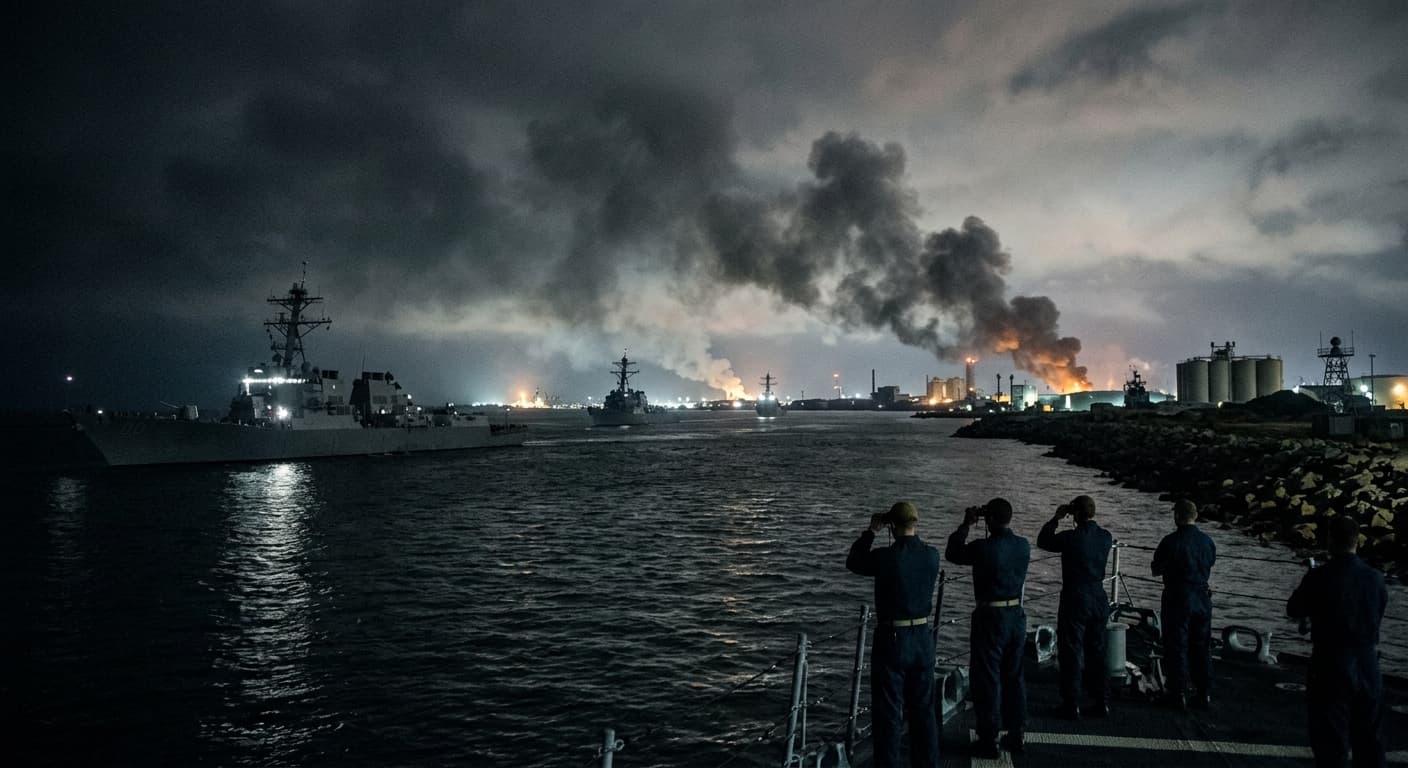
US strikes Iran second night: Strait of Hormuz peace deal fractures
The US hit 90 Iranian targets on July 9, 2026 as Iran struck US bases in Kuwait, Bahrain and Qatar — the June 17 ceasefire is in shreds but not yet dead.
The fight over the June 17 Memorandum of Understanding is not really about whether it collapses — it is about who controls the Strait of Hormuz once it survives. On July 9, 2026, US Central Command struck about 90 Iranian military targets in a second overnight barrage; Iran fired ballistic missiles, cruise missiles and drones at US bases in Kuwait, Bahrain and Qatar, and Jordan intercepted eight projectiles over its airspace. Iran's Health Ministry said 14 people had been killed and 78 wounded across five provinces in the two days of American strikes, per BBC News. And yet Qatari mediators were on the phone with Tehran within hours, and Donald Trump — flying back from Ankara — told reporters the Iranians "want to make a deal so badly,"
Al Jazeera reported. The strikes are not the end of the peace process. They are the negotiation.
What actually happened, in sequence
The trigger was Iranian fire on three tankers transiting the Strait of Hormuz on July 6–7: the Qatari-owned LNG carrier Al Rekayyat, the Saudi-flagged crude tanker Wedyan, and the Liberian-flagged Cyprus Prosperity, according to Al Jazeera. The pattern mattered: all three used the coastal route close to Oman rather than the corridor Iran now insists on policing. The US Navy-led Joint Maritime Information Center raised the strait's threat level to "severe" — its highest reading since June 15 — and the US Treasury revoked the sanctions waiver that had let Iran sell oil under the MoU,
Al Jazeera reported. That waiver, plus the lifting of the naval blockade, was the only immediate material benefit Iran had extracted from the deal.
CENTCOM's first wave hit more than 80 targets on the night of July 7 — air defence systems, coastal radar, missile launch sites, command centres and roughly 60 small boats — per the BBC. Iranian state media said eight army personnel were killed in Bandar Abbas and Bushehr. The second wave, larger, followed on July 8–9 with 90 targets, including strikes near the Bushehr nuclear power plant complex and two railway bridges on the route to Mashhad, where Ayatollah Ali Khamenei was being buried the same day,
the Associated Press reported via NPR. Hitting funeral-corridor infrastructure was not accidental; it was a message aimed at the mourners in Tehran, not at shipping lanes 1,000 kilometres away.
Iran's Islamic Revolutionary Guard Corps called its retaliation the "first phase of the punitive response against the American treaty-breakers," per BBC News. Kuwait's military said it intercepted three ballistic missiles, one cruise missile and 10 drones aimed at Camp Arifjan and Ali Al Salem air base, with one civilian wounded by falling debris. Bahrain shot down incoming fire aimed at the US Fifth Fleet headquarters at Juffair; a drone reached Qatari airspace before being neutralised. Jordan's armed forces said eight Iranian missiles were intercepted with no casualties. Every shot was defeated — a calibrated humiliation rather than a battlefield defeat.
The real fight is Article 5
The June 17 memorandum was always going to be tested here. Point 5 of the MoU commits Iran to "make arrangements using its best efforts for the safe passage of commercial vessels with no charge for 60 days" and to conduct dialogue with Oman on "the future administration and maritime services" in the strait, according to the full text published by the BBC. Point 1 was even more emphatic: "the immediate and permanent termination of military operations on all fronts, including in Lebanon." Read one way, Iran is a facilitator required not to obstruct traffic. Read the other way, Iran is the manager of the waterway with the sovereign right to define who transits and how.
Tehran chose the second reading almost immediately. Iran's chief negotiator, parliamentary speaker Mohammad Bagher Ghalibaf, said the strait would reopen only under "Iranian arrangements", Al Jazeera reported. Ebrahim Azizi, spokesman for the Iranian parliament's national security commission, wrote on X: "This is the only way. Recognise the new and Iranian order in the Strait of Hormuz." Majid Shakeri, an adviser to Ghalibaf, put it more plainly on Iranian state television:
"Either we hold on to this strait, or we go and become martyrs for it one by one. Revenue is subordinate to control."
That is reported by Al Jazeera's Tehran correspondent. The strikes on the Qatari and Saudi tankers were enforcement action, not sabotage — punishment for using a US-backed route without Iranian authorisation. The IRGC is imposing the second reading of Article 5 with missiles before the 60-day negotiating window closes on August 21, 2026.
Washington reads Article 5 as procedural. Scott Uehlinger, a former senior CIA officer, told Al Jazeera the US theory of the case is that hitting maritime traffic control centres and coastal surveillance will force Iran to "return to the MoU" on American terms — meaning free passage without Iranian gatekeeping. Both sides are using kinetic force to establish the interpretation before the clock expires. The MoU committed the parties to reach a final deal in "maximum 60 days, extendable with mutual consent"; without extension, the interim ceasefire has no legal scaffolding after August 21.
Why neither side walks away
Trump has more leverage than he did in April, but less than he needs. US oil is now producing "more than Russia and Saudi Arabia combined," he told reporters in Ankara, and Treasury Secretary Scott Bessent said American crude should trade at a premium to the rest of the world, Al Jazeera reported. But Brent still jumped 4.2% to $77.24 on the news, and US petrol prices — down from a $4.48 May peak to $3.79 per gallon per AAA data — are the political constraint that made Trump sign the MoU in the first place. Ryan Sweet, chief global economist at Oxford Economics, told Al Jazeera the US-Iran deal is "the key domino" for the global economy in the second half of 2026, determining "whether the global economy gets an energy-driven disinflation tailwind or absorbs a second oil shock."
Al-Monitor's Washington analysis captured Trump's bind: he is trying to "extricate himself from an unpopular Iran war" and each round of tanker attacks makes that harder, per Al-Monitor. He has already had to walk back his own "over" language within 24 hours, telling reporters on Air Force One that the Iranians had "called a little while ago" wanting to make a deal.
Iran's calculus is uglier. Ayatollah Khamenei was killed in the opening US-Israeli strikes on February 28, and Iran's leadership is fractured between hardliners who see the strait as a permanent lever and pragmatists who want sanctions lifted, the AP reported. Kharg Island — through which roughly 90% of Iranian oil exports pass — is now on Trump's threat list, alongside strikes on electricity and desalination plants that international law experts told Al Jazeera would constitute war crimes,
per Al Jazeera. Losing Kharg would collapse the Iranian economy in weeks. Losing control of Hormuz would collapse the leverage that produced the MoU's $300 billion reconstruction fund in the first place. Tehran cannot afford either.
That is why the retaliation was calibrated, not maximal. Iran fired at US bases across three Gulf states — but every projectile was intercepted, exactly as Iran's June 2025 salvo at Al Udeid was intercepted after Operation Midnight Hammer destroyed Fordow, Natanz and Isfahan, per the Pentagon's own account. The IRGC knew, before firing, that Patriot batteries around Camp Arifjan and Juffair would defeat the salvo. This is a signalling exchange dressed as a war.
Who benefits — and who pays
Two constituencies benefit from a controlled crisis. Iranian hardliners around the IRGC gain domestic standing at Khamenei's funeral by demonstrating the regime can still hit US assets across the Gulf. Trump gains a coercive backdrop for the harder negotiation that starts once the funeral ends: Iran's enriched uranium down-blending on-site under IAEA supervision (Point 8 of the MoU), the schedule for lifting UN Security Council and IAEA Board sanctions (Point 7), and the mechanics of the $300 billion reconstruction fund (Point 6). Each of those is worth more to both sides than the tactical exchanges of this week.
The clear losers are the Gulf states hosting US bases. Qatar, which brokered the MoU alongside Pakistan, saw one of its own LNG tankers hit and a drone reach its territory. Qatari Prime Minister Sheikh Mohammed bin Abdulrahman Al Thani spent Thursday on the phone with Iranian Foreign Minister Abbas Araghchi urging both sides to "implement the June 17 MoU," Al Jazeera reported. Joey Hood, a former US ambassador, told Al Jazeera that Iran's Gulf-directed fire is "a message to the mediators: you'd better get on our side of this conflict now." That is coercion of the middlemen, and it is working — the GCC Secretary-General Jasem AlBudaiwi issued a rare public rebuke of Iran, and the UAE condemned the "flagrant violation" of Kuwaiti and Bahraini sovereignty,
per the same report.
Hood's second observation is sharper: much of Iran's targeting "is not really aimed at the United States; it's aimed at the Gulf countries." US personnel exposure at these bases is limited — Al Udeid, Juffair and Camp Arifjan are mostly training and logistics footprints — but Doha's LNG revenues and Riyadh's crude exports run through the strait Iran claims to administer. Iran's message to the Gulf: your commercial fleets are hostage until you push Washington to accept our reading of Article 5.
Shipping traffic tells the story. Before the war, an estimated 120–140 vessels crossed Hormuz daily, roughly half oil tankers moving about 20 million barrels per day. Even after the MoU, only seven ships crossed in the four days following the June 14 announcement, per Al Jazeera's account of MarineTraffic data. By early July, Kpler counted 108 verified crossings over a July 3–5 weekend — recovering, but still between one-fifth and one-third of pre-war levels. Every fresh tanker strike resets that recovery.
The historical parallel
There is a useful precedent: the 1987–88 Tanker War, when the US Navy escorted reflagged Kuwaiti tankers through Hormuz during the Iran–Iraq conflict and eventually destroyed half the Iranian navy in Operation Praying Mantis without formally going to war. That episode ended with UN Security Council Resolution 598 and a ceasefire that both Tehran and Washington had spent months pretending to reject. This week's pattern — carefully bounded strikes, intercepted retaliation, mediators in overdrive, oil markets pricing in de-escalation within 24 hours of each escalation — reads from the same script.
What differs is that Iran now sits without Khamenei, without Hezbollah as a functional deterrent (Point 1 of the MoU explicitly ended fighting in Lebanon), and without a functional nuclear breakout option after Operation Midnight Hammer, which the Pentagon says destroyed Fordow with 14 GBU-57 penetrators on June 21, 2025 and set the programme back "by years," per the Department of Defense. Iran's leverage has narrowed to one asset: geography. The strait is 39 kilometres across at its narrowest point and Iran occupies its northern shore. That is why Article 5, not Article 8, is the real fight. The nuclear question is settled in Washington's favour; the maritime question is not.
What to watch
- August 21, 2026 — the 60-day MoU negotiating window expires. Absent an extension "with mutual consent" (Point 3), the interim ceasefire has no legal backstop. Trump has already signalled he considers it dead.
- The next tanker transit on the "unauthorised" Omani coastal route. Iran has demonstrated it will fire on non-compliant ships. If it does again, expect a third US strike wave within 24 hours — this time possibly against Kharg Island infrastructure.
- Qatari and Omani mediation, next 72 hours. Doha's readout of the Araghchi call is the leading indicator. If Qatar publicly withdraws its role, the MoU has no keeper.
- Iranian succession signals after the July 9 Mashhad burial. Whether Khamenei's replacement is drawn from the IRGC hardline camp or the pragmatist Pezeshkian camp will determine whether Article 5 becomes flexible again.
- US Treasury OFAC posture. The July 7 waiver revocation was reversible. Its reinstatement, or a further tightening against the National Iranian Oil Company, is the fastest coercive lever Washington has short of striking Kharg.
The Bottom Line
The peace process is not over — it is being renegotiated at gunpoint over one clause. The June 17 MoU gave Iran sanctions relief and $300 billion in reconstruction; it gave the United States a denuclearised Iran and an open Strait of Hormuz. Article 5 is where those two prizes collide, and neither Trump nor Tehran can afford to let the deal die before they have re-drafted that article in their own favour — which is why, even as 90 targets burn and Gulf capitals shelter under Patriot batteries, Qatari mediators are still on the phone and both sides insist the memorandum is intact.
Follow ongoing conflict coverage as the August 21 deadline approaches.
Discover more
US Politics
House Ethics Committee Pushes Sexual Miscond.
The House Ethics Committee has shifted responsibility for sexual harassment settlement records to the Office of Congressional Workplace Rights, complicating disclosure efforts.
US Politics
SNAP Food Assistance Faces Legal Challenges
In 2026, SNAP faces stricter eligibility rules and mounting legal challenges, threatening food assistance for the millions of Americans who rely on the program.
India
Congress Accuses Modi of Stalling Women's Law
Congress accuses Modi of stalling women's reservation law by linking it to delimitation, revealing a deeper electoral strategy.

Economics
Fed's Amex AML order puts correspondent banking on notice
Federal Reserve's Amex AML order requires board-level controls and a 90-day plan; OCC fined the bank $350 million over enterprise-wide deficiencies.