US Strikes Iran After Hormuz Tanker Attacks
US military action follows attacks on tankers in the Strait of Hormuz.
Model Diplomat5 min readMiddle East
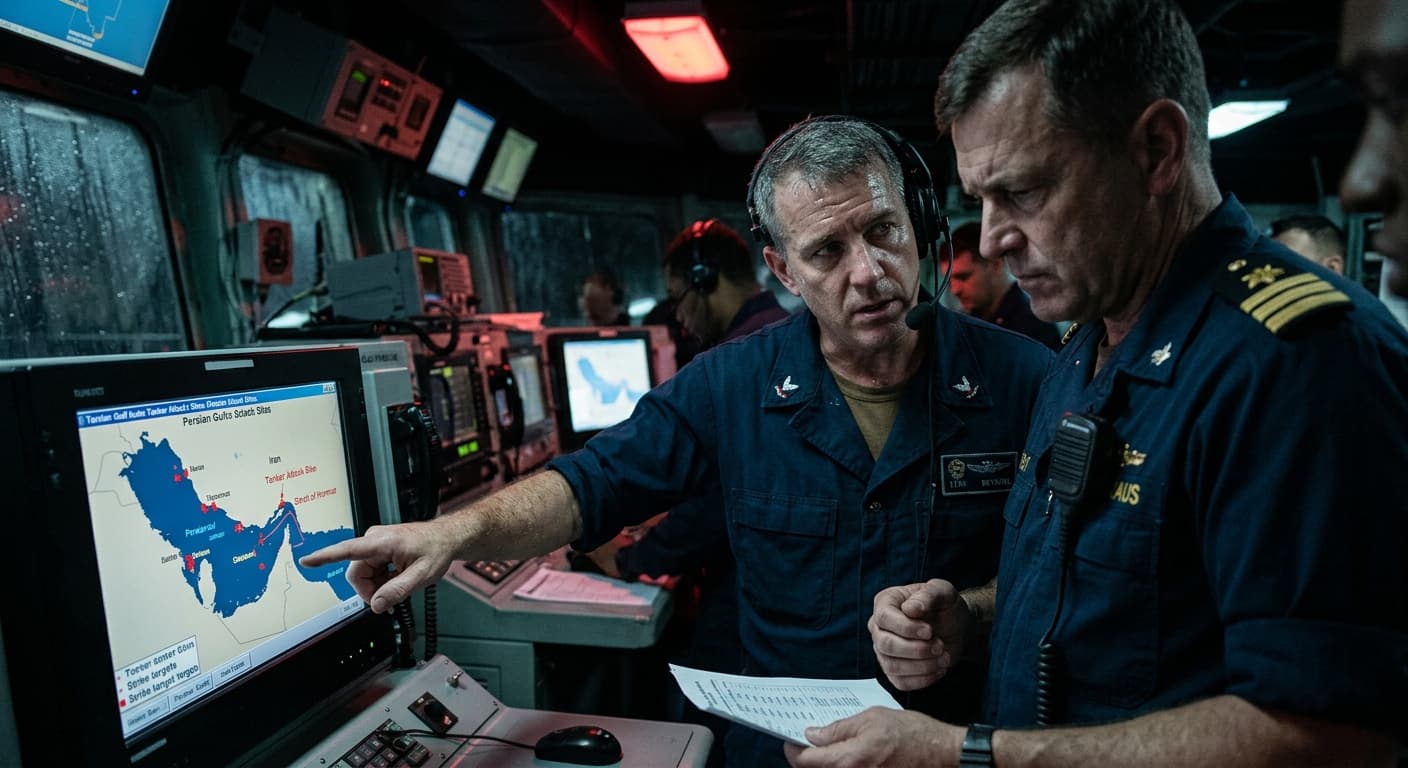
US Strikes Iran After Hormuz Tanker Attacks; Oil Jumps, Gulf Diplomacy Shifts
US strikes Iran after attacks on Qatari and Saudi tankers in the Strait of Hormuz push Brent above $75 and expose the fragility of the June 17 ceasefire framework.
The United States struck more than 80 Iranian targets on July 7, 2026, hours after missiles hit a Qatari LNG carrier and a Saudi supertanker in the Strait of Hormuz — and the decisive shift is not military but diplomatic: Doha and Riyadh, for the first time in this war, have publicly declared Iran "fully legally responsible" for attacks on their flagged vessels, even as they quietly accelerate the security diversification away from Washington that the war itself set in motion. The strikes, and the White House's simultaneous revocation of the sanctions waiver it granted Iran on June 22, have effectively voided Article 5 of the U.S.–Iran memorandum of understanding signed 20 days ago. Brent crude closed near $75.94 and jumped more than 5% in post-market trading, according to FT market data and
Al Jazeera, but the more consequential number is 83 — the percentage of Iranian missile and drone fire that landed on Gulf Cooperation Council territory during the February–June war, per the
Atlantic Council.
What happened, precisely
At around 04:00 GMT on July 7, the U.K. Maritime Trade Operations centre reported that a projectile struck the port side of the Qatari LNG carrier Al Rekayyat near Limah, off Oman's Musandam Peninsula. Within hours the Saudi-flagged supertanker Wedyan, operated by Bahri, was hit in the same corridor. A third vessel was reported struck later that day, Al Jazeera and
BBC News reported. The U.S. Navy–led Joint Maritime Information Center raised the transit risk level to "severe" for the first time since June 15.
Qatar's foreign ministry spokesman Majed Al Ansari called the strike on Al Rekayyat "a grave and blatant violation of international law" and said Doha holds Iran "fully legally responsible." Saudi Arabia's foreign ministry issued near-identical language on the Wedyan. That is the sharpest legal formulation the two Gulf capitals have used against Tehran in this conflict, and it converts a maritime incident into the predicate for state responsibility claims under UNCLOS and the 2005 SUA Convention.
U.S. Central Command retaliated late on July 7, striking Iranian air-defence nodes, coastal radar and Islamic Revolutionary Guard Corps assets around Sirik, Bandar Abbas and Qeshm. CENTCOM said the strikes were designed to impose "heavy costs" and called Iran's actions a violation of the ceasefire. Iranian state broadcaster IRIB confirmed explosions in southern Iran. Simultaneously, the White House revoked the general licence that Treasury Secretary Scott Bessent had issued on June 22 authorizing production, delivery and sale of Iranian crude — the single largest up-front concession Tehran received in the June 17 MoU, and one Obsidian Risk Advisors' Brett Erickson told Al Jazeera amounts to "a complete destruction" of that framework. The timing was pointed: the strikes came as Ayatollah Ali Khamenei's body was being transferred to Qom, and CENTCOM had signalled a pause. Al Jazeera reported that Washington chose to strike anyway.
The MoU is dead — read Article 5
The 14-point memorandum signed at the Evian G7 on June 17 was never a treaty. Its operative language on shipping was aspirational. Point Five, as read to reporters by a senior U.S. official and published by Al Jazeera, commits Iran only to "make arrangements using its best efforts for the safe passage of commercial vessels with no charge for 60 days":
"The Islamic Republic of Iran will make arrangements using its best efforts for the safe passage of commercial vessels with no charge for 60 days only from the Persian Gulf to the Sea of Oman and vice versa … [and] will conduct dialogue with the Sultanate of Oman to define the future administration and maritime services in the Strait of Hormuz."
Two phrases carried the entire ceasefire: "best efforts" and "future administration." Iran's lead negotiator, Parliament Speaker Mohammad Bagher Ghalibaf, told state media on June 18 that "the Strait of Hormuz will not return to pre-war conditions" and Iran would "receive a fee for services" — a claim the BBC's read-out of the MoU and U.S. officials flatly rejected. Tehran subsequently launched a "Persian Gulf Straits Authority" claiming jurisdiction to license transit, prompting a May 7 draft UN Security Council resolution from Qatar, Bahrain, the UAE, Saudi Arabia, Kuwait and the U.S. under Chapter VII, according to
Al Jazeera.
That drafting gap — a genuine ambiguity about whether Iran retains sovereign leverage over Hormuz — is what today's tankers paid for. Every attack since June 24, when a post-war peak of 70 vessels transited the strait, has been an Iranian effort to convert "best efforts" into a de facto tolling regime before the 60-day negotiating window closes on August 16. Shipping operators paid as much as $2 million per vessel to the IRGC for wartime transit, Al Jazeera reported — a revenue stream Tehran is fighting to institutionalize.
Oil markets are pricing a chronic risk, not a spike
Brent's move is telling in what it did not do. Futures rose about 3% intraday and jumped more than 5% post-market to near $76. That is roughly $50 below the wartime peak above $126 and only marginally above the pre-war baseline of $70, according to BBC market coverage. Markets are treating Hormuz not as a binary closure risk but as a permanent risk premium of $3–5 per barrel.
The reason is structural. The Congressional Research Service reports that 20 million barrels of oil per day — 27% of global maritime crude trade and 20% of world petroleum consumption — moved through Hormuz in 2024, alongside 20% of global LNG. Saudi Arabia's East-West pipeline and the UAE's Abu Dhabi Crude Oil Pipeline offer roughly 2.6 million barrels per day of bypass capacity combined, per U.S. Energy Information Administration data cited by CRS. The IEA's spare crude capacity of about 4.4 million bpd sits mostly inside the Gulf itself — meaning the world's insurance policy against a Hormuz closure is largely stored behind the very chokepoint at risk.
The second-order winner is already visible. As Al Jazeera's John Power reported, the war's structural consequence is that "the US strengthens its position as a swing LNG supplier" while Qatar consolidates its long-term contract role — a claim Mohamed Elheddad of the University of Lancashire attributes to the emerging bifurcation of buyers into Hormuz-exposed and Hormuz-hedged categories. American Gulf Coast LNG capacity became strategic infrastructure the moment Ras Laffan burned in March.
The loser is Chinese refiners. Congressional research notes that 80% of Hormuz crude is Asia-bound; China imports Iranian barrels above all others, and the BBC documented $14 billion in Iranian imports to China in the year to October 2025. Trump's January secondary-tariff executive order threatening 25% penalties on Iran's trading partners has not moved that flow — but a revoked Iranian oil licence combined with severed Hormuz transit does what tariffs could not: it forces Chinese buyers back onto Russian ESPO and West African crude, at premium.
Discover more

US Politics
House Ethics Committee Pushes Sexual Miscond.
The House Ethics Committee has shifted responsibility for sexual harassment settlement records to the Office of Congressional Workplace Rights, complicating disclosure efforts.
India
Congress Accuses Modi of Stalling Women's Law
Congress accuses Modi of stalling women's reservation law by linking it to delimitation, revealing a deeper electoral strategy.
US Politics
SNAP Food Assistance Faces Legal Challenges
In 2026, SNAP faces stricter eligibility rules and mounting legal challenges, threatening food assistance for the millions of Americans who rely on the program.

Economics
Fed's Amex AML order puts correspondent banking on notice
Federal Reserve's Amex AML order requires board-level controls and a 90-day plan; OCC fined the bank $350 million over enterprise-wide deficiencies.