US Revokes Iran Oil Waiver Amid Tensions
US strikes Iran as ceasefire collapses over tanker attacks
Model Diplomat7 min readMiddle East
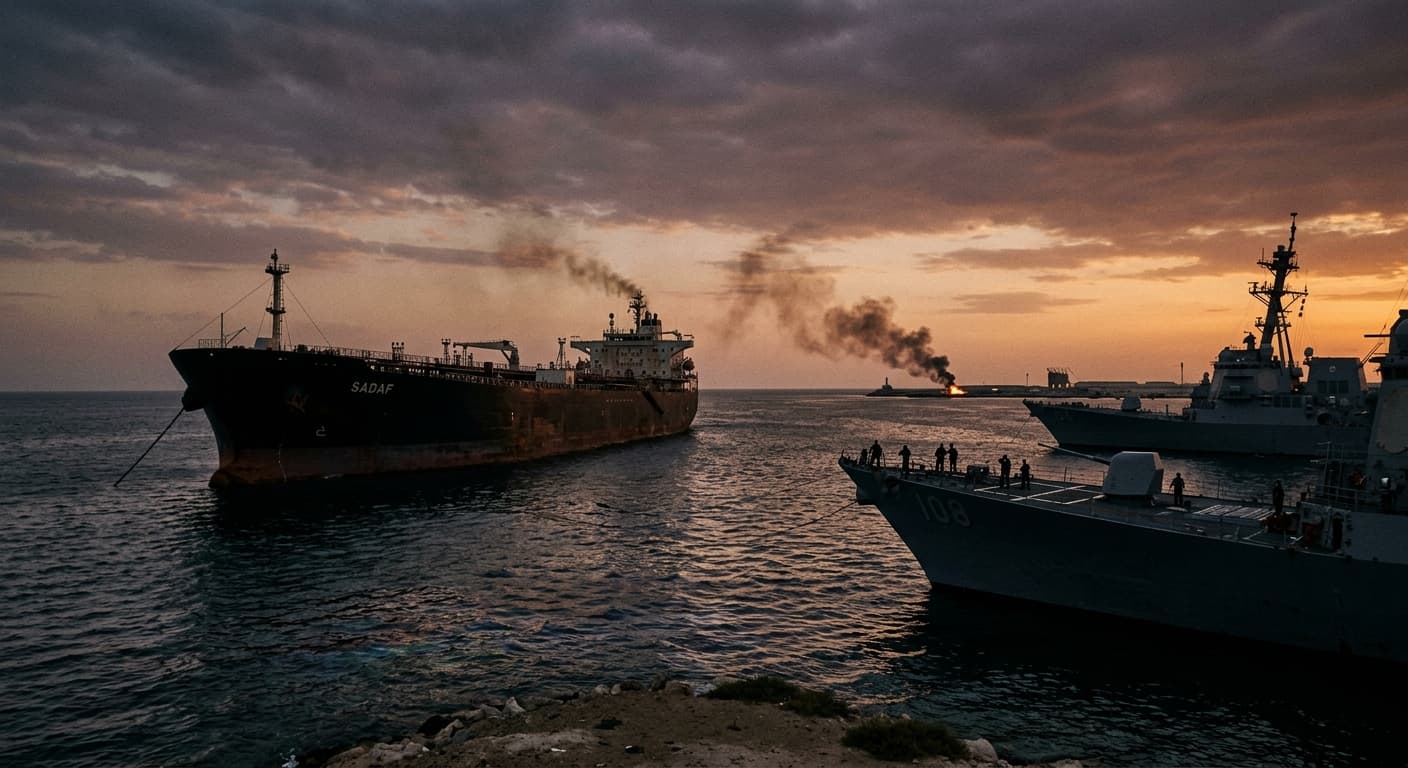
US strikes Iran, revokes oil waiver as Hormuz tanker attacks unravel ceasefire
Trump declares the June 17 memorandum "over" after CENTCOM hits 80+ targets and OFAC pulls General License X. Brent jumps to $78; Iran's 1.3 mbd export lifeline is severed 20 days after it was granted.
Twenty-one days after Washington and Tehran signed a 14-point memorandum to end their four-month war, the US Treasury on July 7, 2026 revoked the general license that let Iran sell oil abroad, and CENTCOM struck more than 80 targets across southern Iran. Brent crude jumped from roughly $73 to $78 a barrel — a 6% single-session move — after President Donald Trump told reporters at the NATO summit in Ankara that the memorandum "was over." The point that matters is not that sanctions returned. It is that the entire economic architecture of the ceasefire — Iranian crude flowing east in exchange for open transit through the Strait of Hormuz — collapsed inside three weeks, and the leverage now belongs to whichever side can absorb more pain: an Iranian regime whose only cash lifeline is oil, or a US administration whose voters feel the pump price of every Hormuz incident.
What actually happened, precisely
The chain broke on the water. On July 6 the Qatari LNG carrier Al-Rekayyat was struck by a projectile off Limah, Oman while transiting south out of the strait, and caught fire in its engine room, according to the United Kingdom Maritime Trade Operations advisory relayed by the BBC. A second vessel, the Saudi-flagged supertanker Wedyan owned by Bahri, was damaged in a separate incident that Riyadh's foreign ministry blamed on Iran. A third tanker reported minor structural damage. Both Qatar and Saudi Arabia issued formal statements holding Tehran "fully responsible," per
Al Jazeera.
The US response arrived in two channels within hours. First, the Treasury's Office of Foreign Assets Control issued General License X1, formally "Revocation and Wind Down of June 21, 2026 Authorization for the Production, Delivery and Sale of Crude Oil, Petrochemical Products," listed on the OFAC general licenses page. That single administrative act ended the 60-day waiver that had been the load-bearing concession of the June 17 memorandum, whose Point 10 obliged Washington to issue such waivers "immediately upon the signing" — the full text of the MoU is published by the
BBC.
Second, CENTCOM launched what it called "powerful" strikes, hitting "over 80 targets with precision munitions" including air defense sites, coastal radar, surface-to-air and anti-ship missile positions, drone-launch sites and more than 60 IRGC small boats, according to CENTCOM's statement carried by Anadolu. Iranian state media reported explosions on Qeshm island, in Sirik, near Bandar Abbas and at two military bases in Bushehr province. Gulf News reported blasts on Kharg Island, Iran's principal oil-export terminal, in a
Gulf News dispatch. Iran's IRGC said it fired missiles and drones at "85 key US military facilities," including a US Navy headquarters in Bahrain and the Ali al-Salem base in Kuwait.
Iran's foreign ministry called the strikes a "flagrant violation" of Article 2(4) of the UN Charter and of Paragraph 1 of the MoU, citing bad faith. Speaker and chief negotiator Mohammad Bagher Ghalibaf named the sanctions reinstatement as a "major MoU violation." Trump, in Ankara, delivered the political epitaph: the memorandum "was over."
The market read: no supply loss yet, all risk premium
The $5 move in Brent is priced almost entirely off risk, not barrels. Iran was exporting essentially nothing through most of May — Vortexa data cited by OilPrice.com put exports at 209,000 bpd, a six-year low, and even after the MoU,
Kpler tallied only 43 crossings of the strait on July 3, dropping to 31 by July 5, versus 120–140 daily crossings pre-war. So the actual physical throughput on July 7 is a fraction of the pre-war 20 million barrels per day that transited Hormuz in 2024, a figure documented by the
Congressional Research Service — roughly 27% of global seaborne oil trade and 20% of world liquids consumption.
That gap between price and flow is the story. Traders are paying for the option value of a full closure, not for a barrel they cannot get today. With the memorandum dead, the two events the market feared most in February — mining of the strait, and a general Iranian assault on Gulf shipping — become live scenarios again. The Joint Maritime Information Center on July 7 raised the transit threat level to "severe" for the first time since June 15, according to Al Jazeera.
Available buffers are thinner than in past Iran scares. The Congressional Research Service puts unused bypass-pipeline capacity — Saudi Arabia's East-West line to the Red Sea and the UAE's Abu Dhabi–Fujairah line — at roughly 2.6 mbd, and IEA-estimated spare crude production capacity at 5.4 mbd as of May 2025. Neither is designed to absorb a sustained 20-mbd Hormuz shutdown. The relevant benchmark is not what OPEC+ can add; it is how long insurance and hull underwriters will keep VLCCs moving after two Gulf-owned tankers were hit in 48 hours.
Who actually loses — and the unexpected beneficiary
The immediate loser is the government in Tehran. Iran had already burned through $5.8 billion in lost oil revenue over April and May under the blockade, according to Al Jazeera's analysis of Lloyd's List data. The June 21 general license was supposed to let those flows restart at scale — a 60-day window Chinese state refiners were already, per
OilPrice.com, considering using for the first time in years. That window shut on July 7. Iran's rial had already hit an open-market low of 1.84 million to the dollar; inflation, per
Al Jazeera, touched its highest reading since 1942.
The unexpected winner is the Chinese state oil sector — and not for the reason most analysts name. State giants Sinopec and PetroChina were briefly re-exposed to Iranian barrels during the licence window. The revocation gives them cover to walk away without embarrassment, leaving the field again to the Shandong "teapots," who now regain their monopsony discount on stranded Iranian crude. Bruegel's Alicia García-Herrero calculated that before the war, China took 80–90% of Iran's oil exports at ~1.4 mbd, paid in renminbi via CIPS to sidestep SWIFT. Every additional turn of the sanctions ratchet deepens that pricing power. Iran needs China more than China needs Iran, and Beijing now knows the discount will widen.
The second beneficiary is Riyadh. Saudi Arabia has been the loudest Gulf voice condemning Iran's Hormuz behaviour after the Wedyan strike; the political case for a US security umbrella tied to a bilateral defence pact — dormant since the war began — has just been handed a fresh casus. Expect Riyadh to press it in Washington within weeks.
The legal architecture that just collapsed
The June 17 memorandum was never a treaty. Article 10 committed Treasury to "issue waivers for the export of Iranian crude oil, petroleum products and derivatives and all associated services including banking, transactions, insurances, transportation," per the BBC's published text. Article 7 committed the US to terminate "all types of sanctions … in an agreed upon schedule." Because the mechanism was a discretionary Treasury general license — not a statute or executive order — the entire concession was revocable by the OFAC director's signature. And on July 7 it was.
That structural fragility was baked into the deal from the start. The Congressional Research Service memo IF12452 notes that President Trump's February 4, 2025 National Security Presidential Memorandum directs "maximum pressure" on Iran as standing policy; any waiver runs against that grain and can be reversed in a single action. Congress has moved separately — H.R. 2012 and H.R. 2570 in the 119th Congress — to constrain future presidential authority to lift Iran sanctions, per the CRS. In other words, even a permanent deal would have faced ratification risk on Capitol Hill. Iran's negotiators understood the fragility; they signed anyway because the alternative was continued blockade.
The move also creates a specific compliance moment. General License X1 typically provides a wind-down window; parties with cargoes loaded during the MoU period will need to complete transactions or face secondary-sanctions exposure. Watch OFAC's next FAQ update — it will tell shipowners, insurers and Chinese refiners exactly how much runway they have.
Diplomat View
The forecast: the ceasefire is not over, but the version signed on June 17 is. Within four to six weeks, expect a narrower successor arrangement — mediated by Oman and Qatar, likely without a written sanctions schedule — that trades a de facto Iranian pilotage regime in the northern Hormuz route for tacit US tolerance of shadow-fleet flows to China at pre-war volumes. This is not a return to 2019 maximum pressure; the Trump administration wants the oil price capped ahead of the November midterms and Iran needs revenue at any discount. Both governments will accept a shabbier equilibrium rather than a war neither can afford.
The forecast changes if any of three things happen. First, if a US-flagged or US-crewed vessel is hit in the strait, the political ceiling on escalation rises sharply. Second, if IRGC forces mine the northern channel — a capability CENTCOM's July 7 target list suggests Washington fears — insurance markets will price the strait shut regardless of policy. Third, if Saudi Arabia formally requests the US–Saudi defence pact as a Hormuz response, the diplomacy migrates from Doha to Riyadh and the framework changes.
What to watch
- August 21, 2026: original expiry of the revoked General License. If OFAC does not issue a replacement waiver by then, Iranian crude flows collapse structurally rather than tactically.
- Next OFAC action: General License X1 wind-down text and any accompanying FAQ. This tells the market how many cargoes remain legally movable and defines the compliance window for Chinese buyers.
- Doha/Muscat mediation channel: the next indirect US–Iran round. Qatar's foreign ministry statement holding Iran responsible for the Al-Rekayyat strike complicates but does not preclude a Qatari mediator role.
- US Fifth Fleet posture: a second CENTCOM strike wave, or a formal convoy escort regime through the strait, would signal Washington has abandoned the memorandum architecture entirely rather than pausing it.
Coverage of the broader arc of the conflict continues on Model Diplomat's international desk.
*
Discover more
US Politics
House Ethics Committee Pushes Sexual Miscond.
The House Ethics Committee has shifted responsibility for sexual harassment settlement records to the Office of Congressional Workplace Rights, complicating disclosure efforts.

US Politics
SNAP Food Assistance Faces Legal Challenges
In 2026, SNAP faces stricter eligibility rules and mounting legal challenges, threatening food assistance for the millions of Americans who rely on the program.
India
Romanian Coalition Party Demands PM Resign
Romania's Social Democrats withdrew from coalition, joining far-right AUR to topple PM Bolojan, risking €10 billion in EU funds by August 2026.

Conflict & Security
Drone Warfare Killing Aid Workers at Unprec
Over 1,000 humanitarian workers killed in three years as cheap armed drones collapse legal protections. Gaza, Sudan, Ukraine, and DRC see deliberate targeting of aid convoys and hospitals with zero prosecutions.