US Push to Break China's Magnet Monopoly
Washington invests $4.3B in rare earths supply chain
Model Diplomat8 min readNorth America
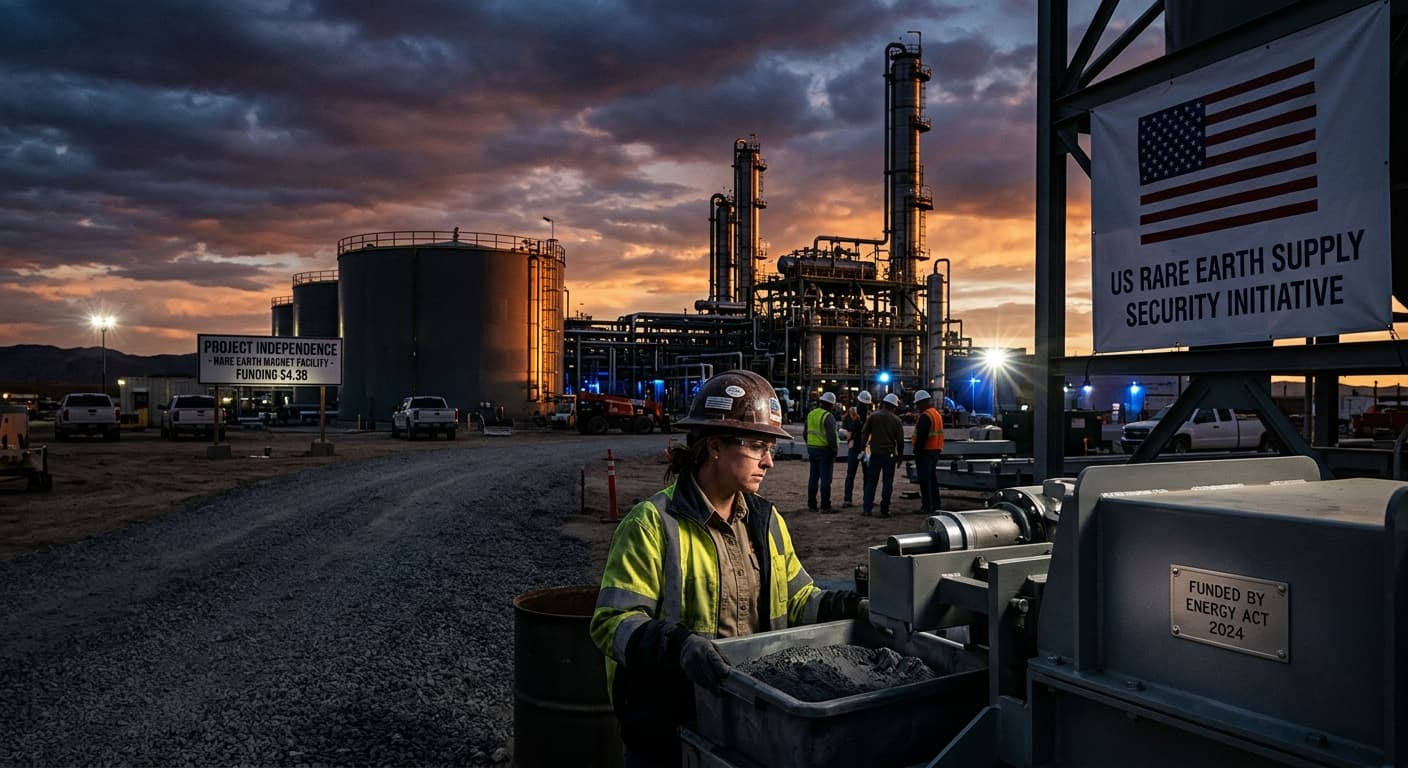
Washington's five-week rare earths blitz targets China's magnet grip
Between June 3 and July 8, 2026, the US committed roughly $4.3B in federal and private capital to build a rare-earth magnet supply chain outside China — but the buyer of last resort is still missing.
Over five weeks this summer, Washington closed roughly $2.9 billion in direct federal commitments and catalyzed another $1.4 billion in private capital to stand up a rare-earths and permanent-magnet supply chain outside China — the fastest concentrated industrial-policy push the sector has ever seen. The thesis is simpler than the deal flow suggests: the United States is now betting that state capital, not market pricing, will break Beijing's chokehold on the 94% of global neodymium-iron-boron magnets it manufactures — and the first-order winners are a handful of listed juniors and one German incumbent, not US downstream manufacturers, who are still buying Chinese. According to Fastmarkets, the June push was coordinated across Commerce, the Department of War (the renamed DoD under
Executive Order 14347), and the Department of Energy. Every dollar flows through a single strategic instruction: get to commercial-scale magnets by 2028, before China's October 2025 extraterritorial licensing regime bites into F-35 and Tomahawk production lines.
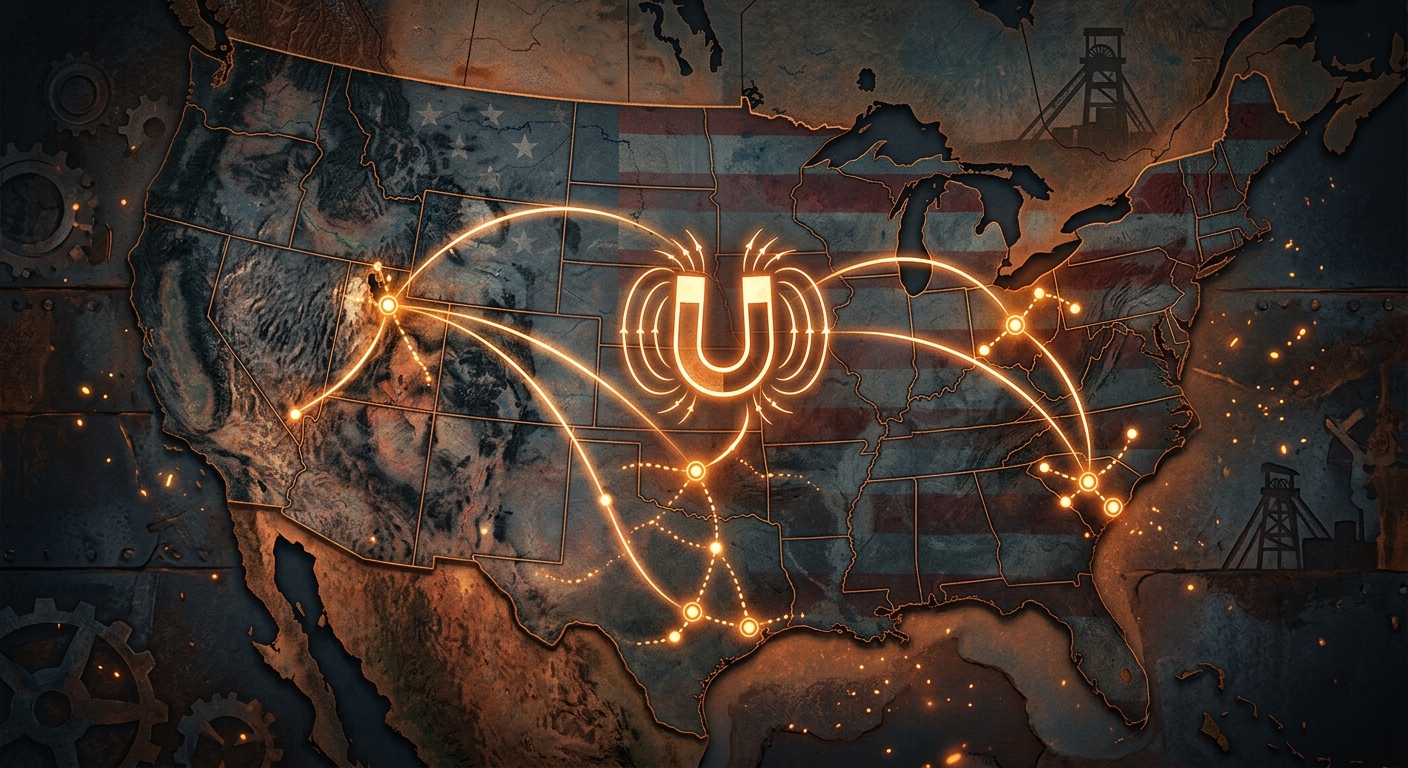
The trigger: Beijing weaponized the value chain, not the ore
The five-week surge is a delayed answer to a question China posed in April 2025. When Beijing imposed export licensing on seven heavy rare earths — samarium, gadolinium, terbium, dysprosium, lutetium, scandium and yttrium — in retaliation for President Trump's tariffs, US and European manufacturers discovered they had no midstream alternative. The BBC reported that within weeks, several producers were forced to shut lines; the Center for Strategic and International Studies noted there was "no capacity outside China to process heavy rare earths."
Then Beijing escalated. On October 9, 2025, MOFCOM Announcement No. 61 extended licensing to any foreign-made magnet containing at least 0.1% of Chinese-origin heavy REEs — or produced using Chinese technology. Starting December 1, 2025, defense end-users were effectively barred. As CSIS put it:
"Under the new rules… companies with any affiliation to foreign militaries — including those of the United States — will be largely denied export licenses. The Ministry of Commerce also made clear that any requests to use rare earths for military purposes will be automatically rejected."
That order is what the June 2026 announcements are answering. According to the Congressional Research Service, China mines about 60% of global rare earths, processes roughly 90%, and produces around 94% of the magnets — while the US remained 67% net import reliant in 2025 (CRS IF13171).
The deals: five weeks, one industrial plan
The largest single package landed on June 3, 2026. USA Rare Earth, a Nasdaq-listed junior with the Round Top deposit in Hudspeth County, Texas, signed definitive agreements with the Department of Commerce for up to $1.6 billion under the CHIPS Program — $277 million in direct federal funding and $1.3 billion in senior-secured loan capacity, according to a company disclosure filed with the FT. The government took 16.1 million common shares and about 17.6 million warrants. The
BBC reported that combined with a $1.5 billion PIPE placement led by Inflection Point, total committed capital to USAR now stands at roughly $3.5 billion. The company also announced a $1.2 billion magnet and rare-earth-metals plant in Cherokee County, South Carolina, on the Duke Energy-prepared
Bailey Industrial Site, targeting 6,400 tonnes per year of NdFeB magnets by 2028.
Two weeks later, on June 18, Energy Fuels announced a conditional $725 million, 20-year senior-secured loan from the Department of War's Office of Strategic Capital, to expand heavy-REE processing at the White Mesa Mill in Utah and build an American Metals Plant. Five days after that, Energy Fuels struck a $1.9 billion definitive agreement to acquire Germany's Vacuumschmelze (VAC), the century-old magnet maker running a new 2,000-tonne-per-year NdFeB facility in Sumter, South Carolina — a plant scalable to 12,000 tonnes — and holding a $41 million Department of War grant of its own, per the
FT-hosted disclosure. VAC is one of the few DFARS-compliant magnet suppliers to the Pentagon.
The July 7 announcement rewrote the geography. REalloys (Nasdaq: ALOY) was selected by the U.S. Army to build the first commercial critical-mineral processing complex on a US military installation — at the Tooele Army Depot in Utah — under a long-term enhanced-use lease, per a Morningstar/PR Newswire release. The instrument matters as much as the site: House testimony from Deputy Under Secretary of War Dale Marks confirmed the Department is "working with industry to develop critical mineral and rare earth element potential lease opportunities" on Department of War land (
House Armed Services Committee, July 2026). That converts idle federal acreage into fast-tracked industrial sites, bypassing state permitting drag.
Phoenix Tailings' "Freedom Facility" for solvent-free rare-earth metallization drew roughly $500 million from the Department of War, with a further $500 million in private co-investment, according to the Fastmarkets tally. ARPA-E layered on $72 million for mineral discovery and domestic magnet R&D. And REalloys locked in a 15-year offtake for 15% of the annual concentrate from Critical Metals Corp's Tanbreez deposit in southern Greenland, with priority rights over dysprosium- and terbium-rich volumes — a direct answer to Beijing's October 2025 rules, per the company's disclosure.
The instrument change: from customer to shareholder
The novelty here is not the money. It is the vehicle. The Pentagon has moved from being a buyer of finished components to holding preferred equity, warrants, price floors and offtake guarantees across the value chain. The MP Materials precedent — a $400 million DoD equity stake, a $150 million loan, and a $110/kg NdPr price floor announced in July 2025 — has now been generalized.
That has drawn Congressional pushback. In February 2026, Senate Energy and Natural Resources Ranking Member Martin Heinrich and House colleagues demanded transparency on equity stakes taken across "Trilogy Metals, Lithium Americas, MP Materials, Vulcan Elements, ReElement Technologies, Korea Zinc, and USA Rare Earth," warning that "there has been no public disclosure of procedures or safeguards" preventing ownership from tainting permitting decisions. The Office of Strategic Capital's own
FY25 investment strategy requires that at least 80% of capital for any funded technology come from non-federal sources — a rule OSC has been stretching, not breaking. The FY2027 request seeks $216 million in discretionary and $20 billion in mandatory capital-assistance funding, per a
CRS in-focus brief.
The problem the money can't solve: US buyers aren't buying US
Here is where the story turns. Even as the Trump administration builds an ex-China supply chain, the material coming off American federally-backed lines is flowing to Asia. According to Archynewsy's reporting, MP Materials, Energy Fuels and Phoenix Tailings have been exporting rare-earth oxides and metals to Japan and South Korea because domestic magnet manufacturing has not scaled fast enough to absorb the output.
Crypto Briefing framed it bluntly: the fastest customer for "America First" material is on the other side of the Pacific.
This is a demand-signal failure, not a supply failure. Detroit is still buying Chinese-made magnets through allied intermediaries because they cost less than half of a US-made equivalent absent the MP Materials-style price floor. Until price floors and Buy-American mandates propagate downstream to automotive, wind and electronics OEMs — not just the Pentagon — federal capital is effectively subsidizing the Japanese and Korean magnet industries. The Bank of Italy's own analysis, cited in a June 2026 RUSI paper by Henry Sanderson, concluded that more than four-fifths of Europe's large companies are within three supply-chain steps of a Chinese rare-earth producer. Substitute "European" for "American" and the picture holds.
Who wins, who loses
The clearest winners are the listed juniors that survived the 2010s bust and are now being recapitalized on federal terms: USA Rare Earth, Energy Fuels, MP Materials, REalloys, Phoenix Tailings, and Vulcan Elements. The most consequential winner may be VAC, whose century of magnet know-how and DFARS compliance now sits inside an American-listed vehicle backed by Office of Strategic Capital debt. Greenland — via the Tanbreez deposit — becomes a strategic supplier without a US mine on its soil, validating the Trump administration's separate diplomatic push there.
The losers split into two groups. First, Chinese magnet exporters, who lost their US defense channel on December 1, 2025 and, according to the Financial Times, are now using the export licensing regime to squeeze foreign rivals and force downstream customers to co-locate production inside China. Second, and more quietly, US downstream manufacturers who assumed cheap Chinese magnets would remain available: EV assemblers, wind-turbine builders, robotics firms, data-center HVAC suppliers. Their bill of materials just got structurally more expensive.
What to watch
- Financial close on Energy Fuels' $725M OSC loan. The commitment is conditional; due diligence, ASM shareholder approval on the acquisition of Australian Strategic Materials, and the VAC deal all need to clear before capital flows. A slip past Q4 2026 would delay the American Metals Plant.
- FY2027 NDAA conference. The House version (H.R. 3838) would grant OSC explicit equity authority, per
CRS. Watch whether Senate conferees strip it — that decides whether the MP Materials model becomes law or remains improvised.
- Round Top first production, targeted 2028. Slippage on USA Rare Earth's Hudspeth County heavy-REE mine would leave the Blacksburg magnet plant fed by imported feedstock and undercut the entire "mine-to-magnet" narrative.
- Project Vault stockpile purchases. The White House's $12 billion Strategic Critical Minerals Reserve, announced February 2, 2026, is the demand backstop the domestic industry needs. First tranche purchases have not yet been publicly disclosed.
Diplomat View
The five-week surge is not a policy pivot — it is the operational execution of a bipartisan bet that has been forming since the first Trump term. What is genuinely new is the instrument set: OSC loans, CHIPS equity, price floors, offtake guarantees, and enhanced-use leases on military bases. Taken together, these amount to an American industrial policy for critical minerals in all but name, and one that will outlive the current administration because both parties now accept its premise.
Our call: by mid-2028, the US and allied ecosystem will have enough separation and magnet capacity to cover Department of War demand — but not commercial demand. The forecast changes if two things happen. First, Congress writes a downstream Buy-American mandate for magnets into the FY2027 NDAA, forcing automotive and wind OEMs onto domestic supply. Second, price floors are extended from NdPr to dysprosium and terbium, where China's leverage is strongest. Without either, federal dollars will keep landing in Ohio, Utah and Texas — and the magnets they make will keep sailing to Yokohama.
Discover more
US Politics
House Ethics Committee Pushes Sexual Miscond.
The House Ethics Committee has shifted responsibility for sexual harassment settlement records to the Office of Congressional Workplace Rights, complicating disclosure efforts.

US Politics
SNAP Food Assistance Faces Legal Challenges
In 2026, SNAP faces stricter eligibility rules and mounting legal challenges, threatening food assistance for the millions of Americans who rely on the program.
Global Politics
Trump's Conflicting Messages on Iran War
Trump's mixed messages on Iran reflect a strategy of audience management, benefiting Tehran amid a complex geopolitical landscape.

Economics
Fed's Amex AML order puts correspondent banking on notice
Federal Reserve's Amex AML order requires board-level controls and a 90-day plan; OCC fined the bank $350 million over enterprise-wide deficiencies.