U.S. Picks Technocrat Over Vote-Winner in
U.S. picks a technocrat over the vote-winner in Venezuela's transition
Model Diplomat10 min readLatin America
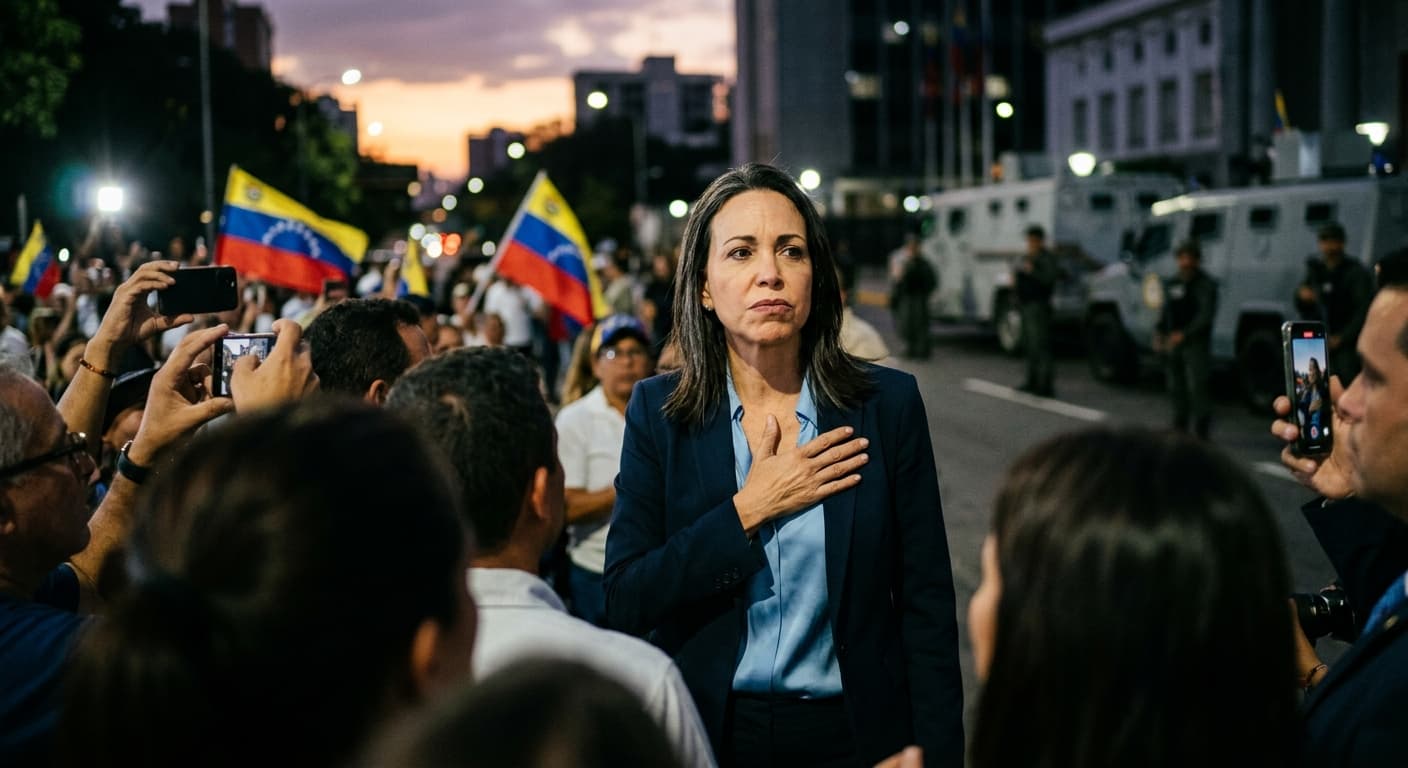
Washington Picks the Technocrat Over the Vote-Winner in Venezuela's Democratic Rebuild
Venezuela's interim government and a U.S.-backed opposition faction launch a bilateral working group Aug. 1 to design electoral reforms. The process deliberately excludes the country's most popular politician, María Corina Machado. Washington wants a controlled transition, not a democratic one.
On July 15, 2026, Venezuela's ruling party and a faction of the opposition announced a bilateral technical working group that will begin designing electoral reforms on August 1 — the first concrete step toward rebuilding democratic institutions since U.S. forces captured Nicolás Maduro on January 3 and his vice president, Delcy Rodríguez, took power in Caracas. Jorge Rodríguez, the interim president's brother who heads the ruling-party National Assembly, co-leads with Dinorah Figuera, a 61-year-old exiled lawmaker who returned from Spain in June under U.S. State Department escort. Secretary of State Marco Rubio backs the process, tying Venezuelan oil revenue and the easing of financial sanctions to compliance with a three-phase plan: stabilization, recovery, and transition, as the Congressional Research Service documented in its January analysis for Congress.
The decisive fact is who is missing. María Corina Machado — who polls at over 80 percent against Delcy Rodríguez and whose coalition won the 2024 presidential vote by independent tallies before Maduro stole it — was excluded from the table. Washington chose a compliant technocrat over the vote-winner. The Trump administration's priority is oil and stability, not democracy. Rubio's team concluded that Machado's hostility among military hardliners made her a liability for the transition they want to manage. The result is a process that may produce elections but cannot guarantee the legitimacy elections require — the exact trap Venezuela fell into in 2024.
How the Process Was Built
The announcement, made July 14 by Jorge Rodríguez on Instagram and confirmed July 15 by Figuera on X, establishes a 20-person working group with 10 representatives from each side to address elections, the formation of the National Electoral Council (CNE), and electoral laws, according to UPI. Figuera, speaking "in my capacity as president of the National Assembly" elected in 2015, said she assumes "the commitment and political will to promote a bilateral technical and political road map, based on a working agenda with concrete objectives and milestones."
At the core of the agreement is what UPI called an "unprecedented mutual recognition between two parallel legislative bodies": the ruling-party National Assembly that controls Caracas, and the 2015 opposition-controlled assembly that retains Washington's recognition and manages key Venezuelan assets abroad. The 2015 assembly's mandate has been contested since 2019, when Maduro stripped it of its powers; most of its lawmakers fled, and Figuera has led it remotely from Valencia, Spain, since 2023, when she replaced Juan Guaidó as the body's president, as BBC News Mundo reported.
The process was originally scheduled to begin weeks earlier but was postponed by the humanitarian emergency caused by twin earthquakes that struck Venezuela on June 24. Government figures put the death toll at 4,829 with 16,740 injured, according to NPR. The most critical phase of the emergency is now over, allowing the talks to proceed. Critics note that Delcy Rodríguez used the earthquake aftermath to delay political reforms and block Machado's attempted return, briefly closing Venezuelan airspace to her plane.
Figuera's emergence as the U.S.-preferred negotiator was not organic. She returned to Venezuela on June 18, telling reporters at Caracas airport that she traveled "on invitation from the State Department" with the aim of pushing for renewal of the CNE, according to the BBC. She met with U.S. chargé d'affaires John Barret and then with Jorge Rodríguez. She had met Deputy Secretary of State Michael Kozak in Washington on April 22 to "address the routes toward a consolidated democratic transition," as
BBC News Mundo documented. Her mandate, as she described it, is "institutional" — exercised separately from her membership in the Primero Justicia party. The BBC's Spanish-language profile of Figuera noted that the State Department "now seems to favour Dinorah Figuera over Machado as the person to negotiate a democratic transition."
Washington's Hand on the Scale
The working group is not a Venezuelan-initiated reconciliation. It is a U.S.-engineered process, carried out directly by Rubio. The White House released Rubio's January 4 briefing in which he said the administration's "objective number one was stability" and that "you have to work with the people currently in charge of the elements of government," according to the White House. The message was explicit: Washington is working with Maduro's inner circle minus Maduro, and democracy is a downstream deliverable.
The leverage is oil. The Congressional Research Service reported that Trump said the United States will "run" Venezuela until a transition takes place. Venezuelan officials would turn over sanctioned oil, reportedly worth some $3 billion, under a deal in which Washington largely controls Venezuela's oil industry. Rubio told Congress that an "oil quarantine" of sanctioned shipments will continue, and that "oil revenue will support a three-phase transition process" — though no timeline has been provided. The CRS noted that Congress has not authorized the military operation, and members have disagreed on its legality and policy goals.
The second-order effect is straightforward: by making oil revenue conditional on compliance, Washington has made Delcy Rodríguez's political survival dependent on U.S. approval. Rodríguez, who is herself under U.S. sanctions for corruption, was described by Trump as "a terrific person" doing a "great job." The Council on Foreign Relations called that posture indefensible, noting that "Rodríguez, Maduro's vice president, cannot legitimately be president any more than Maduro could." The CFR analysis argued that the Trump administration "doesn't seem anxious to push the country through" the democratic door it opened.
The historical parallel is the 2020 Democratic Transition Framework, originally proposed under Trump's first term with opposition leader Juan Guaidó. The Atlantic Council noted that the framework "lost momentum and was overtaken by shifting priorities in Washington ahead of the 2020 US election" — and that Maduro entrenched himself while the opposition coalition lost popular support. The lesson is that U.S.-designed transition plans collapse when Washington's attention drifts. The 2026 version is more leveraged — U.S. troops already removed Maduro — but the structural problem is the same: a process designed in Washington cannot survive a change in Washington's priorities, and Venezuela's democracy cannot be built by actors who have no domestic constituency.
The Machado Problem
The exclusion of Machado is the story's fault line. Machado commands the popular legitimacy that neither Figuera nor Delcy Rodríguez can claim. A February 2026 survey by the Caracas polling firm Meganálisis put Machado at 82.4 percent against Delcy Rodríguez at 4.8 percent in a head-to-head race, as cited by Foreign Affairs. A separate CSIS-commissioned face-to-face poll found the opposition coalition would beat Rodríguez 67 percent to 25 percent, and that 68 percent of Venezuelans think elections should be held within a year, according to
CSIS. Machado's candidate, Edmundo González Urrutia, won the 2024 presidential election by independent tallies before Maduro declared victory and arrested or exiled the opposition leadership.
The State Department's calculation, as reported by the International Crisis Group, was that "the hostility toward her among senior military officers meant she could not guarantee stability and internal security." Trump said after the raid that Machado "doesn't have the support" to lead Venezuela. The
Carnegie Endowment noted that "Washington eventually came to the conclusion that if it wanted a stable and compliant partner in Caracas, Rodríguez would be a more reliable bet than Machado." The Crisis Group went further, arguing that the opposition's decision to "surrender control of their strategy to the Trump administration on the grounds that only foreign military pressure would dislodge the Maduro government may prove to have been a mistake."
Machado has not gone quietly. Her organization, Vocería Oficial de Venezuela, speaking on behalf of Machado and González Urrutia, called an urgent meeting on July 16 with parties from the Democratic Unitary Platform and organizations that signed the Panama Manifesto to assess the working group and "define a unified public position." Machado reiterated that "the center of any agreement and decision must be the urgency of the people's needs" and respect for the "popular mandate of Venezuelans." She has demanded transparent elections within 10 months and questioned how a new electoral authority would be selected.
Her ability to operate inside Venezuela is constrained. She said interim authorities in Caracas were preventing her return — the government briefly closed the country's airspace to her plane in June, as NPR reported. She remains in exile, having escaped Venezuela in December 2024 after the disputed election. The
CFR noted that as of its June analysis, "no exiled political leaders have been allowed to return home," and that when Machado met Trump on March 6, the message was "patience."
The deeper tension is structural: the working group needs Machado's popular legitimacy to make any electoral outcome credible, but the U.S.-engineered process marginalizes the figure who has it. The Atlantic Council argued that "Machado's leadership has reshaped the opposition" and that "she will need a seat at any negotiation table and in any transition planning." But the table was set without her — and the
Hudson Institute warned that "the apparent sidelining of María Corina Machado, winner of the 2025 Nobel Peace Prize, sends the wrong signal."
Who Wins, Who Loses
The winners are clear. Delcy Rodríguez retains power, gains international legitimacy through the working group, and can point to a "transition process" as evidence of cooperation — while keeping Chavista control of the military, judiciary, and state apparatus. Jorge Rodríguez, her brother, gains a seat at the negotiating table that positions him as an indispensable power broker. The U.S. gets a process it controls, tied to oil revenue, with a compliant partner. Figuera gains a historic role — the first opposition figure to return from exile under U.S. protection and negotiate directly with the ruling party — though her authority rests on U.S. backing rather than a domestic mandate.
The losers are Machado and her supporters, who won the 2024 election and have the polling numbers to win again, but are shut out of the process that will design the rules under which any future election is held. The loser is also the principle that democratic legitimacy flows from popular consent, not from foreign leverage. The Chatham House April 2026 policy paper, drawing on a working group of 20 Venezuelan and international jurists, argued that "a political pact on electoral issues will need to be agreed" among "Venezuela's interim president Rodríguez, in dialogue with the opposition and civil society" — meaning all of the opposition, not a hand-picked faction. The Chatham House paper warned that "elections cannot be deferred — as some US messaging seems to have implied — until the economy has recovered. That would be a recipe for kicking the proverbial can down the road."
What the Working Group Must Deliver
The agenda, as set out in the 2015 National Assembly's statement on X and reported by BBC News Mundo, has five priorities: rebuilding democratic institutions, strengthening electoral bodies, restoring political parties, establishing guarantees for all political actors, and full respect for freedom of expression. The Chatham House paper set out what credible reforms require in detail: reappointing an independent CNE, guarantees that politicized armed forces will not interfere, repealing laws restricting free expression and civil society, determining which elections will be held with timelines, renewing voter registration including for the diaspora, a transparent audit of the election system, and professional international monitoring.
"The real danger is not that Venezuela will fail to hold elections, but that it will hold them too soon and present the result as proof of a democratic overhaul. Only the second path holds real promise. In Venezuela, as elsewhere, elections do not produce democracy unless democracy, however fragile and defective, already exists."
That is Foreign Affairs, making the case for a managed transition over a rushed vote. The
Carnegie Endowment concurred that "any transitional timetable will need to advance new elections, starting with the presidency and National Assembly, and take into consideration the need to reestablish independent judicial and electoral authorities." The
CFR demanded specific benchmarks: immediate release of all political prisoners, return of exiled leaders, restoration of parties' ability to elect their own leaders, an independent electoral commission, diaspora voting, and a transitional justice plan. As of mid-July, Venezuela's human rights group Foro Penal reported that hundreds of political prisoners remain jailed more than six months after Maduro's fall.
Diplomat View
This process will hold if Washington's leverage over oil revenue remains intact and Delcy Rodríguez calculates that accommodation is cheaper than defiance. It breaks if Machado's coalition unifies around a rejection of the working group's output — particularly the CNE composition — and mobilizes the 67-percent support base that no technocratic process can manufacture. The forecast hinges on whether "strategic patience" produces a credible CNE by year-end; if it has not, the process will face a legitimacy crisis that no amount of U.S. backing can resolve.
Revision conditions:
- If Machado is allowed to return to Venezuela and join the working group by September, the process gains legitimacy and the transition accelerates.
- If the CNE is appointed without opposition consensus by Q1 2027, the working group will be exposed as a fig leaf for regime continuity minus Maduro.
- If oil revenue flows resume without democratic benchmarks attached, the leverage disappears and so does the transition.
What to Watch
- July 16, 2026 — Machado and González's emergency meeting with Democratic Unitary Platform parties and Panama Manifesto signatories to define a unified position on the working group.
- August 1, 2026 — Bilateral technical working group launches; first test of whether the two assemblies can function together.
- Maduro's next court hearing — The Southern District of New York case continues; a trial date or plea deal would shift the political calculus in Caracas.
- CNE appointment deadline — No date is set, but Chatham House and CSIS both call this the make-or-break benchmark. If the CNE is not appointed with opposition consensus by Q1 2027, the working group is a fig leaf for regime continuity minus Maduro.
Discover more

US Politics
House Ethics Committee Pushes Sexual Miscond.
The House Ethics Committee has shifted responsibility for sexual harassment settlement records to the Office of Congressional Workplace Rights, complicating disclosure efforts.
India
Congress Accuses Modi of Stalling Women's Law
Congress accuses Modi of stalling women's reservation law by linking it to delimitation, revealing a deeper electoral strategy.
US Politics
Virginia's Redistricting Referendum
Virginia's redistricting referendum is drawing a flood of dark money, shaping future elections and the fight for congressional control amid party stakes.

Economics
Fed's Amex AML order puts correspondent banking on notice
Federal Reserve's Amex AML order requires board-level controls and a 90-day plan; OCC fined the bank $350 million over enterprise-wide deficiencies.