US-Iran Conflict Escalates in Gulf
US strikes Iran; Iran retaliates against Gulf states.
Model Diplomat9 min readMiddle East
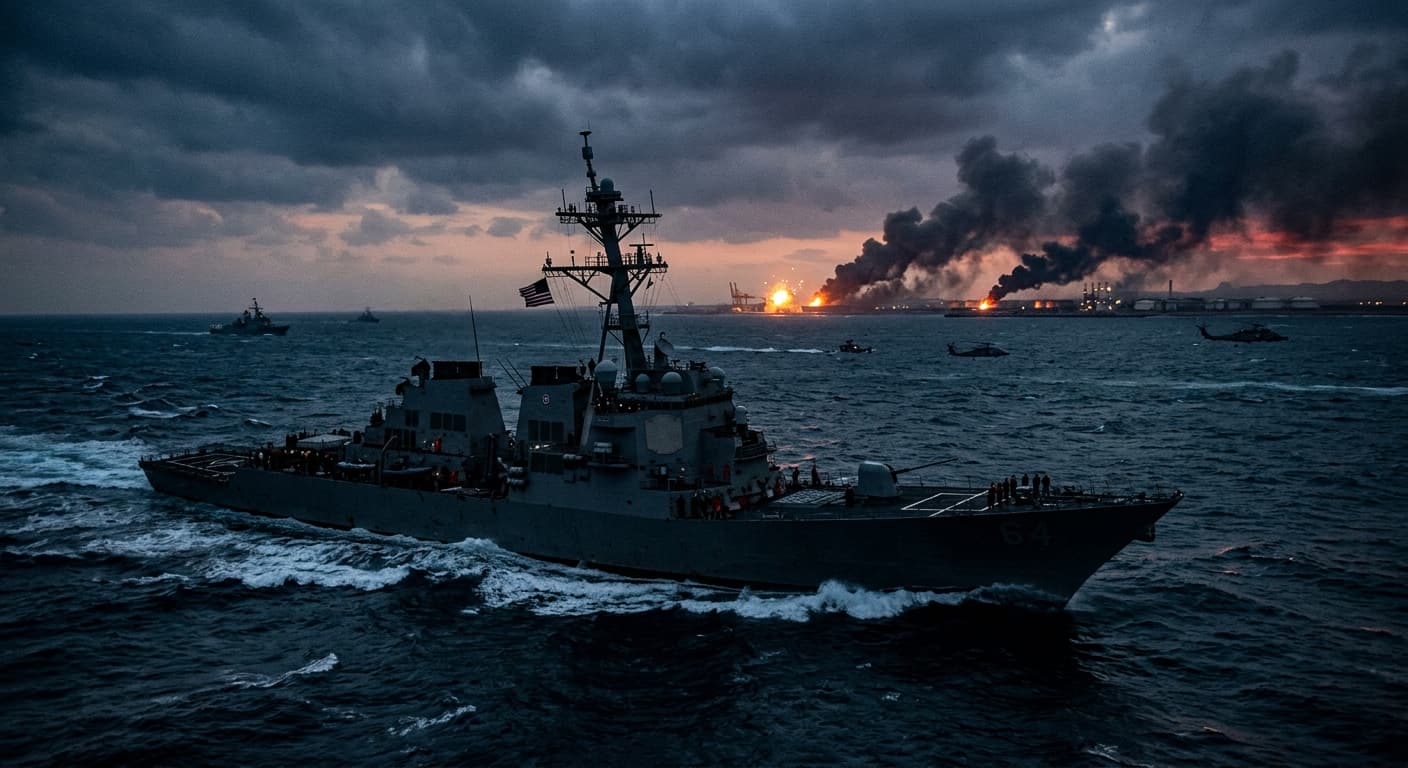
Hormuz war reignites: US pounds Iran, Tehran hits four Gulf states
US strikes hit Bushehr and Chabahar on July 9, 2026; Iran retaliated against bases in Bahrain, Kuwait, Qatar and Jordan, killing 14 in Iran and collapsing the June 17 ceasefire.
The three-week US-Iran ceasefire has broken on the one variable it was designed to contain — who controls the Strait of Hormuz — and the second-order consequence is now visible: Iran has fired directly at four Arab states in three days, converting a bilateral standoff into a multilateral confrontation the Gulf Cooperation Council cannot mediate its way out of. According to Iran's Health Ministry, 14 people have been killed and 78 wounded across five Iranian provinces since US Central Command resumed strikes on July 7, Al Jazeera reported. The strategic story is not the escalation itself. It is that the Gulf monarchies, having spent a decade hedging between Washington and Tehran, are now being physically punished for hosting American forces — and have no exit that preserves both relationships.
What happened on July 8–9
US Central Command said it hit "approximately 90" military targets across Iran's southern coastline in the early hours of July 9, following a first wave of more than 80 targets a day earlier. In a statement quoted by Al Jazeera, CENTCOM said the operation was designed to:
"further degrade Iran's ability to attack commercial shipping and innocent civilian mariners in the Strait of Hormuz."
The targets, per CENTCOM, included "air defense systems, coastal surveillance assets, missile and drone storage sites, naval capabilities, and military logistics infrastructure along Iran's coastline." Verified footage examined by BBC News showed damage to a port control tower in Chabahar and a rail bridge in Aq Qala on the northern route Iran uses to move goods to and from Russia and China. Iranian state agency IRNA reported strikes on Bandar Abbas, Sirik, Kuhestak, Jask, Konarak, Abu Musa island and Bushehr province; a strike on a fishing pier in Sirik killed three civilians and wounded 15, according to ISNA.
At around noon local time on July 9, semi-official Mehr news reported explosions in Bushehr province, where Iran's sole nuclear power plant is located. A local official, Ehsan Jahanian, told IRNA the plant's perimeter had been struck. CENTCOM did not immediately respond to a request for comment, according to the Associated Press via NPR.
Iran's response arrived in overlapping waves. The Islamic Revolutionary Guard Corps said it hit "key infrastructure" at Camp Arifjan and Ali Al Salem in Kuwait, and at Juffair — headquarters of the US Fifth Fleet — and Sheikh Isa airbase in Bahrain. A separate salvo of 10 ballistic missiles was fired at Azraq airbase in Jordan; the Jordanian armed forces said eight were intercepted. Kuwait's Major-General Saud Abdulaziz al-Otaibi said air defences shot down three ballistic missiles, one cruise missile and 10 suicide drones; one person was hospitalised after being struck by falling debris. Sirens sounded three times in Bahrain, home of the Fifth Fleet.
The MoU cracked on one clause
The June 17 memorandum of understanding — mediated by Pakistan and Qatar and celebrated at the time by UN Secretary-General António Guterres as a "critical step" — always contained one load-bearing ambiguity. Its fifth clause committed Iran to using "its best efforts for the safe passage of commercial vessels with no charge for 60 days" through the Strait of Hormuz.
Tehran read that as sovereign discretion. Foreign Ministry spokesman Esmaeil Baghaei told reporters on July 8 that Iran holds sole "responsibility in determining arrangements for the safe passage of ships," Al Jazeera reported. Washington read the same clause as a guarantee of unfettered transit through what it calls an international waterway. The Joint Maritime Information Center, a multinational body including the US, recommended a southern lane through Omani waters after the truce. All three tankers hit on July 6 — Marshall Islands-flagged Al Rekayyat, Saudi-flagged Wedyan and Liberia-flagged Cyprus Prosperity — were sailing that route.
Two moves then made the collapse mechanical. First, US Treasury's Office of Foreign Assets Control revoked General License W and the July 7 authorization that had waived sanctions on Iranian crude oil, petrochemical and petroleum sales — the economic core of what Iran had traded for in June. OFAC's Iran sanctions page lists the "2026 Authorization for the Production, Delivery and Sale of Crude Oil, Petrochemical Products, and Petroleum Products of Iranian Origin (July 07, 2026)" as its most recent action. Second, President Donald Trump declared at the NATO summit in Turkey that the MoU was "over," warning Iran that further attacks would draw a response that was "much worse," per
BBC News.
Iran's chief negotiator, parliamentary speaker Mohammad Bagher Ghalibaf, accused the US of breaching the deal on both oil sanctions and "Iranian adjustments in the Strait." Foreign Minister Abbas Araghchi, in a statement quoted by BBC, "strongly condemned" the strikes as violating the 14-point memorandum and told Pakistan's Field Marshal Asim Munir that Tehran was ready "to defend itself in the case of further US attacks."
The angle: the GCC has become a target, not a mediator
The strategic implication most Western coverage has understated is what has happened to the Gulf monarchies. In April 2024, when Iran retaliated against Israel for the Damascus consulate strike, GCC states quietly assisted regional air defence without becoming Iranian targets themselves. That deniability is gone. Since February 28, when the US-Israel war on Iran began with strikes that killed Supreme Leader Ali Khamenei, Iran has attacked US military assets on the soil of Kuwait, Bahrain, Qatar, the UAE, Iraq and Jordan — repeatedly.
GCC Secretary-General Jasem Mohamed AlBudaiwi called the July strikes on Bahrain and Kuwait a "flagrant violation" of sovereignty and a breach of UN Charter obligations, according to Al Jazeera's compilation of regional reactions. Kuwait's Foreign Ministry cited Security Council Resolution 2817. Qatar, Oman and Egypt joined the condemnation.
But the diplomatic mask slipped on July 9. Iran's Araghchi held a phone call with Saudi Foreign Minister Faisal bin Farhan even as US strikes hit Iranian coastal cities, Al Jazeera's live blog reported. Qatari Prime Minister Sheikh Mohammed bin Abdulrahman Al Thani, whose country hosts Al Udeid airbase and was itself hit on July 9, urged Iran and the US to "commit to diplomacy." Riyadh, which restored ties with Tehran through Chinese mediation in 2023, is holding channels open even as its own tanker Wedyan has been struck.
The consensus that has quietly formed in Riyadh, Abu Dhabi, Doha and Muscat is that Iranian escalation is now a fixed cost of American basing rights. That is a structural shift. It means every future US decision on Iran — sanctions, strikes, redeployments — will meet Gulf resistance that was not there in 2019 or 2020. The winner of that shift is Beijing, whose 2023 brokered rapprochement now looks less like a diplomatic novelty and more like insurance the Gulf paid a premium for.
The economics: markets pricing partial closure, not war
Brent crude rose above $80 a barrel for the first time in two weeks after Trump's remarks and then gave back some of the gain to trade near $78, the Financial Times reported. That price action is the market's tell. It says traders assume the strait stays partially open — that Iran will punish designated tankers but not physically close a chokepoint through which roughly a fifth of global oil and gas flowed before February 28.
The physical data support that read. Just 23 tankers and cargo ships transited Hormuz on July 8, down from 47 a week earlier and 138 on an average pre-war day, according to Kpler figures cited by BBC Verify. The US-recommended Omani southern route has effectively been abandoned: zero transits on July 8, down from about 10 a day the previous week.
The International Monetary Fund warned that a renewed regional conflict would drive up inflation, damage supply chains and weigh on financial markets, per the FT. European Stability Mechanism head Pierre Gramegna told Il Sole 24 Ore that eurozone inflation could reach 5% if Hormuz tensions persist. The oil industry, meanwhile, is preparing to book war-boosted profits — a political liability the White House will discover the next time it seeks bipartisan cover for further strikes.
Nuclear question, unanswered
Iran's Bushehr nuclear complex was hit — or hit near — on July 9. The distinction matters. Bushehr uses Russian-supplied fuel and is under IAEA safeguards; a direct strike would create diplomatic exposure the US has avoided since February. Trump also threatened to hit Iranian civilian infrastructure — electricity and desalination plants — and to seize Kharg Island, through which roughly 90% of Iranian oil exports pass, NPR reported. International legal scholars quoted by Al Jazeera called deliberate strikes on civilian utilities war crimes; a Kharg seizure would require ground forces.
Israeli Defence Minister Israel Katz said on July 9 that Israel is prepared to attack Iran "with even greater force" if needed, according to the Al Jazeera live blog. Prime Minister Benjamin Netanyahu and Trump discussed Gulf developments and security coordination by phone.
Diplomacy, on paper
UN Secretary-General António Guterres, in remarks issued through his spokesman on July 8, said he was "alarmed by the renewed military confrontations in the Gulf." In a statement carried by the UN press office:
"A return to full-scale hostilities would have catastrophic consequences for the peoples of the region, for international peace and security, and for the global economy as a whole. The Secretary-General calls on all parties to exercise maximum restraint, avoid further escalatory action and take immediate steps to de-escalate."
Guterres said he had spoken to Araghchi earlier in the week. Pakistan's Foreign Ministry, one of two MoU mediators, called renewed conflict "in no one's interest." Qatar, the other mediator, was itself targeted the same day it issued its de-escalation appeal.
On Capitol Hill, Republicans have largely stayed silent. Democratic Senator Tim Kaine told reporters, per BBC, that "the US should not be launching new strikes without congressional approval and restarting a war that has raised gas prices, killed Americans and hurt the economy," referencing the Senate's June resolution demanding the president halt hostilities or seek authorisation.
What to watch
- CENTCOM's next 72 hours. Trump signalled a third wave was likely; a strike inside Tehran or on Kharg Island would cross a threshold the June MoU was built to prevent. The commander's public posture — currently framed as protecting freedom of navigation — will indicate whether the mission is expanding beyond Hormuz.
- The 60-day MoU clock. The oil sanctions waiver was originally set to expire August 21, 2026. If Washington and Tehran do not return to the table before that date, the "grace period" for cargoes already at sea ends and Iran loses its central economic incentive to negotiate.
- The next GCC statement. Watch whether Saudi Arabia — which has taken tanker damage but not hosted an Iranian strike this week — moves from condemning Iran to publicly asking the US to pause. Riyadh's language is the leading indicator of Gulf tolerance.
- IAEA response on Bushehr. Director General Rafael Grossi has not yet spoken publicly on the reported July 9 strike near the nuclear plant. An IAEA board meeting or emergency statement would internationalise the nuclear dimension.
- Kpler transit data. If daily Hormuz crossings drop below 20 for a sustained week, insurance and freight markets will price a de facto closure regardless of what either capital says.
The Bottom Line
The July 9 exchange did not just break a ceasefire — it converted the Gulf monarchies from mediators into targets, and made every future American move on Iran contingent on Riyadh's, Doha's and Abu Dhabi's tolerance for being hit. The MoU's fifth clause, ambiguous by design, has proved the operative fault line: whoever controls transit through Hormuz controls the terms of any deal. Until Washington concedes Iranian discretion over the strait or Tehran concedes American definitions of freedom of navigation, expect strikes to resume on a tempo set by tanker traffic, not diplomacy.
Discover more
India
Congress Accuses Modi of Stalling Women's Law
Congress accuses Modi of stalling women's reservation law by linking it to delimitation, revealing a deeper electoral strategy.

US Politics
House Ethics Committee Pushes Sexual Miscond.
The House Ethics Committee has shifted responsibility for sexual harassment settlement records to the Office of Congressional Workplace Rights, complicating disclosure efforts.

India
Delhi CM Rekha Gupta Blasts Opposition's Delm
Delhi CM Rekha Gupta's remarks on women's quota defeat reveal BJP's strategy for the 2029 Lok Sabha elections, focusing on delimitation.

Economics
Fed's Amex AML order puts correspondent banking on notice
Federal Reserve's Amex AML order requires board-level controls and a 90-day plan; OCC fined the bank $350 million over enterprise-wide deficiencies.