US Chip Export Curbs Impact Nvidia in China
Nvidia's market share in China drops to zero amid export restrictions.
Model Diplomat7 min readAsia
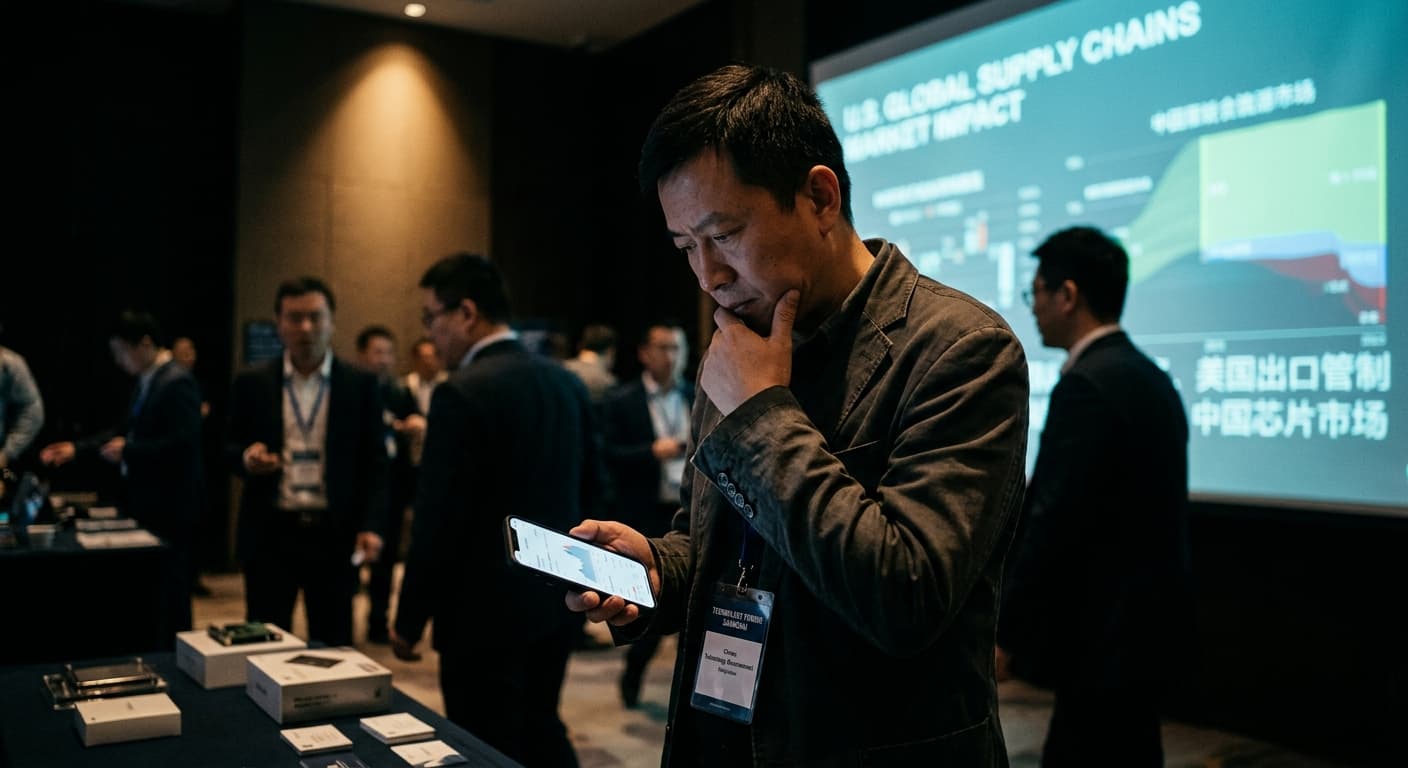
US Chip Export Curbs Bite Chinese Firms Abroad—But Nvidia Has Already Lost China
The May 31, 2026 BIS guidance closes the loophole for Chinese firms buying AI chips through overseas subsidiaries — but Nvidia's China market share is already zero.
The Bureau of Industry and Security issued a two-page notice on May 31, 2026, affirming that US export licences are required to ship advanced AI chips to any entity "headquartered in Country Group D:5 or Macau — or with an ultimate parent company" there, "even if the entities themselves are located outside" those jurisdictions. The clarification, posted to bis.gov and reported by Al Jazeera that Sunday, plugs the extraterritorial hole Chinese buyers have been exploiting since President Donald Trump scrapped the Biden-era AI Diffusion Framework in May 2025 — a year after the loophole opened. The real story is that this fix arrives after Washington has already conceded the Chinese AI chip market: Nvidia's share collapsed from roughly 95% in 2023 to zero on new H200 shipments in mid-2026, and the country closing the loopholes no longer sells the product the loopholes were for.
That inversion — tighter controls, smaller market, faster Chinese self-sufficiency — is the analytic frame for everything that follows. The June 1 clarification is not a fresh crackdown so much as a defensive rearguard on a policy whose commercial premise has collapsed underneath it.
What the BIS clarification actually does
The guidance is narrow and legalistic. In BIS's own words, published on its site, "a license is required to export advanced computing items to entities headquartered in Country Group D:5 (see supplement no. 1 to part 740 of the Export Administration Regulations)…or with an ultimate parent company headquartered in Country Group D:5 or Macau." That drags every offshore subsidiary of a mainland-registered firm — ByteDance's Singapore units, Alibaba Cloud's overseas data centres, Tencent's third-country compute buildouts — back under the licence regime, according to the Bureau of Industry and Security.
The clarification does not amend a regulation. It states how BIS reads an existing one. That distinction matters. Chris McGuire, the former State Department technology-policy official who worked on the Biden controls, told Al Jazeera: "Chinese companies have been buying these chips, very likely at scale. And because BIS has not updated export control regulations to clearly state what it IS enforcing, all of this was legal." McGuire's reading: Blackwell-class shipments to Chinese-headquartered firms outside China are now illegal again, but BIS's own acknowledgement that prior purchasers "don't have to stop using them" is a tacit admission of how much leaked out during the Diffusion Framework's rollback.
The Congressional Research Service, in its June 2026 primer R48642, documents the pattern: BIS's entity-by-entity, subsidiary-by-subsidiary approach — including its year-long tolerance of Huawei-linked fabs it declined to list — has "signalled" impending controls in ways that let PRC firms stockpile. The 2020 antitrust commitments Nvidia gave Chinese regulators, CRS notes, legally obligate Nvidia to allow "PRC entities to buy a year's worth of GPUs" once controls are announced, actively enabling the stockpiling the controls are meant to prevent.
The market Washington is fighting over doesn't exist anymore
Trump's December 8, 2025 decision to reverse course and permit Nvidia's H200 — roughly six times more powerful than the compliance-designed H20 — was sold as commercial re-engagement. The Federal Register rule on January 15, 2026 codified it: China-bound H200 volume capped at 50% of US shipments, a 25% tariff routed via Taiwan, US-supply certifications required. The Council on Foreign Relations called the resulting framework "strategically incoherent and unenforceable", warning that faithful enforcement would block most sales while lax enforcement would neuter the security rationale.
Beijing resolved the incoherence for Washington. China's Ministry of Industry and Information Technology ordered domestic AI companies to boycott the newly-approved H200 and prioritise homegrown silicon on January 14, 2026, per the BBC. The next day, Chinese customs officials instructed agents that H200 chips were "not permitted" to enter China despite the fresh BIS licences, according to
CSIS. By Nvidia's May 21, 2026 first-quarter results, CEO Jensen Huang told CNBC he had "largely conceded" the Chinese market to Huawei; the company booked zero data-centre revenue from China in the current quarter, per
BBC coverage of the print.
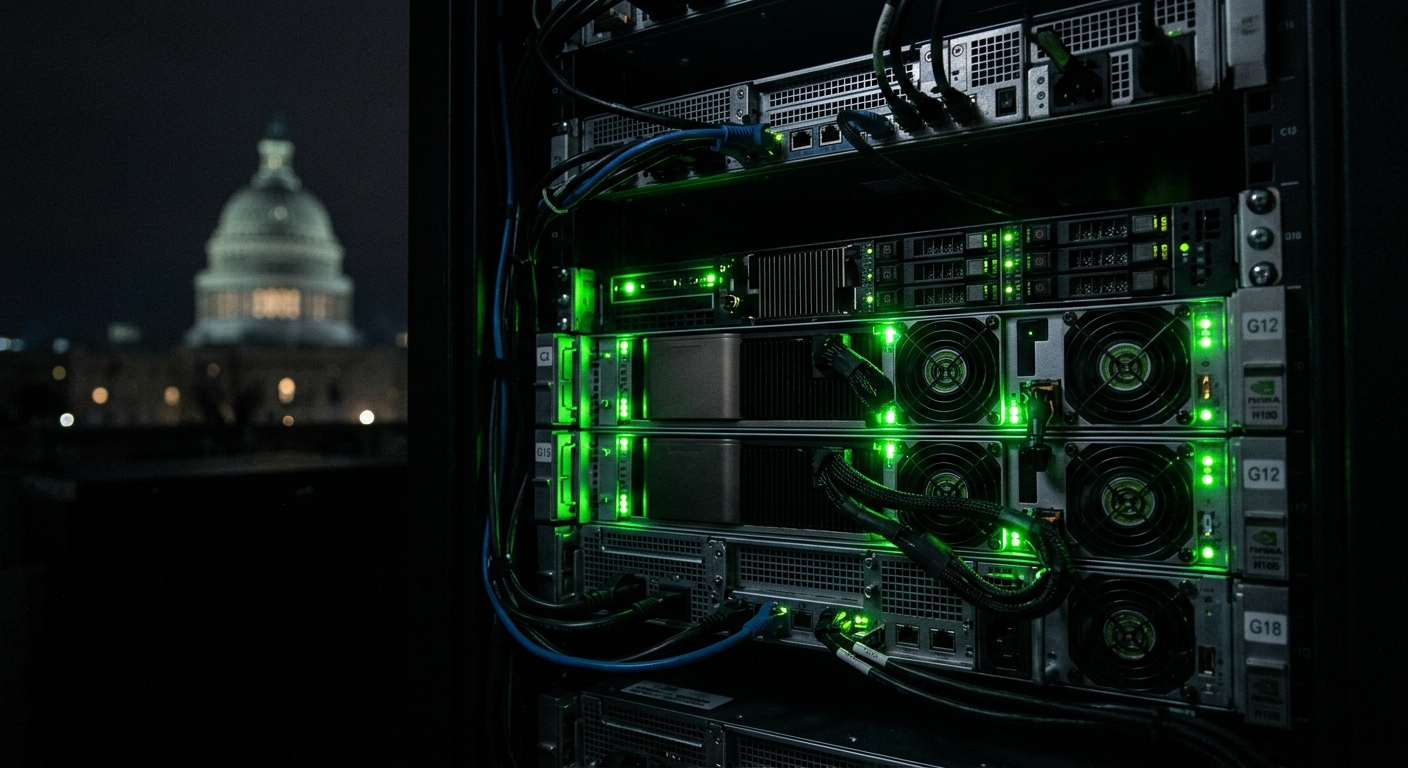
Brookings analyst John Villasenor put it flatly on June 12, 2026: "The ball game is over, and the U.S. has lost." US chipmakers, he wrote, "have exactly zero market share of the AI chip market in China and have no prospect of returning to their once-dominant position there."
The Chinese firms this actually hits — and the ones it doesn't
The May 31 guidance's operational bite falls on three categories of Chinese firms.
First, the offshore data-centre buildouts. ByteDance had planned to spend roughly $7 billion at the end of 2024 to access Nvidia chips on servers outside China, per RAND. Alibaba Cloud and Tencent have parallel Southeast Asian and Gulf infrastructure plans. Every one of those installations, if the parent is Chinese-headquartered, now requires a US licence for any advanced GPU. The Trump administration retained the H200 rule's "presumption of denial" for exports to PRC-owned data centres outside China, per the
CFR analysis of the January regulation. The clarification closes the ambiguity about whether Blackwell — Nvidia's still-banned frontier chip — could reach these firms via third-country subsidiaries. It cannot.
Second, the smuggling and diversion pipeline. In November 2025, the Department of Justice indicted three individuals linked to a US technology supplier for allegedly diverting roughly $2.5 billion of Nvidia-equipped servers to China using dummy-server audits and Southeast Asian shell buyers, according to the BBC. BIS's own June 17, 2026 penalty notice fined Robert Bosch GmbH $36 million for Huawei-related shipment violations. The extraterritorial clarification gives prosecutors cleaner statutory language to charge future diversions where the ultimate customer is a Chinese-parented firm booked as a foreign entity.
Third, the firms it doesn't hit: Huawei, Cambricon, and SMIC. Chinese domestic AI chips made up 41% of China's market in 2025 with about half from Huawei, according to IDC data cited by Brookings on April 30, 2026. Huawei's Ascend 950PR is scaling to 750,000 units this year; Cambricon plans 500,000 AI accelerators in 2026, largely fabricated domestically. SMIC's SN2 facility targets 50,000 wafers per month of 7-nm production. The
CSIS analysis of Huawei's ecosystem puts Ren Zhengfei at the head of a coalition of more than 2,000 Chinese firms aiming for 70% semiconductor self-sufficiency by 2028.
The DeepSeek angle: distillation is the new smuggling
The June 1 clarification lands in the same week Anthropic, Google, and OpenAI — alongside the White House — formally accused Chinese labs, DeepSeek prominent among them, of "industrial-scale" distillation attacks on frontier US models. CFR's December 5, 2025 assessment of DeepSeek V4 reports that V4 was "still trained on smuggled Nvidia Blackwell chips" despite being optimised for inference on Huawei Ascend. Anthropic alleges DeepSeek created over 24,000 fake accounts and ran more than 16 million interactions against its Claude models to extract capabilities.
The BIS chip guidance and the White House's parallel push on distillation attacks are the same policy expressed twice. Both aim to shut down the physical-and-informational conduits by which US AI capability leaks into Chinese models. Neither, on the current evidence, is closing fast enough. As CFR notes, closing the smuggling and distillation loopholes could take the US lead from "seven months to years." Do neither and the lead compresses.
The counter-move Beijing has already made
China's response has run on three tracks. The State Administration for Market Regulation launched an antimonopoly probe against Nvidia in late 2024, revived in visibility during the H20 fight — a probe RAND and the
BBC both read as retaliatory. In May 2026, Beijing's Ministry of Commerce for the first time invoked its 2021 anti-sanctions law to bar Chinese firms from complying with US sanctions on five refineries, per
Al Jazeera. The template is now built: Chinese counter-sanctions can be aimed at chip enforcement next.
The third track is directive industrial policy. China's fifteenth five-year plan, per Brookings, calls for "extraordinary measures" to defeat export controls on semiconductors. Beijing's directive that AI firms boycott the H200 is the sharp end of that.
Who wins, who loses
The winners are Huawei, Cambricon, SMIC, and the state-directed compute ecosystem now building CUDA-compatible architectures to lower switching costs for Chinese developers. Huawei has extracted from Beijing what Nvidia extracted from Washington in 2020: a captive domestic customer base secured by regulation. Goldman Sachs, per RAND, forecast Cambricon's revenue growing 3.7x to 5.5 billion yuan.
The losers are Nvidia, AMD and the US AI chip complex — down roughly 13% of Nvidia's 2024 sales in the Chinese market, which the company now models at zero — and, more subtly, US AI labs that will face a Chinese competitor no longer paying the two-to-four-times compute penalty DeepSeek CEO Liang Wenfeng described in mid-2024. As Brookings' Kyle Chan warned in 2025, the "point of no return" for US chipmakers in China has now been passed.
Diplomat View
The May 31 BIS clarification looks like tightening. It is, in fact, the tidying-up phase of a policy that has already produced its main second-order effect: it has forced Beijing to build the domestic AI-chip stack the controls were designed to prevent. Trump's H200 approval and Beijing's boycott of it settled the question of who controls the Chinese market — and the answer is Beijing, not Washington. The forecast is that Huawei-plus-SMIC Ascend production reaches ≥1 million units and ≥50% Chinese market share in 2026, and that Chinese frontier models close on US capability faster than the seven-month gap CFR estimates today. What would revise the forecast: a genuine collapse of SMIC 7-nm yields (below ~20%); a bilateral chip deal at the next Trump–Xi meeting that trades market access for verifiable end-use controls; or a Section 232 semiconductor tariff that recouples the two supply chains commercially. None of the three has a credible path to materialising before December.
What to watch next
- December 31, 2026 — BIS's extended deadline for Authorized IC Designer applications closes; a hard test of extraterritorial enforcement.
- Nvidia Q3 FY27 earnings, late August 2026 — first full quarter with the extraterritorial rule in force; the China data-centre line item is the metric.
- Huawei Ascend 950DT release, H2 2026 — the roadmap chip Ren Zhengfei has staked self-sufficiency on; delays or yield problems would recalibrate everything.
Related: Global Politics.
Discover more
US Politics
House Ethics Committee Pushes Sexual Miscond.
The House Ethics Committee has shifted responsibility for sexual harassment settlement records to the Office of Congressional Workplace Rights, complicating disclosure efforts.
India
700 Activists Accuse PM Modi of MCC Breach
Over 700 activists allege PM Modi breached election code with a televised address attacking opposition parties just before state elections.

International Relations
Pakistan's Key Role in US-Israel-Iran Meddle
Pakistan is seeking to mediate the US-Israel-Iran conflict, balancing high-stakes diplomacy against severe economic pressures and steep regional challenges.

Economics
Fed's Amex AML order puts correspondent banking on notice
Federal Reserve's Amex AML order requires board-level controls and a 90-day plan; OCC fined the bank $350 million over enterprise-wide deficiencies.