US AI Chip Export Controls Tighten
BIS guidance reveals loopholes in AI chip exports.
Model Diplomat8 min readNorth America
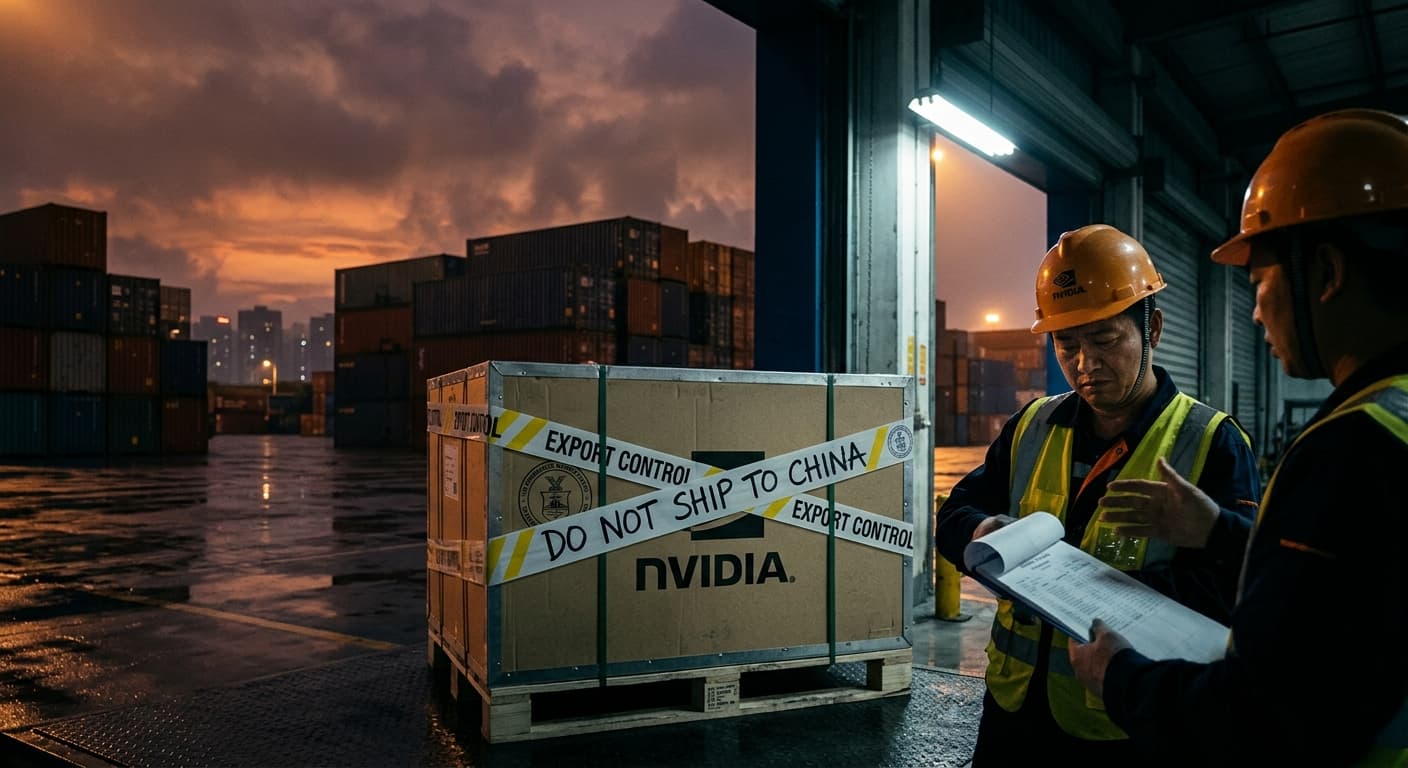
US AI Chip Curbs Tighten as Nvidia Loses China Market
BIS says export licenses now follow Chinese firms abroad — a loophole plug that lands after Huawei has already taken the market Nvidia conceded.
The Bureau of Industry and Security's May 31, 2026 guidance — that US license requirements for advanced AI chips follow any entity "headquartered in Country Group D:5 or Macau … wherever located" — is being marketed in Washington as a tightening. It is really an admission: Trump's December 2025 decision to green-light Nvidia's H200 for China opened a subsidiary-shaped hole in the export regime, and by the time BIS closed it, Nvidia had already been shut out of China entirely. The story is no longer whether US controls slow China's AI build-out; it is that Beijing's counter-boycott is now doing the work Washington's controls used to do — and Huawei, not the US Treasury, is collecting the rent.
What BIS actually did on May 31
The notice, posted under "Guidance Regarding Enforcement of License Requirements for Advanced Computing Items for Entities Headquartered in Country Group D:5 and Macau," clarifies that a license is required to export advanced computing items to any entity whose ultimate parent sits in China or Macau — "even if the entities themselves are located outside" those jurisdictions — according to the Bureau of Industry and Security. The extraterritorial reach is not new law. It tracks the plain text of 15 CFR §740.8, which conditions the Notified Advanced Computing exception on the "ultimate parent" test, as codified at the
Cornell Legal Information Institute. What is new is BIS saying it out loud, in writing, after eighteen months of Trump-era ambiguity.
The immediate trigger, Al Jazeera reported on June 1, was the administration's May 2025 rescission of the Biden AI Diffusion Framework. That framework had set an explicit three-tier global licensing regime with country-level compute caps and validated-end-user attestations; scrapping it left a gaping vacuum on foreign subsidiaries of Chinese firms. Nvidia's Blackwell GPUs remain formally banned for export to China, but Chinese buyers routing purchases through Singapore, Malaysia and UAE holding companies had, in the words of former State Department official Chris McGuire, been buying "very likely at scale — and because BIS has not updated export control regulations to clearly state what it IS enforcing, all of this was legal."
The May 31 guidance criminalises future subsidiary shipments without demanding return of chips already sold. That carve-out is itself the tell — an implicit acknowledgment of how much material has moved through the loophole since May 2025.
The loophole that mattered — and the one that didn't
The Congressional Research Service's June 2026 update, U.S. Export Controls and China: Advanced Semiconductors, catalogues the pathway more bluntly than BIS ever will. It notes that "some experts say that Huawei built its Ascend AI chips at PRC fabs that were notified to BIS but that were not added to the [Entity List]," and that "some Members of Congress criticized Nvidia for not stemming PRC circumvention via third markets." CRS also flags that BIS approvals of the H20 and AMD's MI308 have relied on the "knowledge" standard — a legal test that limits exporter liability to what a seller can be shown to have known about the ultimate end user. In practice, that has meant Nvidia's compliance obligations end at the invoice.
CSIS documented how the loopholes worked before the diffusion rule was gutted: Chinese firms used non-listed intermediary design houses, misrepresented Export Control Classification Numbers to foundries, and rented offshore data-center capacity to train models remotely without ever taking physical possession of a controlled chip. The 2024 revelation that TSMC had unwittingly produced Ascend-bound wafers via a shell design customer forced the Foundry Due Diligence Rule — the rule BIS has now extended to December 31, 2026 for Approved IC Designer attestations, per its own homepage notice. Extending a compliance deadline into 2027 is not the posture of an agency confident it has closed the pipe.
The Justice Department has begun filling the enforcement vacuum through prosecution rather than regulation. The BBC reported that DOJ has charged three individuals linked to a US technology supplier over a scheme in which an unnamed Southeast Asian firm bought roughly $2.5 billion worth of servers containing Nvidia chips, used dummy replicas to defeat audits, and repackaged the real hardware for shipment to Chinese brokers. That case, together with an August 2025 indictment involving ALX Solutions shipping through Malaysia and Singapore to Hong Kong, is what a control regime looks like when the front door has been opened and the traffic is being managed by federal prosecutors after the fact.
What Beijing did with the opening
Here the analysis breaks from the standard Washington narrative. In January 2026, CSIS reports, Chinese customs officials instructed agents that H200 chips were "not permitted" to enter China despite BIS-issued licenses. Beijing then quietly told domestic tech firms to halt orders, and though it later allowed a handful of imports, it is using informal guidance to steer buyers toward domestic alternatives. The message from the Chinese state to Chinese industry was simple: escaping the chokehold matters more than any short-run performance advantage from a US chip.
The financial consequence for Nvidia landed within four months. The BBC confirmed on May 21 that Nvidia posted first-quarter revenue of $81.6 billion, with CEO Jensen Huang telling CNBC he had "largely conceded" the Chinese market to Huawei — and that the company was assuming zero data-center chip revenue from China in the current quarter. That is a company writing off, in a single sentence, a market that generated $12–$15 billion in H20 sales in 2024 alone, as
Brookings' John Villasenor documents. Nvidia took a $5.5 billion write-off in April 2025 when Commerce reclassified the H20; the H200 approval was meant to recover that revenue, and Beijing killed it in a fortnight.
That is the pivot the export-control debate has not caught up to. Washington spent two years engineering a diffusion regime to prevent China from buying the leading US chips. In 2026, BIS is policing a market that Beijing itself will not permit Chinese firms to enter. The 25% tariff Trump imposed on H200 exports to China — which routes chips from Taiwan to the US for tariff collection, then onward to Chinese buyers — is now charging tolls on a road nobody is driving on. As Villasenor puts it: "U.S. chip companies have exactly zero market share of the AI chip market in China and have no prospect of returning to their once-dominant position there."
The Huawei math
Whether Beijing's confidence is warranted turns on a single number: how many domestic AI accelerators Huawei can actually produce. The Council on Foreign Relations, working from Huawei's own internal targets, reports the roadmap as 800,000 Ascend chips in 2025, two million in 2026 and four million in 2027 — and concludes those targets are unlikely to be met given SMIC's constrained 7 nm wafer output. RAND's August 2025 estimate, in
Leashing Chinese AI Needs Smart Chip Controls, that Chinese firms bought roughly one million Nvidia H20 accelerators in 2024 against 450,000 shipped Ascend 910Bs shows how far the substitution gap still runs.
But the Financial Times reported satellite evidence of Huawei building an integrated Shenzhen fab network intended to produce everything from wafer equipment to Ascend processors in-house, with SemiAnalysis founder Dylan Patel calling it "an unprecedented effort to develop every part of the AI supply chain domestically." Alibaba has delivered more than 100,000 units of its Zhenwu 810E accelerator,
CSIS reports, a chip Chinese state media claims is comparable to the H20; at least nine Chinese AI chipmakers have now crossed 10,000 units shipped, including Baidu and Cambricon. That is the emerging domestic base BIS is walling off from US supply — not to constrain it, but because Beijing has already told it not to buy from the US.
The second-order effect is the one Washington finds hardest to accept. As CSIS argues, the controls "have induced China to accelerate its unprecedented efforts to achieve self-sufficiency in chips," and the DeepSeek V4 release, optimised to run on Huawei's Ascend hardware, is the proof point. A control regime originally designed as a narrow national-security tool is now an industrial-policy accelerant for the country it was meant to constrain. Al Jazeera's May 2026 reporting on China's energy advantage frames the trade-off crisply:
the US has the chips and lacks the power; China has the power and lacks the chips, and modular Huawei data centres are being built in six months against a US baseline of at least a year.
Winners and losers
Huawei is the unambiguous winner. Beijing's boycott of the H200 is a subsidy in kind — it forces domestic hyperscalers Alibaba, ByteDance and Tencent into Ascend and Zhenwu 810E orders they would otherwise have hedged with Nvidia silicon. That guaranteed demand is what lets Huawei justify the Shenzhen capital build-out the FT documented.
Nvidia is the reluctant loser. The company still expects $91 billion in second-quarter revenue, per the BBC, and Forrester analyst Alvin Nguyen argues "global AI demand outside China is more than enough to sustain its growth." But Huang's concession sets a precedent: US chip firms can be excluded from a $150 billion terminal market by decree, without a treaty, without a WTO case, and without meaningful US retaliation.
TSMC is a quieter loser. The BIS extraterritorial guidance and the Foundry Due Diligence Rule together push the compliance burden upstream to the fab, forcing more Approved IC Designer attestations and more diligence overhead on the entity least able to walk away from either government.
The Trump administration's 25% H200 tariff is the phantom line-item — designed to monetise a trade Beijing has now forbidden.
What to watch next
- December 31, 2026: the BIS extension for Approved IC Designer applications expires. If the deadline slips again, the enforcement backbone of the entire foundry regime is effectively unfunded.
- Q3 2026 Nvidia earnings: whether Huang updates his "no China revenue" guidance will signal whether Beijing has permitted a face-saving trickle of H200 shipments or hardened the boycott.
- Entity List additions: CRS notes Huawei-tied fabs and design houses remain unlisted. Adding them would test whether the Trump administration's tightening is real or rhetorical.
- DeepSeek V5: if the next release is trained credibly on Ascend-only compute, the "US lead measured in months" thesis collapses.
The Bottom Line
The May 31 BIS guidance is not the tightening it appears to be — it is the belated legalisation of a status quo Beijing has already imposed by fiat. The decisive fact of the 2026 AI chip war is that China has voluntarily left the US market and is subsidising Huawei's substitution curve; Washington's controls are now largely policing a boycott it did not order. Unless BIS lists Huawei's supplier fabs and enforces the foundry rule before December 31, the US will exit this decade with a control regime that succeeded in accelerating exactly the Chinese self-sufficiency it was written to prevent.
Discover more

US Politics
House Ethics Committee Pushes Sexual Miscond.
The House Ethics Committee has shifted responsibility for sexual harassment settlement records to the Office of Congressional Workplace Rights, complicating disclosure efforts.
India
700 Activists Accuse PM Modi of MCC Breach
Over 700 activists allege PM Modi breached election code with a televised address attacking opposition parties just before state elections.

International Relations
Pakistan's Key Role in US-Israel-Iran Meddle
Pakistan is seeking to mediate the US-Israel-Iran conflict, balancing high-stakes diplomacy against severe economic pressures and steep regional challenges.

Economics
Fed's Amex AML order puts correspondent banking on notice
Federal Reserve's Amex AML order requires board-level controls and a 90-day plan; OCC fined the bank $350 million over enterprise-wide deficiencies.