UN's Syria Bet: Reconciliation Last Card
USG DiCarlo's briefing highlights reconciliation's role in Syria.
Model Diplomat6 min readMiddle East
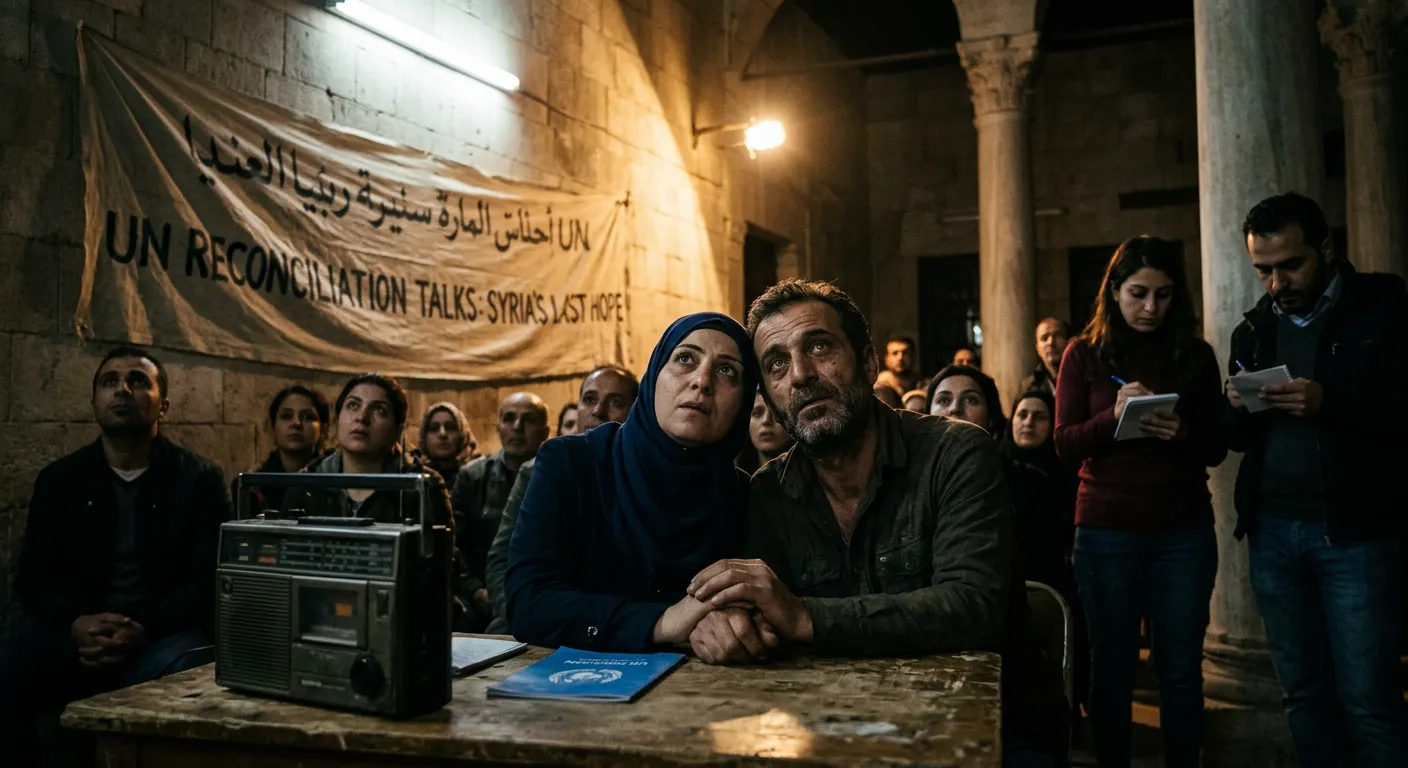
UN's Syria bet: reconciliation is the last card left to play
USG DiCarlo's Security Council briefing framed Syria's transition around reconciliation — the one lever left after Washington seized sanctions policy.
The United Nations no longer sets the pace on Syria's reintegration — Washington does. That reality frames Under-Secretary-General Rosemary DiCarlo's briefing to the Security Council on 18 December 2025, and the follow-on session led by Deputy Special Envoy Claudio Cordone on 22 June 2026: with US President Donald Trump lifting bilateral sanctions in mid-2025 and the Council itself delisting President Ahmed al-Sharaa in November 2025, the UN's remaining leverage lies not in coercion but in one narrow slice of the transition — the reconciliation, transitional justice and security-sector reform agenda that no bilateral partner is willing to underwrite alone. That is the bet DiCarlo laid down in December, and it is the bet Cordone is now trying to cash in as Damascus wobbles.
What DiCarlo actually said — and why the framing matters
DiCarlo used the 18 December session, the first Council briefing after members' first-ever visit to Syria via Jdeidet Yabous, to reframe Syria from a humanitarian crisis file into a political transition file. Her own
remarks recorded the year's tangible gains: state institutions restored, armed factions placed under a single command, a new cabinet formed, more than 1 million refugees and nearly 2 million internally displaced persons returned home, and a 10 March agreement between the government and the Kurdish-led Syrian Democratic Forces. She then anchored the UN's forward role in three deliverables — the National Commissions on Missing Persons and Transitional Justice, the Investigative Committees for the Coast and Sweida, and a Syrian-led programme of security sector reform and DDR (disarmament, demobilization, and reintegration).
The list is the argument. DiCarlo was signalling to Council members that with sanctions leverage effectively transferred to Washington and the EU, the UN's Damascus office would concentrate on the tasks that the interim government cannot legitimize on its own: accountability for chemical weapons and mass atrocities, the fate of the missing, and reconciliation with the Alawite coast, the Druze of Suwayda, and the Kurdish northeast.
The power picture around the briefing
The context strips the illusion that the Council is steering. In November 2025, the UNSC adopted Resolution 2799 under Chapter VII, removing al-Sharaa and Interior Minister Anas Khattab from the 1267 ISIL/Al-Qaida sanctions list by a vote of 14-0-1, with China abstaining, according to
UN News. Three months later, on 27 February 2026, the 1267 Committee removed Hayat Tahrir al-Sham (HTS) itself by consensus after Beijing dropped its objection following Syrian counter-terrorism guarantees, the International Crisis Group
reported. That sequence closed the multilateral coercive file. On 8 July 2026, Trump told al-Sharaa on the sidelines of the NATO summit in Ankara that he would remove Syria from the US state sponsors of terrorism list within 45 days unless Congress blocks it,
Al Jazeera reported.
Cordone's 22 June briefing — the Council's 10,178th meeting — landed in that shifted terrain. He told members Syria's transition was "at a critical phase, with opportunity and fragility existing side by side," and reported his third visit to Damascus, meetings with Foreign Minister Asaad al-Shaibani, the Justice Minister, the National Commission for Transitional Justice, and survivors. He flagged that the People's Assembly had still not been constituted eight months after indirect elections, that 5,989 former-regime detainees were awaiting prosecution, and that the draft transitional justice law must cover "all perpetrators of atrocity crimes" — not only Assad-era ones.
Why reconciliation is the last real lever
Sanctions leverage is gone; recognition is largely granted; the SDF integration is proceeding under a bilateral 10 March 2025 deal, not a UN mandate. What remains uniquely UN-shaped is the machinery that makes reconciliation legible to reluctant Western capitals and Gulf financiers — and that machinery is under strain.
Suwayda is the acid test. The BBC reported that Cordone told the Council there had been "no progress on the implementation of the roadmap for confidence-building and reintegration in Suweida" — where sectarian bloodshed last year left the Druze province excluded from both the parliamentary selection process and Damascus's writ. He warned that "calls within Suweida for secession threatened to undermine Syria's unity and territorial integrity." The Alawite coast is the mirror image: Rami Makhlouf, Assad's billionaire cousle,
issued a video threat from exile this week demanding the release of Alawite prisoners, per Al Jazeera. Nanar Hawach of the International Crisis Group told the outlet that Syria's spoilers now fall into three tracks: "ISIL cells… former regime remnants… and armed actors in Suwayda and the northeast."
The security backdrop reinforces the diagnosis. Twin bombs near the Four Seasons Hotel in Damascus killed one and wounded 36 on 7 July 2026 during French President Emmanuel Macron's visit, per Al Jazeera's account. A separate February 2026
UN Counter-Terrorism Office report identified five foiled ISIL-linked assassination attempts against al-Sharaa, Khattab and al-Shaibani during 2025, and estimated ISIL fields roughly 3,000 fighters across Iraq and Syria, most based in Syria.
Who wins from the UN's narrower role
The Trump administration wins first. The Brookings Karlin testimony delivered to the House Foreign Affairs Committee on 10 February 2026 explicitly recommended that Washington "encourage the United Nations to name a new UN special envoy focused on reconstruction, reconciliation, and humanitarian issues" — a policy blueprint that keeps the geopolitical file (Israel-Syria border demarcation, Hezbollah disarmament, ISIS detainee transfers) inside a US-led regional security convening while off-loading the messy political-legitimacy work to Turtle Bay.
Al-Sharaa wins second. UN certification of transitional justice is a cheaper form of legitimacy than genuine power-sharing. The May 2026 cabinet reshuffle — replacing his brother Maher as head of the presidential office but drawing new ministers "overwhelmingly from his trusted network," per Hawach — showed that Damascus prefers the appearance of technocratic breadth to actual dispersion of power, Al Jazeera reported. A UN-blessed transitional justice track lets him prosecute Assad-era figures like Atef Najib — the former Deraa security chief whose trial opened 26 April 2026 — without opening the file on HTS-era abuses.
Who loses? The Druze, the Alawite coast, and Syrian women. Only six of 140 elected People's Assembly seats went to women in the October 2025 vote, according to the BBC; al-Sharaa's 70 appointees raised female representation to 22 of 210, or roughly 10%. Suwayda remains without designated members. The transitional parliament's first session, scheduled for 6 July 2026, was
postponed indefinitely with no explanation.
The sanctions-relief loop the UN cannot close
The Crisis Group's February 2025 Q&A argued that UN sanctions on interim leaders were "prolonging the country's humanitarian crisis and hampering reconstruction." That analysis has now been overtaken by events — the 1267 delistings of November 2025 and February 2026 removed the multilateral obstacles. But bilateral overcompliance persists. As the Crisis Group's
Watch List 2025 Spring Update noted, even after Trump's 14 May 2025 promise and the EU's 20 May decision to lift most economic sanctions, banks and investors remain wary. The December 2025 US repeal of the Caesar Act built in a four-year, 180-day certification requirement that Damascus is removing foreign fighters — a permanent pressure point Congress can weaponize.
The UN cannot fix that. What it can do is document reconciliation progress credibly enough to give Western regulators cover. That is the workshop DiCarlo opened in December and Cordone is now running.
What to watch
- The rescheduled first session of the People's Assembly: no date has been set after the 6 July postponement. The Council will read further delay as a signal that al-Sharaa is stalling institutional dispersal.
- The 45-day US SST delisting window triggered by Trump's 8 July statement in Ankara. Congressional action to block, or acquiescence, will set the ceiling on private-sector re-engagement.
- The next Security Council Syria session, scheduled on the DPPA calendar for late July 2026, and the draft Transitional Justice Law expected from the National Commission. Cordone flagged both as tests of whether accountability will cover "all perpetrators" — including HTS-era abuses.
- Suwayda: the roadmap Cordone said has produced "no progress." Any renewed sectarian violence there — or the Druze province formally boycotting the assembly — would gut the UN's reconciliation framing.
The Bottom Line
The UN's Syria file has been reduced to one instrument: reconciliation. Washington controls sanctions relief, bilateral partners control recognition, and Damascus controls the tempo — leaving DiCarlo's team to certify transitional justice, missing-persons work, and Suwayda's reintegration so Western capitals have political cover to invest. If that narrow lane closes — if Suwayda secedes in fact, if the transitional justice law spares HTS-era commanders, or if ISIL blasts like the 7 July Damascus bombings become routine — the UN loses the last piece of leverage it still holds over Syria's transition, and reconstruction money stays parked.
Discover more

US Politics
SNAP Food Assistance Faces Legal Challenges
In 2026, SNAP faces stricter eligibility rules and mounting legal challenges, threatening food assistance for the millions of Americans who rely on the program.
Global Politics
Trump's Conflicting Messages on Iran War
Trump's mixed messages on Iran reflect a strategy of audience management, benefiting Tehran amid a complex geopolitical landscape.

US Politics
House Ethics Committee Pushes Sexual Miscond.
The House Ethics Committee has shifted responsibility for sexual harassment settlement records to the Office of Congressional Workplace Rights, complicating disclosure efforts.

Economics
Fed's Amex AML order puts correspondent banking on notice
Federal Reserve's Amex AML order requires board-level controls and a 90-day plan; OCC fined the bank $350 million over enterprise-wide deficiencies.