UN Calls for Ukraine Ceasefire Amid Civilian
UN urges halt to attacks as Russia escalates strikes.
Model Diplomat8 min readEurope
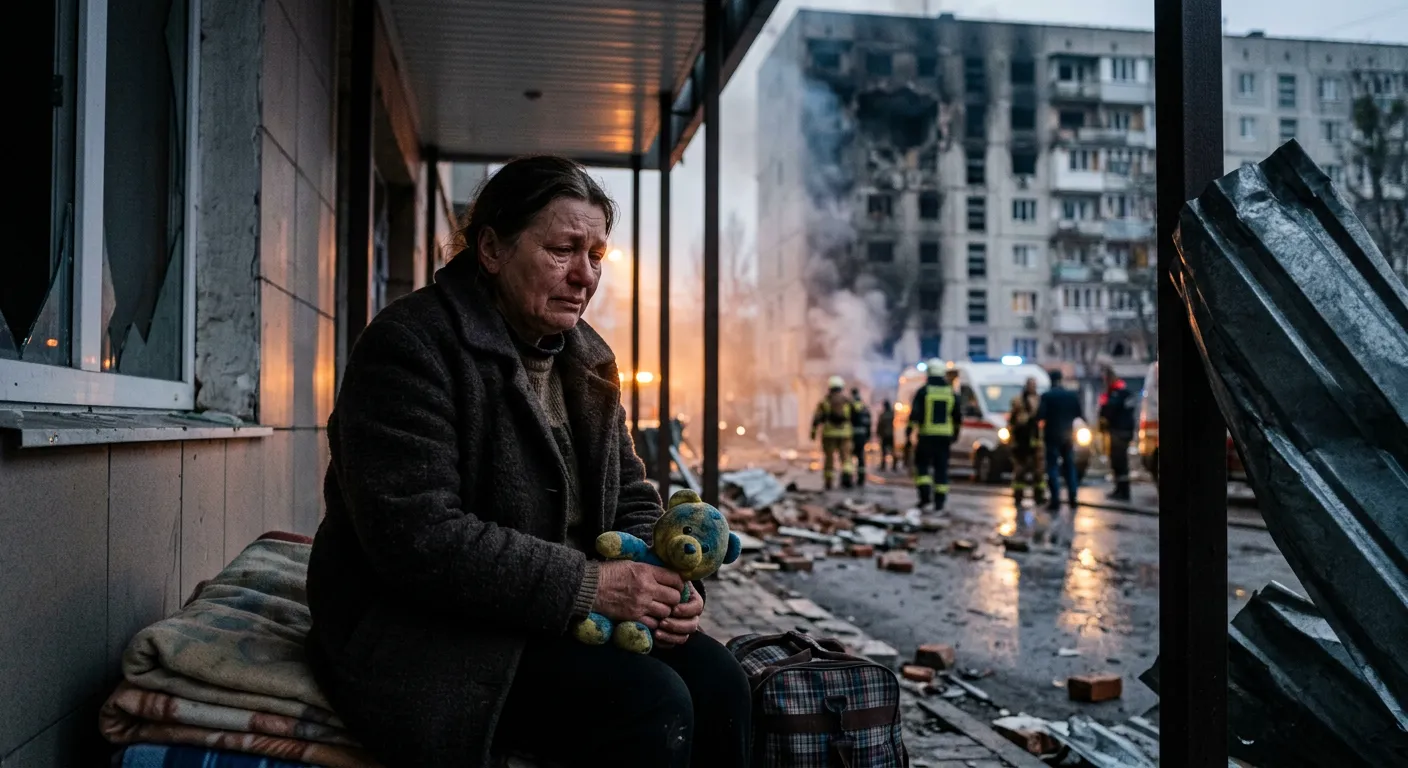
UN pleads for Ukraine ceasefire as Moscow makes civilian terror its main lever
The UN's renewed call to halt attacks on Ukrainian civilians collides with a strategic fact: as Russia's ground advance collapses, indiscriminate strikes have become Moscow's last coercive instrument.
The United Nations is again urging an immediate halt to attacks on civilians in Ukraine and a "renewed push for diplomacy" — but the arithmetic behind the appeal has inverted. Between December 2025 and May 2026, civilian casualties rose 40% year-on-year, and May 2026 was the deadliest month for Ukrainian civilians since April 2022, according to the UN Human Rights Monitoring Mission in Ukraine. Those numbers track precisely with the collapse of Russia's territorial advance. That is the story: Moscow has replaced battlefield progress with mass strikes on cities, which means the UN's appeals — absent hard leverage on air defence supplies and sanctions — now guarantee the strikes intensify, not stop.
What the UN actually said this week
On July 2, 2026, hours after the deadliest attack on Kyiv this year, Secretary-General António Guterres issued a formal note stating that "any attacks against civilians and civilian infrastructure, wherever they occur, are a clear violation of international humanitarian law and must stop immediately," and reiterated his call for "a full, immediate and unconditional ceasefire." The Secretary-General's July 2 note is the primary document anchoring this week's UN posture. It records at least 20 killed and dozens injured in the overnight Kyiv strikes, and explicitly cites the 40% year-on-year rise in civilian casualties documented by the Human Rights Monitoring Mission between December 2025 and May 2026.
Six days later, at the UN Spokesperson's daily briefing on July 8, Stéphane Dujarric told reporters that OCHA staff were tracking continuing drone and missile attacks across the Kharkiv and Kherson regions, and that the World Health Organization now reports that nearly 70% of Ukrainians have experienced worsening health since the full-scale invasion — sleep disorders, headaches, anxiety, depression and post-traumatic stress, with prolonged stress driving higher rates of chronic disease. The framing has shifted from episodic condemnation to structural warning: a population being ground down.
The diplomatic register hardened in Vienna a day later. On July 9, 2026, UK Ambassador Neil Holland told the OSCE Permanent Council that "Russia is not seeking to end the human suffering caused by this war. It is using that suffering as a coercive tool." His statement to the OSCE itemised the July 1–2 attack (496 drones and 74 missiles, at least 30 civilians killed, 91 injured) and the July 5–6 follow-up (351 drones, 68 missiles, 26 dead, more than 120 injured). Holland's rhetorical trap was deliberate: if the strikes are random, Russia is firing indiscriminately into cities; if they are precise, it is targeting civilians. Either violates international humanitarian law.
The inversion: strikes rise as the front line freezes
The reason the UN's appeal reads differently in July 2026 than in previous years is that the war's geometry has flipped. According to the Institute for the Study of War, cited by Al Jazeera, Russia's daily rate of territorial advance fell from 16.6 square kilometres in the first half of 2025 to 1.03 square kilometres in June 2026 — a 94% collapse. Ukraine's military estimated roughly 39,490 Russian casualties in June alone, against Kremlin recruitment capacity of 24,000–30,000 a month, meaning the force is now being consumed faster than it can be replaced. The Centre for Strategic and International Studies, in a July 1 estimate, puts total Russian killed at up to 450,000 and total casualties at roughly 1.4 million.
With ground gains foreclosed, air terror is what remains. The Atlantic Council's Peter Dickinson, writing on July 7, 2026, calculates that Russia is on track to fire more than 1,000 ballistic missiles this year — a nearly fifteenfold increase over 2023 — and that Ukrainian air defences intercepted just four of 49 incoming ballistic missiles during the first week of July. Ukraine's Air Force spokesperson Yurii Ihnat, quoted by
OSW, confirmed the failures reflect a "severe shortage" of Patriot PAC-3 interceptors — the only munition proven consistently effective against Russian ballistic threats.
The strategic logic runs one way: as long as Ukraine's ballistic defence gap is unclosed, Russia's cheapest form of pressure is a Kyiv apartment block. That is why the UK's Holland reframed the strikes as coercion rather than retaliation. It is why Guterres's ceasefire call, absent enforcement, functions politically as background noise.
Data snapshot
The gap between what Ukraine is absorbing and what its air defence can stop is the load-bearing figure of the war this summer.
Who benefits from the "renewed diplomacy" framing
Every actor in this system is now using the word "diplomacy" — but the referent differs sharply.
For the Kremlin, "diplomacy" means a Trump-brokered settlement that locks in occupied Donetsk, Luhansk, Zaporizhzhia and Kherson. Kremlin spokesman Dmitry Peskov, in the same Al Jazeera analysis, said Moscow would "welcome" US mediation while Vladimir Putin publicly rejected two Ukrainian ceasefire proposals — one on long-range strikes and another covering the northern and southern flanks — because "our retaliatory strikes deep into Ukrainian territory are far more powerful, devastating, and… destructive." That is not the language of a party seeking to end the war. It is the language of a party pricing continued escalation.
For Kyiv, "diplomacy" means using mounting Russian battlefield failure to force terms that do not require surrendering the Donbas. President Volodymyr Zelensky used his address to the NATO summit in Ankara to demand allies release stockpiled Patriot interceptors, arguing that European stockpiles were "no good to anyone in storage when civilians are being killed now in Ukraine." He met Donald Trump on the sidelines. The BBC noted Trump has said a resolution is "getting closer than people realise," while also holding a 90-minute call with Putin the same week — a signal Kyiv reads as pressure to accept freezes on unfavourable lines.
For the UN, "diplomacy" means a return to the language of the Charter. Under-Secretary-General Rosemary DiCarlo told the Security Council in February that the war "remains a stain on our collective conscience" and that more than 15,000 civilians have been killed and more than 41,000 injured since 2022, according to the Department of Peace Operations transcript. In May, at the
10160th Security Council meeting, a senior UN briefer told members that "the death spiral must stop" and that a ceasefire was needed "immediate and sustained." Six weeks later, casualties are up, not down. The gap between the UN's normative authority and its enforcement leverage has rarely been more visible.
The clearest beneficiary of the current "diplomacy" cycle is Moscow. Each new mass strike triggers a UN statement, a Western sanctions announcement, and a phone call — but no material closure of the Patriot interceptor gap fast enough to matter this summer. Meanwhile the Kremlin buys time to consolidate territorial claims before winter, when its historical playbook — strikes on the power grid — reactivates.
The historical parallel — and where it breaks
Analysts inside the UN system have quietly begun comparing this phase of the war to the 1994–1996 Chechen bombardments and, more instructively, to the 1999–2000 Grozny campaign, when Russian air and artillery power substituted for a stalled ground offensive. The parallel breaks in one important respect: Ukraine is not Chechnya. It is fighting back with long-range drones deep inside Russia — striking the Omsk refinery 2,700 km from Ukrainian-held territory, per Al Jazeera, and hitting military-industrial sites in Voronezh, Volgograd and Penza. Zelensky announced a 40-day mid- and long-range strike campaign on June 25 explicitly framed as compellence: pressure Russia to negotiate on Kyiv's terms.
This produces a symmetrical escalation trap that the UN's ceasefire call is not designed to resolve. Guterres's July 2 note demanded strikes on civilians stop "wherever they occur," a formulation that also flags Russian civilian casualties from Ukrainian drone strikes reported in Belgorod and Bryansk. The UN's DPPA statement from May 28 warned that "with each passing day diplomacy is delayed, the threat to regional and international peace and security deepens." What the statement did not say — and what officials say privately — is that neither side currently has an incentive to freeze.
The losers no one is naming
Two constituencies absorb the cost of this stalemate and rarely feature in the diplomacy readouts.
The first is Ukrainian civilians in occupied territory. The UN Human Rights Monitoring Mission's Danielle Bell warned in late June that in Oleshky, in occupied Kherson, roughly 2,000 mostly elderly residents remain trapped without gas, electricity, or medical evacuation, subject to short-range drone attacks, according to the Atlantic Council. Bell has called for a local humanitarian ceasefire; neither side has agreed. The UN has no leverage to compel one.
The second is the credibility of the multilateral system itself. The Human Rights Monitoring Mission's own reporting notes that in the first four months of 2026, civilian casualties rose 21% over the same period in 2025, per the UK statement to the OSCE on June 3. At least 16,149 civilians have been killed and more than 46,000 injured since February 2022. The Council has been briefed on Ukraine roughly monthly since the invasion. It has passed one resolution — 2774 (2025) — on the third anniversary. It cannot pass another because Russia holds the veto. That structural fact — not any rhetorical failing — is what turns each Guterres appeal into a documentary exercise rather than a policy instrument.
What to watch next
- Ankara summit outcomes. Whether NATO agrees a concrete Patriot PAC-3 transfer schedule, and whether Washington greenlights joint production in Poland and Ukraine.
- The next Security Council briefing on Ukraine. DiCarlo or her successor will present updated casualty data; watch for whether the framing shifts from "ceasefire" to "protection of civilians" as a fallback.
- EU 19th sanctions package. Kaja Kallas has committed to further measures targeting Russia's military-industrial complex; the test is whether secondary sanctions on Chinese and third-country suppliers materialise.
- A Trump–Putin follow-up call. The Kremlin has flagged one "in the near future." Any pressure on Kyiv to accept Donbas concessions would immediately reshape the UN's diplomatic space.
The Bottom Line
The UN's July 2026 call to halt attacks on Ukrainian civilians and revive diplomacy is normatively unimpeachable and strategically inert. With Russia's ground advance collapsed and its ballistic arsenal expanding fifteenfold since 2023, the Kremlin has made the terror of Ukrainian cities its principal lever — and no volume of Security Council language will change that until the Patriot interceptor gap is closed and secondary sanctions bite the supply chain. Until then, each new UN appeal is a receipt for a strike, not a barrier against the next one.
Discover more

US Politics
SNAP Food Assistance Faces Legal Challenges
In 2026, SNAP faces stricter eligibility rules and mounting legal challenges, threatening food assistance for the millions of Americans who rely on the program.
US Politics
House Ethics Committee Pushes Sexual Miscond.
The House Ethics Committee has shifted responsibility for sexual harassment settlement records to the Office of Congressional Workplace Rights, complicating disclosure efforts.
India
Congress Accuses Modi of Stalling Women's Law
Congress accuses Modi of stalling women's reservation law by linking it to delimitation, revealing a deeper electoral strategy.

Economics
Fed's Amex AML order puts correspondent banking on notice
Federal Reserve's Amex AML order requires board-level controls and a 90-day plan; OCC fined the bank $350 million over enterprise-wide deficiencies.