Trump's Threat to Iran and the Strait of Horm
Analyzing Trump's warning amid Iran's strategic position
Model Diplomat9 min readMiddle East
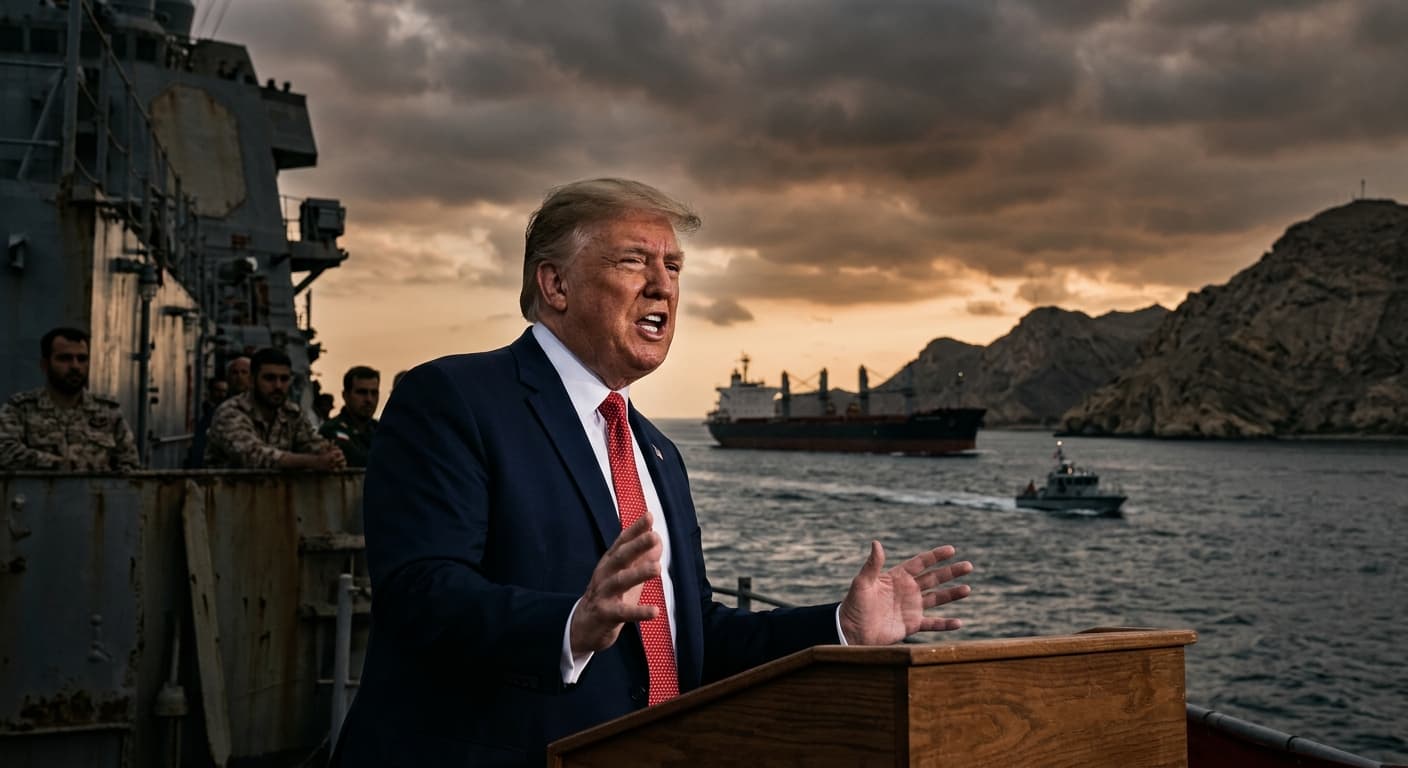
Trump's "Finish the Job" Threat Meets an Iran That Holds the Chokepoint
Trump warned Iran on July 7, 2026 that Washington will "finish the job" without a nuclear deal. The math of the Strait of Hormuz makes the threat harder to execute than it sounds.
President Donald Trump told reporters on July 7, 2026 that Iran must reach a nuclear deal or the United States will "finish the job" — a threat delivered as Ayatollah Ali Khamenei's coffin was still moving between Shia holy cities, and 40 days before the August 16 expiry of the memorandum of understanding both presidents signed at Versailles. The rhetoric is coercive theatre; the leverage has quietly shifted toward Tehran, because Iran's partial hold on the Strait of Hormuz — 38 tanker transits on July 2 versus roughly 130 before the war, according to Al Jazeera — is now the price Trump would pay for restarting a war he ended four months ago. That is why the likeliest outcome of the next six weeks is an extension of the 60-day track, not the second American air campaign Trump is threatening.
The setting matters. Trump's threat, made to reporters on Sunday and reported by Nikkei Asia, landed as millions filled Tehran's boulevards for Khamenei's funeral cortege — the largest mass gathering Iran has staged since the 1989 burial of Ayatollah Ruhollah Khomeini, choreographed by the regime around a single message of "resistance and revenge," per the
BBC. The Islamic Republic that emerged from the 12-day February–April war is battered, missing its founding-generation leader, and headed by an invisible successor. It is not, however, out of cards.
What Trump actually said, and why now
Trump has recycled the "finish the job" phrase since the war's opening weeks — Al Jazeera logged him deploying it on May 27, and the
BBC recorded a near-identical version on April 1 during the closing phase of Operation Midnight Hammer. Its function is domestic and negotiating, not operational: it disciplines his own hawks — Vice President JD Vance, Secretary of State Marco Rubio, congressional Republicans — while pressuring Iran's negotiators to concede before August 16.
The immediate trigger was the second round of indirect technical talks in Doha on July 1–2, which ended with Qatari and Pakistani mediators noting "positive progress" but no bridge on the three core sticking points: the fate of Iran's enriched uranium stockpile, the release of about $6 billion in frozen Iranian assets held in Qatari banks, and the future governance of the Strait of Hormuz. Al Jazeera's account of the Doha round quotes parliament speaker Mohammad Bagher Ghalibaf confirming that IAEA inspectors currently have access only to the Bushehr power plant and the Tehran research reactor — not to the bombed sites at Fordow, Natanz and Isfahan that the war was ostensibly fought over. Ghalibaf added that Iran's parliament had passed a law barring wider IAEA access, and the Supreme National Security Council had adopted a matching resolution — a domestic legal wall that no Iranian negotiator can lightly climb over.
That gap — between what Trump claims Iran committed to and what Tehran will actually let inspectors see — is the crux. IAEA Director General Rafael Grossi told the United Nations on June 18 that "technical work can begin," but conceded in Japan the following week that Iran's damaged facilities would only be opened "within the framework of a final agreement." Grossi has been reduced to saying the timing — "whether this happens the day after tomorrow, or in one week, or in 10 days" — matters less than the sequencing that Iran has already tied to sanctions relief. Trump's July 7 line is aimed at collapsing that sequencing before August 16.
The Versailles document is thinner than it looks
The primary text under threat is the June 17 memorandum of understanding, whose contents the White House has hailed as ensuring Iran "will never obtain a nuclear weapon." The full 14-point text, published by
NPR, commits Iran to "not procure or develop nuclear weapons" and to down-blend enriched uranium on site under IAEA supervision — a climbdown by Washington from its original demand that the material leave the country. In exchange, the memo suspends US sanctions on Iranian oil and chemical exports for 60 days, waives Hormuz transit fees, and gestures at a $300 billion "reconstruction and development" plan whose funding source, per the
BBC, "remains unclear."
The document Democratic senators warned about on the Senate floor lacks the two features that made the 2015 JCPOA durable for as long as it lasted. The Congressional Record for June 18 captures Senator Tim Kaine's dissection: no dispute-resolution mechanism, no snapback, and no enforceable limits on Iranian enrichment beyond the 60-day track. "That is not a dispute resolution mechanism," Kaine said of Trump's threats to resume bombing. "That is just, like: Well, let's just go back to war." The
House of Commons Library reached a similar reading, noting that the 60-day window applies only to talks, not to compliance verification.
That structural weakness is the real reason Trump's threat is loud. Without a snapback lever, "finish the job" is the only enforcement tool the president has publicly reserved. It is also the reason Tehran can extend the clock: the memorandum is explicitly "extendable with mutual consent."
The Hormuz math: why threats bind Washington too
The reason Trump's language is louder than his leverage lies in the shipping data. Before February 28, roughly 20 million barrels of oil moved through the Strait of Hormuz daily — about one-fifth of global supply. When Iran's IRGC began firing on unlicensed ships in March, the strait effectively closed. Brent crude briefly topped $126 in April. OPEC+ output collapsed from 42.77 million barrels per day in February to 33.13 million in May, according to Al Jazeera's reading of OPEC figures.
Since the June 17 memorandum, transits have crept back — but only partway. Al Jazeera reported traffic peaked at just over 70 crossings on June 24, then fell after two commercial vessels were attacked in incidents "widely blamed on Iran." Brent settled at $72 on July 6 — beneath the pre-war level, but only because Saudi Arabia has more than doubled shipping volume since June 17 and Iran has pushed close to 50 million barrels of previously stranded crude to market. Storage that filled during the blockade is now emptying; if the strait closes again, the buffer is gone.
The strategic implication is not subtle. A restarted air campaign would almost certainly close the strait again, this time from a lower baseline of global storage and after five months in which shipping insurance premiums have already rewritten trade routes. Energy analyst June Goh of Sparta told Al Jazeera that buyers and producers alike are "reducing reliance on the strait" through Saudi Arabia's East–West Pipeline, the UAE's Abu Dhabi Crude Oil Pipeline and the Iraq–Türkiye line — but their combined capacity is a fraction of the roughly 20 million daily barrels Hormuz used to carry. Trump's problem is that "finishing the job" means, in practice, accepting a second oil shock in a US midterm-election year.
The Council on Foreign Relations reached a similar conclusion in a July analysis: economic pressure on Tehran takes time to bite, while the ceasefire ends fast — an asymmetry that favours whichever side is willing to keep the strait contested. The BBC's
reporting from Bandar Abbas found Iranian officials openly saying that if the ceasefire breaks, "Iran would close the Strait of Hormuz for sure." That is not a negotiating pose; it is the doctrine of asymmetric warfare on which the Islamic Republic has staked its survival for four decades.
Iran's succession problem is Trump's negotiating problem
The domestic Iranian picture cuts the other way. The regime that Trump is threatening is genuinely brittle. Mojtaba Khamenei, the 56-year-old son named Supreme Leader in March by the Assembly of Experts, has not been seen in public since the February 28 strike that killed his father, his wife Zahra Haddad-Adel, and his 14-month-old niece. Al Jazeera reports, citing sources close to his circle who spoke to Reuters, that he sustained facial injuries and significant leg damage in the strike. Iranian officials cite continuing Israeli assassination threats — Defence Minister Israel Katz publicly reiterated on July 6 that any Iranian leader pursuing plans to destroy Israel "will be killed as well" — as the reason he communicates only through written statements.
That has two effects. It concentrates real negotiating authority in President Masoud Pezeshkian, Vance's counterpart Ghalibaf, and the central bank governor, all pragmatists who signed off on Versailles. And it makes concessions politically radioactive at home: any nuclear climbdown by an invisible Supreme Leader looks, to hardliners, like surrender by proxy. Iranian-American analyst Negar Mortazavi, quoted by Al Jazeera, called Mojtaba's public absence "certainly unusual" for a system whose "past two supreme leaders were visible and seen as top unifying figures."
Karim Sadjadpour, author of Reading Khamenei, put the paradox to the BBC bluntly: "The revolution he preserved was for a world which no longer exists." The regime survived, but its ideological software has not been rewritten to fit a post-war Iran that needs $6 billion in unfrozen assets and the notional $300 billion reconstruction fund more than it needs the physical rubble of Fordow.
The Gulf recalculation is where the story really shifts
The quiet losers here are not in Tehran or Washington. They are the Gulf mediators. Brookings scholar Jeffrey Feltman argues in a July analysis that the war has "exacerbated growing tensions" inside the GCC rather than uniting it. The UAE, hit by more than 3,000 Iranian missiles and drones — more than all other GCC states combined — has moved decisively toward Israel, reportedly accepting an Iron Dome battery and pushing hardest for Iran to "pay a high price." Saudi Arabia is moving the other way: distancing itself from Israel, blocking Trump's efforts to make Abraham Accords accession "mandatory," and, per AFP reporting cited by the BBC, quietly preparing a Riyadh-hosted "reconciliation summit" with Tehran.
That split matters because the July 7 threat sits inside a Gulf order that no longer speaks with one voice. Carnegie's analysis describes "a Saudi-led axis that favours diplomacy with Iran, versus an Emirati team that wants the United States and Israel to 'finish off' the Islamic Republic." Trump's rhetoric aligns with Abu Dhabi; his diplomacy, run through Steve Witkoff and Jared Kushner via Doha and Islamabad, aligns with Riyadh. He cannot have both. Emirati diplomatic adviser Anwar Gargash's unusually blunt May 19 social-media post — complaining that "the victim's role has merged with that of the mediator" — is now the Gulf's operating grievance.
The OSW Centre for Eastern Studies noted that the 14-point Versailles memorandum was drafted by Qatar and Pakistan — not by American negotiators — and that the "deconfliction cell" now managing Lebanon includes Islamabad and Doha but excludes Israel and Hezbollah. The diplomatic architecture Trump is now threatening to blow up is not his to unilaterally rebuild.
Diplomat View
The base case, on current evidence, is not war. It is a technical extension of the 60-day window past August 16, papered over as a "phased implementation" of the memorandum, with a partial IAEA visit to a non-sensitive site — probably Isfahan's civilian components — traded for release of the $6 billion in Qatari-held funds. Trump takes credit for a "deal"; Tehran concedes nothing on Fordow's rubble. This forecast changes if either of three things happens: a second confirmed Iranian attack on shipping in Hormuz shifts the political cost calculus in Washington; Mojtaba Khamenei dies or the Assembly of Experts is forced to move again, collapsing negotiating authority; or Israel launches unilateral strikes, dragging the US in. The Emirati push for exactly that outcome is the single most under-priced risk in the current market. Watch Abu Dhabi, not Tehran.
What to watch next
- August 16, 2026 — expiry of the 60-day MoU window; extension by "mutual consent" is the default, but requires an Iranian signature Mojtaba has never publicly given.
- Next Doha round — Qatar's foreign ministry has said the follow-up meeting will be scheduled "as soon as possible after the conclusion of the funeral processions," which end July 9 in Mashhad.
- Riyadh reconciliation summit — if AFP's report of a Saudi-hosted GCC–Iran meeting materialises before August, it reframes the negotiating table above Trump's head.
The Bottom Line
Trump's "finish the job" threat is aimed at Tehran but constrained by Riyadh, Abu Dhabi and the oil price. The Islamic Republic that buried Ali Khamenei this week is weaker at home than at any point since 1989 — but stronger in the Strait of Hormuz than the White House can politically afford to test twice in one year. Expect an extension, not an escalation.
Discover more
Global Politics
Xi Jinping Calls China-Russia Ties 'Precious'
Xi Jinping's description of China-Russia ties as 'precious' reflects a strategic imbalance, with Beijing dictating terms in the partnership.
US Politics
Virginia's Redistricting Referendum
Virginia's redistricting referendum is drawing a flood of dark money, shaping future elections and the fight for congressional control amid party stakes.

US Politics
House Ethics Committee Pushes Sexual Miscond.
The House Ethics Committee has shifted responsibility for sexual harassment settlement records to the Office of Congressional Workplace Rights, complicating disclosure efforts.

Conflict & Security
Drone Warfare Killing Aid Workers at Unprec
Over 1,000 humanitarian workers killed in three years as cheap armed drones collapse legal protections. Gaza, Sudan, Ukraine, and DRC see deliberate targeting of aid convoys and hospitals with zero prosecutions.