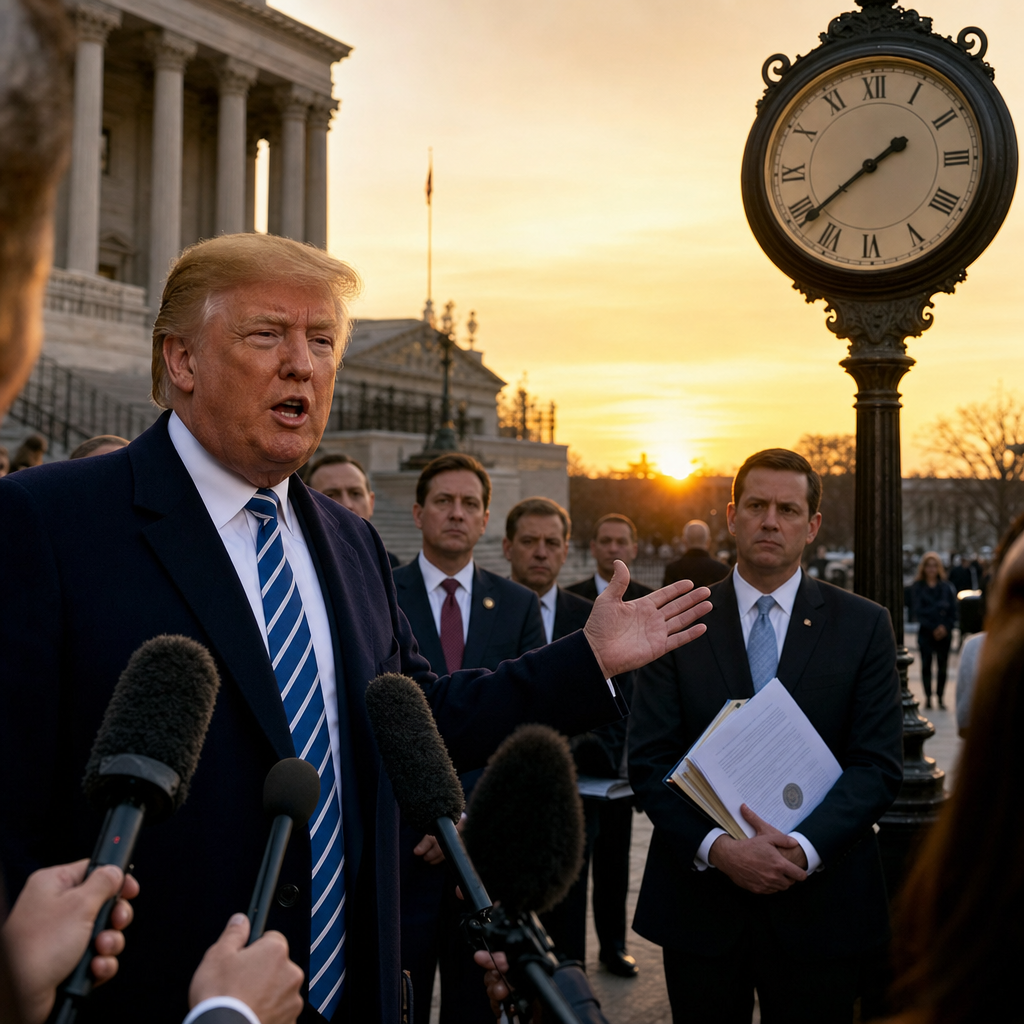
Trump’s clock fight gives states leverage
19 states have passed standby laws for permanent daylight saving time, but only Congress can turn them on — and House Republicans are using Trump’s push to press the issue.
President Donald Trump is trying to turn a recurring nuisance into a political win. After the House Energy and Commerce Committee folded the Sunshine Protection Act into a broader transportation package and advanced it by 48-1, Trump wrote on Truth Social that he would “work very hard” to make permanent daylight saving time law, calling clock changes costly and popular to end ( The Hill;
  The Washington Post). The power dynamic is simple: Congress controls the switch, and the White House is using that leverage to sell a low-friction, high-visibility policy win.
Why the states matter
Nineteen states have already passed laws saying they would adopt year-round daylight saving time if federal law allows it, with Maine and Texas joining the list last year, according to The Hill (The Hill). Florida was first in 2018. The point of those state laws is not immediate change; it is position-taking. These legislatures are signaling to Congress that they are ready to move the moment Washington clears the legal barrier.
That barrier is real. Under current law, states can already stay on standard time year-round, which is why Hawaii and most of Arizona never spring forward. But states cannot unilaterally lock into daylight saving time without a change to federal law (The Hill; The Washington Post). In practice, that means the states that have passed standby bills are waiting on Congress to do what they cannot.
The politics are bigger than the clocks
This is not really a time policy story; it is a coalition-management story. Trump gets to claim he is solving an annoyance that cuts across party lines, and House Republicans get to attach it to a larger bill instead of forcing a standalone vote that would expose divisions. That is why the committee markup matters more than the slogan. A 48-1 committee vote suggests there is enough Republican discipline, and at least some bipartisan cover, to keep the issue alive in the House (The Hill; The Washington Post).
The beneficiaries are obvious: Trump, who can frame this as a consumer-friendly reform; Florida Republicans like Rep. Vern Buchanan, who introduced the bill; and state lawmakers in places like  United States politics-heavy battlegrounds who can show action without having to deliver the final legal change themselves. The losers are lawmakers who prefer permanent standard time, health groups skeptical of year-round daylight saving time, and states that have already legislated for the change but remain trapped by federal inertia.
What to watch next
The immediate question is whether the transportation package survives committee and reaches the House floor in a form that can attract enough support to matter. If it does, the real test shifts to the Senate, where time-change bills have died before despite periodic bipartisan attention (The Hill; The Washington Post). If Congress does nothing, the fallback is unchanged: clocks go back again on November 1.
For now, the states are ready. The question is whether Washington wants to actually hand them the keys.