Trump's Lebanon Ceasefire: A Political Maneu
Analyzing the implications of Trump's ceasefire in Lebanon
Model Diplomat10 min readMiddle East
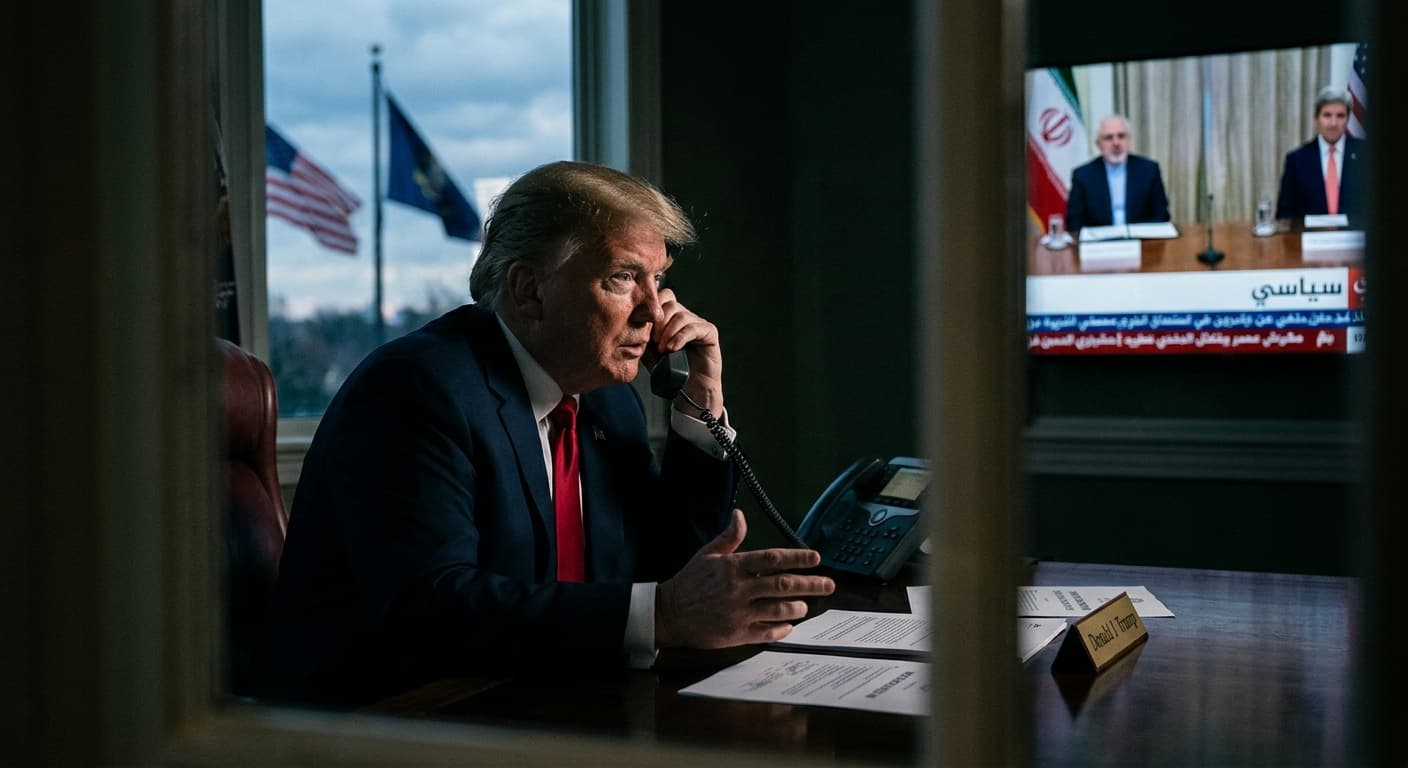
Trump's 10-Day Lebanon Ceasefire Was Never About Lebanon
Trump's April 16 Israel-Lebanon ceasefire, and the June 26 framework that replaced it, redefined Lebanese sovereignty around Hezbollah disarmament — and shielded the US-Iran deal.
The 10-day ceasefire between Israel and Lebanon that Donald Trump announced from Washington at 5 p.m. EST on April 16, 2026, was engineered to protect one thing: the parallel US-Iran memorandum of understanding whose talks were collapsing as Hezbollah and the Israel Defense Forces (IDF) killed each other along the Blue Line. Nearly three months later, that architecture has held for Washington and Tehran — but at the cost of a June 26 trilateral framework that ties Lebanese sovereignty to Hezbollah's disarmament, legitimizes Israel's continued occupation of roughly 6% of Lebanese territory, and leaves at least 4,246 Lebanese dead since March 2. The ceasefire worked as leverage. It has not worked as peace.
The deal, and what Trump actually bought
Trump announced the truce on Truth Social on April 16, declaring that Israeli Prime Minister Benjamin Netanyahu and Lebanese President Joseph Aoun had agreed "to formally begin a 10 Day CEASEFIRE at 5 P.M. EST." According to the BBC, Netanyahu confirmed Israel's participation but said troops would maintain a 10-kilometre-deep "security zone" in southern Lebanon: "We are there, and we are not leaving." A separate
BBC report documented that the announcement blindsided Israel's own security cabinet, which Netanyahu convened "with just five minutes' notice" and without a vote on the terms.
The State Department release accompanying the truce framed it as a "gesture of goodwill" enabling "good-faith negotiations." It preserved Israel's right "to take all necessary measures in self-defence, at any time, against planned, imminent, or ongoing attacks," and required Lebanon to prevent Hezbollah "and all other rogue non-state armed groups" from firing on Israel, per the BBC's summary of the terms. Hezbollah, though not party to the deal, signalled conditional acceptance while demanding "a comprehensive halt to attacks" across Lebanon.
The Council on Foreign Relations named the real driver in its April 17 brief: the ceasefire "removes a critical obstacle to U.S.-Iran peace talks, as Tehran said any truce must also halt fighting between Israel and Hezbollah." CFR expert Steven Cook wrote separately that "Iranian leaders don't want Lebanon to slip from its grasp and become the next Arab country to normalize relations with Israel."
Trump extended the truce by three weeks on April 23. As the BBC reported at the time, the extension followed the first direct high-level Israel-Lebanon contact in three decades, and Trump publicly committed Washington to "working with Lebanon to help it protect itself from Hezbollah." That framing — Washington as guarantor against Hezbollah, not as mediator between two states — is the language that would define every subsequent iteration of the deal.
The framework: Lebanon disarms first, Israel withdraws maybe
The 10-day pause was scaffolding. The load-bearing document is the Trilateral Framework signed in Washington on June 26, 2026. Its central bargain is stated in a single sentence of the State Department text:
"The Government of Israel and the Government of Lebanon commit to a reciprocal, sequenced process, with clear conditions, whereby the LAF will restore effective sovereign authority over all Lebanese territory, pending the verified disarmament of non-state armed groups and dismantlement of associated infrastructure, enabling the Israel Defense Forces (IDF) to progressively redeploy out of the Lebanese territory."
Read literally, the framework inverts the diplomatic logic Lebanon has held since Taif in 1989. The Arab Center's Doha Institute concluded that the framework "replaces the official Lebanese demand for an Israeli withdrawal with an obligation on the Lebanese state itself: that it disarm Hezbollah first, as a condition for Israel's withdrawal." Sovereignty, historically tied in Lebanese political discourse to ending Israeli occupation, is now tied to disarming Hezbollah — with Washington as verifier.
The Institute for National Security Studies in Tel Aviv reads the same document as a strategic win for Israel: "commitment to its primary demand — the disarmament of Hezbollah — alongside agreement on a concrete framework for achieving this objective under close U.S. supervision," plus "implicit agreement that the IDF may, for the time being, continue to maintain a presence in the buffer zone." Two initial "pilot zones" in the Nabatieh region were mapped by Netanyahu at a June 27 press conference, per INSS.
Hezbollah Secretary-General Naim Qassem rejected the framework outright the next day, calling it "humiliating, shameful and a surrender of sovereignty" and vowing that "we will continue as a resistance in the field to defeat the occupation," according to Al Jazeera. Hezbollah MP Hassan Fadlallah warned any Lebanese army attempt to enforce Washington's terms would produce "civil war." An Al Jazeera
explainer quoted Israeli former ambassador Alon Pinkas as "very doubtful and sceptical that this will work out because the deal is between Israel and Lebanon with the US; the issue here is Hezbollah."
Who won, who lost, who is paying
Three actors gained; two absorbed the cost.
Trump won a diplomatic deliverable. By linking the April 16 truce to the US-Iran Memorandum of Understanding signed June 15, the White House converted a stalled Middle East file into a signed regional architecture. The framework's final point records both Israel and Lebanon's "deep appreciation for the vision and leadership of President Donald J. Trump," per the BBC's read of the text. US Secretary of State Marco Rubio publicly called the deal a "first step."
Netanyahu won time and terrain. The Center for Strategic and International Studies observed that "Netanyahu's timetable is more urgent and short-term. He needs to show results in the here and now as he is facing a tight reelection campaign." He got a diplomatic photograph without withdrawing troops. Israel currently occupies roughly 6% of Lebanese territory and, per Defense Minister Israel Katz on June 27, has instructed forces to prepare for an "extended stay" in the security zone.
Aoun and Salam won a narrative. For a president and prime minister who ran as reformists, the framework offers a US-backed pathway Beirut could not have engineered alone. Chatham House has argued that "the choice" facing Aoun and Salam is not whether to confront Hezbollah but whether "the US loses interest in Lebanon" if they fail to move. The June 26 signing bought them Washington's continued attention.
Hezbollah and Iran lost their veto on Lebanese state policy. CSIS's assessment is sharp: since early 2025 the IRGC and Hezbollah "have lost their ability to determine Lebanese state policy," even as they retain the capacity to determine battlefield dynamics. Carnegie's Michael Young argued in November 2025 that "the so-called Axis of Resistance has been severely crippled, with Hamas now incapable of using Gaza as a platform to attack Israel, Syria lost, and Hezbollah completely isolated in Lebanon."
Southern Lebanon paid. Per Lebanon's Ministry of Public Health, at least 4,246 people have been killed and 12,190 wounded since March 2, 2026. UN OCHA's Flash Update #35 recorded 131,200 people in 644 collective shelters on June 15, with nearly a million displaced. By June 25,
OCHA Flash Update #38 reported that shelter caseloads had fallen to 59,700 and more than 523,000 people had begun returning — though returns remained "cautious and often temporary." Aoun said on July 6 that "Israeli occupation prevents the deployment of the army" and continues to keep
more than 600,000 Lebanese from returning home.
The historical parallel Lebanese politicians are naming
Parliamentary Speaker Nabih Berri publicly compared the framework to the 17 May 1983 Agreement — a US-brokered Israel-Lebanon accord signed under IDF occupation during the civil war, abrogated by Beirut within a year under Syrian and domestic pressure. According to the Al Jazeera Centre for Studies policy brief, Berri called the 2026 framework "worse than" 1983 and predicted it "would never be implemented." Walid Jumblatt separately criticised the framework for "effectively sidelining the 1949 Armistice Agreement" — the legal anchor of Lebanese-Israeli relations for 77 years.
The same brief argues the document "goes beyond all previous accords Lebanon has signed with Israel — including the 1949 Armistice Agreement, the 'May 17 Agreement' of 1983… and even the November 2024 agreement that concluded a 66-day war." The November 2024 ceasefire is the closest analogue: it also called for Hezbollah disarmament south of the Litani; Israel then conducted near-daily strikes in what the BBC described as continued targeting of "people allegedly linked to Hezbollah." That template — an agreement Israel treats as authorising ongoing operations — is the pattern southern Lebanese residents cite as reason for scepticism about the June 26 deal.
France's IRIS institute described the June 3 iteration as an asymmetrical ceasefire whose "asymmetrical demands and… ambiguities… deepen Lebanese divisions" and "reinforce Israeli positions" rather than the Lebanese state's. That analytical convergence — Doha, Paris, Tel Aviv reading the same text and reaching adjacent conclusions about who benefits — is unusual.
The second-order effects
Sectarian pressure inside Lebanon is now the axis of the story. On July 5, Netanyahu told Fox News that Lebanese Christian villages had "requested Israeli annexation." A coordinated statement from the mayors and municipal councils of those villages, released July 6, refuted the claim. Middle East analyst Karim Bitar, quoted by Al Jazeera, described the comments as "clearly intended to sow civil strife in Lebanon… a decades-old divide-and-conquer strategy." A June 2026 poll of 1,000 Lebanese by Lebanese American University professor Jad Melki, cited in the same report, found 87% agreed with the view that Israel is "an enemy of the Lebanese" — a domestic ceiling on how far the framework can be politically sold.
Rights groups say the framework abandons war-crimes accountability. According to Al Jazeera, the deal's clause on "cessation of all hostile or adverse actions in international political or legal fora" effectively closes the door on Lebanese state efforts to pursue Israel in international courts — a concession critics describe as betraying victims.
LAF capacity is the framework's structural weakness. INSS's own assessment concedes the LAF "remain at a disadvantage vis-à-vis Hezbollah, even in its current weakened state… lacks both the will and the capability to confront Hezbollah." LAF commander Rodolphe Haykal has repeatedly warned, per IRIS, that any coercive disarmament of Hezbollah through the army carries risk of civil war. On May 21, the US Treasury sanctioned two Lebanese officers accused of passing information to Hezbollah — a signal Washington reserves the right to reshape the LAF itself. UN OCHA's Flash Update #24 recorded that the Lebanon Flash Appeal was funded at only 38% (approximately US$117 million of US$308 million required) as of May — a fiscal environment in which LAF expansion depends almost entirely on US and Gulf disbursements Washington controls.
The Iran linkage that no one is fully saying out loud
The unspoken architecture: Lebanon's ceasefire and the US-Iran MoU are load-bearing on each other. Iran's ambassador to the UN in Geneva, Ali Bahreini, told reporters in early June that "Lebanon is an unquestionable part of the agreement, and whatever happens in Lebanon affects the whole process," according to the BBC. When Israeli strikes on Nabatieh killed 47 people on June 19 — per Lebanon's health ministry, cited in
Al Jazeera's coverage — US-Iran talks on cementing the MoU were suspended the same day.
That is the dependency Trump's Lebanon diplomacy is really managing. Every Israeli strike on the Bekaa or Nabatieh threatens the MoU. Every Hezbollah rocket does the same. The June 26 framework is Washington's attempt to hardwire that dependency into a document — with the LAF, not Israeli or Hezbollah restraint, as the enforcement mechanism.
The June 4 conditional ceasefire previewed the pattern. Al Jazeera noted that between the April truce and the June deal, "more than 600 people have been killed in Israeli strikes across Lebanon while Israel has expanded its military presence in the south of the country, now occupying about one-fifth of the country" at peak — with Israel's defence minister publicly insisting operations would continue.
What to watch
- The pilot zones. Two zones in Nabatieh have been mapped. First measurable test: whether the LAF actually deploys "to the exclusion of all non-state actors," and whether the IDF actually redeploys after. INSS expects this to unfold over months, not weeks.
- Hezbollah's operational response. Qassem has committed to "resistance in the field." Watch for calibrated attacks against IDF forces inside Lebanon designed to test the framework's self-defense clause without triggering full war. An
Israeli drone strike on July 6 that killed at least four people, including a married couple, is the kind of incident that will define whether the framework's ambiguities produce a slow-motion war of attrition.
- Netanyahu's election calendar. CSIS notes he "needs to show results" ahead of a tight reelection. Expect Israeli announcements of "disarmament progress" timed to Israeli political needs, not verification realities.
- The next Beirut strike. A single Israeli strike on Beirut's southern suburbs of the magnitude of June 14 (three killed, 16 injured) or June 19 (47 killed) will re-test the US-Iran MoU. Iran's foreign ministry has stated the MoU applies to "all fronts."
- October 7 commission bill. The Knesset gave first-reading approval on July 6, per Al Jazeera's live blog, to a commission of inquiry into October 7 security failures. A finding that implicates Netanyahu personally would reshape his willingness to make Lebanese concessions.
- LAF funding. The Lebanon Flash Appeal remained underfunded at 38% as of May, per OCHA. Whether Gulf states and the US actually disburse the equipment and training pledged in the framework's Security Annex will determine whether the LAF ever reaches the capacity the deal presumes.
The Bottom Line
Trump's 10-day ceasefire was not a Lebanese peace initiative — it was Iran-deal insurance dressed as one, and the June 26 Trilateral Framework has locked that logic in by making Lebanese sovereignty conditional on disarming Hezbollah rather than ending Israeli occupation. The framework hands Netanyahu terrain and time, hands Washington a signed document, and hands Beirut a task the Lebanese Armed Forces cannot execute without risking the civil war its own commander has warned against. If it holds, it will be because Hezbollah is too weak to break it — not because Lebanon is strong enough to enforce it.
Discover more

US Politics
SNAP Food Assistance Faces Legal Challenges
In 2026, SNAP faces stricter eligibility rules and mounting legal challenges, threatening food assistance for the millions of Americans who rely on the program.

International Relations
Pakistan's Key Role in US-Israel-Iran Meddle
Pakistan is seeking to mediate the US-Israel-Iran conflict, balancing high-stakes diplomacy against severe economic pressures and steep regional challenges.

US Politics
House Ethics Committee Pushes Sexual Miscond.
The House Ethics Committee has shifted responsibility for sexual harassment settlement records to the Office of Congressional Workplace Rights, complicating disclosure efforts.

Economics
Fed's Amex AML order puts correspondent banking on notice
Federal Reserve's Amex AML order requires board-level controls and a 90-day plan; OCC fined the bank $350 million over enterprise-wide deficiencies.