Trump's AI Regulation Sparks GOP States' Rift
Trump's executive order on AI laws fractures Republican unity.
Model Diplomat8 min readUnited States
Trump's AI Order Splits GOP Statehouses From White House
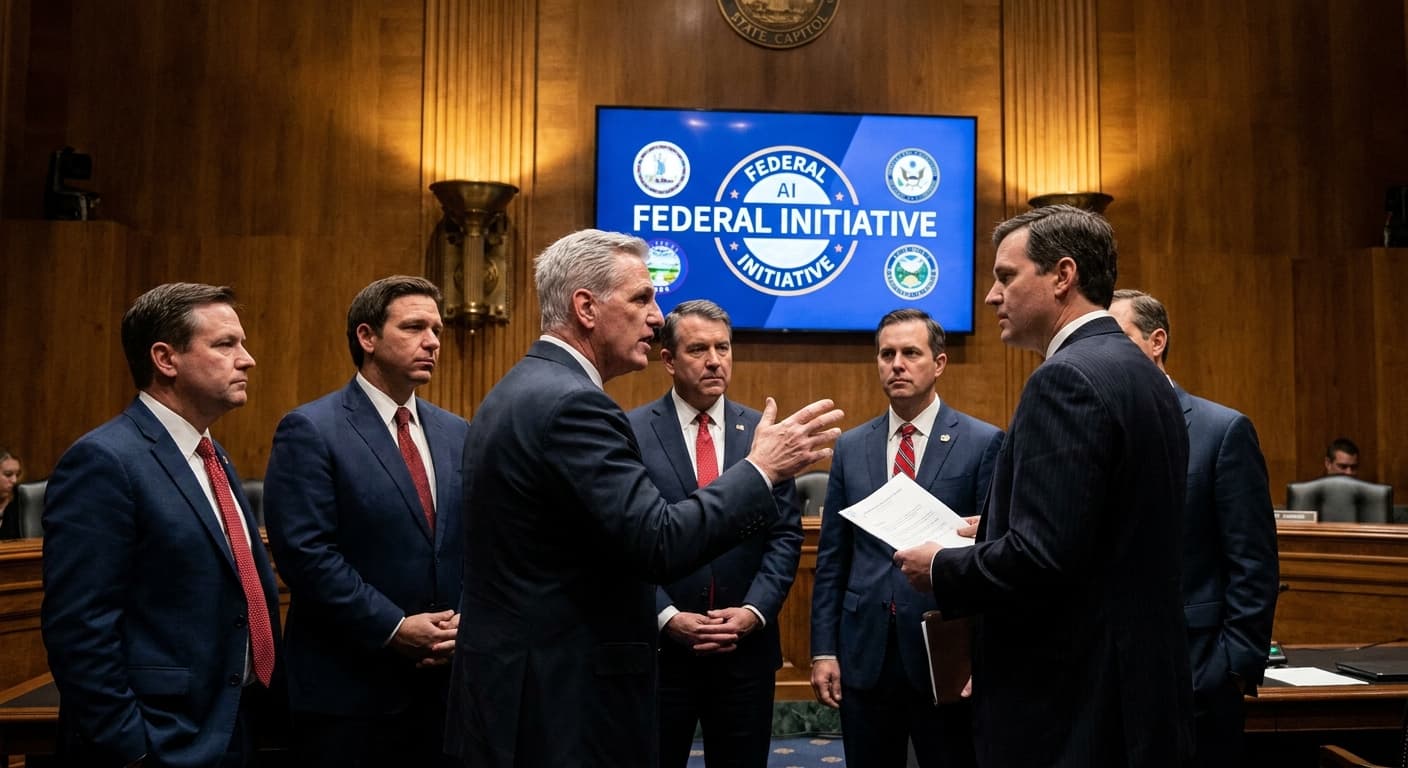
Trump's December 2025 executive order aimed at state AI laws has fractured his own party, with Republican governors and senators defending state authority as the Justice Department readies lawsuits.
Six months after President Donald Trump signed Executive Order 14365 on December 11, 2025, ordering the Justice Department to sue states over "onerous" artificial-intelligence laws, the coalition he needs to make preemption stick is coming apart from the inside. Republican governors in Florida and Utah, GOP senators in Tennessee and Missouri, and Republican state legislators from Pennsylvania to Texas have kept passing — or defending — the very laws Trump's DOJ is now telling them to repeal. The thesis: Trump has the executive pen, but he has lost the Republican statehouses, and without them his 50-state preemption strategy cannot survive either Congress or the courts. The reason it matters is second-order: the same MAGA-aligned Republicans defying him on AI are teeing up a durable, bipartisan state-regulation regime that will outlast his term regardless of what the Supreme Court says.
What the order actually does — and why it is legally thin
The text of the order, published in the Federal Register on December 16, 2025, does two operational things and one rhetorical one. Section 3 creates an "AI Litigation Task Force" inside DOJ "whose sole responsibility shall be to challenge State AI laws," on theories including dormant-commerce-clause violations and federal preemption, according to the Federal Register text. Section 7 directs the Federal Trade Commission to issue a policy statement declaring that state laws requiring "alterations to the truthful outputs of AI models" are preempted by the FTC Act. Section 8 tasks the White House with drafting federal legislation that would formally preempt conflicting state laws.
The rhetorical piece is the carve-out. Trump's order explicitly refuses to preempt state laws on child safety, data-center permitting, or state procurement of AI — a concession the CSIS analysis called "a clear indication that the administration recognizes just how much political traction these issues have at the state level." That is not a drafting choice. It is a political retreat written into the order before litigation has even started.
The legal foundation is unstable. As Brookings analysts noted in a March 2026 analysis, the dormant commerce clause "primarily bars economic protectionism," and most state AI laws apply equally to in-state and out-of-state developers. The FTC's Section 5 authority does not preempt state law by "mere assertion." And the FCC's statutory writ "is limited specifically to the communications industry" — not general-purpose AI. That is why Trump himself, in a Truth Social post the week before signing, acknowledged only Congress could deliver a real preemption. Florida Governor Ron DeSantis said the quiet part out loud on X the same day: "An executive order doesn't/can't preempt state legislative action,"
as NPR reported.
The vote that reframed everything: 99–1
The reason the executive order exists at all is that Trump lost in Congress — twice, with his own party. In July 2025, the Senate stripped a 10-year moratorium on state AI laws out of the One Big Beautiful Bill Act by a vote of 99 to 1, an almost unheard-of margin against a president's signature package. A December 2025 attempt to slip a similar preemption clause into the FY2026 National Defense Authorization Act failed the same way, according to CSIS. The leaders of both defeats were Republicans: Tennessee's Marsha Blackburn, Missouri's Josh Hawley, and — publicly and repeatedly — Georgia's Marjorie Taylor Greene.
That vote count matters because it tells the DOJ's new task force exactly how thin its political cover is. The Justice Department is now being asked to sue states over laws that a bipartisan Senate refused to preempt when it had the chance. Every Republican attorney general or governor whose state gets sued can — and will — cite that 99–1 vote as evidence the administration is trying to do by lawsuit what it could not do by law.
The revolt inside the tent
The defections are not scattered. They are structural.
DeSantis is the loudest. His "AI Bill of Rights," parts of which cleared the Florida Senate in February 2026, requires parental consent before minors interact with companion chatbots, mandates that bots identify themselves as non-human, and bans unauthorized use of a person's name, image, or likeness — provisions reported by NPR as running "in a different direction" from the White House. "I really fear that if this is not addressed in an intelligent and proper way," DeSantis told reporters, "it could set off an age of darkness and deceit."
Utah Governor Spencer Cox has been blunter. Ahead of Trump's signing, he posted that "states must help protect children and families while America accelerates its leadership in AI." In an NPR interview, Cox drew the analogy that unnerves Republican state officials most: social-media companies, he argued, "used this incredible tool to utterly destroy our kids and our families," and "AI is going to be even worse." That is not libertarian talking-point language. That is the language of politicians who have watched Section 230 preemption define a generation of technology policy and do not intend to repeat it.
State lawmakers below the governors are already moving. Pennsylvania Republican State Senator Tracy Pennycuick, sponsor of the SAFECHAT Act, told NPR she is "mildly interested in what the federal government's doing at this point." Utah Republican Doug Fiefia, whose child-safety transparency bill was killed after what he described as a "one-line memo" from the Trump administration, is now among the more vocal critics. Texas State Senator Angela Paxton, a Republican whose state enacted the Responsible AI Governance Act effective January 1, 2026, told NPR: "When you have no regulation, what you have is the wild west."
The volume problem — and why the states keep winning it
The administration's argument is a patchwork one: 50 rulebooks kill innovation. The numbers are real. According to the National Conference of State Legislatures, cited by the BBC, 38 states adopted roughly 100 AI regulations in 2025 alone, out of more than 1,000 AI-related bills introduced. Brookings' own tracking put the total at 386 bills across all 50 states in the 2025 sessions,
per its March 2026 paper.
But the raw count masks convergence. Carnegie Endowment analyst Scott Singer noted in a February 2026 assessment that New York's RAISE Act "directly copies the text" of California's SB-53 in its key definitions, applying the strictest requirements to models trained on more than 10^26 FLOPS and companies with more than $500 million in annual revenue. Michigan and Utah have introduced transparency bills that overlap materially. "Many observers feared last year that an explosion of state legislation on AI would create a thicket," Singer wrote. "So far, that has largely not come to pass."
The American Enterprise Institute, hardly a proponent of state overreach, reached a similar conclusion: most enacted state laws target "high-risk applications where harms are already understood — fraud, misleading advertising, or deceptive practices — rather than attempting to regulate AI in the abstract." Colorado's algorithmic-discrimination law — the one Trump singled out by name in the EO's preamble as "forcing AI models to produce false results" — takes effect June 30, 2026, and applies to consequential decisions in hiring, credit, and insurance. It is not a moratorium on AI. It is a due-process statute.
Congress is the tell
Blackburn's response — introducing the awkwardly titled TRUMP AMERICA AI Act (short for "The Republic Unifying Meritocratic Performance Advancing Machine Intelligence by Eliminating Regulatory Interstate Chaos Across American Industry Act") in April 2026 — reveals where this actually lands. Her section-by-section summary preempts state laws only where they regulate frontier developers' management of catastrophic risk. Section 24 explicitly preserves "any generally applicable law, including a body of common law or a scheme of sectoral governance that may address artificial intelligence."
Read that against H.R. 5388, the House vehicle whose text on Congress.gov imposes a five-year moratorium on state laws "limiting, restricting, or otherwise regulating" AI systems in interstate commerce, and the fissure is obvious. The Senate Republican leading the president's own bill is drafting narrower preemption than the House Republicans, which is narrower still than what the White House asked for in its
March 20, 2026 legislative recommendation. Each downshift is a concession to the same GOP state officials the DOJ is now threatening to sue.
What to watch
- The first DOJ lawsuit. The Litigation Task Force stood up in mid-January 2026 under EO Section 3. Colorado's AI Act became enforceable June 30, 2026. A test case, likely on dormant-commerce-clause grounds, is the next domino. If DOJ leads with Colorado rather than California, that signals it is picking legally weak but politically softer targets.
- The FTC policy statement. Due 90 days after the EO — the deadline slipped past mid-March 2026. Its issuance, or non-issuance, tells you whether Chair Andrew Ferguson is willing to stretch Section 5 as far as the White House wants.
- Blackburn's markup. If the TRUMP AMERICA AI Act moves out of the Senate Commerce Committee before the August recess, preemption becomes real. If it doesn't, the executive order is all Trump has — and the courts are unlikely to give him more.
- The 2027 legislative sessions. Roughly 40 states convene in January. Every AI bill filed after DOJ's first lawsuit is a referendum on federalism, not technology policy.
Diplomat View
The Trump administration is fighting a battle it has already lost politically and is likely to lose legally, and it is doing so because the alternative — admitting Congress will not deliver preemption — would concede the AI-policy field to states his own party controls. The forecast: DOJ's first Litigation Task Force suit fails at the district-court level on dormant-commerce-clause grounds within 12 months, the FTC policy statement is enjoined or narrowed by a federal court by mid-2027, and Blackburn's bill passes the Senate only after being stripped of its broadest preemption language — leaving a federal floor that supplements, rather than displaces, state law. This forecast revises if the Supreme Court takes an early AI preemption case and its conservative majority resurrects the "excessive burden" prong of Pike v. Bruce Church, or if Republicans expand their Senate majority enough in the 2026 midterms to jam through the House-style moratorium. Watch DeSantis: if a serious presidential contender keeps signing state AI bills through 2027, the intra-party debate is settled — the states won.
The Bottom Line
Trump's December 2025 executive order was supposed to consolidate AI authority in Washington. Instead, it exposed that a bipartisan majority — including the president's most vocal Senate allies and his most plausible successor in Tallahassee — believes states should keep the pen. The AI-preemption fight is now less a Trump-versus-blue-states story than a White House-versus-Republican-federalism story, and the White House is losing it.
Read more on US Politics.
Discover more
Conflict & Security
De la Espriella's Razor Win Resets US-Colomb
De la Espriella's razor-thin election win signals a reset in US-Colombia relations, reshaping security ties and the agenda under a Trump-aligned approach.
International Relations
Colombia's Razor-Thin Rightward Pivot
Colombia swings right as Abelardo de la Espriella narrowly wins the presidential runoff by under one percent, exposing a deeply divided and polarized nation.
Global Politics
Iran Demands US Enforce Ceasefire
Iran insists the United States must enforce a ceasefire in Lebanon to uphold the memorandum of understanding, raising pressure on Washington and Netanyahu.

Conflict & Security
Trump's Iran Deal Faces Bipartisan Backlash
Trump's Iran deal draws fierce criticism from both Republicans and Democrats, exposing deep political divides over the ceasefire and the terms of the agreement.