Trump's AI Regulation vs. Utah GOP Lawmaker
Utah's Doug Fiefia challenges Trump's AI strategy.
Model Diplomat8 min readUnited States
Trump's AI Preemption Push Meets a Utah GOP Rebellion
Trump's December 2025 executive order created a DOJ task force to sue states over AI laws. Utah Republican Doug Fiefia is testing how far the White House will go.
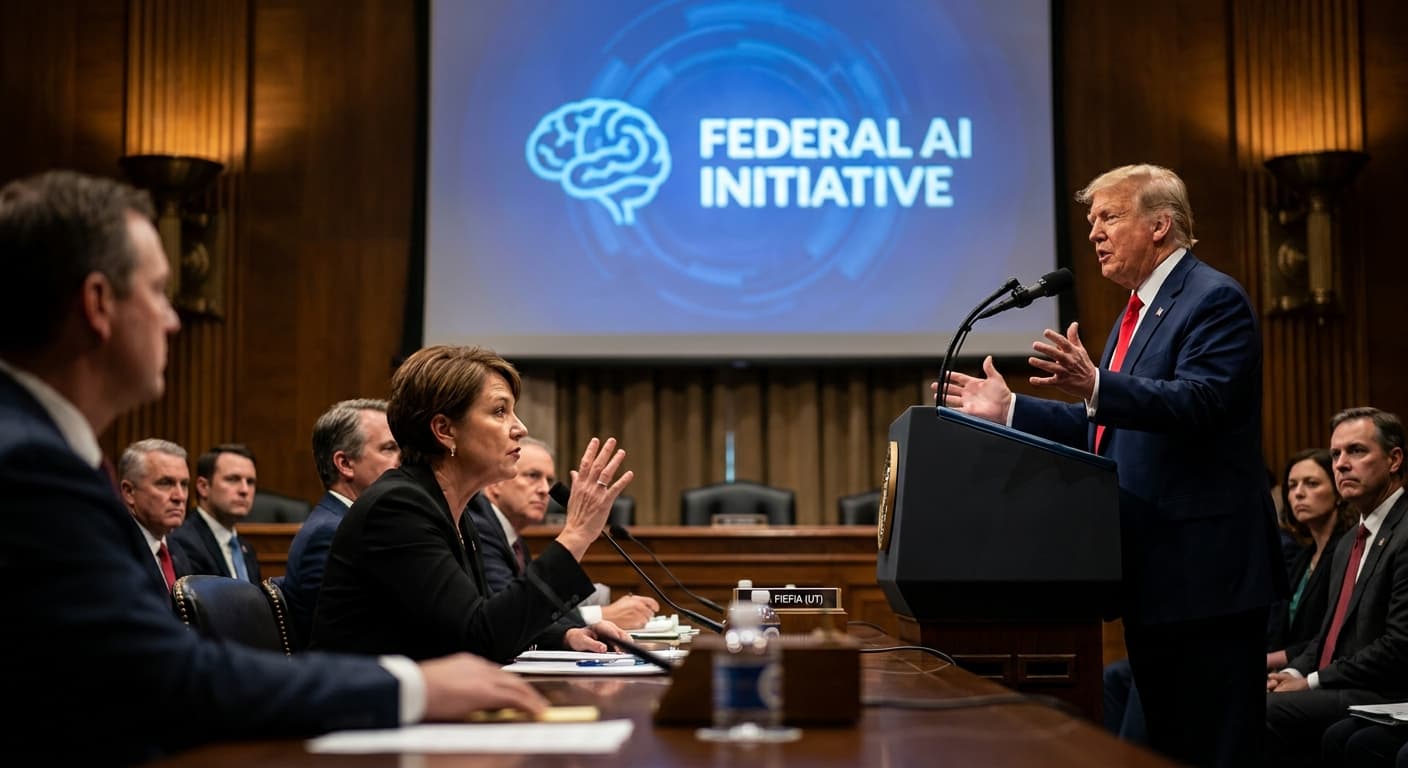
A single-line memo from the White House Office of Intergovernmental Affairs, dated February 12, 2026, declared the Trump administration "categorically opposed" to House Bill 286, a child-safety bill written by a first-term Republican named Doug Fiefia. Six weeks later the bill was dead, never brought to a floor vote, and the confrontation had exposed something more consequential than a state fight over chatbots: Trump's AI preemption strategy now depends on killing Republican bills in Republican states, one at a time, because he cannot get Congress to do it for him.
The Senate stripped a 10-year moratorium on state AI laws out of the One Big Beautiful Bill Act by a vote of 99 to 1, according to a CSIS analysis of the administration's subsequent executive order. A follow-up attempt to insert similar language into the 2026 National Defense Authorization Act also failed. What Congress refused to pass, the White House is now trying to accomplish through litigation threats, conditional federal grants, and direct pressure on GOP state legislators. Fiefia — a former Google account manager turned state representative from Herriman — is the first test case.
The executive order that skipped Congress
Executive Order 14365, signed December 11, 2025, is the operative document. Its text, published in the Federal Register, directs the Attorney General within 30 days to establish an "AI Litigation Task Force" whose "sole responsibility shall be to challenge State AI laws" deemed to unconstitutionally regulate interstate commerce or conflict with federal policy. Section 5 goes further: it instructs the Commerce Department to make states with "onerous" AI laws ineligible for non-deployment funding under the $42 billion Broadband Equity Access and Deployment program, and tells every federal agency to review whether discretionary grants can be conditioned on states agreeing not to enforce their AI statutes.
The order singles out Colorado's algorithmic discrimination law by name, warning it "may even force AI models to produce false results" to avoid disparate impact on protected groups. The White House fact sheet frames the entire order as an interim measure "until such a national standard exists." That framing concedes that preemption without a federal replacement is politically vulnerable, which is why Section 8 directs Trump's advisors to work with Congress on legislation, and why the administration released a four-page framework in March 2026 that Sen. Marsha Blackburn is trying to expand into her "TRUMP AMERICA AI Act."
The Center for Strategic and International Studies called the sequence "highly problematic," arguing the order "puts the cart before the horse, marshaling the resources of the federal government to push back on state laws now while calling for development of a federal framework at some indeterminate point in the future."
Why Fiefia is the wrong target — and the right one
Fiefia's HB286 would have required frontier AI developers to publish safety and child-protection plans, disclose risk assessments on new models, and report catastrophic-safety incidents to Utah's AI Policy Office, with civil penalties of $1 million for a first violation and $3 million for repeats. The bill, as detailed by the Deseret News, was modelled explicitly on New York's RAISE Act and grew out of documented harms — including the case of Jacob Irwin, a Wisconsin cybersecurity worker who was hospitalized in May 2025 with what doctors diagnosed as AI-induced mania after ChatGPT's April 2025 "sycophantic" update reinforced his delusions.
Utah is a red state that has voluntarily made itself the country's AI policy laboratory. Its 2024 Artificial Intelligence Policy Act (SB 149) was the first comprehensive state AI statute in the U.S., codified as Utah Admin. Code Title R166. Republican Gov. Spencer Cox told
NPR's Steve Inskeep in November 2025 that he is "very worried about any type of federal incursion into states' abilities to regulate AI," and that AI's impact on children will be "even worse" than social media's. In January 2026, before the December executive order, Utah Senate President Stuart Adams told the Deseret News that the Trump administration had "backed away" from an earlier challenge and might "model its approach to AI regulation after Utah."
That is what makes the February memo so telling. The White House chose to escalate against a Google-alumnus Republican in the most Republican state legislature in America, on a bill focused on child safety — the one category the administration's own executive order concedes should remain within state authority. Fiefia told NPR in March that the memo "basically mentioned that they're opposed to the bill and viewed the bill as unfixable and was against the administration's AI agenda" — with no legal justification offered. A White House official, speaking anonymously, told NPR the administration "has never told a state it cannot enact child safety protections," a claim that is a contradiction, not a clarification.
The scale problem the White House cannot ignore
State legislatures introduced roughly 1,000 AI-related bills in 2025 and enacted about 100 new laws across 38 states, according to an AEI analysis drawing on University of Florida research. The
Associated Press, reporting from Fiefia's Riverton campaign event in April 2026, put the current pipeline at more than 1,000 proposals active this year alone. That volume is politically radioactive because state AI legislation is one of the few genuinely bipartisan issues in American politics: about 90% of Democrats and 60% of Republicans told a Quinnipiac poll cited by the AP that they want more government involvement in regulating AI.
The industry the administration is defending has no equivalent constituency. A pro-AI campaign committee has spent $2.3 million against New York Democrat Alex Bores, the Palantir-alumnus assemblyman who wrote the RAISE Act and is now running for Congress — a data point Bores himself cites as evidence that "tech companies are trying to make an example" of state regulators. Fiefia co-chairs the AI task force of the Future Caucus with Vermont Democrat Monique Priestley, another former tech employee turned state legislator. The network is small but growing, and it is bipartisan by construction.
The federalism trap
The administration's legal posture depends on two theories: dormant Commerce Clause preemption (state AI laws unlawfully regulate interstate commerce) and federal statutory preemption via FTC and FCC action ordered under Sections 6 and 7 of EO 14365. Both are contested. The Brookings Institution noted last year that Congress has "generally deferred to the states" on undesignated regulatory areas — the default rule of American federalism.
Tennessee Attorney General Jonathan Skrmetti, a Republican who backed the administration's framework, has still publicly warned about "Trump's closeness with the AI industry," per NPR's reporting. The Trump-aligned Republican Rep. Marjorie Taylor Greene wrote in November 2025 that "states must retain the right to regulate and make laws on AI and anything else for the benefit of their state," in comments cited by Al Jazeera. The GOP coalition on preemption is fragile because "states' rights" is not a rhetorical device the party can abandon without cost.
The executive order tries to solve this by writing a carve-out into itself. It "explicitly states that the administration does not intend to push for preemption of state laws on children's safety, data centers, and other select areas," CSIS observed. But the Utah memo targeted a children's-safety bill. The gap between the order's text and the administration's enforcement pattern is the vulnerability that Fiefia, Cox, and the Future Caucus are pressing.
What Congress may actually pass
The federal legislative track is not empty. Rep. Mike Lawler's CHAT Act (H.R. 7218), introduced January 22, 2026, would require age verification and parental consent for "companion AI chatbots" nationwide. Rep. Blake Moore of Utah introduced a broader companion measure,
H.R. 8623, on April 30, 2026, prohibiting minors from accessing AI companions and imposing 30-minute disclosure intervals. Sen. Ted Cruz introduced the CHATBOT Act (S. 4407) with Democrats Brian Schatz and Adam Schiff on April 28.
These bills add federal floors while leaving state ceilings intact — the model Fiefia says he wants. Whether Blackburn's TRUMP AMERICA AI Act, which does contemplate preemption, can pass a Senate that killed the moratorium 99 to 1 is the real question.
What to watch
- Commerce Department BEAD Policy Notice, due within 90 days of EO 14365 (roughly mid-March 2026, now overdue). The notice will name which state laws trigger broadband-funding ineligibility.
- DOJ AI Litigation Task Force's first filing. The task force was to be established by mid-January 2026. Its first target — likely Colorado's AI Act, which took effect February 1, 2026 — will define the administration's legal theory.
- Fiefia's June 30, 2026 primary for Utah Senate District 11. A win legitimizes AI regulation as red-state policy; a loss vindicates the industry's spend against Alex Bores in New York.
Diplomat View
The Trump administration is running an interim preemption strategy without the congressional cover it needs to make preemption stick. Executive Order 14365 buys time; it does not settle law. The White House gambled that pressuring a Utah Republican would deter blue-state legislators and signal industry seriousness. It has instead produced the opposite: Gov. Cox and the Utah Senate president — arguably the administration's most reliable state-level allies — are now publicly defending state authority, and Fiefia is running for higher office on the fight. Our forecast: the AI Litigation Task Force will file its first suit against Colorado, not Utah, and will lose or settle narrowly by mid-2027 unless Congress passes preemptive legislation first. We would revise that call if Blackburn's TRUMP AMERICA AI Act clears the Senate Commerce Committee before recess, if Commerce publishes a BEAD policy notice that names Utah, or if a second Republican governor — DeSantis is the most likely — publicly aligns with the White House against a bill in his own legislature. Absent those triggers, the political geometry favors the states.
The Bottom Line
Trump can preempt state AI laws by executive order, but he cannot preempt them by executive order and keep his coalition. The Fiefia fight is the tell: when the administration has to burn political capital on a Republican child-safety bill in the reddest legislature in America, its preemption strategy is already in trouble — and Congress, which killed the moratorium 99 to 1, knows it. The first DOJ filing is the moment this becomes a court fight, not a memo fight.
Discover more
Tech Policy
EU AI Office Gains Powers Amid US AI Leverage
EU AI Office gains powers to fine AI firms up to 3% of global turnover on August 2, 2026, but US export controls on Anthropic's Mythos model show Washington can revoke AI access, raising questions about enforcement against American labs.

Tech Policy
Russia's AI law strips copyright barriers
Russia approves AI law with copyright safe harbor for training and state mandate for sovereign models. Takes effect Sept 1, 2026.
Tech Policy
EU Forces Google to Open Android AI to Third
EU Digital Markets Act forces Google to open 11 Android AI features to rival assistants by August 2027 and share search data, marking first structural opening of a mobile OS AI layer.
Tech Policy
Anthropic's State Ratchet: AI Safety as a Moe
Anthropic pushes state-by-state AI safety laws, each stricter than the last, to lock in compliance moats and raise rivals' costs, while OpenAI seeks a single harmonized framework.