Trump's $400 Million White House Ballroom
A constitutional battle over executive power and funding.
Model Diplomat9 min readUnited States
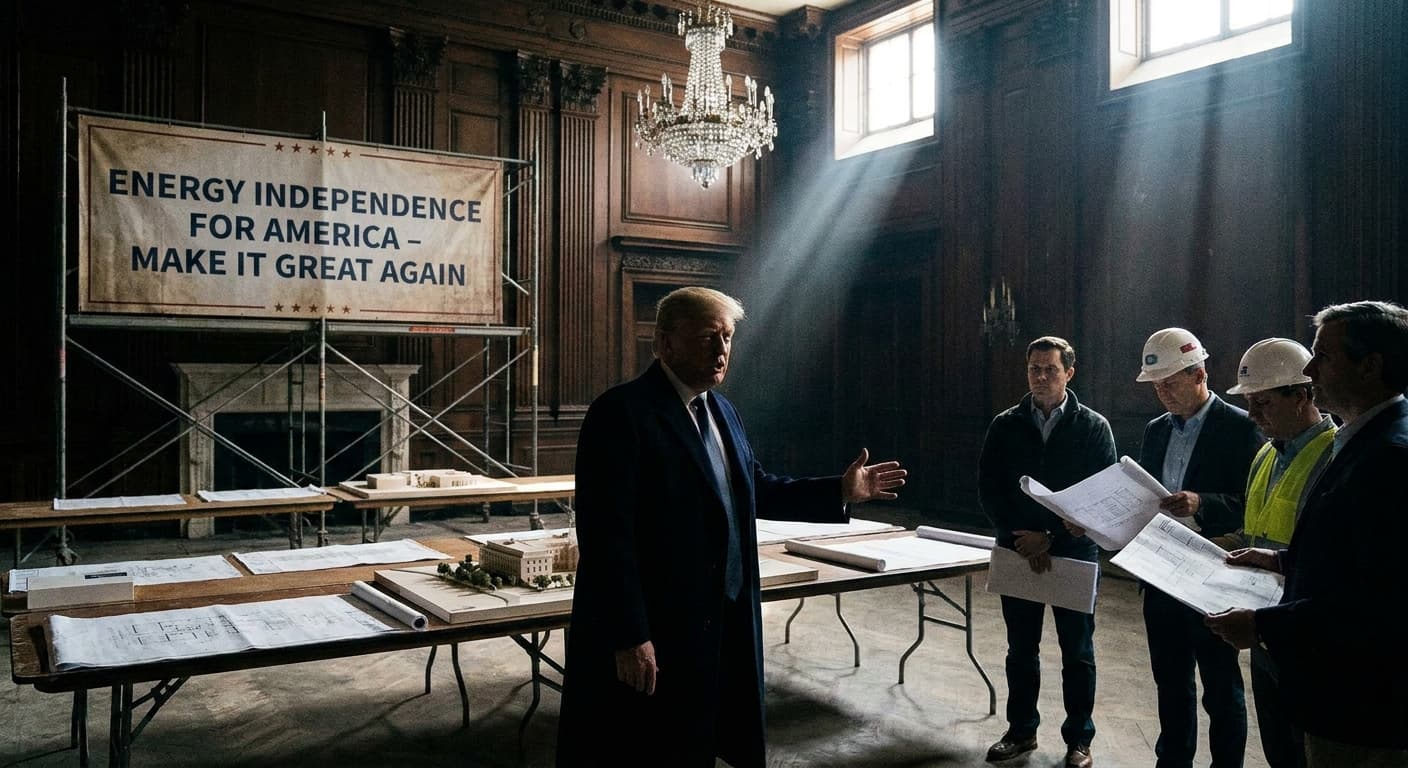
Trump's $400 Million White House Ballroom: The Real Fight
The $400M ballroom on the East Wing site has become the sharpest test of executive power in Trump's second term — a constitutional fight, not a construction project.
President Donald Trump's 90,000-square-foot, $400 million ballroom on the demolished East Wing site is now the most concrete legal test of his second-term theory of executive power — a president deciding he can raze and rebuild federal property using corporate cash without Congress voting a dollar. The building is real; the constitutional question is bigger than the building. A US District Court has ruled twice that Trump exceeded his authority, the DC Circuit has partially reversed, the Senate parliamentarian has killed a $1 billion Republican taxpayer backstop, and every one of the roughly 40 disclosed donors has active regulatory or contracting business before the executive branch that is now selling them commemorative bricks. The ballroom is the vehicle. The precedent is the point.
From $200 million tent-killer to $400 million bunker complex
Trump announced the project in July 2025 as a 90,000-square-foot, $200 million event space seating 650, "paid for by me, and other Patriots." Within a year the seating capacity had risen to 1,350, the cost had doubled to $400 million, and — per the BBC's project timeline — the plans had absorbed a rooftop drone landing zone, "top secret" military facilities, an underground hospital and bomb shelters. Those features were disclosed by Trump himself on Truth Social in April 2026, not by architects at a public hearing.
The East Wing, built in 1902 and traditionally used as the base of operations for the first lady, was torn down starting October 20, 2025, while the federal government was shut down and the National Capital Planning Commission — the federal body that reviews major construction in Washington — was closed. NPR reported that demolition proceeded before the NCPC had signed off. The commission's chairman, White House Staff Secretary Will Scharf, argued at the agency's September 2025 meeting that the NCPC had no jurisdiction over demolition or "site preparation" — a legal position none of Scharf's predecessors had asserted.
That sequencing — demolish first, get approvals later — is the whole fight in miniature.
The constitutional argument: who owns the White House?
The National Trust for Historic Preservation's complaint, filed December 12, 2025, is not a fight about taste. It alleges four hard statutory and constitutional violations: failure to submit plans to the NCPC as required by 40 U.S.C. §8722(d); failure to obtain Commission of Fine Arts review; failure to complete a National Environmental Policy Act assessment for a "major Federal action"; and — the constitutional core — that Congress alone can "dispose of and make all rules regarding property belonging to the United States" under Article IV, Section 3. A separate
expert declaration filed with the court argues the ballroom represents "the most significant modification and change in the structure of the White House… since the comprehensive interior renovations during the Truman Presidency," and that its scale is "incompatible" with the 2000 Comprehensive Design Plan for President's Park, which was itself subject to an Environmental Impact Statement.
On March 31, 2026, US District Judge Richard Leon, a George W. Bush appointee, sided with the Trust. In a 35-page opinion widely quoted for its exclamation points, Leon wrote — as NPR captured verbatim:
The President of the United States is the steward of the White House for future generations of First Families. He is not, however, the owner! Unless and until Congress blesses this project through statutory authorization, construction has to stop!
Leon dismissed the administration's national-security justification for skipping congressional review as "grasping at straws," according to the BBC's account of the ruling, and called the private-funding pipeline — donations routed through the Trust for the National Mall into a National Park Service gift fund under 31 U.S.C. §1321(a)(17) — a "Rube Goldberg contraption" designed to evade the appropriations power. Constitutional lawyer Bruce Fein told
Al Jazeera the scheme violates the Anti-Deficiency Act, which bars the executive from accepting in-kind services to conduct official government functions without express congressional authorization.
The DC Circuit issued an administrative stay on April 11, 2026, letting construction continue by a 2-1 panel vote, and a Trump-appointee-dominated NCPC voted to approve the plans on April 2, 2026 — a day after Leon's injunction — after receiving more than 32,000 public comments, the overwhelming majority opposed. On April 16, 2026, Leon returned fire, halting above-ground work while permitting the underground "bunker" the administration had abruptly reclassified as a national-security facility.
The BBC reported that Leon wrote the administration was "trying to side-step" his earlier order by relabeling a ballroom as a bomb shelter. The Commission of Fine Arts — also stacked with Trump appointees — had already approved the design in February 2026 after acknowledging that of the roughly 2,000 comments received, "over 99%" opposed the project, according to
BBC coverage of the meeting.
Who is paying — and what they want
The White House released its donor list on October 24, 2025. It is the most concentrated cluster of pending regulatory business the executive branch has ever assembled behind a single physical structure. Al Jazeera's donor roster — corroborated by the
BBC's parallel list — names roughly 40 contributors, from Apple, Microsoft, Amazon, Meta, Google, Palantir, Coinbase, Lockheed Martin, Booz Allen Hamilton and Micron to individuals including Stephen Schwarzman, Harold Hamm, Cameron and Tyler Winklevoss, Kelly Loeffler and Jeff Sprecher, and the Adelson and Perlmutter families.
The BBC obtained a pledge form indicating donors could receive "recognition" for their contributions — potentially names etched into the structure itself. Richard Painter, chief White House ethics lawyer under President George W. Bush from 2005 to 2007, told the BBC the arrangement is "an ethics nightmare… These corporations all want something from the government." Painter conceded that proving a quid pro quo is nearly impossible: "But I think the Trump administration is pushing the envelope here."
One donation is not really a donation at all. Court documents reviewed by CBS News and cited by the BBC show YouTube — a subsidiary of Alphabet — will contribute $22 million to the ballroom as part of a settlement of Trump's 2021 lawsuit against Google over the suspension of his account after January 6. In effect, litigation Trump filed as a private citizen is now paying for construction on federal parkland he controls as president. And the pattern outside the ballroom is corroborating. Trump pardoned Binance founder Changpeng Zhao in October 2025 after Binance struck a multibillion-dollar deal with the Trump family's own crypto vehicle, World Liberty Financial — a sequence NPR described as looking, per Cornell economist Eswar Prasad, like a "quid pro quo." The SEC dropped its enforcement suit against Coinbase — a named ballroom donor — earlier in 2025, per
NPR's regulatory rundown.
The taxpayer backstop Trump swore he did not need
Trump's central defense — that the ballroom costs taxpayers nothing — has been quietly abandoned by his own party. On April 29, 2026, Senators Lindsey Graham, Katie Britt and Eric Schmitt introduced S. 4430, the White House Safety and Security Act of 2026, which appropriates "$400,000,000, to remain available until January 20, 2029" for the East Wing Modernization Project. The bill,
as pitched by Graham's office, was cast as a security necessity — invoked after a shooting near a Washington hotel ballroom Trump attended in April — but its plain text authorizes federal money for "design, construction, and other appropriate expenses to complete" the ballroom itself.
That was the smaller ask. The larger one — $1 billion in Secret Service and East Wing security funding attached to a $72 billion immigration reconciliation package — collapsed on May 17, 2026, when Senate Parliamentarian Elizabeth MacDonough ruled it out of order under the Byrd rule.
Al Jazeera reported that MacDonough found the security carve-out did not comply with reconciliation rules, meaning Republicans would need 60 votes in a 53-47 chamber to keep it. On June 4, 2026, the
BBC confirmed the Senate voted 53-45 to advance the immigration bill only after Republicans stripped the ballroom money.
Senator Richard Blumenthal's committee statement captured the arithmetic: "$200 million. The price then rose to $250 million, $350 million, $400 million. They said that the construction of the ballroom would be done entirely with financing by private donors. Now they are seeking taxpayer money, $1 billion, telling us they cannot finish the project without the funds." His amendments requiring donor disclosure, competitive bidding and a GAO audit were defeated in committee on party lines. A separate
Stop Ballroom Bribery Act — S. 3191 — would bar donations from parties "involved in litigation with the Federal Government" or appointed to office by the sitting president. It has not moved.
The historical parallel that reframes everything
Every past White House renovation cited by Trump's defenders — Truman's 1948-52 gut renovation, the Nixon-era press briefing room over the swimming pool, the West Wing expansion under Theodore Roosevelt — proceeded on explicit congressional appropriation. The Truman reconstruction, the last time this much of the White House came down, was authorized by Public Law 80-40 and funded by the Treasury, not by 40 CEOs with pending FTC and DOJ business. The National Trust's expert declaration explicitly invokes that comparison; Leon's ruling implicitly relies on it. The novelty here is not architectural. It is that a president tore down a wing of the White House and paid for its replacement with corporate money, then asked Congress for a $400 million appropriation only after courts blocked the private-funding workaround.
That inversion — build first, seek authorization second, threaten national security if denied — is what the DC Circuit is now being asked to bless. If it does, the precedent will not stay confined to ballrooms. Any future president could restructure federal property using donor cash, disclose recipients selectively, and dare Congress to un-build the fait accompli.
What to watch next
- DC Circuit merits ruling on the injunction appeal — the panel heard argument following its June 5, 2026 session; a ruling upholding Leon on the appropriations question would force construction back to Congress. A reversal effectively legalizes the funding architecture.
- Fate of S. 4430 — the $400M appropriation was referred to Senate Finance; if it clears, Trump's "zero taxpayer cost" claim dies definitionally, but the constitutional challenge to the private-funding scheme becomes moot.
- NEPA remand — Leon left the door open for a National Park Service Environmental Impact Statement to be ordered. An adverse EIS could halt the underground complex the administration is racing to complete.
- Trump's completion target — September 2028, two months before the presidential election that will produce his successor.
Diplomat View
The evidence supports one call: the ballroom will get built, and the courts will let it. Judge Leon has the statutes on his side, but the DC Circuit has already signaled through its 2-1 April stay that it will not enjoin a structure the president has framed as security infrastructure, and the Supreme Court's post-2024 executive-power jurisprudence points the same direction. The real loss for Congress is not the building — it is the precedent that private capital can fund physical alterations to federal property when appropriations are denied, with donor lists disclosed at the executive's discretion. The forecast changes if the DC Circuit affirms Leon in full on the Article I question, or if S. 4430 fails and the Trust for the National Mall gift-fund pathway is enjoined on Anti-Deficiency Act grounds — either would force the administration back to Congress for money it has proven it cannot get. Absent one of those two events by the end of 2026, the ballroom precedent will outlive the ballroom.
The Bottom Line
Trump's $400 million ballroom is not a vanity project — it is a working prototype for governing without appropriations. Roughly 40 corporate and billionaire donors, nearly all with active federal regulatory business, are funding a permanent alteration to the White House that Congress never approved and two federal court rulings have already found unlawful. Whether the DC Circuit lets that stand is the decision that matters — not the marble, not the drone port, not the seating chart.
Discover more
Conflict & Security
De la Espriella's Razor Win Resets US-Colomb
De la Espriella's razor-thin election win signals a reset in US-Colombia relations, reshaping security ties and the agenda under a Trump-aligned approach.
International Relations
Colombia's Razor-Thin Rightward Pivot
Colombia swings right as Abelardo de la Espriella narrowly wins the presidential runoff by under one percent, exposing a deeply divided and polarized nation.

Global Politics
Iran Demands US Enforce Ceasefire
Iran insists the United States must enforce a ceasefire in Lebanon to uphold the memorandum of understanding, raising pressure on Washington and Netanyahu.

Conflict & Security
Trump's Iran Deal Faces Bipartisan Backlash
Trump's Iran deal draws fierce criticism from both Republicans and Democrats, exposing deep political divides over the ceasefire and the terms of the agreement.