Trump-Xi Summit Recasts Trade Order
Key insights from the upcoming Trump-Xi meeting.
Model Diplomat7 min readAsia
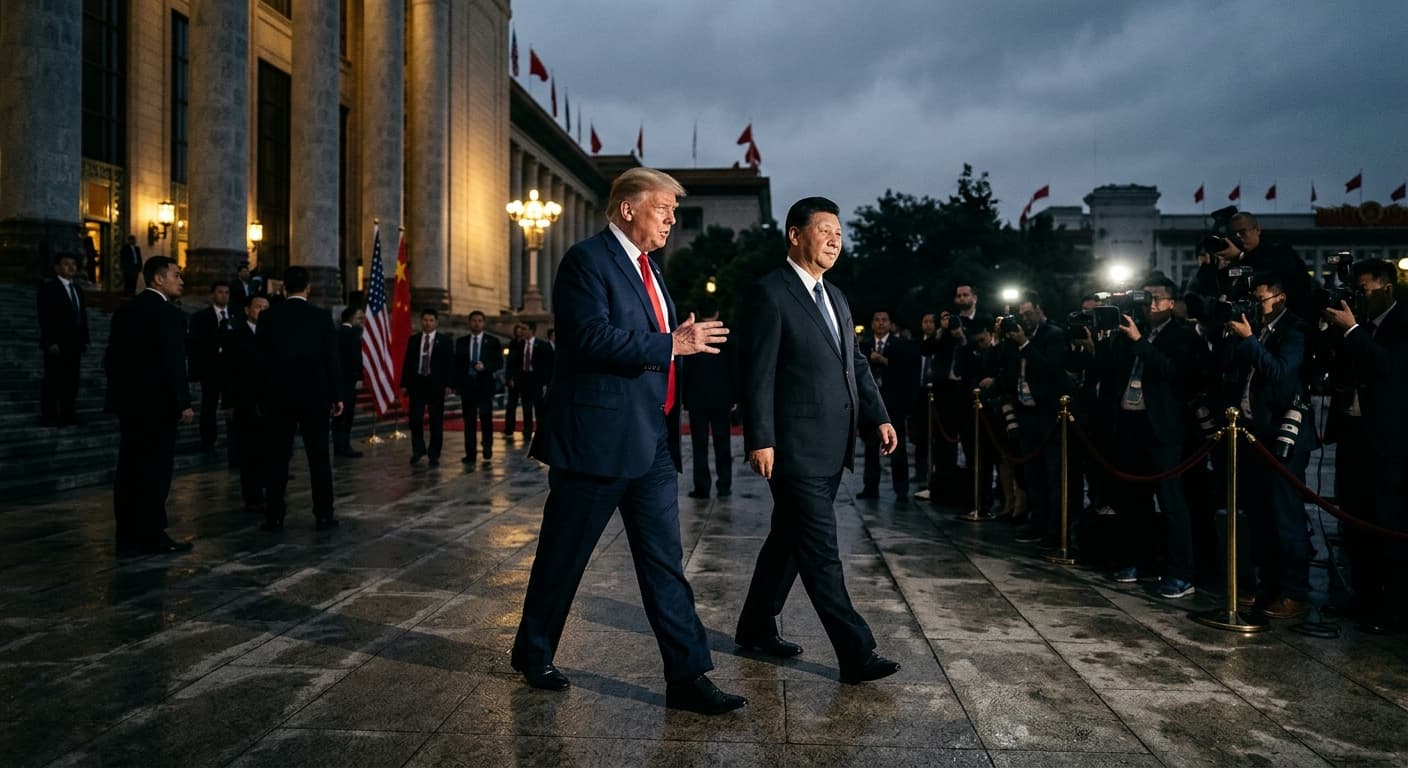
Trump-Xi September Summit Recasts Indo-Pacific Trade Order
Trump will host Xi Jinping at the White House on September 24, 2026 — a return visit that locks in "managed trade" even as PLA patrols and Scarborough Shoal escalate.
President Donald Trump confirmed on July 7, 2026 from the White House Rose Garden that Xi Jinping will arrive in Washington "around September 24" — the return leg of a bilateral choreography that has, in the space of eight months, cut the U.S. goods deficit with China by 31.6% and quietly institutionalized a new operating system for the world's most consequential rivalry. The thesis is straightforward: the September visit is not a "reset" but the ratification of a two-tier settlement — a managed-trade truce in soybeans, Boeings and rare earths on one track, and an unbroken military pressure campaign around Taiwan, Scarborough Shoal and the Korean peninsula on the other. Both leaders now need each track to hold, and the countries paying for the arrangement are third parties in the Indo-Pacific.
What the White House is actually buying
The May 14–15, 2026 Beijing summit produced no grand bargain — it produced an architecture. According to the White House fact sheet released May 17, the "cornerstone" of the agreement is the new U.S.–China Board of Trade and Board of Investment, government-to-government forums to negotiate tariff modifications on "non-sensitive" goods. USTR's
June 2, 2026 Federal Register notice puts the deficit reduction in black and white: the U.S. goods trade gap with China fell to $202 billion in 2025 — the lowest since 2004 — and was down another 46% year-over-year in March 2026.
The transactional deliverables are the political shopfront. USTR Ambassador Jamieson Greer confirmed to Bloomberg that China committed to "double-digit billions" of annual agricultural purchases, an initial 200-aircraft Boeing order — the first major Chinese purchase in nearly a decade — and $17 billion in U.S. farm buys in 2026, 2027 and 2028. In parallel, USTR extended 178 Section 301 tariff exclusions through November 10, 2026 in a
November 5, 2025 press release, and Bureau of Economic Analysis figures show U.S. goods exports to China fell 25.8% in 2025 to $106.3 billion — a decoupling that Greer describes as "diversifying," but which farm-state legislators are watching nervously ahead of the November midterms.
The September 24 visit is designed to lock this framework in. It is calibrated to the UN General Assembly high-level week for maximum optics, and Trump has now openly linked it to construction of the 90,000-square-foot White House State Ballroom — the
$200 million project announced in July 2025 whose scale-up he cited as one reason he needs space for Xi.
The historical parallel: Clinton-era Japan, at scale
The Council on Foreign Relations' Michael Froman warned in October 2025 that the "Board of Trade" model — identifying roughly $30 billion in matched purchases of non-sensitive goods — is a direct throwback to the framework talks between Bill Clinton and Ryuichiro Hosokawa in the mid-1990s, which set numerical targets on Japanese imports of U.S. autos and semiconductors. Those talks collapsed as unmanageable within two years. The new iteration is larger, more politically charged, and — crucially — attached to a partner running a $1.2 trillion global goods surplus that Treasury Secretary Scott Bessent has called "the biggest risk to the global economy."
CFR's follow-up analysis in May 2026 was blunt: the two sides do not define "strategic stability" the same way. Washington wants "managed trade" — bargaining rooms and dispute channels. Beijing wants "managed competition" — recognition and time. As Italy's ISPI's Stephen Olson
argued in his post-summit assessment, the Board of Trade's "non-sensitive" perimeter has not been defined — a gap that will draw lobbying dollars on both sides and open exactly the kind of "grey areas" that undermined the Clinton-Japan targets.
The other track: gray-zone pressure that never paused
Here is the angle wire coverage keeps missing: the tariff détente has bought Beijing space to intensify — not moderate — its military coercion of Taiwan and the Philippines. Within eleven days of Trump leaving Beijing, the PLA conducted two "joint combat readiness patrols" around Taiwan. On May 26, 2026, Taiwan's defense ministry tracked 29 Chinese aircraft and seven warships operating around the island, with 24 aerial sorties crossing the median line. Joseph Wu, secretary-general of Taiwan's National Security Council, publicly labeled Beijing "the sole source of instability in the Indo-Pacific."
Scarborough Shoal is the more revealing data point. According to a July 2, 2026 analysis by the CSIS Asia Maritime Transparency Initiative, China Coast Guard patrols at Scarborough hit 933 ship-days in the first half of 2026 alone — nearly matching the entire 2025 annual total of 1,099, itself already double the 2024 figure of 516. Monthly patrol volumes rose from 90 ship-days in early 2025 to 156 in 2026, peaking at 216 in May. On May 25, Manila filed a diplomatic protest after discovering a 6-by-6-meter Chinese "temporary research facility" inside the shoal's lagoon — the first structure of its kind, removed on June 17 but leaving buoys and monitoring assets in place.
The Brookings analysis by Ryan Hass and Stephen Tan documented the first PLA drone violation of Taiwan's territorial airspace in January 2026 — a red line quietly crossed while trade negotiators were assembling the Board of Trade proposal in Paris. CSIS's
Geometry of Coercion report shows that between 2020 and 2025, the daily average of distinct China Coast Guard vessels in Taiwan's near waters rose more than 500%, with incursions into Taiwan's second maritime security ring more than quadrupling.
The Trump administration's response has been telling. Washington paused a $14 billion arms sale to Taiwan in May 2026 to conserve munitions for the ongoing U.S.–Israel war with Iran, and Trump publicly cautioned Taipei against formally declaring independence, prompting a Taiwanese statement that it was "sovereign and independent" but planned to maintain the status quo. The Iran war is doing what U.S. domestic politics never could: forcing a genuine Indo-Pacific triage.
Korea: the piece that could rearrange everything
The September summit will be crowded by a variable that both capitals want to control but neither can. South Korean President Lee Jae Myung used his January 2026 state visit to Beijing to formally ask Xi to mediate a nuclear freeze with Pyongyang — "no additional production of nuclear weapons, no transfer of nuclear materials abroad, and no further development of ICBMs" in exchange for compensation. At the June G7 summit, Lee said Trump told him "the time had come" to focus on
the North Korea issue. Brookings' Alexandre Mansourov and Foreign Affairs both note that Kim Jong Un has signaled openness — and that his leverage has grown since the failed 2019 Hanoi summit.
The angle: any Trump-Kim deal that Xi green-lights is exactly the kind of foreign-policy trophy Trump could unveil at the September 24 event. That gives Beijing quiet leverage over Washington's Taiwan posture — the same period in which Xi told Trump, per Chinese Foreign Ministry spokesperson Mao Ning, that "the Taiwan question is the most important issue in China–US relations."
Who benefits, who pays
The clear winner is Xi Jinping. He has secured a three-year framework labeled "constructive, strategic and stable"; extended Section 301 exclusions; a pause on the most punishing tariff escalations; and — most importantly — American caution on Taiwan arms and Taiwanese independence rhetoric, all while patrol tempos around Taiwan and Scarborough continue to climb. Beijing's Foreign Ministry readout, analyzed by Observer Research Foundation, notably omitted mention of the Boeing and agricultural volumes the White House trumpeted — leaving China maximum flexibility to under-deliver.
The clear losers are the frontline U.S. treaty allies. The Philippines is being harassed at Scarborough while its defense minister Gilberto Teodoro was barred by China in June 2026. Taiwan's arms package is on ice. Japan and South Korea face a U.S. president publicly warming to Kim. The BEA numbers show trade diversion, not decoupling: the U.S. deficit with Vietnam ballooned to $178.2 billion in 2025, and with Taiwan to $146.8 billion — third-country conduits absorbing Chinese production that no longer crosses U.S. customs directly.
American soybean farmers, Boeing, and pork producers get politically visible wins. American semiconductor firms and Taiwan-linked defense contractors get a slower, quieter pipeline. As the ORF analysis put it: this is a framework for bargaining, not a settlement — and the space for large-scale commercial breakthroughs "has narrowed considerably."
Diplomat View
The September 24 summit will not produce a trade breakthrough — the Board of Trade already is the breakthrough, and by autumn it will still be an empty room with a to-be-negotiated list of "non-sensitive" products. Watch instead for three signals. First, whether Trump extends the Section 301 tariff exclusions past their November 10, 2026 expiry — a de facto vote on whether managed trade holds through the midterms. Second, whether the White House quietly releases the paused $14 billion Taiwan arms package before or after Xi's visit; releasing it before signals leverage, after signals accommodation. Third, whether a Trump-Kim announcement lands within the UNGA window — the strongest indicator that Xi has extracted a concession on Taiwan in exchange for Beijing's cooperation on Pyongyang. The forecast is falsifiable: if PLA joint combat patrols around Taiwan pause in the two weeks bracketing September 24, "strategic stability" has real content. If they intensify — as CSIS data suggests they will — the September summit will be remembered as the moment Washington accepted Chinese coercion below the threshold of war as the cost of a deficit-reduction headline.
What to watch
- September 24, 2026 — Xi arrives in Washington; watch for Board of Trade "non-sensitive" product list and any Taiwan-arms language in the joint statement.
- November 10, 2026 — Section 301 tariff exclusions expire; USTR decision will signal whether the truce survives the midterm postmortem.
- November 2026 APEC (Shenzhen) and December G20 (Miami) — the next two scheduled Trump-Xi encounters; a no-show by either would break the "constructive, strategic and stable" frame explicitly.
Related coverage: Global Politics.
Discover more

US Politics
House Ethics Committee Pushes Sexual Miscond.
The House Ethics Committee has shifted responsibility for sexual harassment settlement records to the Office of Congressional Workplace Rights, complicating disclosure efforts.
India
700 Activists Accuse PM Modi of MCC Breach
Over 700 activists allege PM Modi breached election code with a televised address attacking opposition parties just before state elections.
Global Politics
Trump's Conflicting Messages on Iran War
Trump's mixed messages on Iran reflect a strategy of audience management, benefiting Tehran amid a complex geopolitical landscape.

Conflict & Security
Drone Warfare Killing Aid Workers at Unprec
Over 1,000 humanitarian workers killed in three years as cheap armed drones collapse legal protections. Gaza, Sudan, Ukraine, and DRC see deliberate targeting of aid convoys and hospitals with zero prosecutions.