Trump to Lift Syria's Terrorism Designation
Unlocking $216 billion for reconstruction efforts
Model Diplomat7 min readMiddle East
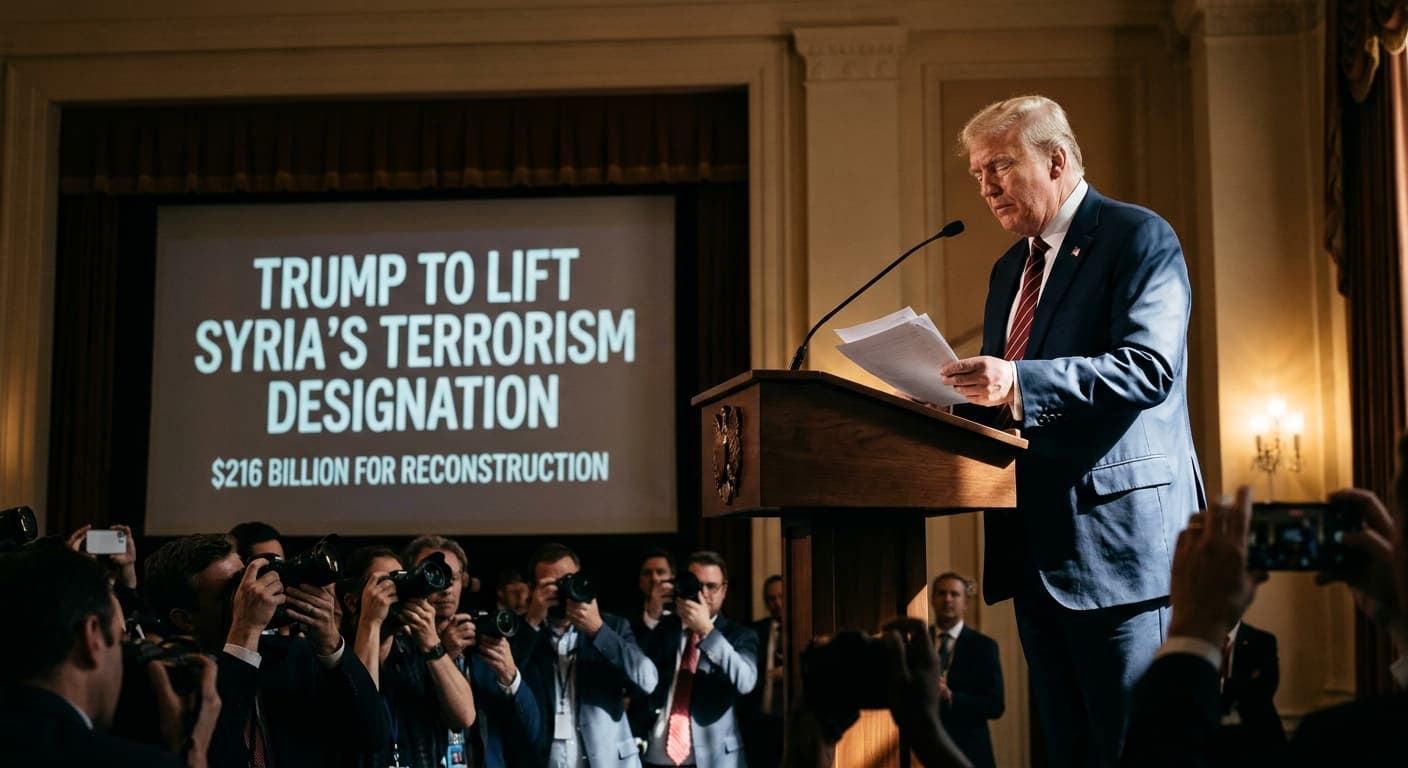
Trump Moves to Lift Syria's Terrorism Tag, Unlocking a $216bn Bet
Trump's July 8 notification to Congress starts a 45-day clock to end Syria's 1979 State Sponsor of Terrorism status — the last legal barrier between Damascus and the dollar system.
President Donald Trump notified Congress on July 8, 2026 of his intent to rescind Syria's designation as a State Sponsor of Terrorism, starting a 45-day statutory clock that — absent a joint congressional resolution — will erase a label in place since December 29, 1979 and, in a single stroke, unlock the reintegration of a $17.5 billion war-shattered economy into the dollar-clearing system. The move is less a diplomatic gesture than the final legal switch on an 18-month project to convert Syria from sanctioned pariah to Gulf-financed reconstruction market — and its biggest immediate beneficiaries are not Syrians but Saudi, Qatari and Turkish capital already sitting on more than $20 billion of signed but stalled deals. What Trump is really lifting is the compliance risk that has kept Western banks, insurers and reinsurers from touching those deals.
What Trump actually did — and what still binds
Secretary of State Marco Rubio's July 8 press statement is unusually explicit about the mechanism: the administration has "informed Congress of his administration's intent to rescind Syria's designation as a State Sponsor of Terrorism (SST), following a 45-day pre-notification period," anchored on "formal assurances provided by President al-Sharaa that Syria will not support acts of international terrorism in the future" (U.S. Department of State). That language tracks the second statutory pathway under section 6(j) of the Export Administration Act, the Arms Export Control Act §40, and the Foreign Assistance Act §620A — the same route used to delist Cuba in 2015.
The legal architecture matters, because the SST tag was the last one Trump could not switch off with a pen. His June 30, 2025 executive order "Providing for the Revocation of Syria Sanctions" already terminated the underlying national emergency and revoked six Syria-specific executive orders, effective July 1, 2025, per the Federal Register. OFAC then wound down the Syria Sanctions Program and folded residual designations into a new
PAARSS regime aimed narrowly at Assad-era actors and Captagon traffickers.
But two locks remained. The Caesar Syria Civilian Protection Act of 2019 is statutory: Trump could only suspend it in 180-day tranches until Congress moved. The SST designation is likewise statute-anchored — 22 U.S.C. 2371, 22 U.S.C. 2780, 50 U.S.C. 4813(c) — and forces an automatic arms embargo, foreign-assistance ban, dual-use export controls, and mandatory U.S. opposition to loans at the IMF and World Bank. It is also the trigger that has made global banks treat any Syria exposure as a de-risking event. As the Middle East Institute's January 2026 trip report put it, six-month Caesar suspensions had "negligible impact upon the acute bank de-risking concerns" because compliance officers price on legal risk, not on political mood.
The Congress track: already 90% run
The 45-day window is not, in practice, contested. Senator Jeanne Shaheen (D-NH), ranking Democrat on Foreign Relations, secured a full repeal of the Caesar Act through the FY2026 National Defense Authorization Act — amendment S.Amdt.3662 to S.2296, co-sponsored with Senator Rand Paul, which reads simply: "The Caesar Syria Civilian Protection Act of 2019 … is hereby repealed." The Senate passed the NDAA on October 10, 2025 with the language intact, and
Shaheen's office confirmed the repeal survived conference. Senator Lindsey Graham's competing conditions-based amendment,
S.Amdt.3889, was folded in as a certification-reporting overlay rather than a block.
House Foreign Affairs chair Brian Mast — arguably the most pro-Israel voice in the House — was the last serious obstacle. Al Jazeera reported al-Sharaa dined with Mast during his November 2025 White House visit. Mast emerged saying the two had discussed "a future for the people of Syria free of war, ISIS, and extremism." Republican leadership is not whipping a joint resolution of disapproval. Barring a sudden atrocity in Syria before the third week of August, the designation lapses.
Who really benefits: the Gulf, and the compliance function
The economic geometry is straightforward. Syria's economy has shrunk from roughly $60 billion in 2010 to about $17.5 billion in 2023 — the World Bank puts the reconstruction bill at a central estimate of $216 billion, with a range of $141–343 billion. The Peterson Institute's Anna Gelpern and colleagues note Syria owes between $20–23 billion in external debt, "much of it to Iran and Russia," making a restructuring unavoidable (
PIIE). No IMF program can proceed until the U.S. stops voting against it — a vote the SST designation compels by law.
That vote-block is the load-bearing constraint the delisting removes. On the demand side, capital is already committed and waiting: the July 2025 Syrian-Saudi Investment Forum produced $6.4 billion in pledges across 47 agreements, per a Friedrich-Ebert-Stiftung analysis, and mid-2025 Gulf forums yielded up to $20 billion in memoranda covering transport, real estate and telecoms, according to
ISPI. Saudi Arabia and Qatar cleared Syria's $15 million arrears with the World Bank in April 2025, unlocking a $146 million grid-restoration grant. But almost none of this money has actually moved. Konrad-Adenauer-Stiftung's
April 2026 assessment is blunt: "Syria's US designation as a State Sponsor of Terrorism, in place since 1979, continues to complicate its full reintegration into global financial and trade networks."
Take that plug out, and correspondent banking risk falls to something approaching normal frontier-market levels. The tell is Central Bank governor Safwat Raslan, the second person appointed to the post in nine months after Abdulkader Husrieh (a former Ernst & Young partner), reacting publicly via Telegram and framing the delisting as opening "investments and economic recovery" — a statement that has not been linked to a primary source and should be verified against the Central Bank's official channel before publication. His problem is concrete: the Central Bank of Syria held roughly $200 million in reserves at end-2025, against $17 billion in 2010, per Reuters figures cited by Al Jazeera. Without dollar clearing, the January 1 redenomination of the Syrian pound — which stripped two zeros and Assad's face — is a cosmetic reform.
The regional cost: Israel loses, Turkey and the Gulf win
The delisting was announced from Ankara, on the sidelines of a NATO summit hosted by Recep Tayyip Erdoğan, with al-Sharaa seated next to Trump. That staging is not incidental. Turkey has been al-Sharaa's principal patron since HTS's original Idlib enclave; the delisting effectively ratifies Ankara's Syria bet at Washington's expense of leverage. According to Chatham House, the May 2025 Trump–al-Sharaa meeting in Riyadh had already "shifted the balance of power" toward the Riyadh-Ankara-Doha axis and away from Iran, which lost its principal Arab client with Assad's fall.
Israel is the conspicuous loser in this round. Prime Minister Benjamin Netanyahu asked Trump not to lift sanctions in early 2025; NPR reported Israel calling the al-Sharaa government "extremist" and running airstrikes deep into Syria as recently as July 2025; the inline link should point to the NPR report, not an Al Jazeera piece dated September 2025. Trump publicly demanded Syria–Israel normalization as a precondition; he then dropped the condition. Al-Sharaa told reporters in September 2025 that a 1974 disengagement-style security deal had been "four to five days" from signature before the Suwayda violence collapsed the talks. Trump moved anyway. That sequence tells you where the leverage actually sits: Trump values the reconstruction dividend for Gulf allies more than he values Israeli veto rights over Levant policy.
The second-order loser is Russia. Carnegie's Haddon Barth documents that al-Sharaa's new sovereign wealth fund is opaque and personally controlled — but its very existence gives Damascus a vehicle to renegotiate the roughly $30 billion in war-era debt owed to Moscow and Tehran on terms the Kremlin cannot enforce without U.S. sanctions cover.
Diplomat View
The delisting will happen. It will underperform expectations for 18 months. Here is the defensible call.
The lift is priced in for the political class and unpriced for the compliance class. Global banks will not re-engage on a State Department press release; they will re-engage when OFAC issues a comprehensive general license replacing the current ad-hoc structure, when FATF removes Syria from enhanced due-diligence status, and when the IMF Article IV mission (last conducted for the first time since 2009 in mid-2025) produces a program. That is a 12- to 24-month cycle. Gulf capital moves faster because it is largely state-directed and politically insured. Expect Saudi PIF and Qatari QIA disbursements against existing MoUs to accelerate visibly by Q4 2026, particularly in power generation and real estate. Western private capital lags by a year.
The forecast revises if any of three things happens: a mass-atrocity event against Alawite, Druze or Christian minorities before the 45-day window closes (which would activate Graham's certification framework and give Mast cover to move a disapproval resolution); a documented HTS-lineage plot against a U.S. or Israeli target; or a formal Syrian debt-repayment gesture to Moscow or Tehran, which would collapse Congressional Democratic support overnight. Absent those, the SST tag is gone by roughly August 22, 2026. Syria's economic center of gravity tilts decisively toward Ankara and Riyadh, with Washington holding the switch and the Gulf writing the checks.
What to watch next
- August 22, 2026 (approx.): 45-day pre-notification window under 22 U.S.C. 2371 expires; SST rescission takes effect absent a joint resolution of disapproval signed into law.
- September 2026: IMF/World Bank annual meetings — first plausible venue for a Syria package now that U.S. law no longer mandates opposition to IFI lending.
- Q4 2026: House-Senate NDAA conference report vote on Caesar Act repeal; watch whether the Graham conditions-and-certification language survives alongside the Shaheen full-repeal text.
- Ongoing: OFAC guidance on residual PAARSS designations and any new comprehensive Syria general license — the compliance document that actually determines whether correspondent banking returns.
Discover more

US Politics
SNAP Food Assistance Faces Legal Challenges
In 2026, SNAP faces stricter eligibility rules and mounting legal challenges, threatening food assistance for the millions of Americans who rely on the program.
US Politics
Congress Targets AI Chatbot Access for Terror
The House passed the Generative AI Terrorism Risk Assessment Act, focusing on AI's role in terrorism and potential surveillance implications.

Global Politics
US Seizes Iranian Ship, Tensions Surge
The US seizure of the Iranian ship Touska highlights a shift in control over the Strait of Hormuz, favoring Iran's strategic position.

Economics
Fed's Amex AML order puts correspondent banking on notice
Federal Reserve's Amex AML order requires board-level controls and a 90-day plan; OCC fined the bank $350 million over enterprise-wide deficiencies.