Trump Shifts Focus to North Korea's Nukes
Experts warn of challenges in new negotiations.
Model Diplomat3 min readAsia
Trump Eyes North Korea After Iran Deal, But Experts See a Trap
Trump signals renewed focus on North Korea's nukes at G7, but a harder target and tighter Moscow–Beijing ties may defeat the Tehran playbook.
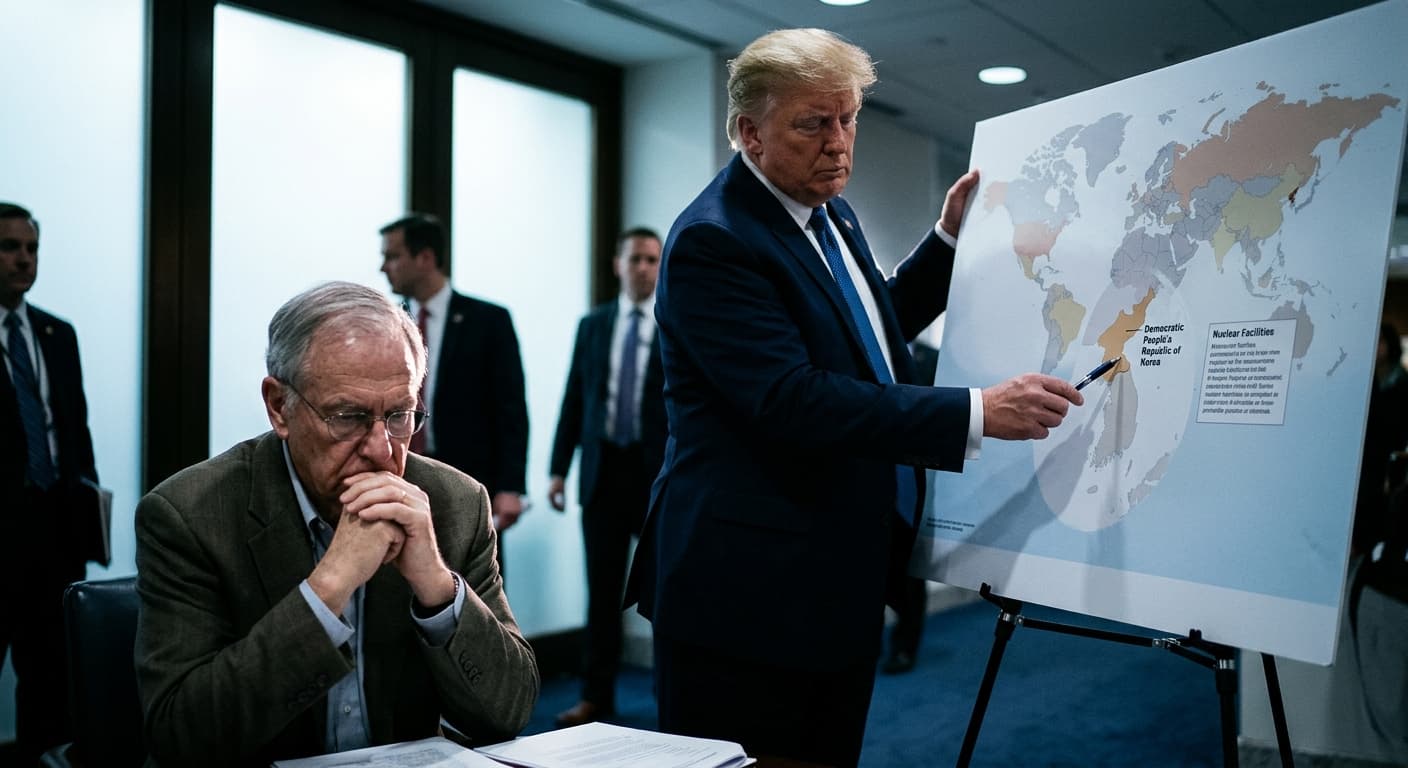
Trump is pivoting to North Korea after securing a ceasefire with Iran—but the two cases are not interchangeable, and Pyongyang appears unmoved. During a 90-minute dinner at the G7 summit on Friday, Trump told South Korean President Lee Jae Myung that "the time had come to pay attention to the North Korea issue," according to
reporting from The Asia Business Daily. Trump had just posted a photo of himself with Kim Jong-un on Truth Social—a public signal of openness to resumed talks. But Lee was blunt: North Korea cannot be handled the way the Middle East was, and Lee walked Trump through a phased denuclearization approach that stops short of full disarmament.
The timing matters. Trump has met Kim three times and declared them "in love" during his first term, yet left office with no deal. Now, Trump sees an opening after the Iran ceasefire—but the structure of the problem has shifted fundamentally. Iran's 14-point memorandum with Washington commits Tehran to not developing nuclear weapons. North Korea's sister Kim Yo-jong rejected the same ask this week, calling the denuclearization line "a line of no retreat that can never be crossed." Pyongyang codified its nuclear status in law (2022) and constitution (2023).
The second layer is leverage. In 2018–2019, North Korea viewed talks with the United States as its lifeline. Today, Pyongyang has Moscow and Beijing, giving it options Washington does not have with Iran. Lee himself told Trump that Russian military support, while small in volume, is "of great help to North Korea." With
China and Russia anchoring the regime, Pyongyang's dependence on US talks has evaporated. It is playing from strength, not weakness.
Trump's own administration is hedging. Deputy Assistant Secretary of State David Wilezol told a Washington forum on Thursday that "if Chairman Kim is ready to talk, the Trump administration is ready to have those conversations"—a signal of openness coupled with a conditional clause. Denuclearization remains the stated objective, not freezing production or rolling back the arsenal. But experts reading Lee's proposal hint at what the real negotiation might look like: freeze first, denuclearize later. That gap between what Washington says it wants and what it might accept is where Pyongyang will look to exploit.
The trap is timing. With US midterm elections in November, Trump may have political incentive to claim a win—a framework agreement, a freeze, a summit. North Korea has incentive to string out talks while anchoring tighter to Moscow and Beijing. South Korea fears being sidelined in bilateral Trump-Kim diplomacy, especially with inter-Korean dialogue frozen and Seoul seeking to reclaim wartime operational control from the US by 2030.
Watch for: Whether Trump's next move is to propose a summit, and if so, what "freeze instead of denuclearization" language might appear in a joint statement. Watch Seoul's coordination with Washington—Lee signaled willingness, but a US-North Korea deal struck without Seoul could destabilize the alliance. And watch whether Pyongyang responds at all; Kim has not answered Trump's hints since August.
Discover more
Global Politics
Trump's Conflicting Messages on Iran War
Trump's mixed messages on Iran reflect a strategy of audience management, benefiting Tehran amid a complex geopolitical landscape.

Global Politics
US Seizes Iranian Ship, Tensions Surge
The US seizure of the Iranian ship Touska highlights a shift in control over the Strait of Hormuz, favoring Iran's strategic position.

International Relations
Pakistan's Key Role in US-Israel-Iran Meddle
Pakistan is seeking to mediate the US-Israel-Iran conflict, balancing high-stakes diplomacy against severe economic pressures and steep regional challenges.

Conflict & Security
Drone Warfare Killing Aid Workers at Unprec
Over 1,000 humanitarian workers killed in three years as cheap armed drones collapse legal protections. Gaza, Sudan, Ukraine, and DRC see deliberate targeting of aid convoys and hospitals with zero prosecutions.