The Donroe Doctrine's Fatal Flaw
Trump's new doctrine faces challenges from China.
Model Diplomat8 min readAmericas
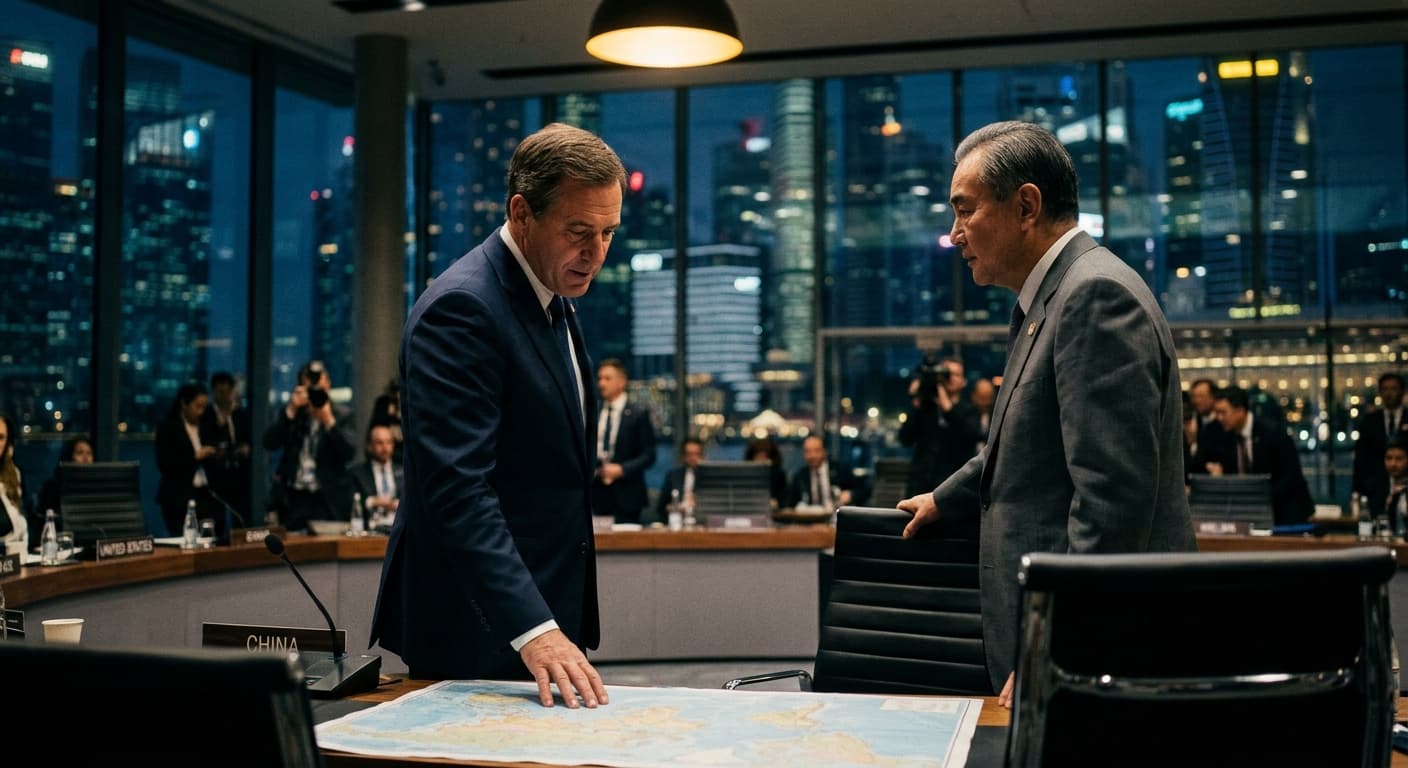
The Donroe Doctrine's fatal flaw: coercion without commerce
Trump's July 9, 2026 Cusco speech formalizes a new Monroe Doctrine — one winning tactically against Maduro and cartels but losing structurally to China's $518 billion regional trade.
The Trump administration used a July 9, 2026 speech in Cusco, Peru to formalize what the president now calls the "Donroe Doctrine" — a Monroe Doctrine rewritten around drug strikes, regime change and a hemispheric squeeze on Beijing. The strategy is winning tactically and losing structurally: it has already toppled Nicolás Maduro, aligned a dozen right-wing capitals behind Washington, and concentrated roughly a quarter of the U.S. Navy's deployed warships in the Caribbean, yet it offers Latin America no credible commercial alternative to the $518 billion trade relationship China built while Washington looked elsewhere. Absent that carrot, coercion will eventually push the region back toward Beijing — and the administration's own analysts know it.
What Colby actually said in Cusco
Speaking to the Conference of Defense Ministers of the Americas, Under Secretary of War for Policy Elbridge Colby laid out the doctrinal architecture behind eight months of escalation. According to The Independent, Colby argued that "the best tradition of the Monroe Doctrine is about protecting our own security and interests by empowering and enabling Latin American nations," while pressing partners to raise defense spending above 1% of GDP and "protect your critical assets" from Chinese ownership. His rhetorical move was to reject the imperial comparison outright: "America doesn't need your assets or your dependency… We seek your success in securing our neighborhood." Reuters,
via The Straits Times, reported that Colby explicitly invoked the "Donroe Doctrine" label, tying it to the September–January boat-strike campaign and Operation Absolute Resolve — the January 3 raid that captured Maduro.
The primary text sits in the 2025 National Security Strategy, which pledges to "assert and enforce a 'Trump Corollary' to the Monroe Doctrine" and to deny "non-Hemispheric competitors the ability to position forces or other threatening capabilities, or to own or control strategically vital assets" in the Americas. A Congressional Research Service report,
U.S. Foreign Policy in the Western Hemisphere: Issues for Congress, notes that the State Department's FY2026–2030 Strategic Plan extends this pledge to rollback of Chinese control exercised "through purportedly private entities" — the legal hook the administration is using against Chinese port operators and utilities from Chancay to the Panama Canal.
The tactical scoreboard: why Trump thinks it's working
Read narrowly, the Donroe Doctrine has delivered. Maduro is in a U.S. federal detention facility awaiting trial on cocaine trafficking charges after a two-hour, twenty-minute raid the BBC described as "virtually unprecedented" — around 150 aircraft, cyber operations that darkened Caracas, and a Delta Force team that arrived at Maduro's Fuerte Tiuna compound with blowtorches. Acting President Delcy Rodríguez has since agreed to expanded U.S. oil exports and cooperation on migration, and Trump has publicly praised her performance. A right-wing electoral wave has followed: José Antonio Kast in Chile, Keiko Fujimori in Peru, and Abelardo de la Espriella in Colombia have all won on crime-and-cartels platforms, with
Foreign Affairs noting that the alignment gives Washington more cooperative partners than at any point since the 1990s.
Public opinion, counterintuitively, has moved with Trump. An AtlasIntel survey cited by NPR found that 53% of Latin Americans backed U.S. military intervention against Maduro, versus roughly 30% of Americans; a January Atlas/Bloomberg poll put approval of the Maduro operation at 74% in Peru and 64% in Colombia. Crime is the number-one political issue across the region, and Trump's willingness to "use missiles… right into the living room," as he told the March Doral summit per
Al Jazeera, plays directly to that anxiety.
The Miami architecture has followed. The March 7 "Shield of the Americas" summit at Trump National Doral produced the Americas Counter-Cartel Coalition — 12 aligned governments plus a security declaration Trump signed on stage. The Center for Strategic and International Studies called it the first multilateral meeting Trump has convened with regional heads of state in his second term, filling the vacuum left by the cancelled 2025 Summit of the Americas. Kristi Noem, freshly ousted as Homeland Security secretary, was named special envoy for the initiative.
The structural problem: no economic offer
Here the analysis pivots. Every serious assessment of the Donroe Doctrine converges on the same objection: Washington is asking Latin American governments to walk away from China without offering a substitute. China is now the leading trade partner of every South American country except Colombia, and its regional trade hit $518 billion in 2024, according to CSIS. Beijing has lent more than $120 billion to hemispheric governments, built a 36-port network, and embedded Huawei in at least a dozen national telecom systems.
The Council on Foreign Relations, in a March analysis titled "The Donroe Doctrine Leans on Sticks But Needs Carrots," put the argument plainly: "If the so-called Donroe Doctrine is to succeed, it needs to mobilize companies and deals, not just gunboats and pressure." The Development Finance Corporation was recapitalized last year, but the Export-Import Bank reauthorization remains stuck in Congress, and no hemispheric equivalent of the Belt and Road Initiative has been proposed. Argentina illustrates the gap: even after receiving a $20 billion U.S. bailout, its foreign minister was in Beijing weeks later reassuring the Chinese that Buenos Aires remained open for business,
NPR reported from the Doral summit.
Chancay is the flashpoint. The $1.3 billion COSCO-run megaport north of Lima now handles Peru's largest container flows, and a January 2026 lower-court ruling stripped Peruvian regulator Ositran of oversight powers over the site, as the AP reported via NPR. The State Department's Bureau of Western Hemisphere Affairs responded on social media that "cheap Chinese money costs sovereignty" — a phrase that has since become the Donroe Doctrine's export rhetoric. But when interim Peruvian President José María Balcázar postponed a Lockheed Martin F-16 purchase in April, his defense and foreign ministers resigned in protest,
Al Jazeera reported, signaling that even aligned governments are hedging.
Table — The economic gap the Donroe Doctrine can't close
| Metric | China in Latin America | United States in Latin America |
|---|---|---|
| Regional trade (2024) | $518 billion | ~$260B excluding Mexico |
| Cumulative government lending | $120+ billion | DFC portfolio ~$45B globally |
| Ports owned or operated | 36-port network | No comparable US operator network |
| Telecom footprint | Huawei in ≥12 national networks | Ericsson/Nokia via commercial contracts only |
| #1 trade-partner status in South America | Every country except Colombia | Colombia only |
| Deployed naval assets (2026) | Port access only | ~25% of US Navy warships in Caribbean |
Source: CSIS (March, May 2026); Brookings (Feb 2026); White House 2025 NSS.
The second-order effect Beijing is quietly counting
This is where the doctrine's most sophisticated critique emerges. In February 2026, Brookings scholar Sun Chenghao argued that the Trump Corollary may hand Beijing a strategic gift regardless of its regional outcomes. His numbers are striking: 25% of the U.S. Navy's deployed warships are now concentrated in the Caribbean, and every marginal ship, aircraft and intelligence asset diverted to hemispheric coercion is one not available for a Taiwan contingency. "If the United States were to cripple the PRC's standing in Latin America but relinquish its own influence in Asia in the process," Sun wrote, "history would remember the 'Trump Corollary' as a Pyrrhic victory."
A Congressional Research Service brief on the NSS quietly acknowledges the same tension, noting the strategy calls for "readjusting our global military presence to address urgent threats in our Hemisphere" while simultaneously "deterring a conflict over Taiwan, ideally by preserving military overmatch." Both cannot be true with the same fleet. The March BlackRock-led attempt to buy CK Hutchison's global port network — including the Panama Canal terminals — collapsed after Beijing insisted COSCO take a controlling stake, leaving the flagship Donroe Doctrine deliverable stranded and Chinese leverage over global chokepoints intact.
There is a second-order political risk too. The Miami summit deliberately excluded Brazil, Mexico and Colombia — the region's three largest economies. Lula da Silva, seeking a fourth term in an October 2026 election that polling shows as a dead heat with Flavio Bolsonaro, has already turned Trump's 50% tariff threat into a sovereignty rally. In June,
Brazil's Supreme Court convicted Eduardo Bolsonaro of "courting U.S. interference" in his father's coup trial — a criminal conviction that treats Trump's own lobbying as an actionable offense. If Lula wins in October, the doctrine will face its first electoral repudiation in a country China now covets as a soybean and iron-ore anchor.
The historical parallel Trump should worry about
The White House's preferred analogy is Theodore Roosevelt. The better one, historians told NPR, is Woodrow Wilson — the president who ordered the most Latin American interventions of any modern occupant of the office, and whose gunboat diplomacy in Nicaragua, Haiti and the Dominican Republic (1912–1934) triggered the
27 armed deployments that eventually forced Franklin Roosevelt into his Good Neighbor retreat. Michael Cullinane of Dickinson State University put it bluntly to NPR: "The lead-up to what Trump did is very similar to what Roosevelt did, but the 'speak softly' bit was missing."
The parallel matters because the twentieth-century backlash produced Castro and Perón — precisely the kind of anti-American leaders the Donroe Doctrine claims to prevent. Foreign Affairs' warning is that the third decade of the twenty-first century may repeat the pattern: a coercive spasm, followed by a generational drift into Beijing's arms. That drift is already visible in Argentina's China hedging, Peru's F-16 wobble, and Panama's inability to actually pry Chinese operators off the Canal despite a year of pressure.
What to watch next
- Brazil's presidential election, October 4, 2026. A Lula win, still favored by post-scandal polls, gives the doctrine its first ballot-box defeat in a country accounting for roughly half of South American GDP.
- Peru's July 28, 2026 presidential inauguration. Fujimori's team must decide whether to attempt reclaiming Chancay from COSCO — the test case for the Donroe Doctrine's rollback thesis.
- The Trump–Xi summit, expected fall 2026. If Panama Canal and port-network language appears in the joint text, Beijing has conceded ground; if it doesn't, the doctrine's flagship deliverable has failed.
- Ex-Im Bank reauthorization vote. Without it, the CFR "carrot" argument dies in Congress, and the doctrine remains sticks-only.
The Bottom Line
The Donroe Doctrine has already produced results no Latin America policy has delivered in decades — a captured dictator, an aligned right-wing bloc, majority regional support for U.S. military action. But it is a doctrine of coercion built on borrowed time. Without an Ex-Im-scale economic offer to match China's $518 billion trade footprint, every tactical win compounds the strategic problem: Washington is teaching Latin American governments that sovereignty means hedging harder, not aligning deeper. The doctrine will be judged not on Maduro's fate but on whether Brasília and Lima are closer to Washington or Beijing when Trump leaves office.
Discover more
India
700 Activists Accuse PM Modi of MCC Breach
Over 700 activists allege PM Modi breached election code with a televised address attacking opposition parties just before state elections.
US Politics
SNAP Food Assistance Faces Legal Challenges
In 2026, SNAP faces stricter eligibility rules and mounting legal challenges, threatening food assistance for the millions of Americans who rely on the program.
US Politics
Virginia's Redistricting Referendum
Virginia's redistricting referendum is drawing a flood of dark money, shaping future elections and the fight for congressional control amid party stakes.

Economics
Fed's Amex AML order puts correspondent banking on notice
Federal Reserve's Amex AML order requires board-level controls and a 90-day plan; OCC fined the bank $350 million over enterprise-wide deficiencies.