Tehran Summons UK Envoy Amid Legal Tensions
Iran and UK engage in diplomatic tit-for-tat over state threats.
Model Diplomat11 min readEurope
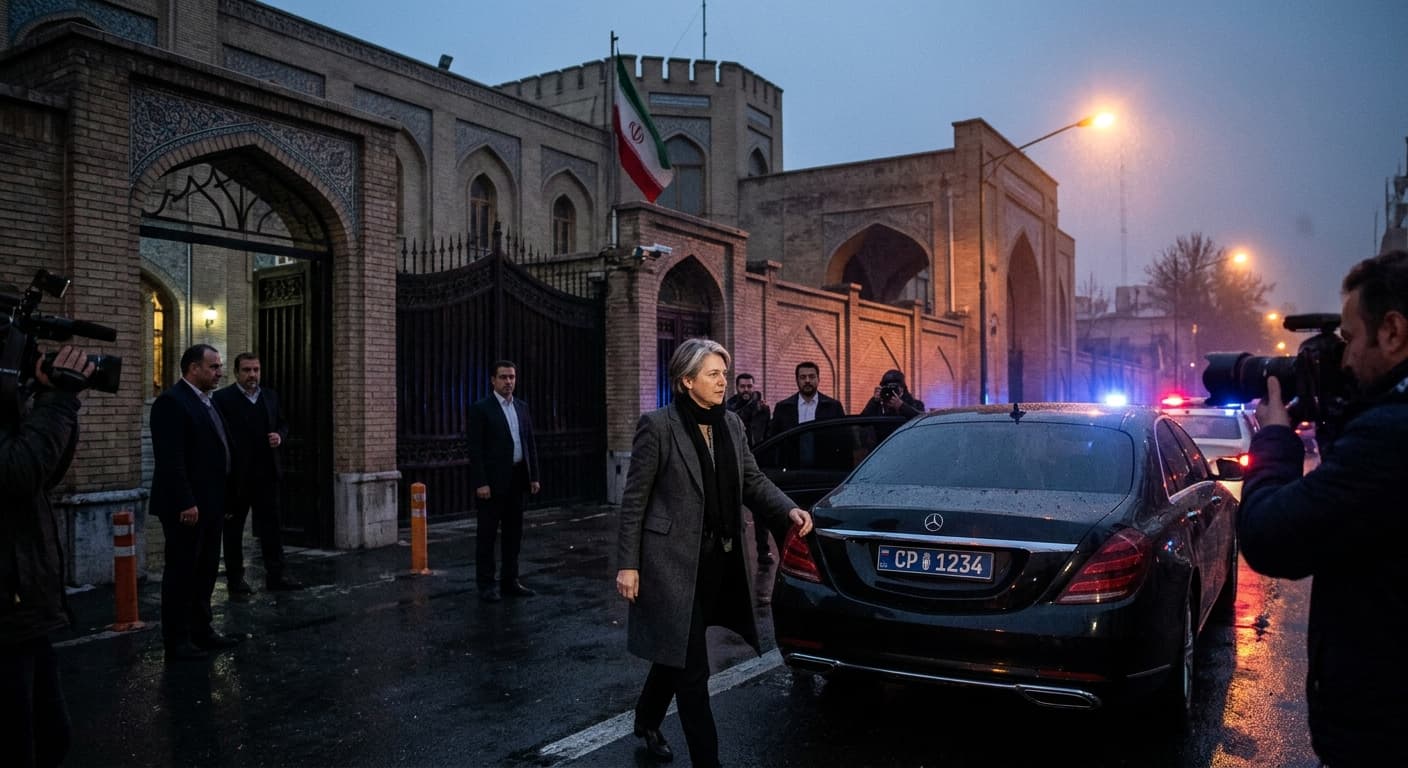
Tehran Summons UK Envoy as London's Iran Playbook Hardens
Iran and Britain traded ambassadorial summonses on July 7 and July 9, 2026 — a diplomatic ritual that now sits atop a hardened UK legal architecture for treating Tehran as a state threat.
Iran's foreign ministry summoned British ambassador Hugo Shorter on July 9, 2026, two days after London hauled in Iranian Chargé d'Affaires Ali Nasimfar over the Woolwich Crown Court sentencing of two Romanian nationals for stabbing Iran International presenter Pouria Zeraati. For the first time, a UK judge has formally ruled that an act of violence on British soil was carried out under the "foreign power condition" of the National Security Act 2023, giving the Foreign Office a statutory finding, not just intelligence, to pin on Tehran. That verdict, arriving in the middle of a resumed US–Iran shooting war and eight months after the E3 triggered UN snapback sanctions, is what makes this exchange different from the twelve summonses that preceded it since 2022.
What actually happened
The Foreign, Commonwealth and Development Office confirmed on July 7 that Middle East Minister Hamish Falconer summoned Nasimfar following the sentencing of Nandito Badea, 21, and George Stana, 25, at Woolwich Crown Court. According to the
BBC, Badea received 12 years and Stana eight for the March 29, 2024 knife attack outside Zeraati's Wimbledon home, which left the presenter with three stab wounds in his upper thigh. The judge told the court he was "sure this attack was carried out for, or to the benefit of, a foreign power" and that Stana "knew, or ought to have known" of the connection to Iran. A third alleged participant, David Andrei, remains in Romania and could not be extradited.
The trial exposed the mechanics of the operation. Prosecutor Duncan Atkinson KC told the jury the attack was "a planned attack preceded by reconnaissance, and which was ordered by a third party acting on behalf of the Iranian state," according to the BBC's trial reporting. Reconnaissance began in March 2023, when Stana was stopped by police in a garden at Zeraati's Wimbledon address wearing gloves and a surgical mask, carrying scissors, with an unidentified companion holding a bag containing what appeared to be a sports bat. Mobile-mast data linked further reconnaissance in February and March 2024 to Badea and Andrei; money transfers were traced to a British–Iranian dual national named Edgar Hakkopian.
Tehran responded within 48 hours. As Iran International reported, Alireza Yousefi, Director General for Western Europe at the Iranian Ministry of Foreign Affairs, handed Shorter a protest note dismissing London's claims as "baseless" and demanding Britain stop hosting media outlets it alleges act as "proxies of Israel." The
Diplomatic Insight confirmed the formal delivery of the note the same afternoon. Iran International itself has been designated a "terrorist organisation" by Tehran, and posters bearing Zeraati's face with the caption "Wanted: dead or alive" were pasted around the Iranian capital in November 2022, according to court testimony reported by
the BBC.
The legal fulcrum: Section 31 of the National Security Act
The reason this summons carries more weight than the four the FCDO has already issued in 2026 is Section 31 of the National Security Act 2023. The statute, published by the UK legislation office, defines the "foreign power condition" as met where conduct is "carried out for or on behalf of a foreign power" and the actor knew, or ought to have known, that fact. Once a court applies it, an ordinary criminal offence becomes an act of state-directed hostile activity — with sentencing uplifts and prosecutorial discretion attached.
Stana became the first person on UK soil found to meet that condition in connection with a physical attack. Badea, the man who wielded the knife, did not — the judge concluded prosecutors had not proven he understood the Iranian link. That split verdict is politically awkward for Tehran but strategically decisive for London: it establishes case-law scaffolding for future prosecutions of Iranian-directed proxies, which MI5 Director-General Sir Ken McCallum told Al Jazeera in October 2024 now dominate the domestic threat picture alongside Russia. McCallum said state-threat investigations at MI5 had jumped 48 percent in a single year and warned that Iran and Russia were "turning to proxies to do their dirty work."
The Foreign Influence Registration Scheme, brought into force on July 1, 2025 via statutory instrument specifying Iran as an "enhanced tier" foreign power, was the executive branch's parallel move. The regulations name the Supreme Leader, the entire Government of Iran, the IRGC, the Ministry of Intelligence and Security, the Artesh, the Supreme National Security Council, the judiciary and the Islamic Consultative Assembly. Anyone directed by any of them to conduct activities in the UK — including criminal proxies — must register or face five years in prison. Read together with Section 31, the two instruments do something UK counter-terrorism law has never previously done: apply proscription-style disruption to a sovereign state's intelligence apparatus without formally proscribing the IRGC.
Why Tehran keeps taking the punch
The obvious question is why the Islamic Republic tolerates this cycle rather than de-escalating. The answer sits in three overlapping pressures Tehran cannot resolve at once.
First, snapback. The E3 — Britain, France, Germany — triggered the JCPoA snapback mechanism on August 28, 2025, and UN sanctions reimposed on September 27, 2025, according to the E3 joint statement. UK Chargé d'Affaires James Kariuki told the
UN Security Council on June 9, 2026 that Iran remains the "only state without nuclear weapons to accumulate over 400kg of high enriched uranium," and that the IAEA now cites "sustained gaps in monitoring" and refusal of access to nuclear sites. Britain is the diplomatic anchor of the reimposed sanctions regime; attacking Iran International presenters is, from Tehran's calculus, an asymmetric response to E3 leverage its own military cannot answer directly.
Second, war. The US–Iran ceasefire signed on June 17, 2026 broke on July 6, when Iran struck three merchant vessels in the Strait of Hormuz and CENTCOM retaliated against approximately 80 Iranian coastal targets. Al Jazeera reported a further 90 US strikes on July 8, targeting missile storage, drone facilities and logistics sites, with a US strike also hitting a railway bridge in Iran's northeast. The Stimson Center's
Joaquin Matamis argues Tehran is executing a "dual approach" — negotiating and coercing simultaneously — to force acceptance of Iranian administration of Hormuz. UK-based dissidents are one lever in that portfolio; each Iran International broadcast documenting the war's civilian cost weakens the negotiating hand of Parliament Speaker Mohammad Bagher Ghalibaf, Tehran's lead negotiator.
Third, succession. Iran's Supreme Leader Ayatollah Ali Khamenei was killed in February 2026 in the opening hours of the US–Israel strikes, according to Al Jazeera's July 8 analysis. The transitional leadership — with Ghalibaf negotiating and President Masoud Pezeshkian managing sanctions — cannot afford to appear weak toward exiled opposition media that provided the loudest coverage of the war's civilian toll. Pezeshkian has already rejected a US demand to hand over Iran's enriched-uranium stockpile in exchange for a three-month sanctions exemption, telling reporters, per
the BBC, that Iran would not "put ourselves in such a trap and have a noose around our neck each month." Coercion of dissidents is politically cheaper than concession.
What London has still not done
Britain's response has hardened at the legal-technical layer while remaining strikingly restrained at the diplomatic-political one. The FCDO summoned Iran's chargé d'affaires and ambassador at least four times in 2026: January 13 over protest violence in Iran,
March 4 over regional escalation,
April 28 over the Iranian embassy's inflammatory social-media posts, and now July 7. Foreign Secretary Yvette Cooper unveiled a new
sanctions package on May 11, 2026 targeting the Zindashti network — a group
Foreign Policy Watchdog and the BBC's own investigation have linked to Iranian intelligence — along with the Berelian and GCM currency exchanges and 12 named individuals. The UK now holds "over 550 sanctions against Iranian-linked individuals and entities," according to
the Home Office.
What London has not done is proscribe the IRGC or downgrade diplomatic relations. Prime Minister Sir Keir Starmer signalled in May 2026 that state-threat proscription legislation will be included in the King's Speech on May 13, according to the BBC. But the Terrorism Act 2000 has still not been amended to reach the IRGC, and Labour has quietly stepped back from the pre-election pledge it made in 2024. Shadow Foreign Secretary Priti Patel has attacked the delay from the opposition benches, arguing "our allies from Europe to Canada and the Gulf have already acted, and the UK is lagging behind." The EU designated the IRGC as a terrorist organisation earlier this year, with High Representative Kaja Kallas telling
the BBC that "repression cannot go unanswered." The Intelligence and Security Committee's July 2025 report — cited by
the BBC — concluded the UK faces a "rising and unpredictable threat from Iran," with a sharp increase in physical threats against regime opponents on British soil.
The reason for the restraint is functional. Proscribing the IRGC or expelling the ambassador would collapse the only remaining bilateral channel the E3 uses on the nuclear file. Foreign Secretary Cooper made that trade-off explicit in her January 13, 2026 statement to the Commons: she summoned Iran's ambassador and personally raised abuses with Foreign Minister Abbas Araghchi rather than sever ties. The FCDO is running a two-track policy — legal hardening at home, diplomatic aperture abroad — and each summons is a message that the tracks can be walked simultaneously.
The historical parallel London is not repeating
The instructive comparison is not to the 2011 sacking of Britain's Tehran embassy, but to the Skripal response of 2018. After the Salisbury nerve-agent attack, the May government expelled 23 Russian intelligence officers and mobilised a coordinated Western expulsion of more than 150 Russian diplomats. That was a proportionate response to an attack that used a chemical weapon on British soil, and it produced, on the Freedom House assessment, a measurable reduction in overt Russian intelligence presence in the UK.
The Zeraati case is deliberately not being escalated to a Skripal-scale response — and that choice reveals London's operating theory. Iran, unlike Russia in 2018, sits inside an active nuclear diplomacy that Britain still needs. Freedom House's transnational-repression report notes that UK authorities have layered protection around specific targets — including panic buttons issued by counter-terrorism police to journalist Sima Sabet after intelligence indicated an assassination plot — rather than break diplomatic ties. The state-threats architecture built between 2023 and 2026 is designed precisely to escalate against Tehran within a preserved diplomatic frame.
The Zeraati precedent's real weight
The narrower legal significance of Woolwich is that UK prosecutors now know how to build a "foreign power condition" case around a proxy attack in which no Iranian national is on the docket. That matters because Iran's operating pattern, as detailed in the BBC's investigation, is to sub-contract violence to organised crime groups — the Zindashti network, the Thieves-in-Law, low-level European criminals — precisely to keep IRGC officers out of British courtrooms. Sources inside UK security services told the BBC the Romanian defendants in the Zeraati case were "part of the Thieves-in-Law, allegedly hired by Iranian agents."
The Woolwich verdict punctures that firewall. Prosecutors did not need the actual Iranian intelligence officer in the dock; a Romanian getaway driver's WhatsApp messages, mobile-mast data and a British-Iranian dual national's money transfers were enough. Expect the Crown Prosecution Service to reach for the same statutory hook in the case of Mostafa Sepahvand, Farhad Javadi Manesh and Shapoor Qalehali Khani Noori — the three Iranian nationals charged in May 2025 for surveillance targeting Iran International journalists, whose prosecution is proceeding through the courts, according to a Home Office national security update and reporting by
the BBC.
The FCDO press release, notably, quoted the judge's finding verbatim:
"The judge concluded that this attack was carried out in the interests of, and on behalf of, the Iranian state. This follows a longstanding pattern of hostile activity by the Iranian intelligence services on UK soil."
That sentence is a template. It converts a criminal verdict into a diplomatic instrument — one that can be read out at the UN, cited in sanctions designations, and repeated the next time an Iranian diplomat is summoned.
Named winners and losers
Iran International is the clearest institutional winner. The channel, which relocated its broadcasting studios to Washington DC in February 2023 after threats spiked, resumed London operations in September 2024 and now has a court verdict identifying it as the target of an Iranian state-sponsored attack. Its editorial standing — and the case for protective spending by UK security agencies — is unassailable. BBC Persian and Manoto TV, both broadcast from London, benefit indirectly: the ISC report explicitly identified them as "prominent targets" alongside Iran International, and their protective posture is now underwritten by the same legal architecture.
The clear loser is Iran's diplomatic mission in London. It has cycled through summonses in January, March, April and July of this year alone and is bracketed by the FIRS enhanced tier as an entity whose associates must register or face criminal liability. Ambassador Seyed Ali Mousavi's freedom of action is narrower than any of his predecessors' since diplomatic relations resumed in 2015. The Iranian embassy's April 28 social-media rebuke — where Falconer told Mousavi to cease "any form of communications that could be interpreted as encouraging violence in the UK or internationally" — suggests the mission itself is now viewed by London as part of the influence problem, not part of the solution.
The Conservative front bench is a smaller but real winner: Priti Patel's proscription argument gets stronger with every verdict, and the government's failure to move on the Terrorism Act creates a live political vulnerability heading into the autumn parliamentary session.
What to watch next
- King's Speech, autumn 2026: whether the state-threats proscription bill contains an explicit IRGC-facing power, and whether Downing Street uses it. Failure to do so hands the Conservative opposition a running argument through 2027.
- Iran International prosecutions: the trial of Sepahvand, Manesh and Noori — charged May 17, 2025 with reconnaissance against Iran International staff — will be the second test of the National Security Act's foreign power condition. A guilty verdict compounds the Zeraati precedent and unlocks a template for the next case.
- UNSC 1737 Committee: the UK is pressing for the appointment of a Panel of Experts to police reimposed sanctions. Russia and China are blocking. Expect a fresh UK-led resolution attempt before the September anniversary of snapback.
- US–Iran MoU: if Trump formally walks away from the June 17 memorandum, E3 diplomatic space narrows and UK restraint on IRGC proscription becomes politically harder to sustain.
Diplomat View
The tit-for-tat summonses are cover for a structural shift most reporting has missed: Britain is now prosecuting Iranian state hostility as a criminal-legal problem rather than treating it purely as an intelligence one. The Zeraati verdict is the first successful application of the National Security Act 2023's foreign power condition to a violent act on British soil, and it gives the FCDO a court finding — not a briefing — to weaponise diplomatically. That is why Tehran responded with a written protest rather than a phoned complaint.
The forecast: London holds the two-track policy through 2026 — sanctions and prosecutions escalate, but the ambassador stays and the IRGC remains unproscribed under the Terrorism Act. What would revise that call is a successful lethal attack on UK soil, a collapse of the US–Iran MoU that ends the diplomatic utility of the Tehran channel, or a Conservative motion the government cannot whip through. Absent one of those triggers, expect three more summonses before Christmas, another sanctions tranche in the autumn, and no ambassadorial expulsion. The reciprocal ritual is not weakness — it is the deliberate acoustic of a policy that has moved to the courtroom.
Discover more
US Politics
House Ethics Committee Pushes Sexual Miscond.
The House Ethics Committee has shifted responsibility for sexual harassment settlement records to the Office of Congressional Workplace Rights, complicating disclosure efforts.
India
Romanian Coalition Party Demands PM Resign
Romania's Social Democrats withdrew from coalition, joining far-right AUR to topple PM Bolojan, risking €10 billion in EU funds by August 2026.
India
Congress Accuses Modi of Stalling Women's Law
Congress accuses Modi of stalling women's reservation law by linking it to delimitation, revealing a deeper electoral strategy.

Economics
Fed's Amex AML order puts correspondent banking on notice
Federal Reserve's Amex AML order requires board-level controls and a 90-day plan; OCC fined the bank $350 million over enterprise-wide deficiencies.