Tamil Nadu’s Governor Test Puts Vijay’s Mandate on Hold
Arlekar’s delay shows the real leverage in a hung House: the Governor can slow the transfer of power, but the Assembly still decides it.
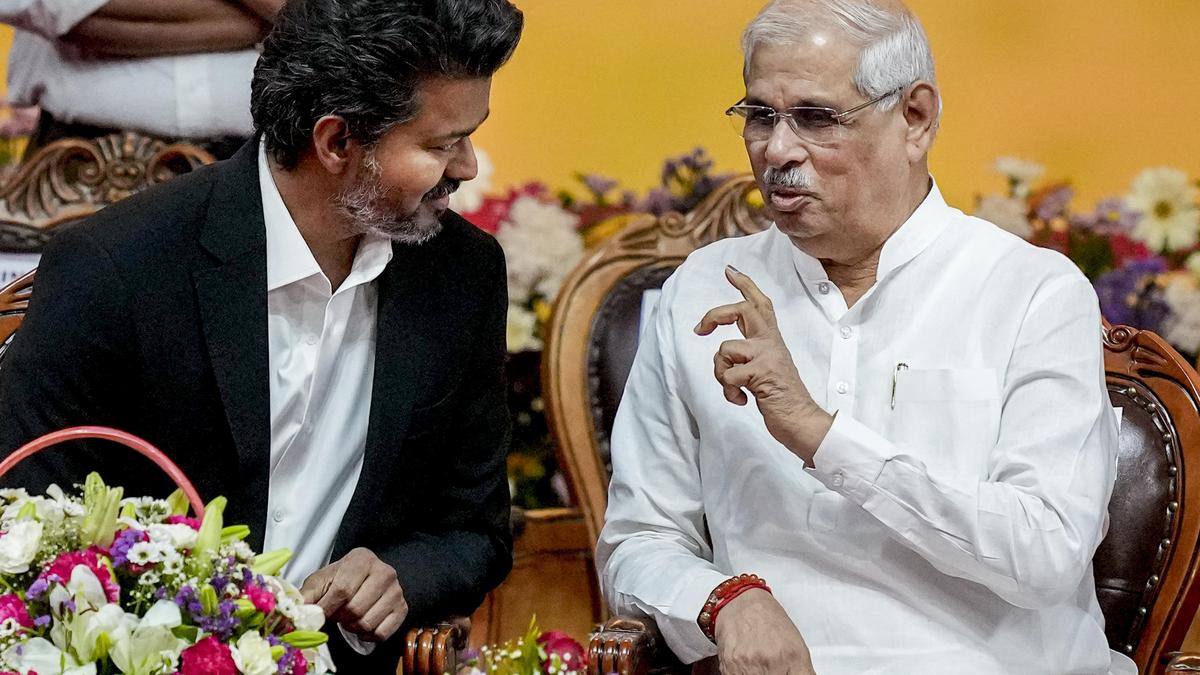
Tamil Nadu Governor Rajendra Arlekar has held back the formal invitation to TVK chief C. Joseph Vijay until he is satisfied the alliance can command a majority, while petitions in the Supreme Court argue he is obliged to invite the single largest bloc first and let the House decide later,  The Hindu ; The Hindu. The Governor controls the gate to office, but only until a floor test forces the arithmetic into the open, The Hindu.
What Arlekar is doing
The immediate dispute is about timing, not just numbers. The Hindu reported that Arlekar told Vijay the “requisite majority support” had not been established and later sought proof of support from 118 MLAs in the 234-member Assembly, even though TVK had won 108 seats and later secured backing from Congress, CPI, CPI(M), VCK and IUML legislators-elect, taking its tally to 120, The Hindu ; The Hindu. The Governor has also directed Vijay to seek a confidence vote by May 13, which means the contest is now moving from Raj Bhavan’s discretion to a deadline inside the Assembly, The Hindu.
That is the power dynamic: the Governor can delay, but not ultimately decide. Business Standard’s reporting frames the same fight as a dispute over whether a governor can demand proof of majority before issuing the first invitation at all, or whether the invite must go first and the confidence test follow,  Business Standard.
Why the conventions matter
This is where the constitutional gap matters. Article 164(1) says the chief minister is appointed by the Governor, but it does not spell out a rigid formula for a hung Assembly. The Hindu’s explainer notes that the Sarkaria Commission and the Punchhi Commission filled that gap with a hierarchy: first a pre-poll majority alliance, then the single largest party with support, then a post-poll coalition whose partners join government, and finally a post-poll support arrangement, The Hindu.
The Supreme Court has also narrowed the Governor’s room. In S.R. Bommai and Rameshwar Prasad, the Court said the floor of the House is the proper place to test majority, not the subjective satisfaction of Raj Bhavan, The Hindu. That matters because it turns the Governor into a temporary referee, not a political chooser. In a fractured House, the side that can produce numbers fastest benefits; the side that relies on delay loses. Right now that means Arlekar can pressure for documentary proof, but he cannot permanently displace the Assembly’s verdict.
For  India, the larger issue is federal leverage. Every time a Governor insists on extra-constitutional proof before inviting a claimant, it sharpens the argument that Raj Bhavan is acting as an extension of the Centre rather than a neutral constitutional office, The Hindu.
What to watch next
The next decision point is the confidence vote due by May 13, and any Supreme Court order on the petitions challenging Arlekar’s handling of the claim, The Hindu. If the Court steps in, it could further limit how much pre-floor discretion a Governor can exercise in a hung Assembly. If it does not, the immediate winner is Raj Bhavan’s leverage; the longer-term winner is whichever bloc can convert letters of support into a tested majority on the floor.