Supreme Court Leaves Senthil Balaji Probe to CBI
By refusing to block the case, the court shifts a politically sensitive Tamil Nadu procurement probe out of the state’s control.
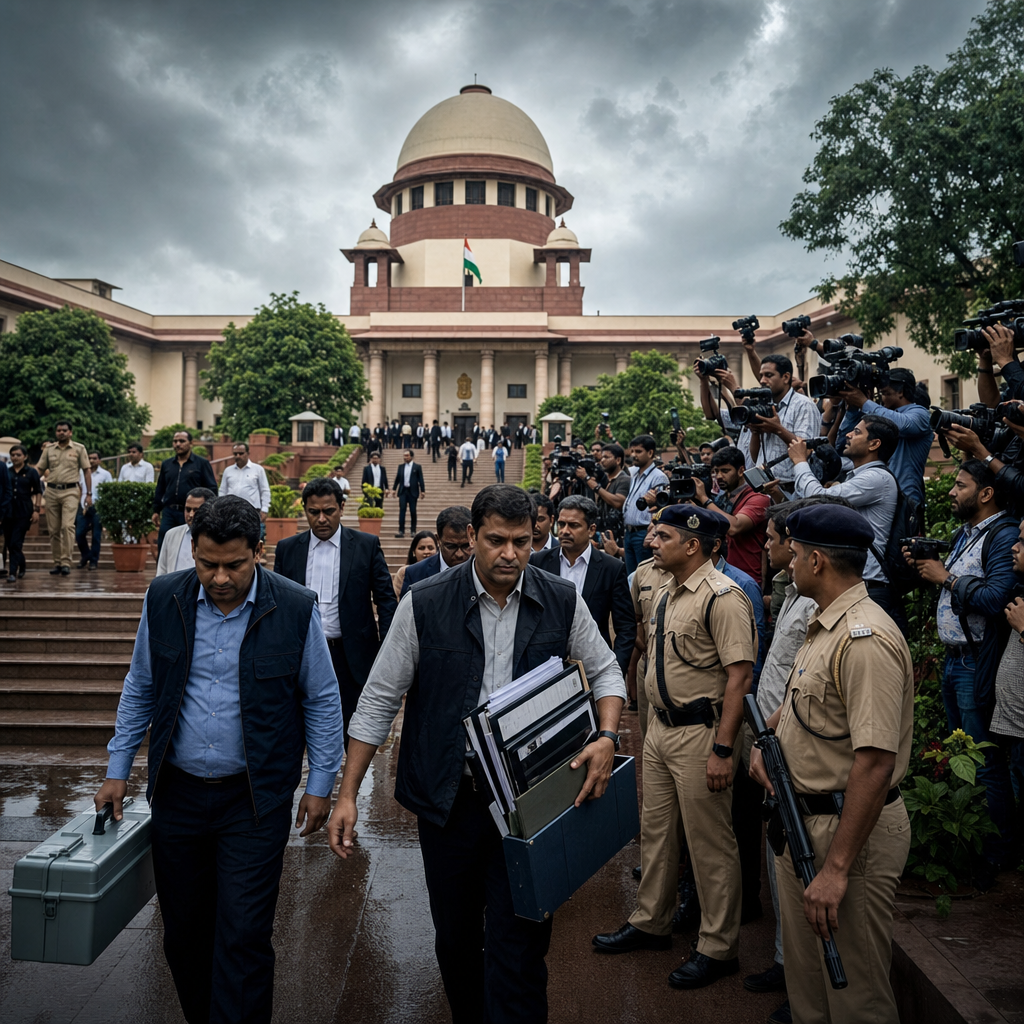
The Supreme Court on Monday dismissed appeals against the Madras High Court’s order sending the transformer procurement case to the CBI, telling the parties it did not need a formal prayer to order such a probe and that the investigation should proceed without being influenced by the High Court’s remarks, according to  The Indian Express and
  LiveLaw. The bench of Justices Vikram Nath and Sandeep Mehta declined to entertain the challenge, which means the Madras High Court’s April 29 transfer order stands for now.
What the court is really moving
The power shift is straightforward: the case is no longer being kept inside Tamil Nadu’s own vigilance system. The High Court had ordered the state’s Directorate of Vigilance and Anti-Corruption to hand the files to the CBI after finding the state’s handling of the complaint deeply delayed and narrowly confined, raising what it called a reasonable suspicion of a cover-up, as reported by  The Hindu and
  The News Minute. The allegations concern procurement of roughly 45,800 distribution transformers between 2021 and 2023, with petitioners claiming a loss of about Rs 397 crore through collusive bidding and cartelisation, according to The Hindu.
That is why the forum matters as much as the accusation. A state agency investigating a case that touches a former electricity minister, a former TANGEDCO chairman, and procurement decisions taken under a DMK government would have been vulnerable to suspicion even if it acted cleanly. The High Court’s logic was that appearance of independence matters when the accused sit near the top of the state’s political and administrative chain, a point emphasized in The Hindu.
Who gains, who loses
The immediate winner is the CBI, which now has a politically sensitive case handed to it by both the High Court and, indirectly, the Supreme Court’s refusal to stop that move. The immediate loser is the state government, because it loses control over timing, sequencing, and narrative. Former minister V. Senthil Balaji also loses room to frame the matter as a local administrative dispute; the case now sits in a central investigative lane with national visibility, as described by  CNBC TV18.
Balaji has denied wrongdoing and argued that procurement procedures were followed as they had been since 1987, according to The News Minute. But that defense now matters less than the next procedural step: whether the CBI appoints its investigating officer quickly, seeks the transferred records, and converts the High Court’s order into a full criminal case. That is the next test of whether this becomes a short-lived headline or a durable corruption file.
What to watch next
The next deadline is the High Court’s two-week timeline for handing over papers, which puts the first real operational test around mid-May, as noted by The Hindu. Watch for two things: whether the CBI registers an FIR immediately, and whether the state tries any procedural fightback through review, delay, or a narrower cooperation posture.