Taiwan's 47% Export Surge and Security
Taiwan's exports soar, impacting geopolitics and security dynamics.
Model Diplomat8 min readAsia
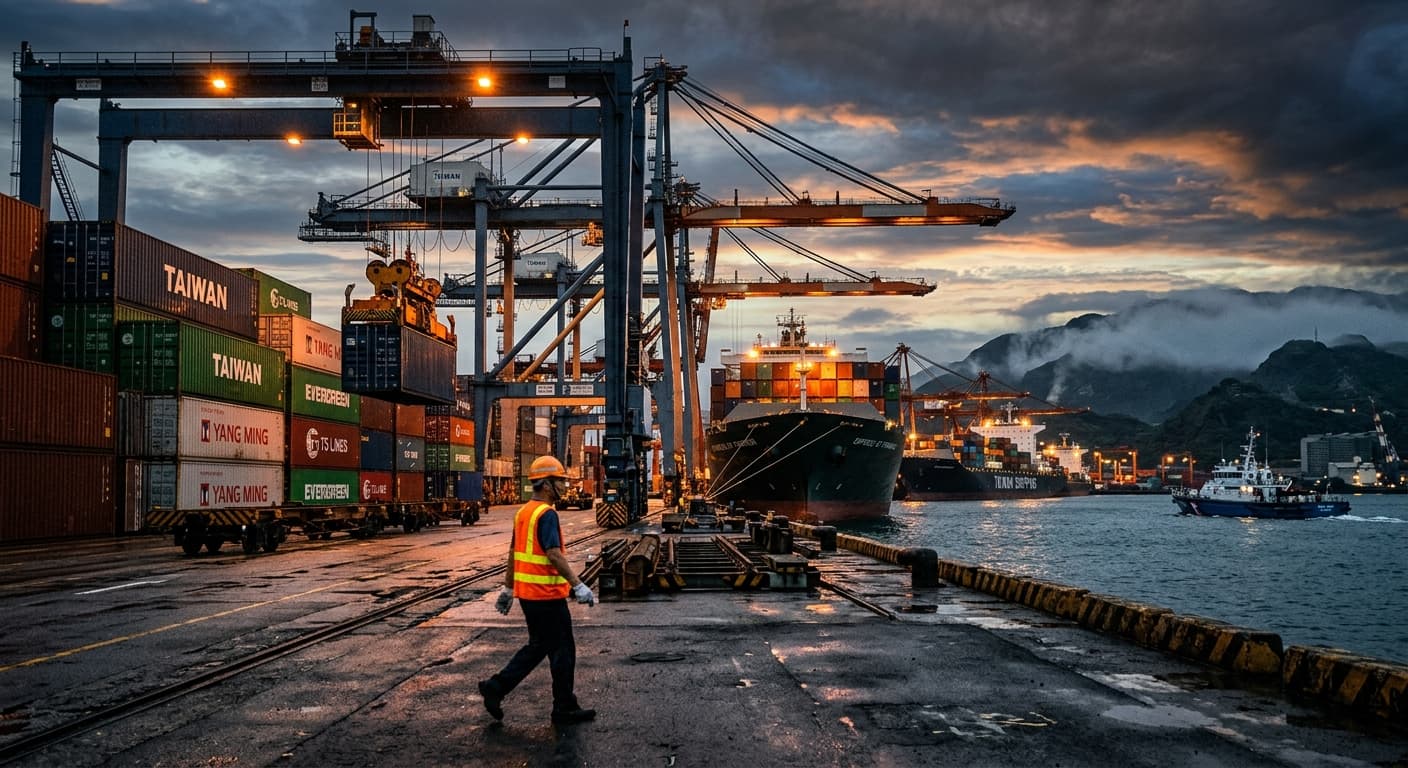
Taiwan's 47% Export Surge Weaponizes the Silicon Shield
Taiwan's H1 2026 exports hit $416.66 billion on AI chip demand, giving Lai leverage against Beijing coercion and Washington's reshoring push.
Taiwan's exports jumped 47.1% to a record $416.66 billion in the first six months of 2026, according to Ministry of Finance data released July 9 — a boom that hands President Lai Ching-te the strongest economic hand any Taipei government has held in a generation, but also compresses the timeline in which he must convert that leverage into hard security before Washington's chip-reshoring drive and Beijing's grey-zone coercion erode the very concentration that gives Taiwan its "silicon shield." The near-vertical trajectory of Taiwan's AI-driven trade is now the central variable in Indo-Pacific supply-chain politics: it has already flipped Taiwan past China as a top-tier U.S. goods partner, and if it holds through 2027 it will force a decision in Washington that Lai would rather defer — whether Taiwan is an ally to be defended or a bottleneck to be bypassed.
The numbers Lai now owns
June exports alone hit $74.83 billion, up 40.3% year-on-year, the 32nd straight month of growth and the third-highest monthly print in Taiwan's history, Focus Taiwan reported citing MOF statistics director Beatrice Tsai. Information, communication and audiovisual products contributed $33.92 billion; electronic components another $25.39 billion — the second-highest monthly total on record for that category. Second-quarter exports crossed $220.93 billion, the first quarter above $200 billion, with ICT and electronics shipments up 56.9% year-on-year.
The geographic pattern is more consequential than the headline number. Shipments to the United States rose 69% in H1 2026, to Europe 55.7%, and to ASEAN 55.4%, per MOF data cited by Focus Taiwan. Taiwan's bilateral trade surplus with the U.S. crossed $104 billion in six months — already higher than the full-year 2024 figure — and Tsai projects it will exceed $200 billion by December. Tsai also noted Taiwan's 47.1% export growth ranked second globally in H1, behind only South Korea's 48.4%, and its 32-month expansion streak is the longest among major economies.
Central bank confirmation lands the point at primary-source weight. In its June 18 monetary policy statement, the Central Bank of the Republic of China revised its 2026 GDP forecast up to 9.45%, citing "robust growth in exports and steady expansion in private investment on the back of strong demand for AI and other emerging technology applications," according to the CBC. That follows an 8.63% expansion in 2025 and a 13.69% first-quarter print in 2026,
Al Jazeera reported, citing HSBC data showing the Taiwan Stock Exchange more than doubling to $2.2 trillion between 2019 and 2025. Foreign-exchange export proceeds for June 2025 alone showed a 47.1% year-on-year jump to $37 billion in
CBC summary statistics — the pattern is now more than a year old and accelerating.
The "AI island" as doctrine, not slogan
Lai's "AI island" framing — launched during his 2024 campaign and now the operating principle of his industrial policy — is doing three jobs simultaneously. It rebrands Taiwan's role for a Trump administration that talks about semiconductors in national-security rather than trade terms. It gives Taipei a positive-sum pitch to Southeast Asian and European partners nervous about being seen to "help" Taiwan. And it converts the silicon shield from a passive deterrent — the idea that Beijing would not attack the source of chips it needs — into an active bargaining chip.
Lai has been explicit about the pitch. As the Council on Foreign Relations noted, he told U.S. counterparts Taiwan is "an indispensable partner in the process of rebuilding American manufacturing" and that Taipei wants to "help the United States reindustrialize and become a global AI hub." That is the language of a supplier who knows its customer has no near-term alternative. TSMC produces over 90% of the world's most advanced logic chips, and the U.S. share of global fabrication capacity is projected to rise only from around 10% to 14% by 2032 even after TSMC's $165 billion Arizona commitment, per the same
CFR analysis. At end-2025, TSMC began 2nm production in Taiwan — the industry's most advanced node — deliberately holding the frontier onshore, according to a stress-test by
Istituto Affari Internazionali.
The doctrine also has a southbound dimension that quietly rewires regional geometry. Taiwan launched the Taiwan-Philippines Economic Corridor in August 2025, aligning semiconductor and smart-agriculture investment with the existing U.S.-Japan-Philippines Luzon corridor, a June 2026 CSIS assessment found. Integrated circuits jumped from 1.6% of Taiwan's exports to India in 2016 to 51% in 2025, and Taiwan's ASEAN trade rose 32.5% in 2025 to $181.5 billion, per the same CSIS study. The historical parallel is Japan in the 1980s — an export superpower whose leverage over Washington briefly looked structural before the Plaza Accord and Tokyo's own currency and reshoring choices dissipated it. Lai's team appears to have read the same history and is trying to lock in security commitments before the analog concludes.
The trap inside the boom
Here is where the analyst's brief diverges from the celebratory wire copy. The same numbers that give Lai leverage in Washington also create the pressure that could dissolve it.
The trade surplus is a political time bomb. A $200 billion bilateral surplus would be roughly triple Taiwan's 2024 level, and President Trump's tariff regime is explicitly premised on treating such deficits as an emergency. The July 2025 U.S.-Taiwan Reciprocal Trade Agreement lowered Taiwan's base tariff from 20% to 15% and secured a $250 billion Taiwanese investment pledge in U.S. chip and technology manufacturing, per the Council on Foreign Relations. But CFR's parallel analysis of the deal warned that Taiwan's surplus "is set to expand" and that "the AI boom, while underscoring Taiwan's importance as a U.S. partner, may also exacerbate concerns about relying too much on the island," according to
CFR. Commerce Secretary Howard Lutnick has said publicly the administration wants 40% of Taiwan's semiconductor supply chain onshored — a target Taiwan's vice premier Cheng Li-chiun has publicly called unrealistic.
The currency squeeze is real. The New Taiwan dollar has appreciated sharply against the U.S. dollar since spring 2025 under U.S. pressure. Each one-percent NTD appreciation cuts TSMC's operating margin by roughly 0.4 percentage points and ASE Technology's gross margin by about 1.5 points per NT$1 move, according to a MP-IDSA analysis. Foxconn has already trimmed its full-year growth outlook. The 2025 U.S. Trade Representative's National Trade Estimate report kept the NTD on the Treasury's currency monitoring list, MP-IDSA noted — the leverage is codified. In other words, the dollar figures for H1 2026 flatter the underlying volume story, and smaller Taiwanese exporters in traditional machinery and petrochemicals — the constituencies Lai's DPP most needs to hold — are already feeling the pinch.
The silicon shield thesis is under quiet revision. Beijing has been methodically reducing dependence: Chinese imports of Taiwanese advanced chips fell from 61% to 53.8% of the total between 2020 and 2023, per the Istituto Affari Internazionali stress-test. Meanwhile the PLA is normalising pressure. CSIS's May 2026 "Geometry of Coercion" report found that between 2020 and 2025 the daily average of distinct China Coast Guard vessels in Taiwan's near waters rose over 500%, with incursions into the second maritime security ring more than quadrupling, according to
CSIS. On May 26, 2026, Taipei tracked 29 PLA aircraft and seven warships in a second "joint combat readiness patrol" within a week, and Taiwan's National Security Council spotted the Liaoning carrier group in the West Pacific,
Al Jazeera reported. Chatham House modelled the second-order stakes: a Chinese air-sea blockade of Taiwan would cut global GDP by 5%, a U.S.-China war by nearly 10%, with the EU and Southeast Asia hit hardest after Taiwan itself, according to
Chatham House.
Energy is the choke point that could pre-empt the choice. TSMC alone consumes 9% of Taiwan's electricity today, projected to hit 15% by 2030, on an island with 4.2% energy self-sufficiency whose last nuclear reactor shut in May 2025, according to CSIS. Taiwan imported nearly 70% of its crude and 34% of its LNG from the Middle East in 2024, mostly Qatari — the same LNG that transits waters Beijing is learning to constrict. The AI island runs on fossil-fuel supply lines that a customs quarantine could interdict without a shot fired.
Who wins, who loses
The unambiguous winners are TSMC's American customers — Nvidia above all, whose GPUs are almost exclusively fabricated by TSMC on Taiwanese soil — and TSMC itself, whose leverage against U.S. onshoring pressure grows with every export record. Lai's DPP wins in the near term: an 8.6% GDP economy underwrites his defence budget and mutes domestic critics who accused him of provoking Beijing. Vietnam and the Philippines quietly win as chip re-export and assembly nodes, which is why Manila signed onto the TPEC framework and why U.S. imports from Vietnam surged despite tariffs, Al Jazeera reported.
The losers are more diffuse but strategically important. Traditional Taiwanese manufacturers absorbing NTD appreciation without margin cushion. Intel and Samsung, whose reshoring pitch is undermined every quarter TSMC widens its lead. Ordinary Taiwanese who see house prices soar while wages lag — Al Jazeera noted GDP grew 8.63% in 2025 while public trust in the U.S. as a security partner slid, with one poll cited by
CFR showing 60% of Taiwanese now view the U.S. as untrustworthy, up 10 points from 2024. That erosion is the deepest threat to Lai's strategy: an "AI island" that alienates its own electorate cannot bargain from strength for long.
Diplomat View
The forecast is this: Taiwan's export leverage peaks between now and mid-2027, then compresses. Three forces converge to close the window — TSMC's first Arizona 2nm output coming online in 2028, Beijing's grey-zone campaign hardening into scheduled quarantine drills, and NTD appreciation eating into the margin cushion that funds Taiwan's defence buildup. Lai's task in the next twelve months is not to sustain growth — that's baked in by AI capex cycles — but to convert it into binding U.S. and allied security commitments before the reshoring narrative in Washington concludes that Taiwan is a supplier, not a partner. What would revise this forecast: a U.S. carve-out extending chip tariff exemptions past 2027 without further onshoring quotas; a formal EU-Taiwan supply-chain resilience pact of the kind the IAI paper recommends; or, on the downside, a Chinese customs "quarantine" exercise that materially disrupts a single week of container traffic through the Taiwan Strait. Any of the three would tell you which way the geometry has locked.
What to watch next
- August 2026: MOF July export data release — a print below 30% YoY growth would be the first sign of demand normalisation.
- September 2026: Expected U.S. Section 232 semiconductor tariff determination; carve-out terms will define TSMC's next move.
- October 2026: CBC Q3 monetary policy meeting and any signal on NTD intervention; the pain threshold sits near NT$30 to the dollar.
The Bottom Line
Taiwan's 47% export surge is not a story about chips — it is the moment Taipei's economic indispensability and its strategic vulnerability cross paths. Lai has roughly eighteen months to trade AI leverage for durable security guarantees before Washington's reshoring math, Beijing's grey-zone tempo, and the NTD's rise conspire to make the silicon shield thinner than the balance sheet suggests.
Discover more
India
Women’s Reservation Bill 2026
The Constitution (131st Amendment) Bill, 2026 was defeated in Lok Sabha, revealing deeper political conflicts over women's reservation and delimitation.
India
Modi's Women’s Convention in Varanasi
Modi's Varanasi rally frames women's reservation as a national mission, targeting the 2027 Uttar Pradesh elections with a strategic narrative.

India
BJP's Misunderstanding of Women's Quota Needs
The BJP's linking of the Women Reservation Bill to delimitation risks delaying women's empowerment in India, misreading the aspirations of female voters.

Economics
Fed's Amex AML order puts correspondent banking on notice
Federal Reserve's Amex AML order requires board-level controls and a 90-day plan; OCC fined the bank $350 million over enterprise-wide deficiencies.