Modi's Women’s Convention in Varanasi
A strategic rally for UP 2027 elections
Model Diplomat8 min readIndia
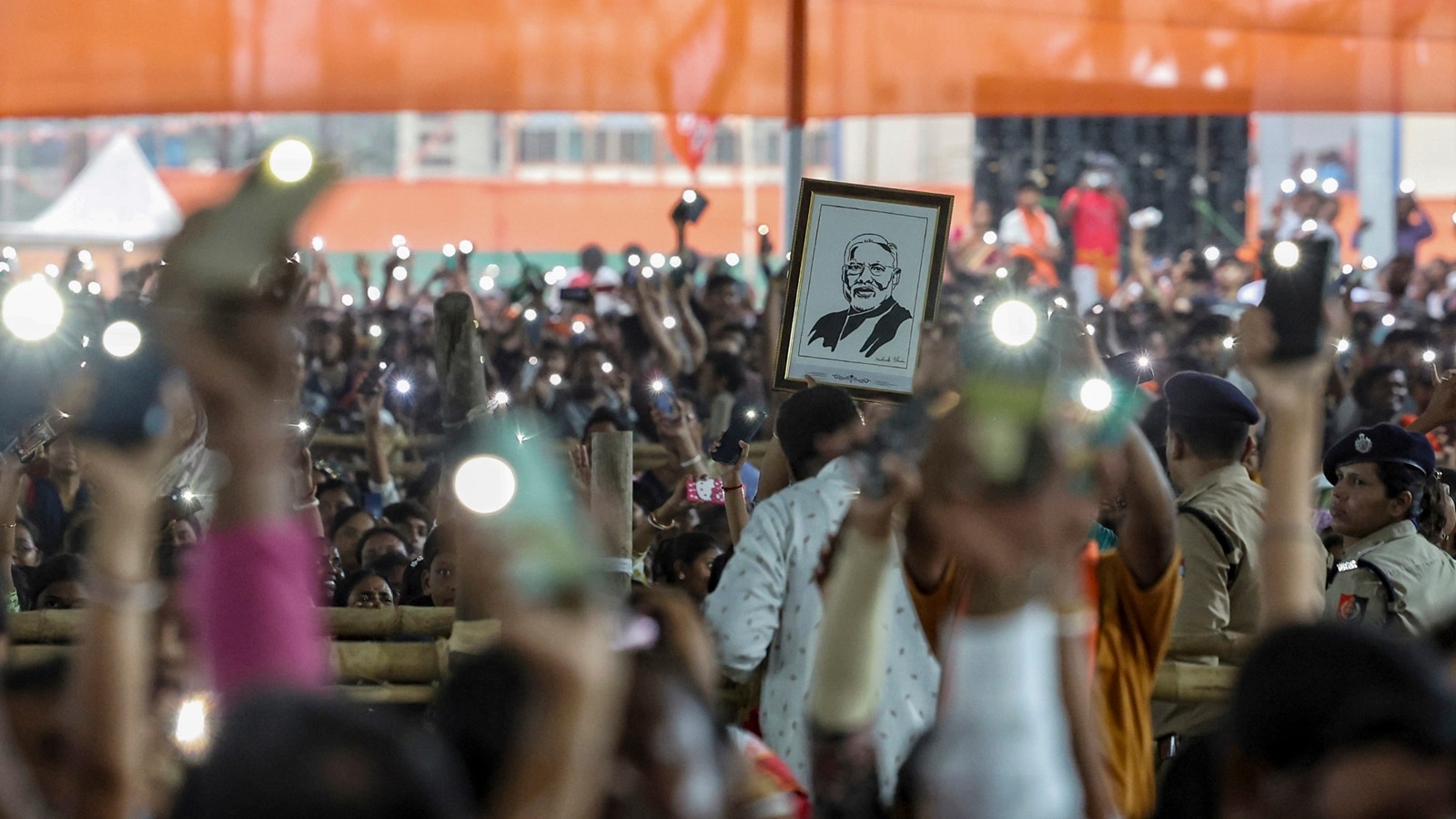
Modi's Varanasi Women's Convention: A UP 2027 Opening Bell
Modi told 50,000 women in Varanasi on July 7, 2026 that reservation is a "national mission" — and blamed the opposition for the April defeat of the 131st Amendment.
Prime Minister Narendra Modi's Mahila Sammelan in Varanasi on July 7, 2026 was not a policy launch — it was the first campaign rally of the 2027 Uttar Pradesh state election, disguised as a women's convention. Standing in his own parliamentary constituency, twelve weeks after his government's Constitution (131st Amendment) Bill collapsed in the Lok Sabha with only 298 votes in favour against 230, Modi converted a rare legislative defeat into a wedge issue: the opposition, not the BJP's own arithmetic, killed women's reservation. The Rs 6,350 crore in projects he inaugurated is the delivery arm; the reservation grievance is the mobilisation arm. Together they are the template the BJP intends to run in India's most populous state next year.
What actually happened in Varanasi
According to the Prime Minister's Office, Modi addressed a Mahila Sammelan in his Varanasi constituency and inaugurated or laid foundation stones for projects worth roughly Rs 6,350 crore across health, sanitation, connectivity and housing. State broadcaster
DD News reported the crowd at around 50,000 women, with Muslim women visibly placed in the front rows — a staged tableau clearly aimed at the coming Uttar Pradesh contest. Uttar Pradesh Chief Minister Yogi Adityanath and BJP general secretary Nitin Nabin flanked him, per
New Kerala, giving the event the character of a state-level, not merely constituency-level, mobilisation.
The message was tightly framed. Modi called women's reservation "a national mission" and, according to the Indian Express, attacked the Congress, Samajwadi Party, TMC and DMK for defeating the 131st Amendment Bill in April. The
Times of India quoted him arguing that "parivarvadi" (dynastic) parties see the rise of women legislators as an existential threat. The
Economic Times captured the framing device — "Nari Shakti is the strongest pillar of Viksit Bharat" — that ties women's empowerment directly to the government's 2047 developed-nation slogan.
The April defeat that made this rally necessary
To read Tuesday's convention correctly, start with April. On April 17, 2026, the Constitution (131st Amendment) Bill — which sought to expedite the 33 percent women's quota by linking it to a Lok Sabha expansion from 543 to 850 seats and a delimitation based on 2011 census data — was defeated in the lower house. Lok Sabha Speaker Om Birla, in his end-of-session statement carried by the Press Information Bureau, confirmed that the House discussed the three bills for 21 hours 27 minutes with 131 members participating, and that "the Constitution Amendment Bill was not passed by the House."
The vote was 298 in favour and 230 against — well short of the two-thirds majority a constitutional amendment requires. As the NUS Institute of South Asian Studies noted, this was "the first time that the passage of a constitutional amendment was blocked" during Modi's decade in office. Al Jazeera had reported before the vote that the NDA controls 293 Lok Sabha seats while a two-thirds majority requires roughly 360 — the math, according to
Al Jazeera, was never there.
That is the point of the Varanasi framing. The BJP knew it lacked the numbers. It ran the bill anyway, in the middle of state election campaigns, and then blamed the opposition when it collapsed. Senior journalist Adesh Rawal told BBC Hindi the exercise looked designed less to legislate than to construct a narrative that "the opposition is against half the country's population" — a script Modi could then run across state after state. The Takshashila Institution's
post-mortem reached the same conclusion: the bills, packaged against the backdrop of state polls, were "seen as an affront to federalism and were defeated."
The table below is the whole story
| Item | Number |
|---|---|
| Votes in favour of 131st Amendment | 298 |
| Votes against | 230 |
| Two-thirds threshold required | ~360 |
| NDA strength in Lok Sabha | 293 |
| Current women's share of Lok Sabha | ~14% |
| Proposed Lok Sabha expansion | 543 → 850 |
| Reserved share for women (2023 Nari Shakti Vandan Act) | 33% |
| Sources: PIB (Speaker's statement), ISAS-NUS, Al Jazeera, BBC Hindi. |
Why the strategy just misfired — and why it may still work in UP
There is an obvious counter-case to Modi's playbook: the states where he tried it first this year did not reward it uniformly. In the April–May 2026 assembly elections, the BJP's welfare-and-women pitch, coupled with the reservation blame game, produced two very different results.
In West Bengal, the strategy delivered a historic breakthrough. The BJP won 207 of 294 seats with a 46 percent vote share, reducing Mamata Banerjee's TMC to 80 seats — the first time in nearly 50 years that the ruling party at the Centre has won Bengal, per ISAS-NUS. The BJP's manifesto promised women Rs 3,000 a month, double the TMC's Lakshmir Bhandar scheme, and, as the
BBC noted, urban women in particular deserted Banerjee — a decisive dent in the coalition that had elected her three times.
In Tamil Nadu, the same script died. According to BBC live coverage, actor-turned-politician Joseph Vijay's TVK swept the state, with the BJP nowhere near power. As the
Economist observed the day the parliamentary special session began, the fight for women voters — with cash transfers doubled and redoubled — has become the central axis of Indian state politics. Tamil Nadu's DMK had already scaled up its own Kalaignar Magalir Urimai Thittam cash-transfer scheme (Rs 1,000 a month to women heads of households), documented by the
Observer Research Foundation, inoculating the state against BJP welfare promises. The reservation-defeat narrative also collapsed there because DMK leader M.K. Stalin had burned a copy of the bill on the Assembly floor, per Al Jazeera — making him a symbol of southern federalism, not of anti-women politics.
The Bengal outcome is what Varanasi is being organised around. Uttar Pradesh has 80 Lok Sabha seats — the single largest state bloc — and the BBC has long described it as "the biggest prize" in Indian elections. If the BJP can port the Bengal formula — doubled cash transfers, welfare-plus-polarisation, and a reservation grievance aimed at the Samajwadi Party's Yadav-Muslim base — into UP for 2027, Yogi Adityanath's return becomes very likely. That is what the Muslim women in the Varanasi front rows were meant to signal.
The historical parallel: 2019 all over again, with better data
There is a precedent for exactly this move. In March 2019, weeks before that year's general election, Modi held a National Women Livelihood Meet in Varanasi and unveiled projects worth Rs 3,350 crore in the district — PIB records show he addressed self-help groups with 65 lakh women participating by video conference across 75,000 locations. The BJP won the general election that May with a bigger mandate than in 2014.
The 2026 Varanasi convention doubles the price tag (Rs 6,350 crore) and layers on the reservation narrative that did not exist in 2019. What Modi has learned since is that women vote as a bloc when cash and identity are combined. Al Jazeera's post-mortem of the 2024 general election, citing Lokniti-CSDS survey data, found that women actually voted marginally less for the BJP (36 percent) than men (37 percent) — the outreach had plateaued. Carnegie's
analysis of BJP mahila mobilisation argues that the party has since retooled around "seva" (service) framing and self-help-group networks — precisely the infrastructure a 50,000-strong Varanasi rally activates.
The reservation issue is the ideological upgrade the 2024 pitch lacked. It lets Modi accuse the opposition of blocking a right that, per the 2023 Nari Shakti Vandan Adhiniyam, is already on the statute books. The government's own PIB factsheet frames the Act as "a landmark constitutional reform" reserving 33 percent of Lok Sabha and Assembly seats for women — deliberately eliding that the reservation cannot activate until a census and delimitation are complete, which by
Carnegie's estimate means 2029 at the earliest.
Who wins, who loses
The winners are named. Yogi Adityanath gets a Prime-Ministerial rally in his state 18 months before he seeks a third term. Modi gets a talking point — "we tried, they blocked us" — usable in every UP constituency where the Samajwadi Party's OBC-Muslim alliance is the threat. BJP women's-wing (Mahila Morcha) cadres get a national showcase in Kashi, the party's spiritual anchor.
The losers are equally specific. The Samajwadi Party's Akhilesh Yadav, who during the April session raised the question of Muslim sub-quotas within the women's reservation as reported by Al Jazeera, has been cast as the parivarvadi obstacle. The Congress, whose leader Rahul Gandhi called the 131st Amendment "an attempt to seize power through delimitation and gerrymandering", finds itself defending a defeat that most voters will not parse in constitutional detail. And southern parties — DMK, YSRCP, BRS — remain locked out of a narrative built in Hindi-belt Kashi.
The deepest loser, ironically, is the reform itself. As the BBC noted when the 2023 law passed, women's actual entry into Parliament remains contingent on census and delimitation. Every additional political cycle in which reservation is debated as a symbol rather than implemented as a schedule pushes the real 33 percent further into the future. Carnegie's Milan Vaishnav-adjacent analysis warned in 2023 that democratic backsliding could "cloud the quotas' numerous benefits" — a warning that fits a scenario in which the reform is invoked as campaign material but never operationalised.
What to watch next
- Uttar Pradesh Assembly election notification (expected Q4 2026 / Q1 2027). Watch whether the BJP formalises a doubled cash-transfer scheme for UP women modelled on the Bengal manifesto's Rs 3,000/month promise.
- The next parliamentary session (Monsoon Session, mid-2026). Watch for whether the government reintroduces a modified 131st Amendment stripped of the delimitation trigger — the single change that would flip most opposition votes.
- Census 2026 progress. The census launched in April 2026 is a one-year exercise; delays past mid-2027 make 2029 implementation of the women's quota functionally impossible, converting Modi's "national mission" into an indefinite promise.
The Bottom Line
The Varanasi Mahila Sammelan is not about women's reservation — it is about Uttar Pradesh 2027, using a legislative defeat the BJP itself could not have won as a mobilising grievance. The Bengal result shows the formula scales; the Tamil Nadu result shows its ceiling. If Modi can graft the Bengal cash-transfer-plus-polarisation playbook onto UP's 80 Lok Sabha seats, the 2029 general election is effectively pre-decided from the ghats of Kashi — well before a single reserved seat for a woman ever comes into existence.
Discover more
India
Congress Advocates 33% Women’s Quota
Congress calls for a 33% women's reservation in the existing 543 Lok Sabha seats, countering Modi's plan to expand the house to 850 seats.

Global Politics
US Seizes Iranian Ship, Tensions Surge
The US seizure of the Iranian ship Touska highlights a shift in control over the Strait of Hormuz, favoring Iran's strategic position.

US Politics
House GOP Rejects Limit on Trump's Iran War
The House narrowly rejected a resolution limiting Trump's military actions in Iran, exposing deep GOP divisions over war powers and presidential authority.

Economics
Fed's Amex AML order puts correspondent banking on notice
Federal Reserve's Amex AML order requires board-level controls and a 90-day plan; OCC fined the bank $350 million over enterprise-wide deficiencies.