Suvendu’s Bengal Win Gives BJP a New Power Base
The BJP has captured West Bengal for the first time, putting Suvendu Adhikari in charge and forcing Mamata Banerjee into opposition after 15 years.
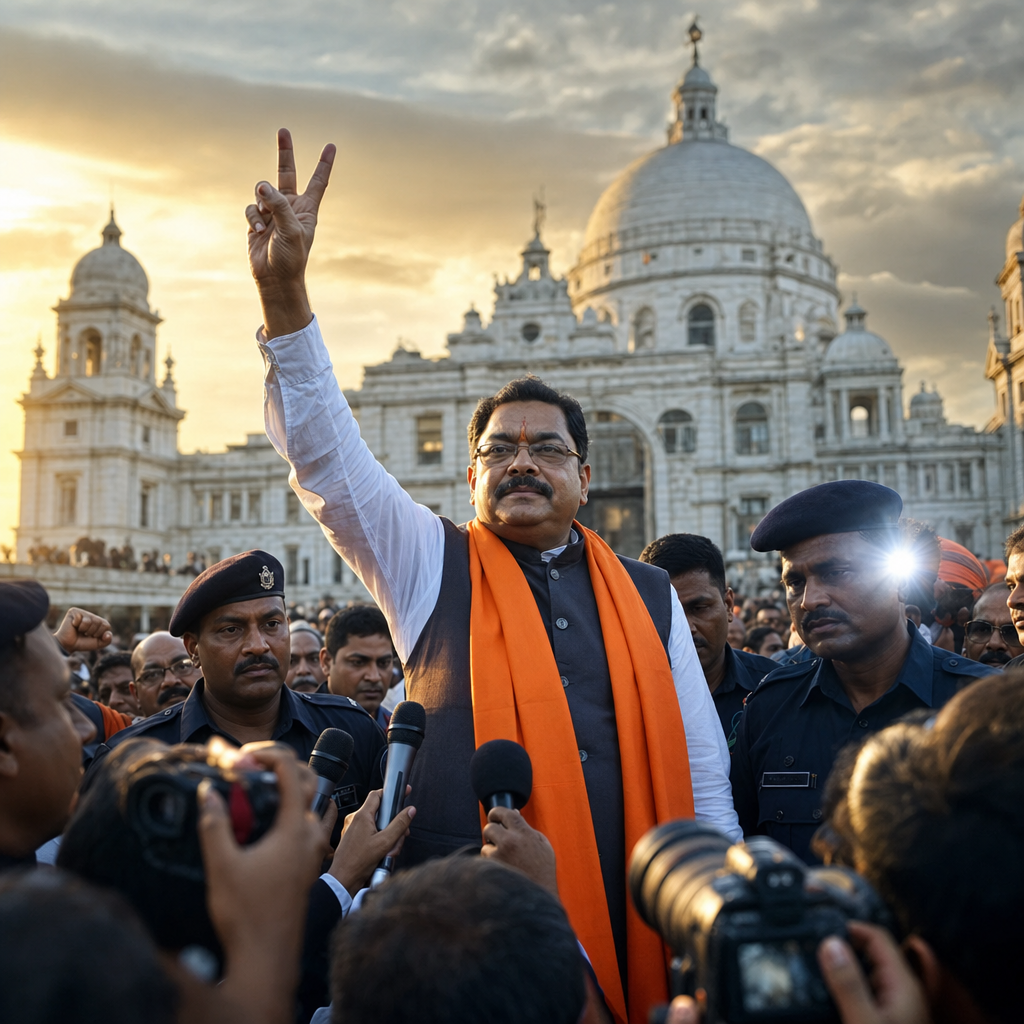
The BJP has named Suvendu Adhikari as West Bengal’s next chief minister, and he is set to be sworn in on May 9 after the party’s first-ever victory in the state, according to  The Hindu and
  IANS. That is the power shift that matters: the BJP now controls India’s most politically consequential eastern state, ending Mamata Banerjee’s 15-year run and giving the party a governing foothold well beyond its Hindi-belt base.
Why this changes the map
West Bengal is not just another state. It is one of India’s largest, most mobilized political arenas, and for years it served as a bastion against the BJP’s national expansion. By winning 207 of 294 seats, the BJP has shown it can turn anti-incumbency, law-and-order grievances, and organizational pressure into a full state takeover, AFP reported via  Yahoo News. That matters for
  India because the BJP now has another major state government to align with the center on policing, welfare delivery, and cadre-building.
Mamata Banerjee’s loss is also strategically bigger than the seat count suggests. She built her politics on resisting the BJP’s national machine; now she has to regroup from outside government. The immediate signal is that the Trinamool Congress’ old assumption — that Bengal was structurally out of reach for the BJP — no longer holds. The BJP’s victory is also a warning to other regional parties: once the organization, candidate selection, and booth-level machinery are in place, regional identity alone may not be enough.
The BJP is governing, not just winning
The first cabinet choices suggest the BJP understands the limits of a purely ideological victory. The Hindu reported that the new ministry was built around regional and caste balance, with faces drawn from the Matua, tribal, OBC, Rajbangshi, Brahmin, and Kayastha communities. That is the governing logic now: after winning power, the BJP is trying to convert a breakthrough into durability.
Adhikari himself is a useful symbol for that project. He is a former Trinamool leader, so his elevation signals both defection politics and continuity with Bengal’s hard-edged competitive style. He is also expected to run the state with “collective leadership,” according to IANS. In plain terms, the BJP is trying to avoid making Bengal look like a one-man regime.
What to watch next
The next test is not the oath ceremony on May 9; it is whether the new government can stabilize the state after the post-poll violence and prove it can govern without narrowing into factional conflict. Mamata’s response will matter just as much: if she can keep the Trinamool unified and turn Bengal into a long opposition campaign, this becomes a long fight, not a settled realignment. For now, the BJP has the lever; Bengal is where it will have to prove it can use it.