Singapore's $390M Nvidia Chip Case Explained
A pivotal case reshaping AI supply chain enforcement.
Model Diplomat8 min readAsia
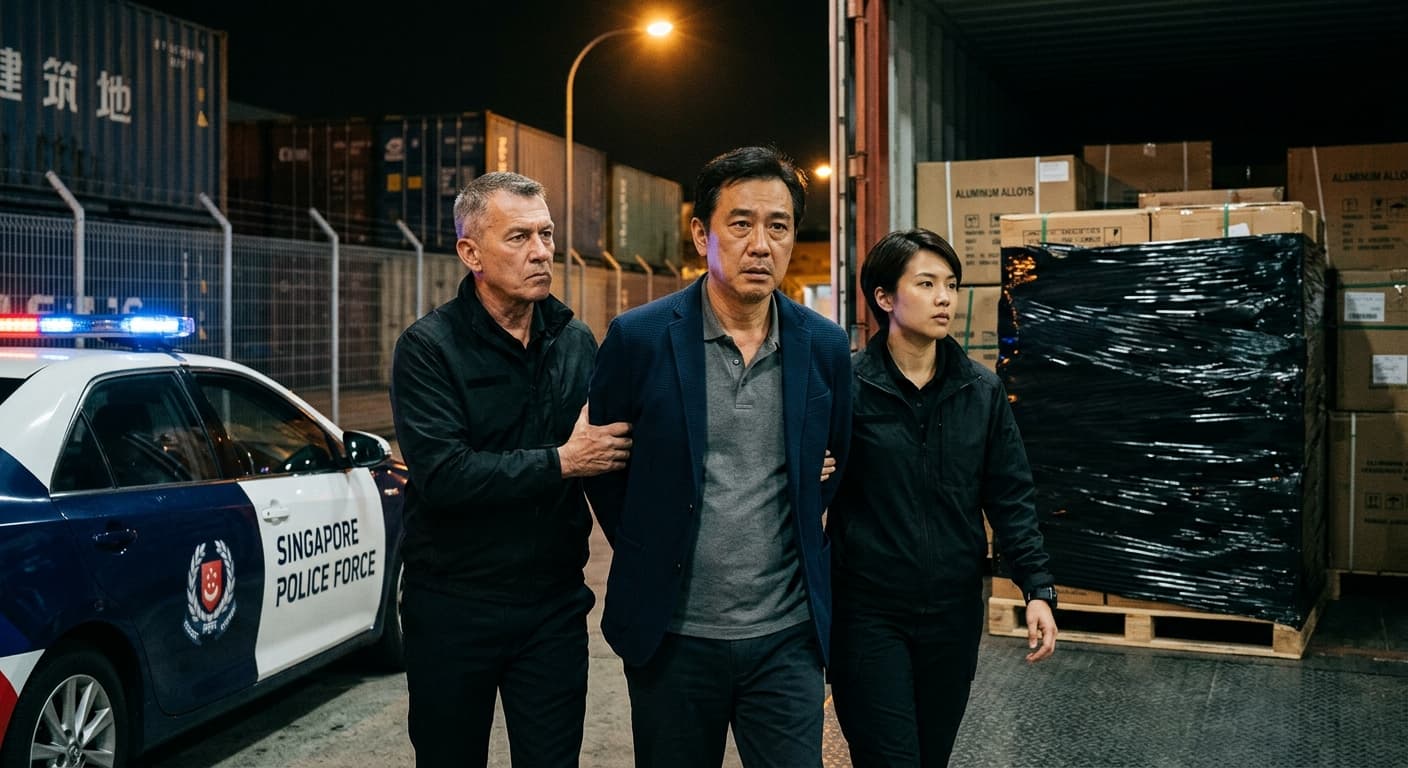
Singapore's $390M Nvidia Chip Case Is Now a Test of Global AI Rules
Alan Wei Zhaolun pleaded not guilty on July 6, 2026 to 11 charges in Singapore's largest semiconductor export-control prosecution — a case that redraws the map of AI supply-chain enforcement.
Singapore is trying its biggest AI-chip smuggling case not as an export-control violation, but as fraud and money laundering against Dell, Super Micro Computer and Asus — a legal workaround that quietly turns the city-state's commercial-crime code into the sharpest tool the West now has for policing Nvidia's global supply chain. On July 6, 2026, Aperia Group chief executive Alan Wei Zhaolun, 50, pleaded not guilty in a Singapore court to 11 charges including a S$38 million ($30 million) money-laundering count tied to a Nassim Road bungalow allegedly bought with proceeds from a US$390 million scheme to divert Nvidia AI servers. Bail was set at S$1.25 million. Two Singapore-registered corporate entities — three Aperia companies and a firm called Luxuriate Your Life — are also being prosecuted, which the Singapore Police Force calls the first corporate charges of their kind in the investigation, per the BBC.
The thesis is simple. Because Singapore does not enforce Washington's unilateral chip controls, prosecutors have converted the case into a criminal breach of private commercial contracts with the manufacturers themselves. That doctrine, if it holds, exports US export controls through third-country fraud law — with implications for every AI-chip transshipment corridor from Johor to Jebel Ali.
The charge sheet, and what it does not say
According to Bloomberg via Yahoo Finance, Wei now faces nine fresh counts on top of two earlier charges, including allegations that he acquired more than S$3.2 million in criminal proceeds and channelled S$38 million of it into the purchase of a S$55 million (US$42.5 million) house near Singapore's Botanic Gardens. The Singapore Police Force said in its July 1 statement that at least two-thirds of the property's price was funded by illicit earnings, and that around S$1 million in bank balances was also seized, according to the
BBC. Four individuals in total have been charged since February 2025.
Notice what is missing. There is no charge under Singapore's Strategic Goods (Control) Act, which implements the Wassenaar Arrangement and other multilateral regimes. That is deliberate. Foreign Minister Vivian Balakrishnan told Parliament on February 18, 2025 that Singapore "is not legally obliged to enforce the unilateral export measures of 200 countries" and gives effect only to multilateral controls agreed at the UN Security Council and export-control fora, per the Ministry of Foreign Affairs. The US 2022 chip rules are unilateral. Singapore, therefore, is not prosecuting Wei for shipping restricted chips. It is prosecuting him for lying to Dell, Super Micro and Asus about who the end users would be — a straight commercial-fraud theory under the Penal Code.
That doctrinal move is the story. It converts a US extraterritorial enforcement problem into a domestic offense that a Singaporean court can hear, using suppliers as the named victims of deception rather than the US Bureau of Industry and Security as the wounded regulator.
Why Singapore had no real choice
The pressure to act built long before Wei's arrest. When DeepSeek's low-cost AI model surfaced in January 2025, US officials and the press quickly turned to Singapore, which had booked roughly 22% of Nvidia's global revenue while receiving less than 2% of physical chip shipments, according to Nvidia's SEC filings cited in Parliament. The Lowy Institute described the resulting phenomenon as "Singapore-washing" — Chinese firms reincorporating or transacting through the city-state "to mitigate the geopolitical risks and scrutiny often directed at China-based entities," according to
Lowy's Alvin Camba.
Left unaddressed, that gap threatened two Singaporean assets at once: its Financial Action Task Force standing and its US "Tier 2" position under the (now-rescinded) AI Diffusion Rule. The Trump administration scrapped that framework in May 2025 but reaffirmed on June 1, 2026 that export-licence requirements apply to all firms headquartered in China regardless of where their servers sit, per Al Jazeera. That guidance re-criminalised, at the US end, exactly the corridor Wei is accused of running. Singapore's July prosecution is the mirror at the receiving end.
Parliament is separately tightening the paper trail. A Regulation of Imports and Exports (Amendment) Bill introduced in 2025 creates a new licensing regime for "trade information certificates" and expands Singapore Customs' investigative powers, per the Singapore Parliament bill text. It is a quiet but pointed signal that transshipment via falsified declarations is now a policy target, not merely a compliance nuisance.
The dummy-server ecosystem behind Aperia
The Aperia case does not sit alone; it sits at the Singaporean node of a much larger web. On March 20, 2026, US prosecutors unsealed an indictment in Manhattan naming Super Micro co-founder Yih-Shyan "Wally" Liaw and two others for allegedly diverting approximately $2.5 billion in AI servers to China. The scheme relied on an unnamed "Company-1" based in Southeast Asia and used thousands of non-working "dummy" servers to defeat compliance audits, according to the US Department of Justice. "Between late April 2025 and mid-May 2025 alone, at least approximately $510 million worth of the U.S. Manufacturer's servers, assembled in the United States, were diverted to China," the indictment states.
The Manhattan filing does not identify Company-1. But the modus operandi — dummy-server staging, fabricated end-user declarations, orders placed by a Southeast Asian purchaser — mirrors what Singaporean prosecutors allege of Aperia and Luxuriate Your Life. Whether the two cases converge on the same corporate actor will be the single most consequential evidentiary question of the summer.
Parallel actions are stacking up. In August 2025, two Chinese nationals were charged in Los Angeles over 21 shipments of Nvidia H100s and RTX 4090s routed through Singapore and Malaysian shipping firms, per Al Jazeera. In December 2025, the DOJ announced "Operation Gatekeeper," seizing more than $50 million in Nvidia hardware from a Texas-based operator who had exported or attempted to export at least $160 million in H100s and H200s to China, according to a
Justice Department release. And on June 29, 2026, Taiwanese authorities raided Super Micro's Taiwan offices, per the
Financial Times. The map is coming into focus: Silicon Valley origin, Taiwan handoff, Singapore or Malaysia paperwork, China endpoint.

Why the fraud theory is more dangerous than an export-control case
Read from Beijing or Kuala Lumpur, Singapore's approach is a template — and a warning. An export-control prosecution requires a host government to formally adopt another country's unilateral rules. A fraud prosecution merely requires that a broker lied on a purchase order. Every jurisdiction on Earth criminalises that.
That flips the compliance burden onto Nvidia's OEM partners. Dell, Super Micro and Asus become named victims in a Singaporean courtroom, giving Washington an indirect enforcement channel it does not have to negotiate. It also gives suppliers a new litigation exposure: sworn testimony from their own compliance officers about what "know your customer" actually detected — or missed. The American Enterprise Institute's Ryan Fedasiuk has written that US export enforcement now "runs on bribeable compliance auditors and stickers that can be peeled off with a hair dryer," per AEI. The Aperia trial will drag that criticism into open court.
The Center for a New American Security estimates that in 2024 an unquantified but very large flow — one smuggler alone reportedly handled a $120 million order of 2,400 H100s — moved through Southeast Asian conduits, per CNAS. Testifying before the House Select Committee on the CCP in April 2026, former CrowdStrike CTO Dmitri Alperovitch told lawmakers that "the common thread across many of these cases is the use of Southeast Asian intermediaries for transshipment to Chinese end-users," per his
written statement. Alperovitch urged Congress to pass on-chip location verification — the core of the pending Chip Security Act, which the Atlantic Council argues would enable "software-based location verification and lifecycle tracking" across allied jurisdictions, per
Atlantic Council.
If that bill passes, the Aperia model becomes redundant — the chip snitches on itself. Until then, Singapore's fraud statute is what the West has.
Who wins, who loses
Nvidia is the immediate winner. Its public position — "smuggling is a nonstarter" — is materially reinforced by a Singaporean court reading out chapter and verse on how the deception worked, according to a company statement quoted by Al Jazeera. Every dollar of proceeds seized in Singapore is a dollar shifted off Nvidia's reputational balance sheet.
The US Department of Commerce also benefits. With only nine Export Control Officers stationed at embassies worldwide, per AEI, BIS has been outmatched. A conviction in Singapore effectively subcontracts enforcement to the Singapore Police Force's Commercial Affairs Department — which brings vastly more capacity to the corner of the map that matters most.
The losers are less obvious. Malaysia and the UAE, two other transshipment hubs, now face a template they will be asked to match. Singapore-registered corporate service providers, real-estate agents and private bankers who touched the Nassim Road bungalow will be next in the investigative queue: recall that the 2023 S$3 billion Chinese money-laundering case eventually implicated dozens of intermediaries, per the BBC. And Chinese cloud arbitrage — the "remote access to offshore data centres" workaround flagged by Brookings — becomes the last uncovered loophole. As Brookings' John Villasenor observed, non-Chinese data centres in Singapore and Malaysia "currently obtain U.S. chips without a license and lease access to the chips to Chinese companies," per
Brookings.
Diplomat View
The Aperia prosecution matters not for what it recovers — a bungalow, S$1 million in cash, four defendants — but for what it institutionalises. Singapore has quietly created the most viable third-country enforcement doctrine yet against AI-chip diversion: prosecute deception of the manufacturer, not violation of a foreign licence regime. That doctrine will spread. Expect Malaysian and Emirati regulators to test analogous fraud theories within twelve months, particularly if the Chip Security Act stalls in the US Congress and on-chip geolocation remains voluntary. The forecast changes if two things happen: first, if the Manhattan trial of Wally Liaw fails to name Aperia or Luxuriate Your Life as Company-1 — that would suggest a more fragmented smuggling ecosystem than the DOJ has implied, weakening the deterrent value of Singapore's action. Second, if Singapore's courts accept a defence argument that supplier declarations were not material to purchase decisions, the fraud theory collapses and Wassenaar-plus statutes become the only tool left. Watch the plea calendar, not the press releases.
What to watch
- July–August 2026: Aperia Group's pre-trial conferences and any severance of the corporate charges from the individual charges — a signal of whether prosecutors are testing the corporate-liability theory alone.
- Autumn 2026: The Liaw trial in the Southern District of New York; the extent to which Company-1 is identified in open court will determine whether the Singapore and US cases formally merge as evidence.
- Q4 2026 – Q1 2027: US Chip Security Act floor action, and the outcome of the Section 232 semiconductor investigation flagged in Singapore's April 7, 2026
parliamentary Order Paper, which could reprice every legitimate chip flow through the region.
The bottom line: Singapore is not enforcing America's chip rules — it is prosecuting lies told to American companies, and that distinction is the most consequential legal innovation in AI export control since the 2022 restrictions. If Wei is convicted, the world's transshipment hubs will have a new obligation they cannot legally refuse, imposed by their own commercial-fraud statutes. If he is acquitted, the "Singapore-washing" corridor stays open — and the next generation of Nvidia's Blackwell GPUs will keep quietly finding their way to Shenzhen.
Discover more

Conflict & Security
West Africa Food Crisis: Three Shocks in 2026
Conflict, climate extremes, and the Strait of Hormuz closure drive a severe food crisis in West and Central Africa, with fertilizer prices surging 80% and millions displaced.
Economics
US Tariffs on Brazil: A Political Play
US imposes 25% tariff on Brazil but exempts 66% of exports, targeting manufactured goods ahead of Brazil's October election. Analysis of the political calculus, exemptions, and Brazil's response options.
Tech Policy
US Restarts China Export Controls With 52-Ent
US Commerce Department adds 52 Chinese entities to Entity List and tightens controls on five-axis CNC machine tools, ending eight-month enforcement pause after Trump-Xi Busan truce.
Economics
Trump's 50% Tariff on Canada Ends USMCA's Tar
Trump invokes Section 338 of the Tariff Act of 1930 for the first time, imposing 50% tariffs on $20 billion of Canadian goods and ending the USMCA tariff shield.