Seoul Faces 12.5% U.S. Forced-Labor Tariff
South Korea's tariff shift raises political stakes with the U.S.
Model Diplomat7 min readAsia
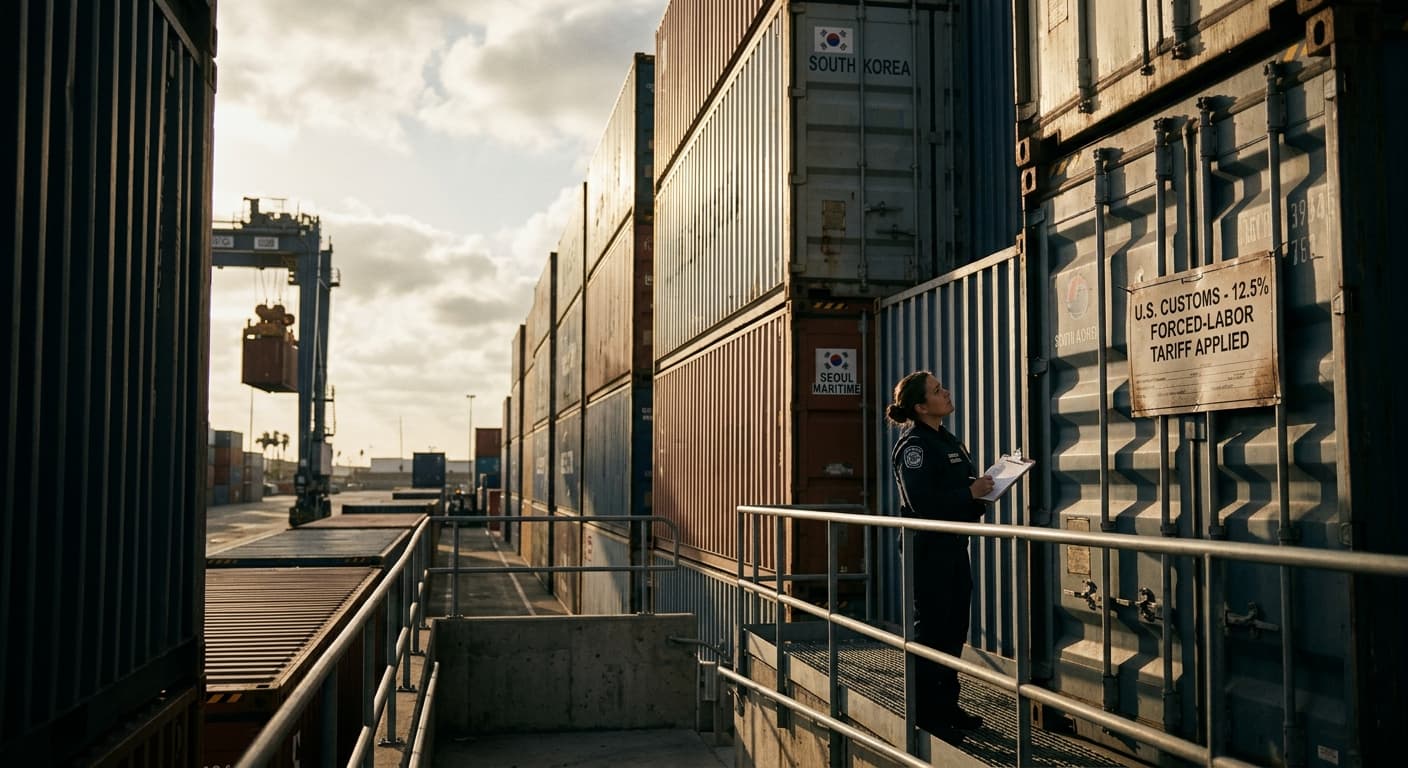
Seoul Faces 12.5% U.S. Forced-Labor Tariff as Section 122 Expires
South Korea faces a proposed 12.5% U.S. tariff under Section 301 as the 10% global levy expires July 24, 2026 — a shift that rebrands an ally as a forced-labor enforcement failure.
The Trump administration is preparing to swap a plain 10% global tariff on South Korean goods for a 12.5% penalty formally labeled as punishment for failing to police forced labor in supply chains — and that relabeling, more than the 2.5-point rate hike, is the story. Washington is not just replacing a legal instrument the Supreme Court invalidated on February 20, 2026. It is converting a balance-of-payments surcharge into a moral indictment of a treaty ally, on a legal theory whose evidentiary basis Seoul says does not exist. The 12.5% rate arrives with an accusation attached, and that changes the political price both sides will pay before the 15% ceiling agreed last year is tested.
What actually happens on July 24
The Section 122 tariff — the temporary 10% "balance-of-payments" surcharge President Donald Trump imposed on February 24 after the Supreme Court struck down his International Emergency Economic Powers Act (IEEPA) tariffs — expires by statute after 150 days. It cannot be extended without congressional action Trump is not expected to seek, according to the Center for Strategic and International Studies. In its place, the Office of the U.S. Trade Representative (USTR) is set to activate the 12.5% Section 301 forced-labor tariff proposed on June 2, 2026, following
public hearings on July 7–9.
According to the USTR's June 2 Federal Register notice, 45 of the 60 investigated economies — including South Korea, Japan, India, Australia, New Zealand, China, and Vietnam — are slated for the 12.5% rate. A smaller group of 15, including Canada, Mexico, the European Union, and the United Kingdom, would face 10% because USTR concluded they already run partial forced-labor import programs. Al Jazeera's
account of the notice captures the framing: every investigated economy was found to have "failed to effectively enforce a forced labor import prohibition."
That finding is the load-bearing beam of the whole structure. Under Section 301 of the Trade Act of 1974, the President can retaliate against foreign practices that are "unjustifiable, unreasonable, or discriminatory" and burden U.S. commerce. It is the same statute Ronald Reagan used against Japanese semiconductor dumping in the 1980s. It was not built to police allies' labor-enforcement systems.
Why Seoul is fighting the label, not the rate
South Korea is not disputing that a 12.5% tariff will land. It is disputing what the tariff says about Korea. In formal comments submitted to USTR on July 7, Seoul argued the finding rests on "weak evidence and factual inconsistencies," noting that Korea prohibits forced labor under domestic law and international treaties including ILO conventions. The Korea International Trade Association (KITA), the country's largest business lobby, filed a parallel submission
urging USTR to defer implementation or cut the rate to 10%. KITA Chairman Yoon Jin-shik told the agency Korea "strictly prohibits forced labor," according to Yonhap.
CSIS's Bill Reinsch, a former Commerce Department official, reviewed the underlying USTR report and concluded the findings for each country amount to "two or three paragraphs each, simply asserting that the country in question failed to impose and effectively enforce a forced labor import prohibition. No evidence is presented for that conclusion." The 98-page document, he notes, spends most of its length arguing that forced labor is bad — not that any specific country tolerates it.
For Seoul, the label matters commercially and politically. Korean firms subject to the Uyghur Forced Labor Prevention Act's due-diligence regime — Samsung, SK Hynix, Hyundai — have spent four years re-engineering supply chains precisely to prove they don't source from Xinjiang. Being tarred as a forced-labor enforcement laggard, on a two-paragraph justification, is a reputational hit that outlasts any tariff cycle.
The stacking problem: 12.5% is a floor, not a ceiling
The immediate 2.5-point step-up masks a bigger risk. South Korea is one of 16 economies still under a parallel Section 301 investigation for "structural excess capacity" in manufacturing — a probe launched on March 11, 2026, that targets steel, shipbuilding, semiconductors, and chemicals. If USTR concludes that investigation the same way it concluded the forced-labor one — everyone found guilty — additional tariffs would stack on top of the 12.5%.
The Herald Business reported that Seoul's central objective is now keeping the combined effective rate below the 15% ceiling that Trump and President Lee Jae Myung agreed to in October 2025. A 12.5% forced-labor tariff plus even a modest overcapacity surcharge would breach that ceiling. The Peterson Institute for International Economics
estimates the two Section 301 tracks together cover roughly 90–95% of U.S. imports — a scope that has almost nothing to do with the statute's original design and that PIIE's Alan Wm. Wolff argues is unlikely to survive Supreme Court review.
Add in the Section 232 sectoral tariffs — 50% on steel and aluminum, 15% on autos — and the picture is a country running a $66 billion goods surplus with the United States, according to CFR, while paying tariffs stacked across three or four legal authorities simultaneously.
The geopolitical inversion
Here is what makes this different from the 2025 tariff rounds. Last year, Trump's tariffs on Korea were nakedly transactional — pay $350 billion in U.S. investment, buy $100 billion in LNG, or face 25%. Seoul understood the game and, as BBC News reported, President Lee walked away with a 15% deal his own aides called "the worst avoided."
The forced-labor pivot changes the register. It moves the U.S. from transactional leverage to normative leverage against an ally. Brookings' Andrew Yeo, Georgetown's Victor Cha, and former Korean Trade Minister Dukgeun Ahn warned in February that a Section 301 route "basically blames a country for doing bad things," and that such accusations "would not just be economically but also politically difficult for the Korean side to accept."
Consider what Seoul is being asked to swallow simultaneously: a public U.S. finding that it fails to police forced labor; a still-unratified $350 billion investment package; a 50% steel tariff untouched by any deal; an ongoing dispute over the September 2025 immigration raid on Hyundai's Georgia plant that detained more than 300 Korean workers; and pressure to underwrite U.S. shipbuilding and possibly host or fund U.S. nuclear submarine capacity.
Every one of those files pushes Lee's government toward a domestic political question it does not want to answer out loud: whether the trade framework is worth the terms. Lee has publicly stayed the course — his office said after the SCOTUS ruling that Seoul would continue "preferential consultations" and honor the investment commitments even though the legal basis for the 15% tariff had evaporated. That restraint is a strategic choice, not an inevitability.
Who benefits, who loses
The clearest winner is not the U.S. Treasury. It is China. Beijing gets to watch the United States apply the same forced-labor logic it built to isolate Xinjiang against Japan, South Korea, Australia, and the European Union — flattening the moral distinction that gave the Uyghur Forced Labor Prevention Act its diplomatic weight. As Brookings notes, UFLPA "reshaped global supply-chain due diligence practices" because it named a specific atrocity. Applying the same framework to New Zealand and South Korea dilutes it into a generic tariff pretext.
The losers, in order: Korean exporters in sectors already carrying Section 232 stacks (steel, autos, batteries); the credibility of the U.S.-Korea Free Trade Agreement, which since 2012 had eliminated tariffs on most manufactured goods; and, over the medium term, U.S. leverage in future forced-labor cases where the accusation would genuinely mean something.
The quiet beneficiary inside Korea is the Democratic Party of Korea, which controls the National Assembly and has been slow-walking ratification of the trade framework. Each new Washington move that arrives as an accusation rather than a negotiation makes the ratification bill harder to sell — and gives Lee's government cover to renegotiate rather than deliver.
Legal fragility
The whole edifice may be temporary. PIIE's Wolff argues Section 301's plural application to 60 countries at once is structurally incompatible with a statute that speaks in the singular of "the act, policies, and practices of a foreign country." The Court of International Trade has already invalidated the Section 122 tariff for some plaintiffs, according to Brookings, in a ruling on track for Supreme Court review.
CSIS's Reinsch predicts every country will be found guilty in the overcapacity probe too, and that the resulting tariff wall will face litigation lasting well into 2027. In the interim, Korean exporters pay.
Diplomat View
The 12.5% forced-labor tariff is not a rate hike. It is a category shift: from bilateral haggling to unilateral labeling. Seoul's response — file formal comments, keep investing, refuse to reopen the framework — is a bet that Trump's tariff architecture will collapse in the courts before the political costs of accepting the "forced-labor" tag compound. That is a reasonable bet, but a fragile one. It fails if three things happen: the Supreme Court upholds Section 301's broad use; the parallel overcapacity investigation concludes with additional tariffs that breach the 15% cap; and the National Assembly, seeing Washington move the goalposts, refuses to ratify the $350 billion package. Any two of those would force Lee to choose between an alliance that Korean voters increasingly experience as extractive and a strategic hedge toward Beijing that Lee's own political base has quietly encouraged since he took office in June 2025. Watch the Assembly floor, not the tariff table.
What to watch next
- July 24, 2026 — Section 122 tariff expires; USTR expected to publish final Section 301 forced-labor tariff determination.
- Third quarter 2026 — USTR overcapacity investigation results due; a "guilty" finding for Korea would stack tariffs above the 15% ceiling.
- Fall 2026 — Korean National Assembly ratification vote on the U.S.-Korea trade framework and the $350 billion investment vehicle; passage no longer assured.
- Pending — Supreme Court review of the Court of International Trade's Section 122 ruling, and eventual constitutional challenge to the blanket Section 301 tariffs.
Discover more
US Politics
SNAP Food Assistance Faces Legal Challenges
In 2026, SNAP faces stricter eligibility rules and mounting legal challenges, threatening food assistance for the millions of Americans who rely on the program.
US Politics
Virginia's Redistricting Referendum
Virginia's redistricting referendum is drawing a flood of dark money, shaping future elections and the fight for congressional control amid party stakes.

US Politics
House Ethics Committee Pushes Sexual Miscond.
The House Ethics Committee has shifted responsibility for sexual harassment settlement records to the Office of Congressional Workplace Rights, complicating disclosure efforts.

Conflict & Security
Drone Warfare Killing Aid Workers at Unprec
Over 1,000 humanitarian workers killed in three years as cheap armed drones collapse legal protections. Gaza, Sudan, Ukraine, and DRC see deliberate targeting of aid convoys and hospitals with zero prosecutions.