Saudi Arabia's Syria Pivot Rewires IMEC
Riyadh explores a new route for the IMEC through Syria.
Model Diplomat8 min readMiddle East
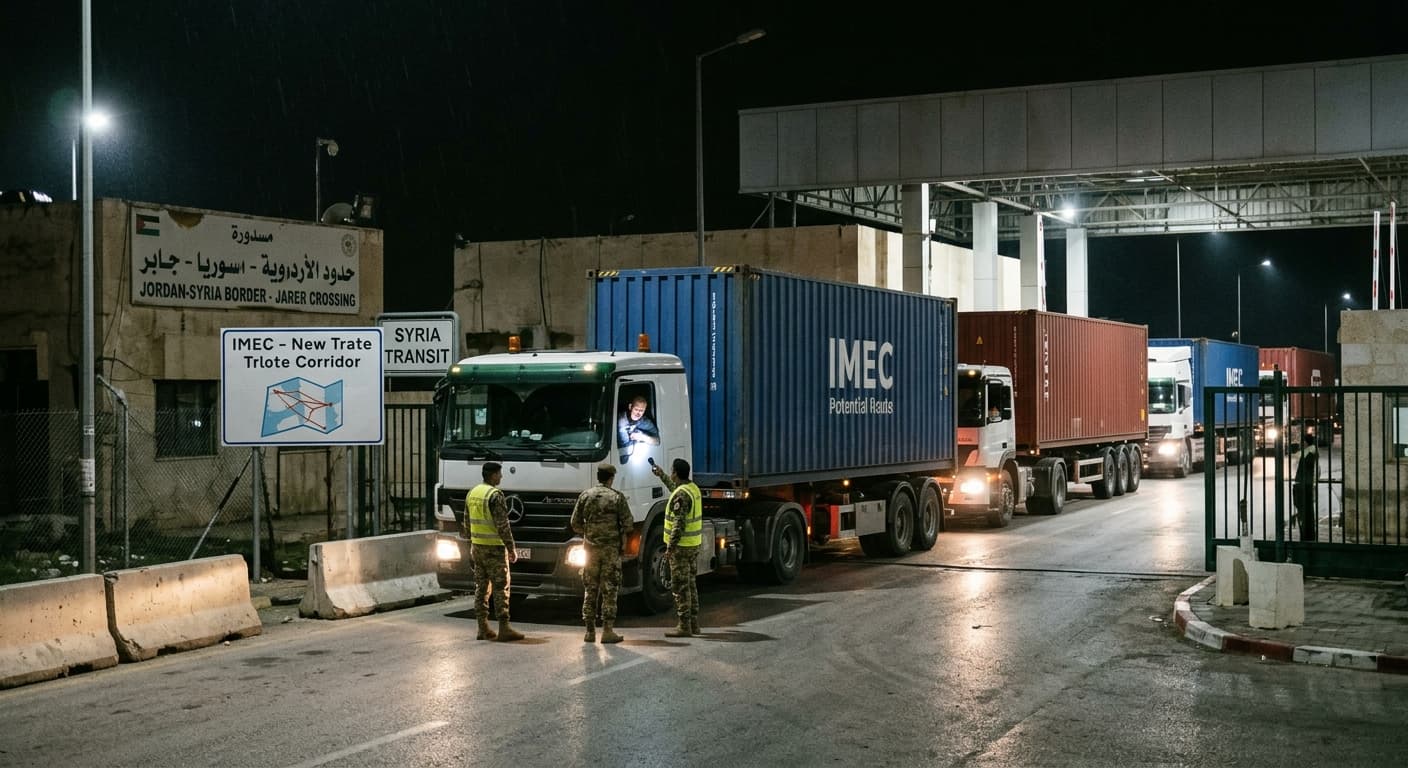
Saudi Arabia's Syria pivot rewires IMEC — and Israel's energy gateway
Riyadh is weighing a Damascus routing for the India–Middle East–Europe Corridor. If it holds, Haifa loses its role and the Levant's energy map is redrawn.
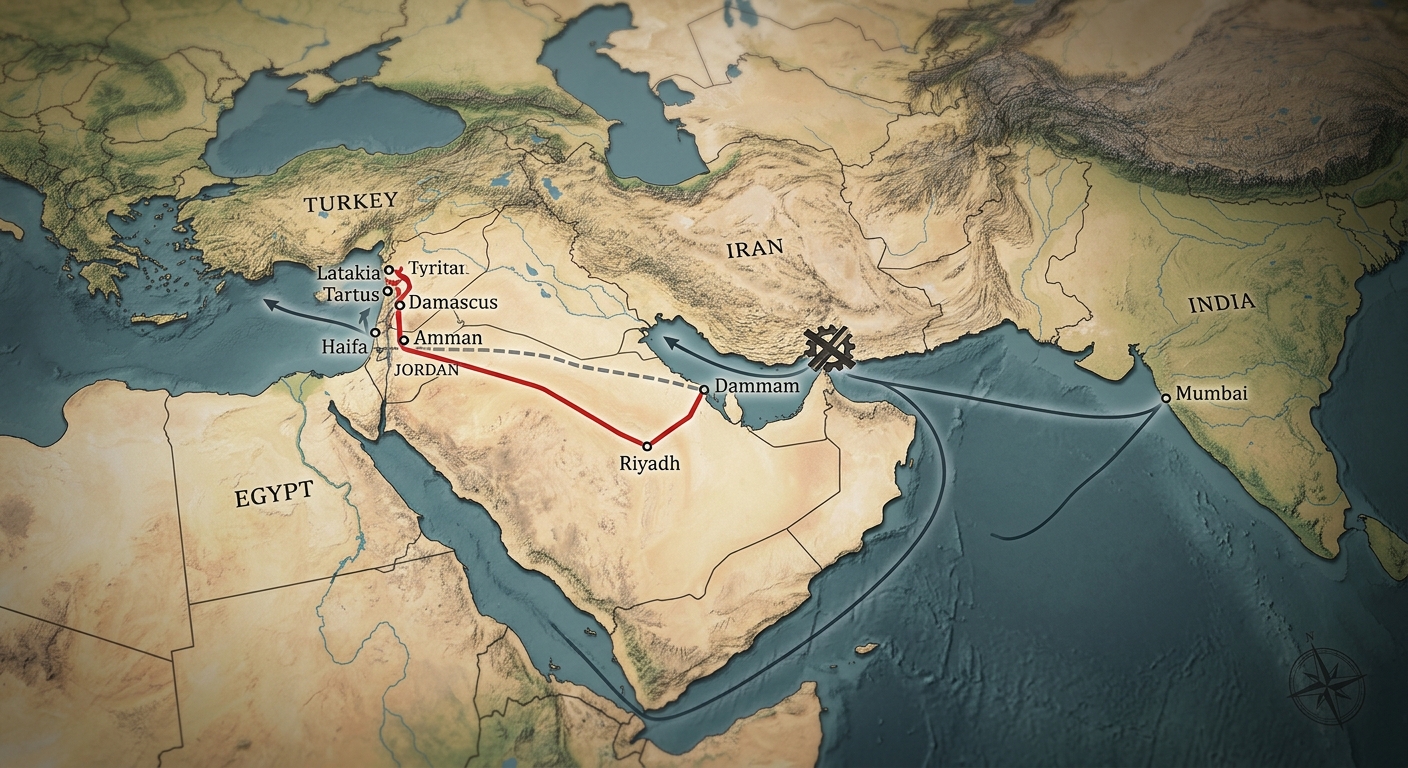
Saudi Arabia is actively exploring a Syria routing for the India–Middle East–Europe Economic Corridor (IMEC) that would sideline Israel entirely, according to two sources who spoke to The Jerusalem Post on July 8, 2026 — a shift that, if executed, would divert an estimated $331 billion in potential annual trade away from Haifa and toward Tartus and Latakia, redirect Gulf crude and hydrogen exports around the Strait of Hormuz through Damascus, and hand post-Assad Syria a transit rent stream large enough to underwrite its reconstruction. The thesis is narrower than the headline: the corridor is not being killed by Gaza — it is being rewired by Hormuz, and the country that emerges as the indispensable node is neither Israel nor the UAE, but al-Sharaa's Syria, funded largely by Saudi money.
That reframing matters because IMEC was sold in 2023 as a normalization vehicle. It is now being repurposed as a chokepoint hedge. Every actor in the corridor — Riyadh, Abu Dhabi, Ankara, New Delhi, Brussels — is making that trade explicitly. Only Israel and, quietly, Washington are still arguing over the old map.
What Riyadh is actually reconsidering
The founding document is unambiguous about the original geography. The IMEC Memorandum of Understanding signed at the G20 in September 2023 commits the eight participants to a corridor "enabling goods and services to transit to, from, and between India, the UAE, Saudi Arabia, Jordan, Israel, and Europe," with a railway spine plus "cable for electricity and digital connectivity, as well as pipe for clean hydrogen export," per the text released by the White House. Israel — specifically the Haifa land bridge to the Mediterranean — is the corridor's only western exit in that text.
Three shocks have made that exit politically and commercially unusable. First, the Gaza war froze Israeli–Saudi normalization; a Washington Institute poll in early 2026 found 99% of Saudi respondents opposed to normalization, per the Middle East Institute. Second, the fall of Bashar al-Assad in December 2024 reopened the Levantine land bridge; the Trump administration lifted sanctions in May 2025, and Congress repealed the Caesar Act inside the NDAA later that year, per the
Atlantic Council. Third — and decisive — the US–Israel war on Iran that began on February 28, 2026 shut the Strait of Hormuz. The World Bank's April Commodity Markets Outlook called the resulting 10.1 million-barrel-per-day supply loss "the largest oil market disruption in history," per
the World Bank. A Congressional Research Service brief documented Brent breaking $100 as Iranian forces declared the strait closed on March 4, 2026, per
Congress.gov.
Riyadh's reassessment sits on that stack. As one Post source put it: "They are contemplating different options — one of them is Syria."
The northern corridor already exists on paper — and increasingly on the ground
The most consequential fact about the Syria reroute is that it is no longer speculative. It is a construction schedule.
Saudi Arabia's North–South Railway opened commercial freight service on March 31, 2026, running more than 1,700 kilometres from the Dammam–Jubail industrial cluster to the Jordanian border at Al-Haditha, with each train carrying over 400 containers and bypassing both Hormuz and the Red Sea, per an Atlantic Council analysis by Kirsten Fontenrose and colleagues. On April 7, 2026, Türkiye, Jordan and Syria signed a trilateral transport MOU; on June 9, Saudi Transport Minister Saleh bin Nasser Al-Jasser and Turkish counterpart Abdulkadir Uraloğlu signed a bilateral railway MOU to close the roughly 400-kilometre gap between the Saudi line at Al-Haditha and the Turkish network at Gaziantep, per
MP-IDSA.
The maritime terminals are already in Gulf and French hands. DP World took a 30-year concession at Tartus for $800 million in July 2025, replacing the Russian firm Stroytransgaz, per Al Jazeera. CMA CGM renewed its Latakia container concession the same month for €230 million; Latakia already handles roughly 95% of Syrian containerised trade, per
IISS. Ad Ports of Abu Dhabi bought a minority stake in the Latakia terminal from CMA CGM in November 2025.
And Riyadh is writing the biggest cheques. Saudi Investment Minister Khalid al-Falih announced $6.4 billion in Syrian deals at a Damascus forum in July 2025, of which $2.9 billion was infrastructure, per Al Jazeera. A February 2026 signing at the People's Palace added the newly launched Elaf fund's $2 billion commitment to two Aleppo airports, a Saudi–Syrian budget carrier and the SilkLink telecoms project — "plans to lay thousands of kilometres of cable to boost connectivity between Asia and Europe," in the words of Syrian communications minister Abdulsalam Haykal, per
Al Jazeera. That last phrase is the tell: SilkLink is IMEC's digital pillar, rerouted.
The energy story is the real prize
Trade corridors dominate the headlines. Energy is where the reroute pays for itself.
Saudi Arabia's East–West pipeline is already running at full 7 million-barrel-per-day capacity to Yanbu on the Red Sea, and the UAE's Habshan–Fujairah line at 1.8 mb/d, per Brookings. Both bypass Hormuz. Neither reaches Europe overland. That is the gap the Syria route closes. A Gulf International Forum analysis by energy economist Robin Mills quantifies what a Gulf–Mediterranean pipeline through Jordan and southern Syria to Banias — a modern rebuild of the old Tapline — could carry: 1.5 to 2 million barrels per day of crude, with a wider Four Seas system moving 3 to 4 mb/d plus 40 to 50 billion cubic metres of gas annually to Europe, per
Gulf International Forum. The same paper estimates Damascus would collect $3 to $6 billion a year in transit fees — "more fiscal breathing room than any aid package on offer."
That is the load-bearing number. Syria does not need aid if it gets rent. Every Gulf capital investing in Damascus knows it, and it is why Saudi, Emirati, Qatari and Turkish investments — usually competitive — are converging on the same map.
For India, the calculus is uglier. New Delhi bet its Middle East strategy on the original corridor: Modi visited Netanyahu in Tel Aviv just two days before the Iran war began, and he addressed the Knesset in February 2026 explicitly promoting IMEC and I2U2, per Al Jazeera. An ISPI analysis by Islam Alhalawany argues the Hormuz crisis has left India with "limited independent capacity to respond" — importing half its crude from the Gulf and unable to guarantee the security architecture IMEC assumed, per
ISPI. A Syria routing lets India keep the corridor. It just forces New Delhi to accept a version of it that no longer runs through a normalization deliverable it spent political capital selling in Washington.
Who wins, who loses
Israel is the clear net loser. The 2023 blueprint made Haifa — acquired by India's Adani in 2022 — the corridor's only Mediterranean exit. An INSS analysis by Yoel Guzansky warned that Riyadh "might try to bypass Israel through more expensive and longer routes — a move that would undermine the original objectives of the project," per INSS. That move is now under way. Israeli officials have no leverage over it: Turkish, Saudi and Emirati capital, French port operators, and a Syrian government that answers to none of them are laying the alternative independently of Israeli consent.
Türkiye is the sleeper winner. President Recep Tayyip Erdoğan declared in 2023 that "there can be no corridor without Turkey." Twenty-two months later, there is one — running through the Turkish-sponsored Syrian government, via a Hejaz Railway rebuild Ankara is financing, terminating at Turkish-controlled crossings. Ankara now sits astride both IMEC's northern spur and its own Development Road via Iraq.
The UAE is hedging on both ends: DP World at Tartus, Etihad Rail into Jordan, and the Habshan–Fujairah pipeline outside Hormuz. Qatar sees a gas transit lifeline. The European Union, whose Global Gateway is quietly funding the IMEC digital pillar under the "Blue Raman" subsea project, per the European Commission, gets its Indo-Mediterranean supply chain diversification either way — but on terms set in Riyadh and Damascus rather than Washington.
The United States is the ambiguous case. The Council on Foreign Relations warned that if Tehran normalises transit tolls at Hormuz, "it will only accelerate other countries' efforts to reduce their reliance on the strait by building bypass pipelines," per the Council on Foreign Relations. That acceleration is now visible — and it is running through a Syrian government whose president was on the US terrorism list eighteen months ago. Washington backed the corridor as a normalization tool. It may end up with a corridor that works without normalization at all.
What to watch
- The IMEC ministerial promised for late 2026. The Atlantic Council reports one is being organized; whether the communiqué formally admits Egypt and Syria as network nodes — or clings to the 2023 Haifa map — will signal whether Riyadh has won the argument.
- Financing for the 400-km Al-Haditha–Gaziantep gap. The Saudi–Turkish MOU of June 9, 2026 committed to "develop a financial plan"; a firm figure and lender syndicate (World Bank, IsDB, GCC funds) is the trigger event.
- Iran's Hormuz posture through August 21, 2026. The US Treasury's revocation of the Iranian oil sanctions waiver, effective July 17, 2026, resets the escalation clock. Any prolonged closure past Q3 makes the Syria route commercially unavoidable, not just politically attractive.
- Israeli response. Watch whether Jerusalem tries to salvage a role via an Egypt spur to Haifa, or accepts the demotion.
Diplomat View
The Syria reroute is not a rumour Riyadh will walk back after a Gaza ceasefire. Too much money is already committed, too much rail is already welded, and the Hormuz risk is now priced permanently into every Gulf sovereign's capital plan. Our call: by the 2027 G20, IMEC will be formally reconstituted as a networked corridor with Tartus and Latakia as recognised Mediterranean exits, Haifa relegated to an optional Egypt-linked spur, and Damascus collecting transit rents in the $3–6 billion range that stabilise the al-Sharaa government more effectively than any Western aid package. This forecast fails under two conditions: a durable US–Iran settlement that reopens Hormuz to insurable traffic at pre-war volumes, restoring the Gulf–Suez economics that make the overland detour uneconomic; or a security collapse in Syria — a Druze or Alawite insurgency, a fresh Israeli strike on Damascus infrastructure — that spooks DP World, CMA CGM and Aramco off the northern route. Absent those, the corridor has moved. Israel's window to be indispensable to it has closed.
The Bottom Line
The bottom line: IMEC is being quietly rewritten from a normalization vehicle into a Hormuz hedge, and the country that gets the rent is Syria — funded by the same Saudi money that was once meant to buy Israeli integration. If Riyadh completes the reroute, Haifa's decade of geoeconomic centrality ends the day the first freight train pulls into Latakia.
Discover more
India
Women's Reservation Bill 2026: A Political Sh
India's Lok Sabha rejected the Women's Reservation Bill, exposing a political maneuver to redraw electoral maps favoring the north over the south.

US Politics
US Launches $166B Tariff Refund Portal
The US is launching a $166 billion tariff refund portal to aid importers hit by Trump-era tariffs, with major implications for trade and supply costs.

India
Vijay's Political Rise vs Silent Tamil Nadu
Actor Vijay's popularity surges across Tamil Nadu even as campus student politics fades, raising fresh questions about youth engagement and future power.

Economics
Fed's Amex AML order puts correspondent banking on notice
Federal Reserve's Amex AML order requires board-level controls and a 90-day plan; OCC fined the bank $350 million over enterprise-wide deficiencies.