Russia's African Push: Sahel and Ethiopia
Lavrov's tour solidifies Moscow's influence in Africa.
Model Diplomat7 min readAfrica
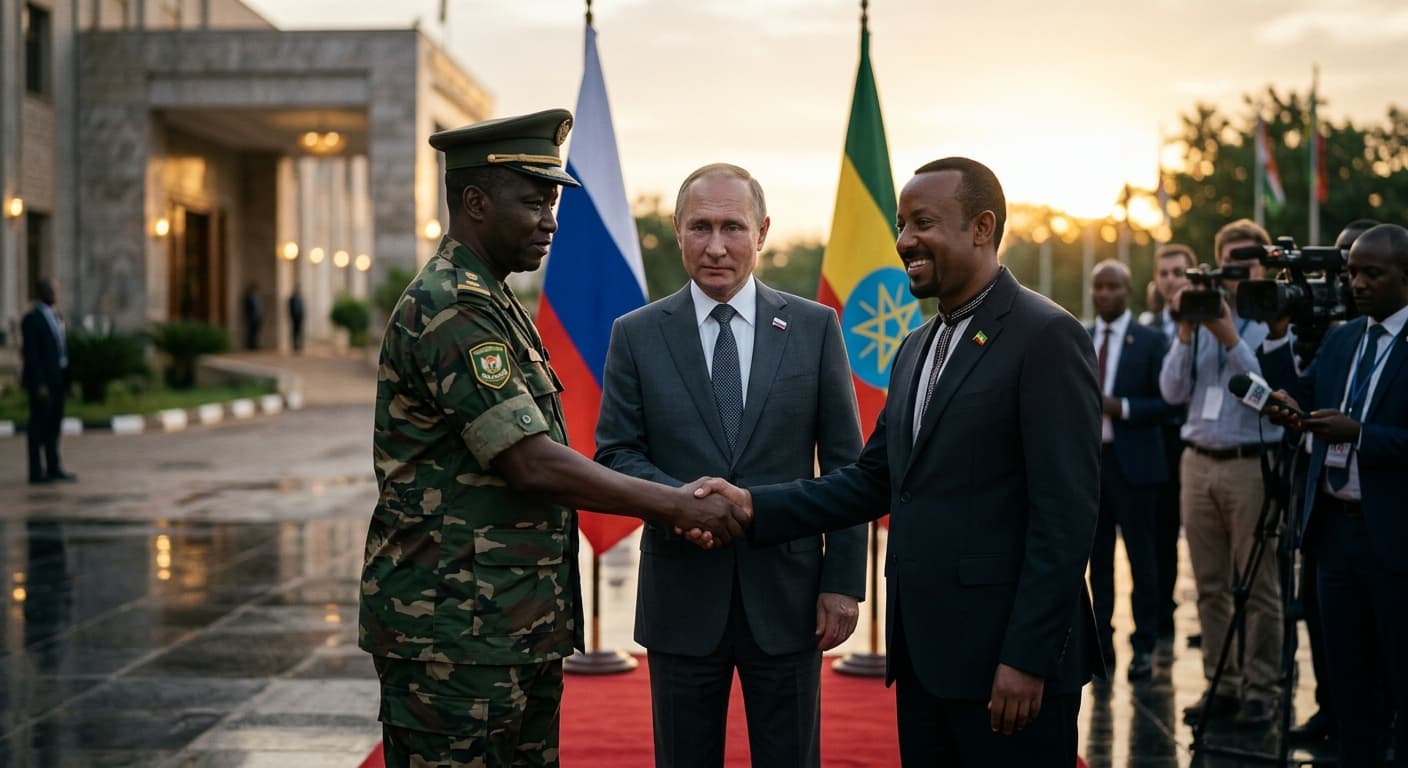
Russia's African Push: Sahel Pacts and an Ethiopia Nuclear Deal
Lavrov's July 2026 Africa tour institutionalises Moscow's presence in the Sahel juntas and Ethiopia — reshaping regional stability, resource flows and multipolar alignment.
Sergey Lavrov spent July 7–9, 2026 turning what had been ad hoc Russian influence in Africa into a treaty-shaped architecture: chairing the second Russia–Alliance of Sahel States ministerial in Niamey, blessing a "3+1" security-finance-media framework with the three junta capitals, and using an Addis Ababa stopover to lock in a Rosatom-built nuclear power plant for Ethiopia and to prepare an October summit to which Vladimir Putin has personally invited the coup leaders of Mali, Burkina Faso and Niger. The through-line is not a charm offensive; it is the transfer of long-duration infrastructure — reactors, air-defence, media, budget support — into regimes that have already exited every Western-anchored institution. That is how Moscow converts a bad war in Ukraine into a durable position on a continent it could not afford in cash.
What Lavrov actually signed
The Niamey round was the second ministerial in a format Moscow launched in April 2025. Lavrov opened it by declaring that Russia and the AES — the confederation of Mali, Burkina Faso and Niger — share a vision of a "fair multipolar world order," according to a readout carried by HCN Times. The concrete output was a coordination framework covering three verticals: security cooperation with the Africa Corps as the operational arm; a finance track tied to the AES's new Sahel Investment and Development Bank; and a media pillar built around RT, Sputnik and the AES's own confederal television channel. According to
Il Sole 24 Ore, Lavrov also delivered Putin's personal invitation to the AES heads of state to attend the third Russia–Africa Summit.
In Addis Ababa the same week, Lavrov held what Russia's foreign ministry described as high-level consultations with African Union Commission Chair Mahmoud Ali Youssouf. Per a joint communiqué reported by Russia's Pivot to Asia, AU Commission Chair Mahmoud Ali Youssouf welcomed Moscow's backing for expanded UN financing of African peacekeeping. (Note: a separate source in the audit pack names the chair as Moussa Faki Mahamat — editors should verify the correct officeholder before publication.) The Ethiopian file was the harder currency: bilateral trade of over $435 million in 2025, a metallurgy and resources diversification track, and — decisively — the operationalisation of a Rosatom–Ethiopian Electric Power framework agreement signed in September 2025 for a large-scale nuclear power plant, embedded in a 10-year human-resources programme. That deal, as the Manohar Parrikar
Institute for Defence Studies and Analyses argues, "functions as a strategic infrastructure of alignment" — locking Addis Ababa into Russian fuel, servicing and technical training for a 60-year horizon.
Why nuclear, why now — and why Ethiopia
Rosatom is the load-bearing beam of Russia's African strategy for a simple reason: nobody else offers turnkey nuclear plants with 85–93% state-backed vendor financing, and few African governments can command Western export-credit cover after Ukraine. The Istituto Affari Internazionali estimates Rosatom controls roughly 70% of the global export market for new reactors. Its Egyptian El Dabaa plant — $28.75 billion, with a $25 billion Russian loan repayable over 35 years — is the template Moscow is now selling to Addis Ababa, according to reporting compiled by the
MP-IDSA.
Ethiopia's calculus is legible. Since joining BRICS on January 1, 2024 — alongside Egypt, Iran and the UAE — Prime Minister Abiy Ahmed has been searching for infrastructure finance outside the IMF/World Bank frame following Ethiopia's 2023 sovereign default and its CCC rating, as documented by the European Parliament Research Service. The Grand Ethiopian Renaissance Dam is fully operational but climate-exposed and, more importantly, politically exposed to Egypt. A nuclear baseload — even one that will not turn on until the 2040s — is a strategic hedge against Cairo, and a card to play against Washington after the collapse of AGOA access. The second-order effect nobody in Addis says out loud: the same Rosatom that is building El Dabaa for Egypt is now building leverage against Egypt for Ethiopia, and Moscow becomes the pipe through which the Nile Basin's power balance is priced.
That is the pattern Rwanda's May 19, 2026 nuclear MoU with Rosatom already fits, as Al Jazeera reported. Nairobi analyst Fred Ochieng told the outlet that most such deals "are symbolic" and may take a decade to become operational. That is the point. The symbol is the alignment, not the megawatt.
The Sahel: from mercenary presence to state architecture
Two years ago Russia's Sahel footprint was a handful of Wagner columns and Telegram propagandists. Today it is a treaty-adjacent bloc that has withdrawn from ECOWAS, adopted a mutual-defence clause modeled on Liptako-Gourma, and built parallel institutions: a Sahel Investment and Development Bank, a joint 6,000-troop force, a common passport, a confederal TV channel and — under discussion — a common currency to displace the CFA franc. That trajectory was mapped in detail by Al Jazeera after December's Bamako summit.
The Africa Corps, run out of the Russian defence ministry by Deputy Minister Yunus-Bek Yevkurov and GRU Major-General Andrey Averyanov, has replaced Wagner as the delivery vehicle. According to a 2026 Polish Institute of International Affairs report, the corps now fields over 6,000 personnel across Africa, with about 2,000 in Mali, 100–300 in Burkina Faso, 100–200 in Niger and 1,600 in the Central African Republic. Fighters in Mali reportedly earn at least $3,000 a month, the
BBC reported when Africa Corps confirmed its withdrawal from Kidal.
That Kidal withdrawal, on April 28, 2026, is the crack in the story Moscow does not want in the readout. A coalition of the Front for the Liberation of Azawad and JNIM overran the Tuareg stronghold, killed Mali's defence minister Sadio Camara (a principal architect of the Russia partnership), and, per Al Jazeera, forced Africa Corps into a joint retreat with the Malian army. Fatalities linked to Islamist groups reached record highs across the AES states in the first half of 2024 and again in early 2025; the Center for Democracy and Development counted 12,964 conflict-related fatalities in the region in January–June 2025 alone. RAND has documented that Russian-supported operations in Mali produced deliberate killings of at least 32 civilians and burned over 100 homes in late 2024, and executions in January 2025 that included a two-year-old child, in a
June 2025 assessment.
The security picture, in other words, is deteriorating. The political architecture Moscow is building on top of it is nonetheless hardening, because the juntas need external validation more urgently than they need battlefield wins, and Russia is the only P5 partner willing to supply both.
The Euro-Atlantic implication
Read against Western capitals, the Lavrov tour has two effects that matter. First, it institutionalises what the Elcano Royal Institute's July 2026 analysis calls a "regime-protection model": a security order whose contract is not with populations, elections or ECOWAS norms, but with the men who took power by force. Second, it sidelines the ECOWAS regional deployment plan agreed in March 2026, which foresees an initial 2,000 troops against jihadist groups but is chronically underfunded, as
Al Jazeera documented. Where France once anchored 4,000 troops, Russia is now delivering the S-band air-defence system Niger acquired in April 2024, the media platforms crowding out AFP and DW, and the diplomatic cover for regimes that need it at the UN.
For Rosatom itself, the picture is more constrained than Moscow lets on. As the OSW Centre for Eastern Studies noted in a January 2026 assessment, the corporation has not signed a single binding new-build contract for a foreign reactor in three years — Ethiopia, Rwanda, Nigeria and Burkina Faso remain MoU-stage. The Sahel and Horn deals are options on future influence, not shovels in the ground. But an option that ties an African state to Russian training, fuel and servicing for six decades is still an option Washington and Paris cannot match without dismantling their own sanctions architecture on Rosatom — a debate the
Royal United Services Institute has repeatedly urged and Western governments have repeatedly deferred.
Diplomat View
Moscow's African push in July 2026 is best read as a shift from mercenary opportunism to structural entrenchment: nuclear plants for capital-scarce governments in the Horn, "3+1" governance formats for the Sahel juntas, and an October summit in Moscow designed to legitimise both. The forecast: by end-2027, expect a Rosatom engineering-procurement-construction contract with Ethiopia (following the Uzbek pattern), an AES common-currency roadmap unveiled at the Bamako or Ouagadougou heads-of-state summit, and at least one further AES-plus state — Chad, Togo or Guinea — signalling observer status. The forecast breaks on two conditions: Africa Corps loses a capital-city battle after Kidal, or Ethiopia's post-default IMF programme forces Abiy Ahmed to price the cost of his alignment with Moscow. Absent either shock, Russia will exit 2026 with more institutional depth in Africa than at any point since the collapse of the Soviet Union — and Western policy will still be arguing about whether to sanction the vehicle that carries it.
What to watch next
- October 28–29, 2026 — Third Russia–Africa Summit, Moscow. Watch attendance of AES heads of state, and whether the Rosatom–Ethiopian Electric Power framework is upgraded to a binding EPC contract, as happened in Uzbekistan.
- November–December 2026 — Ethiopian budget cycle and next IMF Article IV consultation. The debt–restructuring window will reveal whether Addis Ababa can carry Russian concessional financing without triggering Paris Club creditor objections.
- First quarter 2027 — Rotating AES chair passes from Burkina Faso's Ibrahim Traoré; a Nigerien or Malian succession would determine whether the confederation deepens (common currency) or stalls under battlefield pressure from JNIM and IS-Sahel.
The Bottom Line
Russia's July 2026 tour did not buy Africa; it rented durable infrastructure — reactors, air defence, media, budget lines — inside regimes that have already burned their Western bridges. That is why the Ethiopia nuclear deal and the Sahel "3+1" pacts matter more than the sum of their megawatts and troop counts: they convert a sanctioned wartime economy into a 60-year presence on the continent that Washington and Paris are still debating how to contest. If Moscow's October summit produces even one binding follow-through — an EPC contract, a currency roadmap, an observer accession — the multipolar architecture of Sub-Saharan Africa will have moved from rhetoric to plumbing, and it will be Russian plumbing.
Related: Global Politics.
Discover more

US Politics
SNAP Food Assistance Faces Legal Challenges
In 2026, SNAP faces stricter eligibility rules and mounting legal challenges, threatening food assistance for the millions of Americans who rely on the program.
India
Romanian Coalition Party Demands PM Resign
Romania's Social Democrats withdrew from coalition, joining far-right AUR to topple PM Bolojan, risking €10 billion in EU funds by August 2026.
US Politics
House Ethics Committee Pushes Sexual Miscond.
The House Ethics Committee has shifted responsibility for sexual harassment settlement records to the Office of Congressional Workplace Rights, complicating disclosure efforts.

Economics
Fed's Amex AML order puts correspondent banking on notice
Federal Reserve's Amex AML order requires board-level controls and a 90-day plan; OCC fined the bank $350 million over enterprise-wide deficiencies.