RBNZ Rate Hike Decision: Key Insights
Analyzing the RBNZ's upcoming OCR decision amid market uncertainty
Model Diplomat7 min readOceania
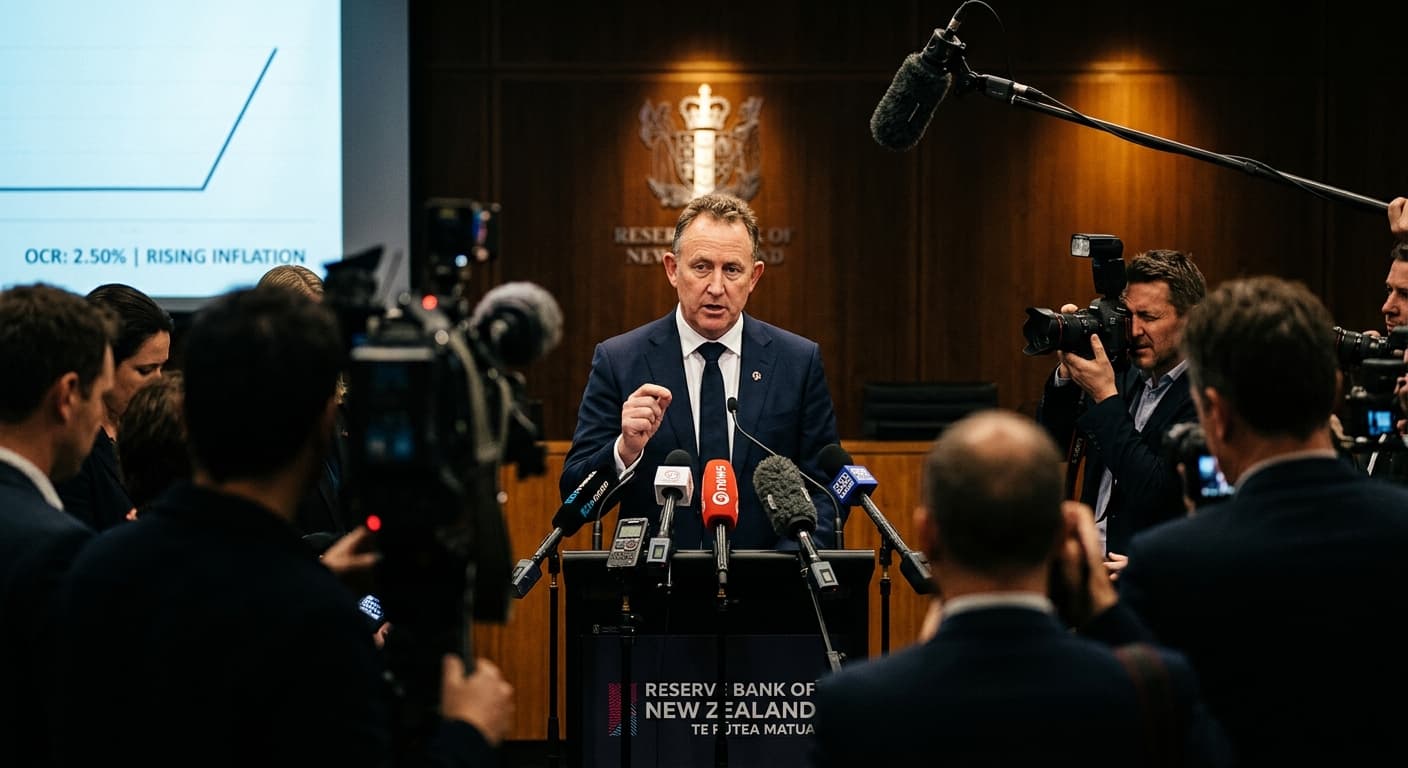
Will the RBNZ Hike Tomorrow? Inside a Line-Ball OCR Call
New Zealand's central bank meets July 8, 2026 with markets pricing a 75% chance of a hike to 2.50% — while four of five big banks say hold. Who's right, and what breaks the tie.
The Reserve Bank of New Zealand meets tomorrow with the sharpest split between market pricing and analyst consensus of Anna Breman's short tenure — traders assign roughly a 75% probability to a 25-basis-point hike to 2.50%, yet four of the country's five largest banks expect the Official Cash Rate to stay at 2.25%. The real story is not whether the RBNZ moves on July 8, but that a war-driven oil shock has forced the bank to choose between anchoring inflation expectations now and preserving a fragile recovery that the IMF says has already stalled into a second-quarter contraction. Both paths lead to a higher OCR by year-end. The disagreement is about the cost of getting there.
The split, in detail
Heading into Wednesday, ANZ is the lone Big Four bank forecasting a hike, arguing it is "sensible to get a hike under the belt" despite the sharp retreat in oil prices, as NZ Herald reported on July 7. ASB, Kiwibank, BNZ and Westpac all expect a hold, though each of them concedes further tightening is coming later this year.
The NZIER Monetary Policy Shadow Board landed in the same place — a hold, but only just. "The decision has become a line-ball call," the panel said, according to NZ Adviser. BNZ head of research Stephen Toplis argued that "interest rates need to be raised towards neutral as soon as possible," and Victoria University professor Viv Hall said the OCR "should therefore be increased to 2.50% at the upcoming meeting." Kiwibank chief economist Jarrod Kerr took the other side — the recent price spike is a "temporary supply shock now unwinding," and there is "no need to jump at shadows."
ASB's note, published July 6, is the sharpest statement of the hold case. The bank invoked former Governor Adrian Orr's line about policymaking during a shock — likening it to "jumping at a crocodile in a dimly lit room" — and argued that Governor Breman would need to confirm a hike "without clear medium-term indicators," inconsistent with her cautious tone in public appearances, according to investingLive. ASB explicitly acknowledged that market pricing disagrees with its call.
That gap between ASB's model and the swaps curve is the trade of the week. Overnight indexed swap pricing has been an unbiased predictor of RBNZ decisions inside a six-month horizon, research from the RBNZ Bulletin has shown — so a 75% market-implied hike probability is not idle speculation. It is the accumulated position of the offshore funds and local trading desks that have to be right about the next 24 hours.
Where the primary documents point
The primary-source anchor here is not the RBNZ — it is the International Monetary Fund. The Fund's Article IV Concluding Statement, issued June 30 after a mission led by Yan Carrière-Swallow met Governor Breman, Finance Minister Nicola Willis and Treasury Secretary Iain Rennie, states plainly that "monetary policy should gradually withdraw policy accommodation to ensure medium-term price stability."
The Fund's numbers set the boundaries of the debate:
- Headline inflation stuck at 3.1% y/y in Q1 2026, above the RBNZ's 1–3% target band, with tradables inflation driven by higher energy prices.
- Inflation projected to rise "temporarily to around 4 percent in mid-2026" and stay above target until end-2026, returning to the 2% midpoint only in the second half of 2027.
- Output "estimated to have contracted in 2026Q2," with full-year growth of 2%.
- Net public debt at roughly 27% of GDP after a mildly expansionary fiscal stance in FY2024/25–FY2025/26.
That is a textbook stagflationary snapshot for a small open economy — inflation running a percentage point above target, output contracting, and the policy rate still below the IMF's own estimate of neutral (3–3¼%). Historically, that combination has been where the RBNZ falls behind the curve. A 2026 study of RBNZ Monetary Policy Statements from 1990–2025 by Weshah Razzak found that inflation has been "systematically underpredicted" across four governors, and that breaches of the upper bound of the target range "occurred without being anticipated." Falling behind the curve, the paper argues, "meant policy was often reactive rather than forward looking."
Why the oil shock is doing the analytical work
The wildcard is petrol. The May Monetary Policy Statement projected inflation peaking at 4.3% in the September quarter, driven largely by the war-linked oil spike. Oil has since retreated — a lot. Kiwibank's hold call cites the "rapid decrease in oil prices and a stabilising situation in the Middle East" as reason to wait for confirming data.
But there is a reason petrol prices carry outsized policy weight in New Zealand, and it is not just the mechanical effect on the CPI basket. Research published in Energy Economics by Puneet Vatsa and Gabriel Pino using Bayesian SVAR models found that petrol price shocks have "a slightly delayed but persistent effect on one-year inflation expectations" in New Zealand, though five-year expectations remain anchored. A follow-up threshold analysis in the
Australian Economic Papers confirmed the link is strongest for the most visible prices — petrol and food — and holds in both high and low inflation regimes.
The implication cuts against ASB's "wait" argument. If short-run expectations move with petrol prices, then even a transitory oil shock can rekindle wage-price dynamics if the RBNZ appears to accommodate. That is precisely the mechanism the Bernanke-Blanchard framework applied to New Zealand by RBNZ Analytical Note 2024/03 flagged as distinctive: labour-market tightness has done more of the work in New Zealand's inflation cycle than in most peer economies. The negative output gap the IMF cites for 2026 dampens that risk — but only so long as unemployment continues to rise. Wage growth "slowed" but did not collapse, per the Fund.
That is the argument the hawks — ANZ, BNZ, ANZ's peers on the Shadow Board — are making in one line. Rates at 2.25% are still stimulatory relative to the RBNZ's own neutral estimate of about 3%. With inflation on track to print a 4-handle, waiting means letting real rates fall further at exactly the wrong moment.
What Breman actually has to weigh
Governor Anna Breman, the former Riksbank deputy who became the RBNZ's first female governor, inherits a monetary policy framework reverted in December 2023 to a single price-stability mandate. That matters for tomorrow's optics: unlike her Australian counterparts, Breman does not have a dual mandate to fall back on if she wants to nurse the labour market through the oil shock. As the IMF's 2025 Article IV report noted, the framework revision "is not expected to affect monetary policy in the short term," but it does raise the credibility cost of any perceived tolerance for above-target inflation.
The pass-through channel is more concentrated than in most advanced economies too. Around three-quarters of New Zealand mortgages by value are on fixed terms of two years or less, meaning OCR decisions transmit to household cash flow within quarters, not years. A hike tomorrow lands on borrowers refinancing into the September–December window; a hold pushes the pain into the first half of 2027. For New Zealand households already navigating what one broker called "a cost-of-living era," the timing question is not academic.
The kiwi dollar is the other lever. NZD has traded weaker through 2025 on the RBNZ's easing cycle. A hold on July 8 against a 75%-priced hike is the kind of surprise that historically drives a 1–1.5% same-day move — the FT's archive on the RBNZ shows past dovish surprises knocking the currency by 1.5% intraday. A weaker NZD, in turn, feeds back into tradables inflation, which is already the problem child.
Diplomat View
The RBNZ hikes 25 basis points to 2.50% on July 8. Governor Breman inherited a framework rewritten specifically to prioritise price stability, an inflation print projected to run above target through end-2026, an IMF telling her in writing to withdraw accommodation, and a market that has already put the trade on. Holding after all that would signal the RBNZ is willing to let short-run inflation expectations drift while it waits for June-quarter CPI in mid-July — a bet the Razzak evidence on 35 years of RBNZ underprediction says central banks in Wellington have consistently lost. The falsifiers: if the Middle East ceasefire tips into fresh escalation and Brent rebounds above pre-shock highs before Wednesday, the RBNZ can credibly delay; and if the June-quarter labour market data (out July 30 in the HLFS release) show unemployment breaking above 6% before it lands, the doves' output-gap argument becomes politically decisive. Absent those, the crocodile has teeth.
What to watch next
- July 8, 2:00pm NZST — RBNZ Monetary Policy Review and OCR decision; no updated forecasts (that comes at the August MPS).
- July 21, 2026 — Stats NZ Q2 CPI release. If tradables inflation prints above the RBNZ's May 4.3% peak track, the September hike becomes a follow-through, not an opener.
- August 20, 2026 — Next full Monetary Policy Statement, including updated OCR track. This is where Breman will have to publish a rate path consistent with the IMF's "gradual withdrawal" language — or explain the divergence.
The Bottom Line
New Zealand's central bank will almost certainly raise the OCR to 2.50% on Wednesday, because the price of waiting — letting real rates fall further while inflation runs toward 4% — is higher than the price of hiking into a soft economy the IMF already expects to recover in the second half. The banks calling for a hold are not wrong about the shock being transitory; they are wrong about how much benefit of the doubt a first-term governor with a single-mandate framework can afford to extend.
Discover more

US Politics
SNAP Food Assistance Faces Legal Challenges
In 2026, SNAP faces stricter eligibility rules and mounting legal challenges, threatening food assistance for the millions of Americans who rely on the program.

India
Delhi CM Rekha Gupta Blasts Opposition's Delm
Delhi CM Rekha Gupta's remarks on women's quota defeat reveal BJP's strategy for the 2029 Lok Sabha elections, focusing on delimitation.
India
Women’s Reservation Bill 2026
The Constitution (131st Amendment) Bill, 2026 was defeated in Lok Sabha, revealing deeper political conflicts over women's reservation and delimitation.

Economics
Fed's Amex AML order puts correspondent banking on notice
Federal Reserve's Amex AML order requires board-level controls and a 90-day plan; OCC fined the bank $350 million over enterprise-wide deficiencies.