Qatar Protests Iran After LNG Tanker Attack
Doha's formal protest signals a shift in Gulf diplomacy.
Model Diplomat7 min readMiddle East
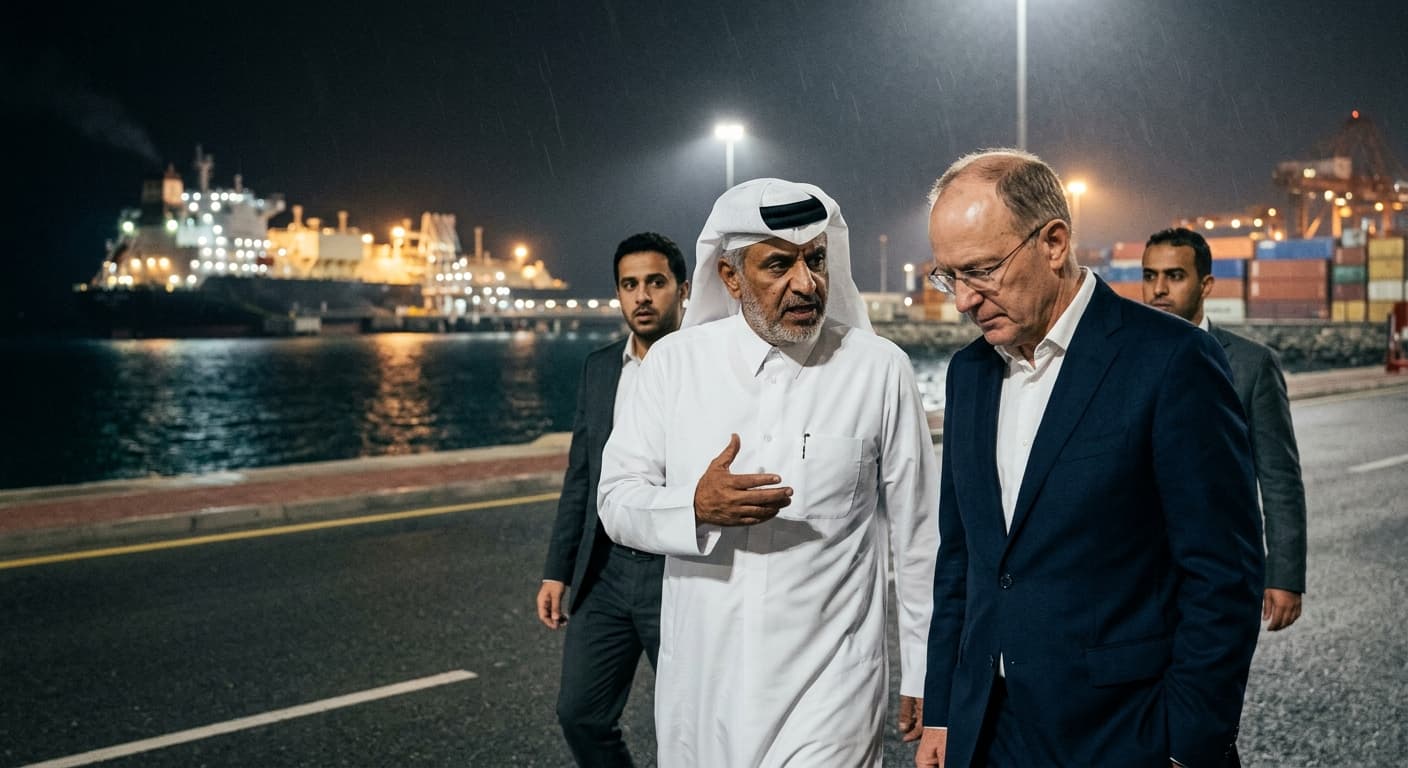
Qatar summons Iran envoy as LNG tanker burns off Hormuz
Doha handed Iran's deputy ambassador a formal protest note on July 7, 2026, after the LNG carrier Al Rekayyat was struck near the Strait of Hormuz — a rupture that has already pulled down the US–Iran ceasefire.
Qatar's summoning of Iran's deputy ambassador on July 7 is not another routine démarche — it is the moment the country that co-brokered the US–Iran ceasefire publicly declared Tehran had shot its own mediator's cargo, and within hours the memorandum of understanding that paused a four-month regional war began to collapse. The protest note demanded an "urgent explanation" for the strike on the Qatari LNG carrier Al Rekayyat off the Omani coast and reserved Doha's right to "take any measures it deemed appropriate," according to the Qatari Ministry of Foreign Affairs. By the time it was delivered, the White House had revoked Iran's oil-sales waiver, US Central Command had struck more than 80 targets across southern Iran, and President Donald Trump had told reporters the MoU was "over,"
the BBC reported. The tanker attack is the trigger. The diplomatic protest is the receipt.
What actually happened off Limah
The United Kingdom Maritime Trade Operations centre logged the incident in the early hours of July 7: a tanker struck by a projectile on its port side roughly 8 nautical miles off Limah, Oman, southbound out of the strait, with a fire in the engine room, Al Jazeera reported. Three sources told Reuters the vessel was the Qatari LNG carrier Al Rekayyat, that its crew were safe, and that the ship was briefly at risk of exploding. A second vessel, the Saudi-flagged very large crude carrier Wedyan, owned by Bahri, was damaged in a separate strike the same night; US officials cited by Axios described at least two IRGC missiles fired at commercial shipping.
The US Navy-led Joint Maritime Information Center raised the Hormuz threat level to "severe" — the first time it has done so since June 15 — citing "deliberate hostile action likely under current conditions." Iran's foreign ministry spokesman Esmail Baghaei called Qatar's accusation "contrary to the principle of good neighbourliness" and said vessels not coordinating with Iranian authorities risked collision, per the BBC. Iranian state TV suggested the LNG carrier had ignored warnings, without directly claiming the strike.
The mechanics matter. Since April, Tehran has insisted only its designated route close to the Iranian shore is safe; a competing corridor along the Omani coast, developed with the International Maritime Organization, was denounced by the IRGC on June 25 as "unacceptable and extremely dangerous." Al Rekayyat was hit while using the Omani side. A Tehran-based analyst, Hossein Royvaran, told Al Jazeera the tanker may have "strayed into an area where Iranian teams were performing mine-clearing operations." Whether by choice or by shrapnel, the message is identical: the Omani corridor is not survivable without Iran's permission.
The document that reframes the relationship
The protest note, delivered by Protocol Department director Ibrahim bin Yousef Fakhro to Deputy Ambassador Mohsen Mohammad Ghanei, is worth quoting because Doha rarely uses this register with Tehran. According to The Peninsula Qatar, the ministry stated:
"The targeting of the Qatari tanker 'Al Rekayyat' as it passed near the Strait of Hormuz constitutes an unacceptable assault on the security and safety of international navigation and global energy supplies, and a grave and blatant violation of international law, particularly the rules guaranteeing freedom of maritime navigation and safe passage through international waterways."
Ministry spokesman Majed Al Ansari added on X that Qatar holds Iran "fully legally responsible for this assault and any resulting damages or consequences." The formulation — "fully legally responsible" — is the same one Doha used in a March 19 statement expelling Iran's military and security attachés after Iranian missiles hit the Ras Laffan gas complex, per MOFA Qatar. That is not stock language. It is a legal predicate for state-responsibility claims, for compensation demands, and — as Qatar has already done thirteen times this year, according to
MOFA correspondence with the Security Council — for further UNSC referrals.
The doctrinal anchor is UN Security Council Resolution 2817 (2026), adopted 13–2 on March 11, which "strongly condemned" Iranian strikes on seven neighbouring states and reaffirmed the right of merchant vessels to freedom of navigation, per the UN. A follow-on Bahrain–US draft now circulating in the Council targets exactly the conduct Doha alleges: "attacks and threats against merchant and commercial vessels in the Strait of Hormuz," the placement of mines, and "illegal tolling." Qatar's protest note is the evidentiary spine of that second resolution.
Who benefits, who loses
The power dynamic exposed by this incident is uglier than a routine spat.
Iran is deliberately converting its geography into leverage. MarineTraffic logged 49 attacks on commercial vessels in the strait between late February and early July, according to Al Jazeera; most were blamed on Iran. Lloyd's List has documented an IRGC "toll booth" system routing pre-vetted vessels through Larak Island for clearance codes, with some operators reportedly paying up to $2 million per transit during the war. Mohsen Milani of the University of South Florida told Al Jazeera the emerging fee regime "reflects Iran's effort to convert its sovereignty over half of the strait into lasting influence." Hitting Al Rekayyat on the Omani side enforces that architecture.
Qatar is the loser Iran cannot afford. Doha is the world's third-largest LNG exporter — 77.2 million tonnes in 2024, roughly 20 percent of global supply, per the International Gas Union. After the March 18 Ras Laffan strike, Dutch and British wholesale gas prices jumped nearly 50 percent and Asian LNG benchmarks 39 percent in a single session,
Al Jazeera reported. Qatar has spent 2026 painstakingly mediating between Washington and Tehran; the MoU that briefly reopened the strait was hammered out under Qatari auspices. Attacking Qatari-flagged hydrocarbons is not a message to Washington. It is a message to Doha: your ships are not exempt from our permission system.
The unexpected beneficiary is US LNG. With QatarEnergy still operating below full capacity — repairs to Ras Laffan will take months, energy experts told NPR — American exporters have sold cargoes at roughly $20 per MMBtu in Asia and Europe against feedstock costs near $3. Cheniere brought new Corpus Christi capacity online in late March; S&P Global forecasts US LNG output growing 84 percent over five years. Every tanker attack near Hormuz widens that spread. This is the second-order effect of Iran's Hormuz leverage that Tehran has not priced in: it is funding the industrial displacement of its neighbour's export franchise.
The MoU is the immediate casualty. Trump on July 8 called the ceasefire "over" after CENTCOM struck Sirik, Qeshm and Bandar Abbas in response to the tanker attacks, Al Jazeera's live blog reported. Brent rose more than 3 percent to $76 on the news. UAE presidential adviser Anwar Gargash said Iran "remains incapable of committing to the requirements of de-escalation." Qatar's own foreign ministry, in a second statement the same day, condemned fresh Iranian attacks on Bahrain and Kuwait.
The Bloomberg register: what markets and lawyers do next
Three near-term catalysts will decide whether the July 7 protest is a stepping stone to a second UNSC resolution or the opening move in Qatar detaching from mediation altogether:
- The Bahrain–US Hormuz resolution. Diplomats at the UN expect a vote in the coming weeks. Russia and likely China will oppose; the Al Rekayyat file, filed as an official Council document under Qatar's ongoing letter series, dramatically strengthens the 9-vote threshold.
- Insurance and shipping response. JMIC's severe rating typically translates into war-risk premiums doubling within days; BIMCO has already told member lines to consider avoiding the strait, per
Al Jazeera. Kpler recorded transits collapsing from 43 on July 3 to a fraction of that this week.
- QatarEnergy's next tender. Doha has not publicly halted LNG shipments after the Al Rekayyat strike, unlike its March 2 suspension. If it does, expect JKM prices to spike within 48 hours and European storage plans for winter 2026 to be rewritten in real time.
Diplomat View
Qatar's protest note is the clearest signal yet that the Gulf's most patient mediator has run out of patience — and that Iran has miscalculated by treating Doha as a permanent buffer rather than a stakeholder in freedom of navigation. The forecast: within 30 days, Qatar will co-sponsor the Bahrain–US Hormuz resolution and formally re-cite Resolution 2817; within 90 days, Doha will quietly deepen intelligence and air-defence integration with US Central Command and expand offtake commitments to US LNG buyers to hedge its own export exposure. What would falsify this call is a credible Iranian gesture — an admission that the strike was a targeting error, compensation to Al Rekayyat's owner, and a public IRGC withdrawal of the "unapproved route" doctrine — before the UNSC vote. Absent that, the July 7 note will be remembered less as a diplomatic protest than as Qatar's exit from the fiction that it can broker peace between Tehran and Washington while its own tankers burn off Limah.
The bottom line: Doha did not summon Iran's deputy ambassador to preserve a relationship — it did so to build the legal record for the next Security Council resolution and to signal to insurers, shippers and LNG buyers that Qatar will no longer absorb the cost of Iran's Hormuz strategy. If the Al Rekayyat attack goes unpunished, the Iranian "toll booth" over the world's most important energy chokepoint becomes the new normal. If it does not, this is the week the Global Politics map of the Gulf quietly redrew itself around Washington and Doha, with Tehran on the outside.
Discover more
India
Romanian Coalition Party Demands PM Resign
Romania's Social Democrats withdrew from coalition, joining far-right AUR to topple PM Bolojan, risking €10 billion in EU funds by August 2026.
US Politics
House Ethics Committee Pushes Sexual Miscond.
The House Ethics Committee has shifted responsibility for sexual harassment settlement records to the Office of Congressional Workplace Rights, complicating disclosure efforts.

US Politics
SNAP Food Assistance Faces Legal Challenges
In 2026, SNAP faces stricter eligibility rules and mounting legal challenges, threatening food assistance for the millions of Americans who rely on the program.

Conflict & Security
Drone Warfare Killing Aid Workers at Unprec
Over 1,000 humanitarian workers killed in three years as cheap armed drones collapse legal protections. Gaza, Sudan, Ukraine, and DRC see deliberate targeting of aid convoys and hospitals with zero prosecutions.