Putin Escalates Ukraine Conflict Amid Trump
Putin rejects peace talks, plans military escalation in Ukraine.
Model Diplomat7 min readEurope
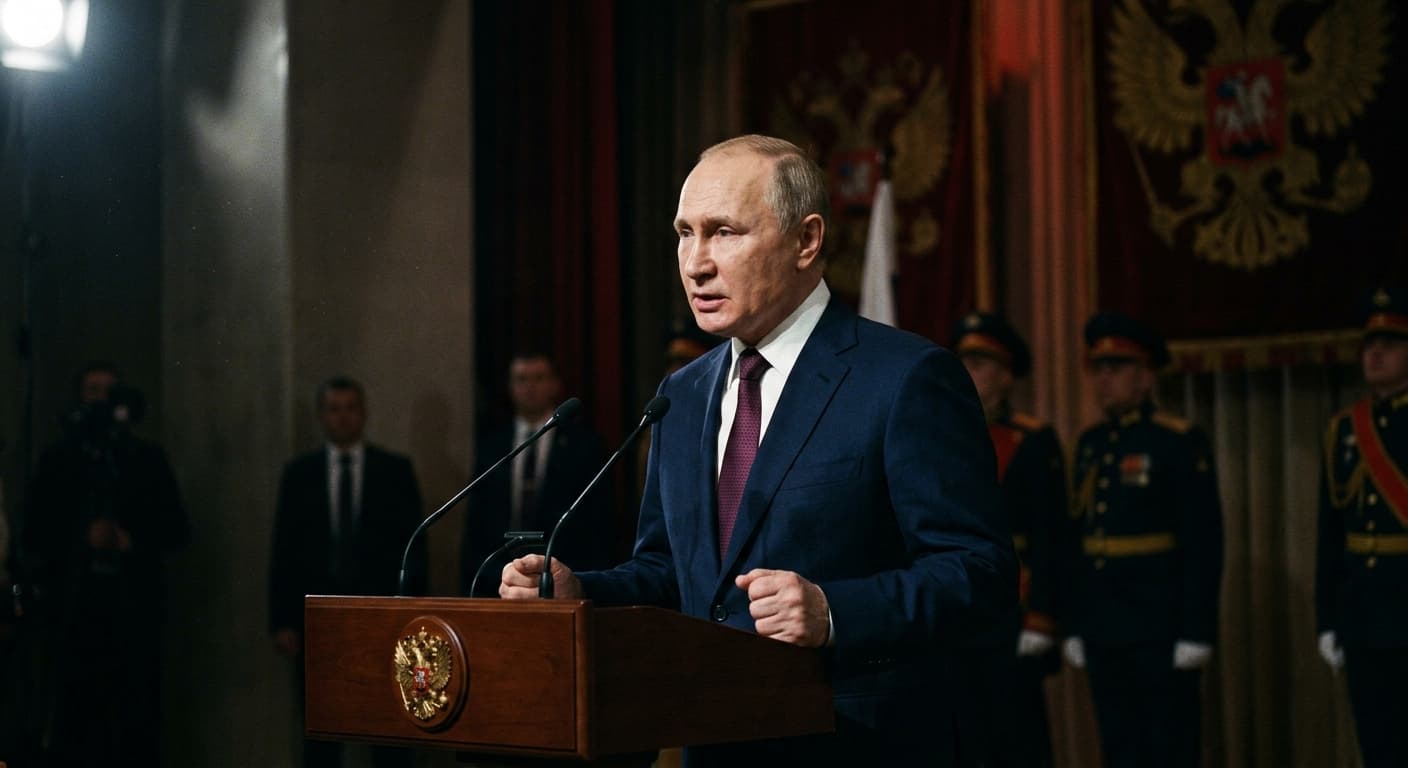
Putin Chooses Escalation Over Trump's Ukraine Peace Push
Reuters reports Putin plans to escalate the Ukraine war despite Trump's peace push, as NATO pledges €70 billion and Kyiv's drones cripple Russian oil.
Three sources close to the Kremlin told Reuters on July 9, 2026 that Vladimir Putin is rejecting peace negotiations and preparing to escalate the war in Ukraine — a decision announced one day after NATO leaders in Ankara pledged €70 billion in military aid to Kyiv and Donald Trump granted Ukraine a licence to manufacture Patriot missile interceptors. Putin is not walking into a quagmire he cannot escape; he is choosing one to reframe the war as a fight against NATO itself, buying political cover for the partial mobilisation Ukrainian intelligence expects him to order after Russia's September 18–20 parliamentary elections. The next 90 days are less about Donbas geography than about whether Putin can convert battlefield stalemate into a domestic war economy without triggering the transatlantic response that the Ankara summit was designed to advertise.
The Kremlin's answer to Ankara
The Reuters exclusive, carried by The Star and mirrored by
The Economic Times, reports that advisers who proposed a compromise on the Donbas were rebuked. Two of the three sources described the probability of further escalation as "high." Kremlin spokesman Dmitry Peskov made the message explicit the same day, dismissing Secretary of State Marco Rubio's suggestion at Ankara that Ukrainian deep strikes could push Russia toward talks.
According to Al Jazeera, Peskov warned that Moscow would respond by "creating a larger security zone" — a euphemism for seizing more territory — and cautioned that "further escalation may prolong the special military operation." That is the operative sentence. Peskov is telling Washington that pressure will lengthen the war, not shorten it, and that Russia's answer to a €70 billion Ukraine package is to widen the objectives, not narrow them.
The NATO Ankara Summit Declaration reaffirmed the alliance's Article 5 commitment and pledged equivalent 2027 support. In his
closing press conference, NATO Secretary General Mark Rutte layered on a €27 billion NATO fuel-supply investment aimed squarely at eastward warfighting readiness, with new pipelines toward the eastern flank. The clear signal to Moscow: NATO is now planning its logistics on the assumption that this war does not end in 2026.
Why the battlefield tells Putin to double down — not stand down
Escalation is not a signal of strength. It is a signal that the current tempo is failing.
According to the Warsaw-based OSW Centre for Eastern Studies, Russia's territorial gains in May 2026 were the smallest in three years — Ukraine's DeepState project measured a net 14 square kilometres in Russia's favour, while the Institute for the Study of War judged that Ukraine had actually clawed back more than 250 square kilometres.
Al Jazeera, citing ISW and CSIS data, calculated that at the June 2026 pace, Russia would need roughly 14 years to complete its stated objective of seizing the remaining 20% of Donetsk oblast — even as Kyiv puts June's Russian death toll at around 40,000.
Ukraine's Commander-in-Chief General Oleksandr Syrskyi, quoted by OSW after his May 20 briefing to the Ukraine–NATO Council, put Russian losses in 2026 alone above 141,500 troops, more than 83,000 of them permanent — a ratio of killed to wounded that Syrskyi attributed to the saturation of attack drones and Russia's inability to evacuate the wounded.
At the same time, Ukraine's "logistics lockdown" campaign is biting. Kyiv's drones struck Russia's Omsk refinery — 2,700 km from Ukrainian-held territory, per Al Jazeera — and drone-force commander Robert "Magyar" Brovdi told
the BBC that at least 25 Russian tankers were hit in the Sea of Azov between July 6 and 9. Fuel queues have appeared in Moscow and St Petersburg; Putin took to state television to concede the shortages are "obviously creating problems," but insisted they were "not critical," according to
the BBC.
The Atlantic Council framed the summer more bluntly, writing that Russia's offensive has been a "debacle" and that Pokrovsk and Kramatorsk — Putin's stated targets — remain in Ukrainian hands. The Royal United Services Institute's Jack Watling
warned in advance that Russia's stocks of legacy Soviet armour and artillery will begin exhausting between now and mid-autumn 2026 — meaning any escalation must be paid for by conscription, industrial mobilisation, or foreign supply. All three carry political costs.
The mobilisation calendar drives everything
This is the analytical spine that most of the wire coverage misses. Russia's State Duma elections are scheduled for September 18–20, 2026. Lt. Gen. Ihor Romanenko, former deputy chief of Ukraine's general staff, told Al Jazeera that Putin is preparing at least a partial mobilisation immediately after that vote — and that the "war with NATO" framing now openly used by Peskov exists to justify it.
That reframing is not rhetorical drift. On July 6, per the BBC, Putin instructed his generals to analyse the "real combat actions" of Ukraine's European allies "for taking responsible decisions in the future" — language military analysts read as legal-political scaffolding for a broader mobilisation decree. Peskov followed on state television with the once-taboo admission that "there's a war going on, a real war," blaming Berlin, Paris, The Hague, Oslo and Washington.
The implication is one that European chancelleries should mark. Nina Khrushcheva of The New School told the BBC that Putin is unlikely to bend under fuel-shortage pressure: "The more pressure he feels, the more likely he would act aggressively and repressively." European hopes of forcing him to the table were, she said, "a fantasy."
The operational read: an escalation announced before September looks reckless; one announced after a controlled Duma result looks legitimate. Putin needs the escalation curve to peak in October, not July.

The second-order effects: who wins, who loses
The Ukrainian defence industry is the sleeper winner. Trump's Patriot production licence — announced at Ankara and reported by the BBC — is the single most durable outcome of the summit. Patriot interceptors have been Ukraine's bottleneck against Russian ballistic missiles, and RUSI's Jack Watling
noted a direct correlation between interceptor supply and Russia's ballistic damage. A production licence takes years to yield hardware, but it embeds a long-term US-Ukrainian defence-industrial dependency into any future negotiation. Kyiv leaves Ankara less negotiable than before.
The loser inside Russia is the technocratic faction around the economy. Russia's Central Bank and finance ministry have spent 2026 warning about the cost of oil-price declines and defence-industrial overheating. RUSI's pre-summer assessment flagged that continued offensive operations into 2026 would likely require forced mobilisation — "both politically and economically challenging." Putin's rebuke of ceasefire advisers, reported via
AOL, signals that the security bloc has again outmuscled the economic bloc.
The loser abroad is European strategic autonomy — in the short run. Trump used the Ankara stage to impose a trade embargo on Spain over defence spending and float lifting CAATSA sanctions on Turkey, according to Al Jazeera. Emeritus professor Jolyon Howorth of the University of Bath told the outlet there was "little unity, either within Europe or between the Atlantic partners, as to the way forward with Ukraine." Peskov will read that fracture as vindication of the "creating a larger security zone" line.
The historical parallel worth naming is not 2022, but late 1916 — a war in which both sides recognised, privately, that the front had frozen, but neither could afford to be the first to say so publicly. Russia's Duma vote plays the political role Verdun once did: a domestic set-piece the leadership must survive before it can move openly to total war economy. The UN Human Rights Monitoring Mission's May 2026 protection update recorded 274 civilians killed and 1,763 injured in Ukraine — the highest monthly total since April 2022, with long-range weapons accounting for 46% of the toll. That is what "frozen" looks like from below.
What to watch
- September 18–20, 2026: Russian State Duma elections. Ukrainian intelligence and Al Jazeera-cited analysts flag the immediate post-vote window as the likely trigger for a partial-mobilisation decree.
- US 50-day tariff deadline: Trump's threat of 100% secondary tariffs on Russia's remaining trade partners, reported by
the BBC, runs into early September — colliding with Russia's election window.
- Witkoff–Kushner Moscow shuttle: The
Al Jazeera readout of the July 5 Trump-Putin call flagged Steve Witkoff and Jared Kushner as prepared to return to Moscow. Any concrete date — or a public collapse of that channel — will signal whether Trump's peace push has real substance or is running on autopilot while the war widens.
- Ukrainian winter grid campaign: OSW's assessment that Russia will pivot deep-strike targeting back to Ukrainian power generation before winter should be tested against strike patterns in September–October.
The Bottom Line
Putin's choice, as relayed by three Kremlin sources on July 9, is not to end the war but to change the story about why it continues — from "special military operation" to a defensive fight against NATO's 32 members. That reframing is the political prerequisite for the mobilisation Russia's stagnant front now requires; Trump's peace push, absent enforcement, is the diplomatic cover Putin needs while he prepares it. The next inflection point is not a summit but a ballot: what Russia does in the ten days after September 20 will tell Europe whether it is fighting the war it has, or the wider one Moscow is now openly rehearsing.
Discover more

US Politics
SNAP Food Assistance Faces Legal Challenges
In 2026, SNAP faces stricter eligibility rules and mounting legal challenges, threatening food assistance for the millions of Americans who rely on the program.
India
BJP's Misunderstanding of Women's Quota Needs
The BJP's linking of the Women Reservation Bill to delimitation risks delaying women's empowerment in India, misreading the aspirations of female voters.

US Politics
House Ethics Committee Pushes Sexual Miscond.
The House Ethics Committee has shifted responsibility for sexual harassment settlement records to the Office of Congressional Workplace Rights, complicating disclosure efforts.

Conflict & Security
Drone Warfare Killing Aid Workers at Unprec
Over 1,000 humanitarian workers killed in three years as cheap armed drones collapse legal protections. Gaza, Sudan, Ukraine, and DRC see deliberate targeting of aid convoys and hospitals with zero prosecutions.