Pentagon's $300M Lithium Stockpile Move
DLA to buy lithium carbonate amid China export curbs
Model Diplomat7 min readNorth America
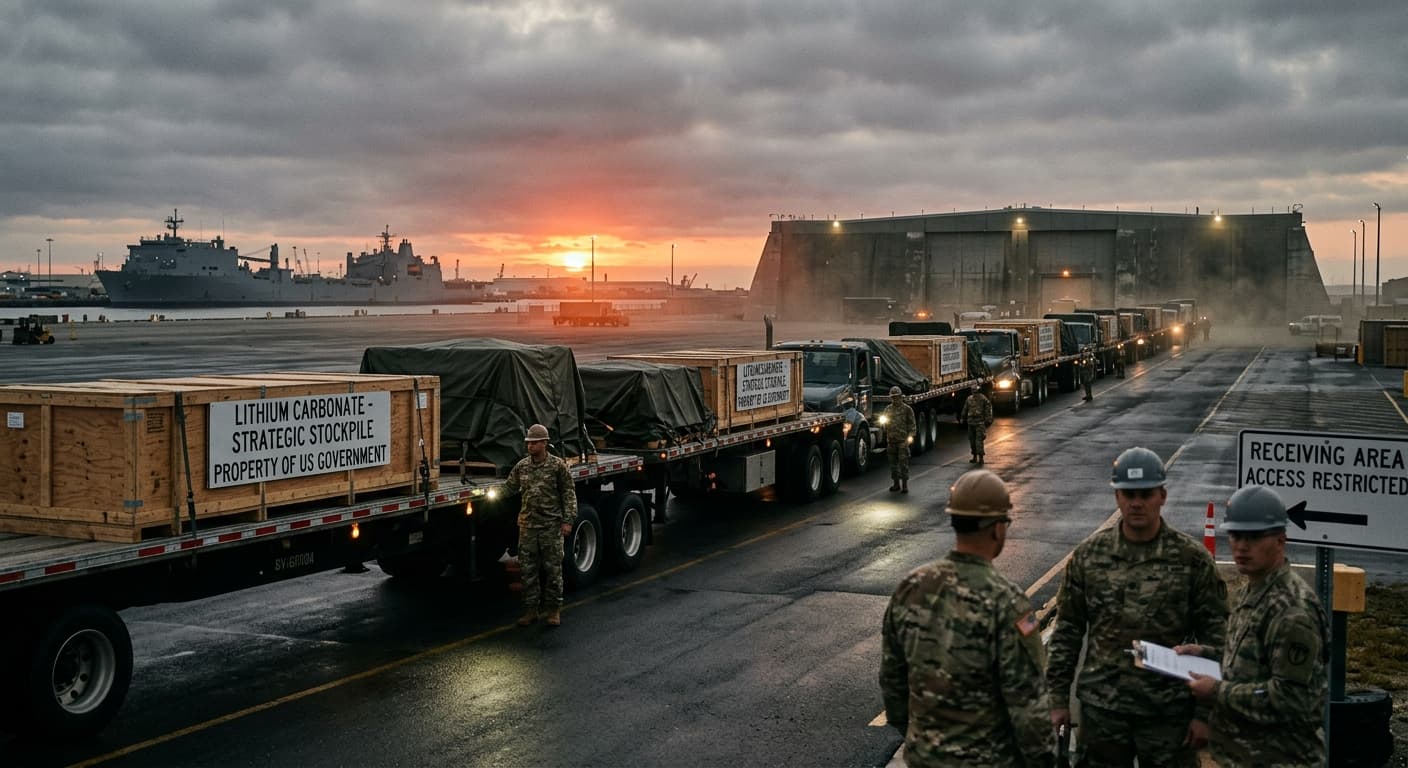
Pentagon's $300M Lithium Stockpile: The Battery Chokepoint Move
The Defense Logistics Agency will buy 16,200 tons of battery-grade lithium carbonate over five years — the first time lithium enters the US strategic stockpile, and a direct answer to China's October 2025 export curbs.
The US Department of Defense on June 2, 2026 posted a solicitation to buy up to 16,200 tons of battery-grade lithium carbonate over five years, worth as much as $300 million, with offers due July 17 — the first time in the 86-year history of the National Defense Stockpile that lithium has been added to the reserve. The move looks like a supply-chain footnote. It is not. It is Washington quietly conceding that the private US battery industry cannot generate a bankable demand signal on its own, and that the Pentagon must become the buyer of first resort to keep any non-Chinese refining capacity alive — a role the strategic stockpile was explicitly designed not to play.
The tender was reported by E&E News/POLITICO and confirmed against the trade press by
Caliber.Az. It sits inside a $2 billion critical-minerals appropriation in the 2025 reconciliation package and layers on top of President Trump's $12 billion Project Vault reserve,
described by Al Jazeera, which combines a $10 billion Export–Import Bank loan with $2 billion in private capital. The Pentagon is no longer trying to hedge Chinese supply. It is trying to replace it.
What the tender actually is — and what it isn't
The Defense Logistics Agency (DLA) is the National Defense Stockpile Manager under 50 U.S.C. §98e, whose statutory purpose is to "provide for the acquisition" of "strategic and critical materials" needed "in times of national emergency," according to the US Code. Congress last amended the statute on December 18, 2025 (Public Law 119-60), tightening notification windows and shifting acquisition authority from the President to the Stockpile Manager directly — a technical change that materially shortened the lag between political direction and contract award.
The stockpile itself is small. A Congressional Research Service primer put the DLA's holdings at a market value of roughly $561 million as of February 2024, spread across dozens of alloys, ores and rare earths. An
Atlantic Council analysis noted that a 2023 assessment found the reserve would cover less than half of the military's shortfalls and under 10% of essential civilian demand in a prolonged war with China. A $300 million lithium buy — roughly the size of the entire pre-existing reserve — is not decorative.
Neither is it enough. At current spot prices of about $10,700 per ton for battery-grade carbonate (Policy Center of the New South tracked the 85% price collapse from the November 2022 peak), 16,200 tons will cost roughly $170 million at market. The tender ceiling of $300 million implies DLA expects to pay a substantial premium for non-Chinese, battery-grade product with provenance guarantees. That premium is the policy.
The real chokepoint is one link downstream
Lithium mining is not the problem. Australia produces the majority of the world's spodumene; Chile and Argentina dominate brine output. According to a peer-reviewed study in Nature Communications, Chile and Argentina supply 28% of global lithium and Australia produces 37% — but most of that raw material "is refined into battery-grade lithium salts in China," which controls "over 60% of lithium chemicals to battery-grade materials." The
BBC puts Chinese share of global cell manufacturing at "more than three-quarters" as of late 2025. The Observer Research Foundation, citing Chinese industry data,
reports that Chinese firms produce roughly 85% of cathode material and over 90% of anodes.
The DLA solicitation targets battery-grade carbonate — the refined chemical, not the ore. That distinction is the story. In her March 2026 testimony to the Senate Armed Services Committee, the Pentagon's industrial-base office described a deliberate strategy of "moving down the value chain," acquiring "higher-purity, processed materials further downstream" — specifically "the materials that represent the true bottlenecks in the supply chain." Lithium carbonate is exactly that: the choke point between Australian rock and a functioning American battery.
The problem is that almost nobody outside China can produce it at scale. The Thacker Pass mine in Nevada, in which the US Department of Energy took a 5% stake in October 2025, is designed for 40,000 tons per year of battery-grade carbonate in its first phase — but is not yet in commercial production. Albemarle's Kings Mountain project is stalled. Piedmont Lithium's Tennessee refinery is unfunded. A
Peterson Institute policy brief by Cullen Hendrix argues that Western critical-minerals projects face "persistent bankability issues" because "without guaranteed demand at predictable prices, these projects struggle to attract private capital." The DLA tender is the guaranteed demand.
Beijing set the trap. Washington is trying to spring it.
The timing is not accidental. On October 9, 2025, China's Ministry of Commerce imposed sweeping export controls on rare earths, lithium-ion batteries, graphite anode materials and the associated production equipment — with extraterritorial reach requiring foreign firms to obtain Chinese licenses even for products made abroad using Chinese-origin material. A partial suspension until November 10, 2026 was negotiated at the Trump–Xi meeting in Busan, according to the
European Parliamentary Research Service. Controls on fourth-generation LFP cathode technology, imposed July 15, 2025, were not suspended, according to the
German Council on Foreign Relations.
The Swedish Institute of International Affairs concluded that Beijing's 2025 restrictions were "primarily imposed as an additional tool in the broader trade and tariff war with the United States." China now treats lithium refining and battery IP the way it treats rare-earth magnets: a lever it can pull whenever bilateral relations deteriorate. A five-year DLA offtake, at ceiling prices, is Washington's answer to the November 2026 cliff.
There is also a domestic-legal dimension. According to a company announcement carried by the Financial Times, new US defense procurement rules banning Chinese-origin rare-earth materials take effect in 2027. A Pentagon that has not pre-positioned lithium carbonate before those rules bite will find itself with weapons programs that legally cannot be sourced.
Who benefits — and who quietly loses
The obvious beneficiaries are the handful of North American and allied producers positioned to bid. Lithium Americas / Thacker Pass, in which Washington now holds equity, is the presumptive anchor supplier for phase-one output. Albemarle's Silver Peak operation in Nevada is the only currently producing US carbonate source. Australian majors — IGO, Pilbara Minerals, Mineral Resources — can bid via US converters if they can get product to battery-grade specification. Canadian firms qualify as "domestic sources" under the Defense Production Act, as the DoD confirmed in its Nano One award announcement.
The less obvious beneficiary is Chile. Its state agency Cochilco has projected a lithium surplus of 141,000 tons in 2025. A US buyer of last resort at premium prices provides Santiago with a way to absorb that surplus outside the Chinese refining orbit — and gives SQM and Codelco's new joint venture political cover for pricing discipline.
The losers are structural. US electric-vehicle manufacturers — Ford, Stellantis, and every Tier-1 cell maker not named CATL — will bid against the Pentagon for a scarce non-Chinese supply. The Peterson brief warns explicitly of "crowding out": if the government stockpiles processed material without differentiating from commercial demand, it creates the exact price signal that will slow the EV transition. And Beijing itself: the more the US treats lithium as a wartime material, the harder it becomes for Chinese refiners to argue against reciprocal Western sanctions on the LFP cathode technology they still dominate.
The Diplomat View
The Pentagon is doing something the Strategic and Critical Materials Stock Piling Act was written to prevent. The 1979 statute expressly declares the stockpile "is not intended to influence prices in the market or insulate private industry from supply shocks," according to the Federal Register notice. The 2026 lithium tender, at prices likely 40–70% above spot, does exactly that. It is de facto industrial policy, executed through a strategic-materials wrapper because Congress will authorise $2 billion under the "national security" banner that it will not authorise under "clean-energy subsidy."
The forecast: the DLA award — likely announced in the fourth quarter of 2026 — will go to a consortium anchored by Lithium Americas and one or two allied Australian or Chilean converters, at a blended price well above market. It will not be the last such tender. Expect nickel sulfate, cobalt sulfate, and battery-grade manganese solicitations to follow within eighteen months. The forecast fails if two things happen: (1) Beijing lifts its LFP-cathode controls unconditionally at the November 2026 review, removing the political urgency, or (2) Congress rescinds the $2 billion appropriation in a fiscal-2027 continuing-resolution fight. Neither is likely.
The deeper signal is that the Trump administration has stopped pretending that markets alone will rebuild American battery supply chains. It is buying them, one solicitation at a time. The United States is discovering, three decades late, what Beijing figured out in 2001: minerals policy is industrial policy is defense policy.
Four dates that matter
- July 17, 2026 — Proposals due at DLA. Expect at least four bidders: a Lithium Americas–led consortium, an Albemarle bid, an Australian–US converter joint venture, and at least one Chilean-backed offer via a US midstream partner.
- November 10, 2026 — Expiration of China's suspended export controls on lithium-ion batteries, graphite anodes and third-generation LFP cathode material. If Beijing lets them snap back, expect an emergency Pentagon Defense Production Act Title III drawdown.
- Q1 2027 — First deliveries of the "China-free" defense procurement rules on rare earths take effect. A lithium extension is already drafted in the FY2027 NDAA markup.
- FY2027 NDAA (Section 1411 series) — The tell is language expanding the National Defense Stockpile Transaction Fund to "no-year" authority, as Pentagon industrial-base officials
requested in March 2026 testimony. That is the tell that lithium is the template, not the exception.
Discover more
US Politics
House Ethics Committee Pushes Sexual Miscond.
The House Ethics Committee has shifted responsibility for sexual harassment settlement records to the Office of Congressional Workplace Rights, complicating disclosure efforts.
India
700 Activists Accuse PM Modi of MCC Breach
Over 700 activists allege PM Modi breached election code with a televised address attacking opposition parties just before state elections.
US Politics
SNAP Food Assistance Faces Legal Challenges
In 2026, SNAP faces stricter eligibility rules and mounting legal challenges, threatening food assistance for the millions of Americans who rely on the program.

Economics
Fed's Amex AML order puts correspondent banking on notice
Federal Reserve's Amex AML order requires board-level controls and a 90-day plan; OCC fined the bank $350 million over enterprise-wide deficiencies.