OPEC+ July 5 Deal: A Saudi Loyalty Test
Saudi Arabia's move to maintain Gulf cohesion after UAE exit
Model Diplomat7 min readMiddle East
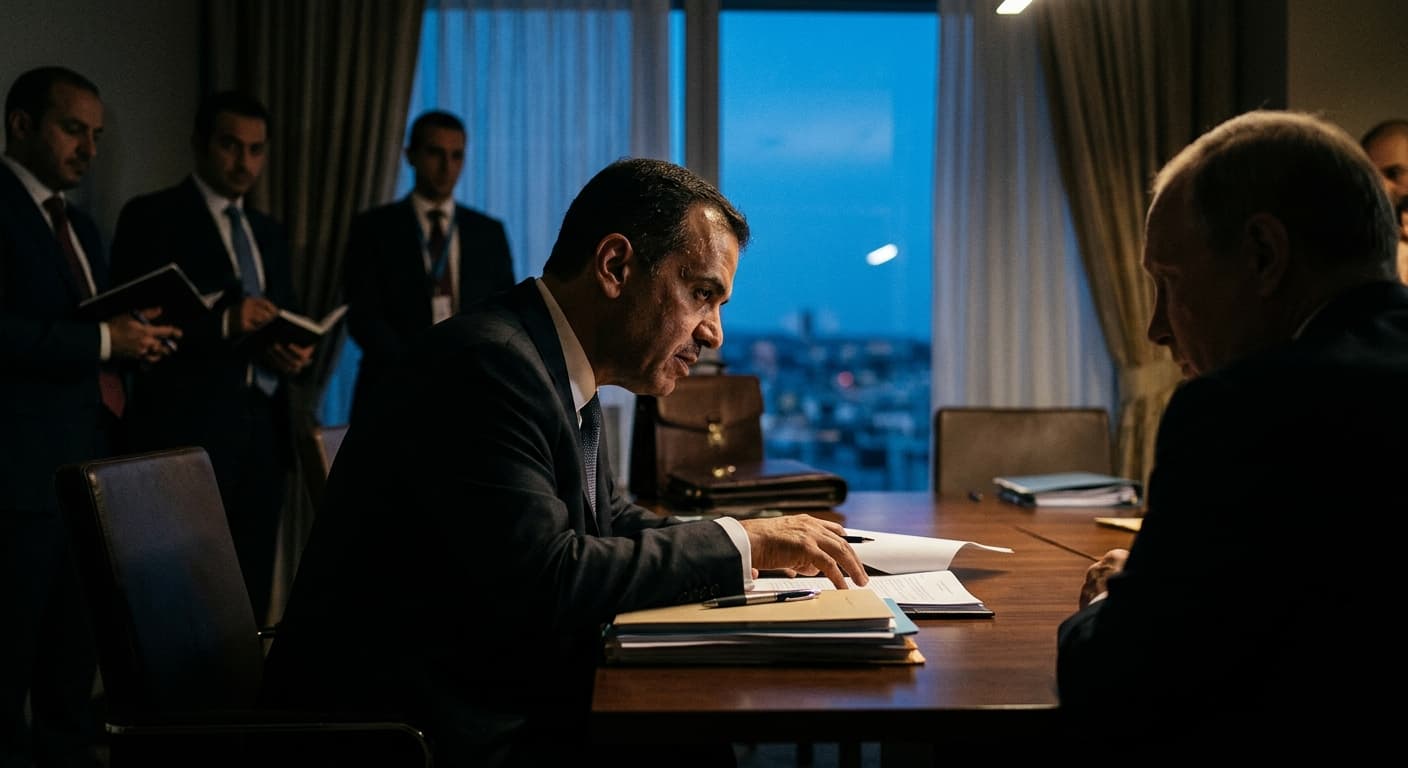
Inside OPEC+'s July 5 Deal: A Loyalty Test After the UAE Walkout
OPEC+'s seven-nation decision to add 188,000 b/d for August 2026 is less an oil-market move than a Saudi-led effort to hold the Gulf order together after the UAE quit, the war on Iran, and the Hormuz shock.
The 188,000-barrel-a-day production hike that seven OPEC+ members announced from Riyadh on July 5, 2026 is not really about oil. It is a Saudi-led loyalty ritual — designed to freeze the group's internal geometry after the United Arab Emirates walked out on May 1, to reassure Washington that Gulf producers can still refill a market throttled by the Iran war, and to keep Russia inside a cartel it has quietly grown to dominate. In barrels, the increase is trivial: OPEC+'s own figures show combined output collapsed from 42.77 million barrels per day in February to 33.13 million in May, according to Al Jazeera. What the meeting sold to the market was not supply. It was cohesion.
The decision, in one paragraph
The seven — Saudi Arabia, Russia, Iraq, Kuwait, Kazakhstan, Algeria and Oman — met virtually on Sunday, July 5, and agreed to raise August quotas by 188,000 b/d, extending the fifth consecutive monthly increase since the war began. Their communiqué "reaffirmed the importance of adopting a cautious approach and retaining full flexibility to increase, pause or reverse the phase out of the voluntary production adjustments," per the text carried by Riyadh Daily and echoed by
Al Jazeera. The next Joint Ministerial Monitoring Committee review is set for August 2. In the same weeks, the group is finishing the third-party audit of each member's true production capacity that will inform 2027 quotas — the assessment the
Middle East Institute says the UAE's exit has made unavoidable.
Two facts frame everything else. First, Brent settled at $72 on July 6, back below its $72.48 pre-war close on February 27, per Al Jazeera's price data. Second, by July 8, US strikes on Iran and a Treasury revocation of the 60-day Iranian oil sanctions waiver had knocked Brent back above $76, according to a follow-up Al Jazeera report. The quota decision is being taken in a market whose real price signal is set by warships, not spreadsheets.
The paper barrel
Analysts covering the meeting were unusually blunt about what the number means. "Actual barrels have been constrained for months by the Strait of Hormuz blockade, falling well short of the quota," Fabien Yip of IG Sydney told Al Jazeera. Neil Crosby of Sparta Commodities called the quotas "essentially meaningless" in the short term. The Middle East Institute concluded that both the May 3 and July 5 increases "will remain symbolic for now" because Saudi Arabia, Iraq and Kuwait — the three producers meant to deliver most of the new barrels — physically cannot export them while Hormuz traffic sits at roughly a third of pre-war levels.
The physical picture confirms it. Wood Mackenzie's Hormuz shock report tracked around 11 million b/d of production shut in at peak. The Sasakawa Peace Foundation's
analysis of OPEC monthly data recorded Saudi output falling from 10.11 million b/d in February to 6.87 million in April, Iraq from 4.14 million to 1.49 million, and Kuwait from 2.58 million to just 560,000 — a combined loss of 9.28 million b/d across four states. No 188,000-barrel notice on OPEC letterhead moves that needle.
What the deal is actually doing
Strip away the barrels and three real transactions are happening at once.
One: it papers over the UAE's exit. The UAE ended 58 years of OPEC membership on May 1, effective the previous Friday, in what the BBC framed as a "big deal" and one analyst as "the beginning of the end of Opec." The
Council on Foreign Relations traced the move to a specific rupture: the Saudi Air Force's late-December 2025 strikes on Southern Transitional Council forces in Yemen, a UAE-backed faction, followed by a public quarrel that extended to Sudan. The Atlantic Council's
Jonathan Panikoff called the exit "a long time coming" and predicted Saudi Arabia would answer economically rather than militarily. The July 5 statement — which never names the UAE — is that answer: business as usual, seven signatures, no gap on the page.
Two: it locks Russia in. Since 2016, when the Declaration of Cooperation formalised OPEC+, Moscow has been the alliance's most consequential non-OPEC partner. An IMF working paper by Yousef Nazer and Andrea Pescatori notes that the enlarged OPEC+ "represents about 60 percent of the global crude oil production" and that its "double leadership (KSA and Russia) add complexity to the decision-making process." A
World Bank analysis of OPEC's history observed that when OPEC+ began reversing cuts in April 2025 prices fell to below $60 in December. With Russia's own oil sector, per MEI, "dealing with a crisis of its own" after strikes and sanctions escalation, Riyadh needs Moscow's name on the July communiqué more than Moscow needs Riyadh's — and it got it.
Three: it signals to Washington. The Sasakawa Peace Foundation's analysis argues the UAE's departure "aligns, to some extent, with US preferences for stable oil prices" as Abu Dhabi tightens its embrace of Washington. Saudi Arabia is playing the same game from the opposite side of the counter: by repeatedly announcing hikes it cannot yet deliver, Riyadh telegraphs to a Trump White House — which has publicly attacked OPEC for "ripping off" consumers per the BBC — that the cartel is a supplier of last resort once Hormuz normalises. The signal is cheap; the barrels are hypothetical.
Who wins, who loses
The winner is Saudi Arabia — but only in the diplomatic sense. In the fiscal sense the kingdom is bleeding. OilPrice.com's reporting from Saudi General Authority for Statistics data shows March 2026 oil-export revenue jumped to $24.7 billion — a 3.5-year high — as prices spiked above $100, but only because Aramco pushed the East-West pipeline to its 7 million b/d ceiling to reach Yanbu on the Red Sea. The
World Bank's MENA Macro Monitor already recorded a 43% year-on-year jump in Saudi Arabia's 2024 fiscal deficit and warned oil revenues in Q4 2024 were 31% below the same quarter in 2023. With the IMF's estimated $91 fiscal breakeven and Brent at $72, another oil price crunch reopens the gap.
The clearest loser is Iraq. Analytics firm Kpler, cited by the Financial Times via OilPrice, estimates Gulf producers had already lost $15.1 billion in oil and gas revenue in the first weeks of the war, with Iraq — most reliant on oil and thinnest on sovereign-wealth cushioning — the country whose government finances face the sharpest strain. Iraq is also OPEC's chronic quota over-producer, meaning the "compensation for overproduced volumes since January 2024" language the July 5 statement recycled from earlier meetings is aimed squarely at Baghdad.
The unexpected beneficiary is Canada. Wood Mackenzie's data shows Asian refiners "moved quickly to replace lost Persian Gulf barrels with Canadian grades" via the Trans Mountain expansion — a structural share shift OPEC+'s paper increases do nothing to reverse.
The historical parallel that reframes it
There is a precedent for this exact choreography, and it is not flattering. In July 2021, an internal fight over the UAE's baseline quota deadlocked OPEC+ and canceled a meeting outright, per the Center for Strategic and International Studies. The alliance held together then because Abu Dhabi and Riyadh still needed each other in Washington. By 2026 they no longer do — the UAE simply left. The 2021 crisis was resolved by raising the UAE's baseline; the 2026 crisis is being managed by pretending the UAE was never there. That is a weaker fix, and it is why the third-party capacity audit due by year-end matters: it will determine whether Iraq, Kuwait and Kazakhstan get the higher quotas that would have gone to Abu Dhabi.
Diplomat View
The July 5 announcement is not a market signal — it is a Saudi statement about who still answers when Riyadh calls. Read it as the moment OPEC+ formally became a seven-plus-Russia club under Saudi tempo, with the UAE outside the tent and Iran, Libya and Venezuela exempted for reasons that have not changed in a decade. That structure is more Saudi-dominated than the pre-war cartel, but it is also more brittle: it depends on Hormuz reopening cleanly, on Russia's oil sector not deteriorating further, and on Iraq accepting compensation cuts it has never really honoured. If any of those slip, the group's next "adjustment" will move from symbolic to real, in the wrong direction. The forecast to revise if: Hormuz traffic fails to clear 80 vessels a day by end-August, or the Saudi–Iraq compensation dispute becomes public. Either would tell you the seven-nation format is not the new equilibrium — it is a way station.
What to watch
- August 2, 2026 — Next JMMC review meeting; first test of whether the seven can agree a September hike or blink under a rebounding price.
- August 17, 2026 — 60-day US–Iran MoU deadline, per the
BBC's published text. A final deal or its collapse will decide Hormuz throughput and Iran's re-entry to the export market.
- Q4 2026 — OPEC+ third-party capacity audit expected to conclude, setting the 2027 quota fight between Iraq, Kuwait and Kazakhstan.
The Bottom Line
OPEC+'s July 5 production hike is not an oil decision — it is a diplomatic loyalty test that Saudi Arabia needed to pass after losing the UAE and half the Gulf's export capacity. The 188,000 barrels are a message to Washington, Moscow and Baghdad that Riyadh still runs the room. Whether the room is worth running depends on the Strait of Hormuz, not on the communiqué.
Discover more
US Politics
SNAP Food Assistance Faces Legal Challenges
In 2026, SNAP faces stricter eligibility rules and mounting legal challenges, threatening food assistance for the millions of Americans who rely on the program.
Global Politics
Trump's Conflicting Messages on Iran War
Trump's mixed messages on Iran reflect a strategy of audience management, benefiting Tehran amid a complex geopolitical landscape.

India
Delhi CM Rekha Gupta Blasts Opposition's Delm
Delhi CM Rekha Gupta's remarks on women's quota defeat reveal BJP's strategy for the 2029 Lok Sabha elections, focusing on delimitation.

Conflict & Security
Drone Warfare Killing Aid Workers at Unprec
Over 1,000 humanitarian workers killed in three years as cheap armed drones collapse legal protections. Gaza, Sudan, Ukraine, and DRC see deliberate targeting of aid convoys and hospitals with zero prosecutions.