OFAC Sanctions CJNG Fuel Network Impact
Sanctions leverage against Sheinbaum in USMCA talks
Model Diplomat7 min readNorth America
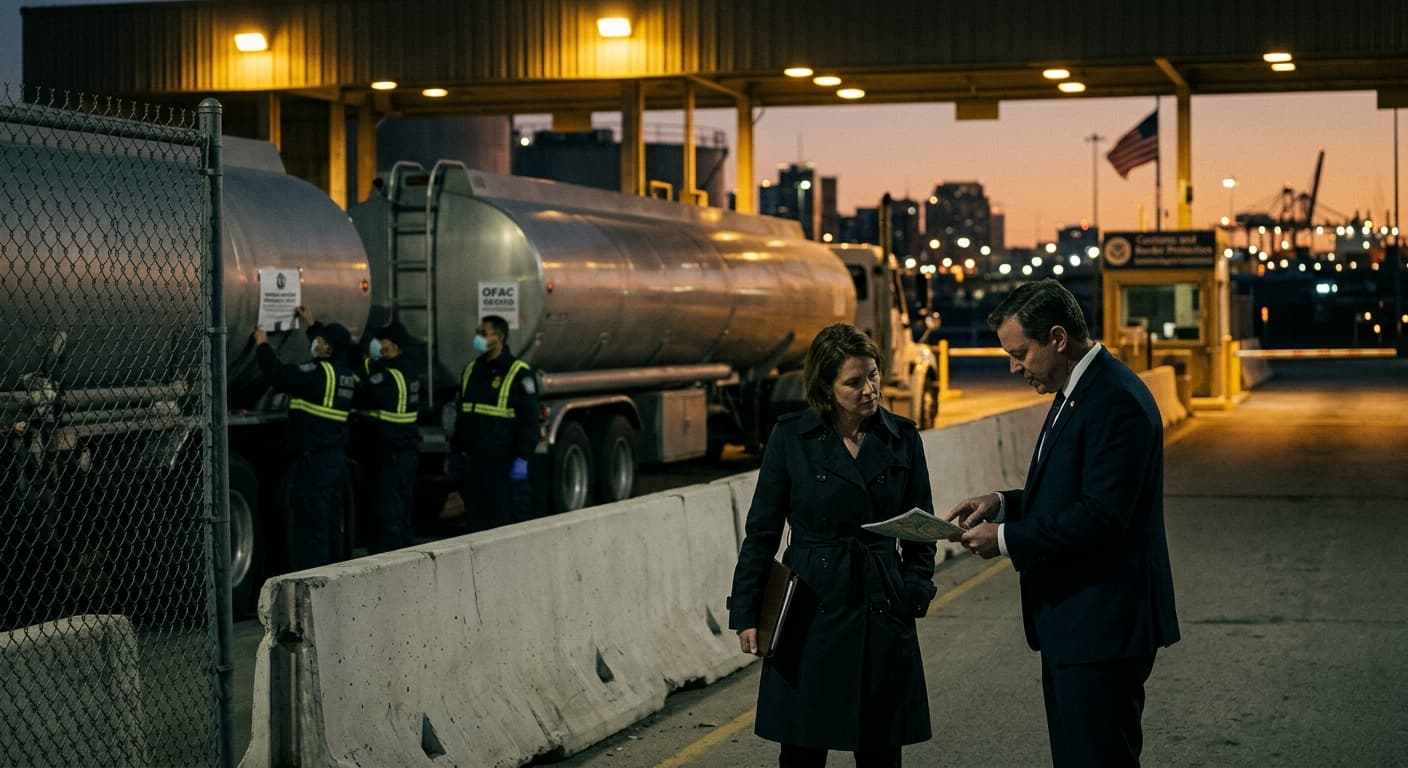
OFAC Sanctions CJNG Fuel Network: Sheinbaum's USMCA Leverage Point
OFAC's June 30, 2026 sanctions on a CJNG-linked fuel smuggling and tax evasion network — and FinCEN's supplemental money laundering alert — reset US–Mexico leverage weeks before the USMCA review.
The US Treasury's June 30, 2026 designation of two Mexican nationals and nine entities in a Cartel Jalisco Nueva Generación (CJNG) fuel-smuggling ring is being read in energy circles as an enforcement story. That is the wrong lens. The action is a trade-negotiation instrument aimed squarely at Claudia Sheinbaum, timed to the USMCA review President Donald Trump refused to renew "in its current form" ten days earlier. By anchoring the sanctions to huachicol fiscal — a tax-evasion scheme that costs Mexico an estimated $24 million a day in lost revenue — Washington has weaponised a problem Mexico City must solve, converting a criminal-finance file into a lever over refined-product flows, USMCA rules of origin, and the political survival of Sheinbaum's Morena coalition. The immediate winners are the compliance-strict US refiners and midstream operators near the Permian; the losers are the Mexican political networks in Tamaulipas, Veracruz, and Tabasco whose franchise on discounted diesel is now a US federal crime with extraterritorial reach.
What Treasury actually did
According to the U.S. Department of the Treasury, the June 30 action was executed under Executive Order 14059 (illicit-drug proliferation) and Executive Order 13224 (counterterrorism), the dual authority unlocked when the State Department designated CJNG as a Foreign Terrorist Organization and Specially Designated Global Terrorist on February 20, 2025. Among the newly designated is Oscar Guillermo Juraidini Silva, whom Treasury alleges runs a fuel-smuggling enterprise that generates "hundreds of millions of dollars each year" for CJNG, per the release circulated through allied outlets including
News Europe. The nine entities operate the classic huachicol fiscal stack: shell importers, falsified customs paperwork misclassifying diesel as "waste oil" or lubricants, and a retail-station distribution tail.
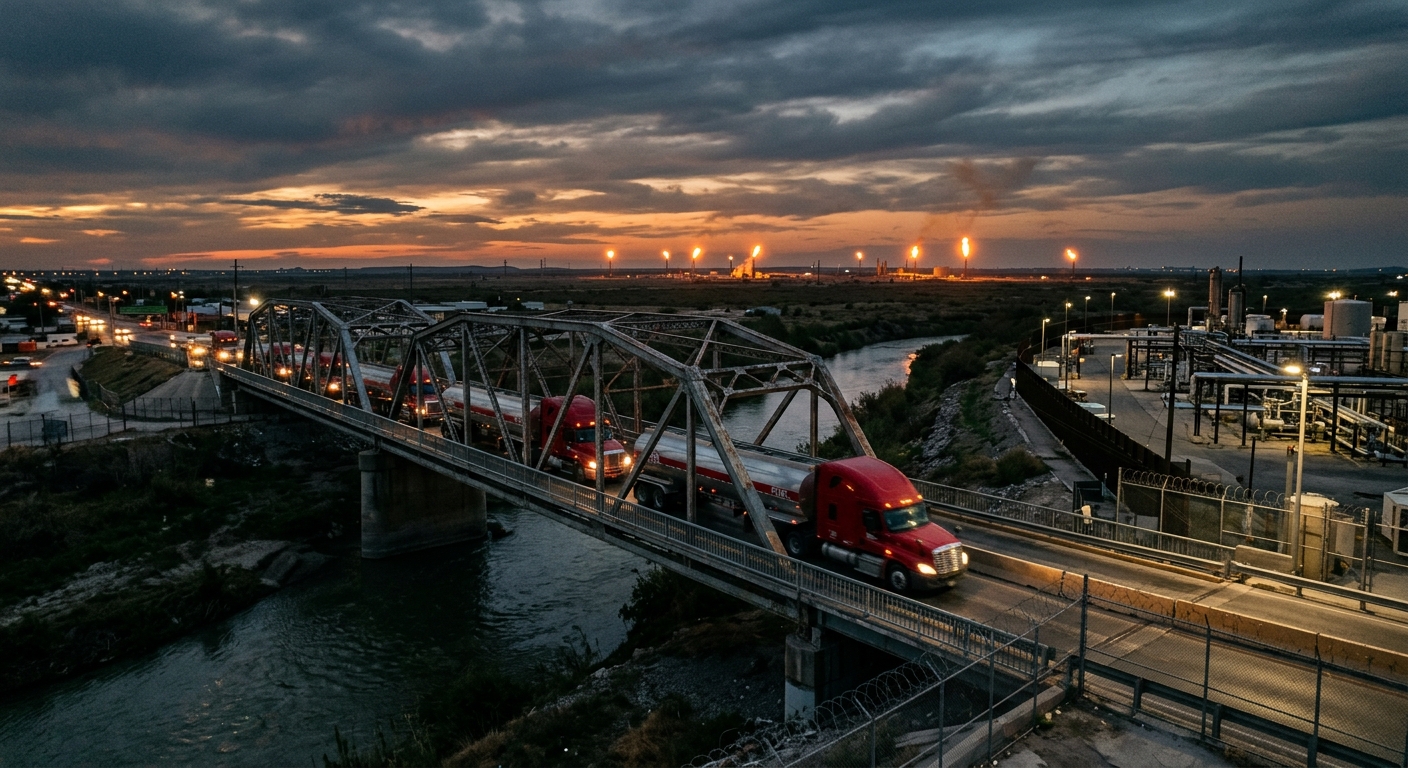
The FinCEN supplemental alert issued in parallel is where the compliance world reacted most sharply. It builds on FIN-2025-Alert002 of May 1, 2025 — the crude-oil smuggling notice catalogued on the FinCEN advisories index — and shifts the red-flag typology from stolen Pemex crude flowing north to US-refined product flowing south under falsified tariff codes. Treasury disclosed that in the 12 months following the May 2025 alert, FinCEN received more than 160 SARs detailing over $7 billion in suspicious flows — primarily between the United States and Mexico — with subjects clustered in Brownsville, Mission, Eagle Pass, and McAllen.
AML Intelligence flagged the correspondent-clearing exposure for Texas fuel jobbers as the operative compliance risk.
The number that reframes the story
The market context is not fentanyl. It is fiscal.
The Financial Times' visual investigation put illicit diesel and gasoline at 16–27% of Mexico's annual fuel consumption — between 172,000 and 290,000 barrels per day, with a retail value of $12–21 billion. Verifigas, cited by
Al Jazeera, estimates Mexico lost roughly $10 billion in 2025 to the trade. The bipartisan Cornyn–Rosen
Stop Fueling Cartel Violence Act, introduced in the 119th Congress, cites Treasury enforcement data putting daily lost tax revenue at approximately $24 million and notes that "between 16 and 27 percent of total annual fuel consumption in Mexico originates from illegal sources."
That last figure is the one Sheinbaum cannot ignore. Mexico's 2026 federal budget already assumes a Pemex bailout envelope and a 7.7% Pemex spending increase, with production targeted at 1.8 million barrels per day. Every barrel of contraband US diesel that clears a Tamaulipas customs booth as "lubricant" undercuts Pemex retail margins domestically and drains the treasury of the IEPS fuel excise. In effect, the Trump administration is telling Mexico: your fiscal crisis is being financed by a cartel-run arbitrage on our refined product, and we now consider your enforcement failure a US national-security matter.
Why this is a USMCA move, not a drug move
The timing is the tell. On July 1, 2026, the BBC reported that the United States had formally blocked the long-term renewal of USMCA, converting the treaty's statutory review into an open-ended pressure track.
Al Jazeera's explainer frames it as strategic ambiguity: the deal survives, but on Washington's calendar.
CSIS's Ryan Berg put the operating logic bluntly in his analysis of the Sinaloa governor indictment: "the price of admission to the trade table is now security cooperation." The June 30 sanctions extend that logic into the energy file. Sheinbaum, whose security minister Omar García Harfuch has recovered more than 40 million litres of stolen fuel and detained Vice Admiral Manuel Roberto Farías Laguna in the huachicol probe — as
BBC Mundo documents — is now being forced to escalate against political allies inside her own Morena coalition, particularly in Tabasco, or forfeit tariff relief on Mexican auto and steel exports.
Foreign Affairs captured the bargain from the US side. Trump's dealings with Sheinbaum, it observed in a July 2026 essay, have been "unexpectedly productive" because he has leveraged tariffs and the threat of military strikes to extract "unprecedented" security coordination — 92 cartel figures transferred to US custody since Sheinbaum took office, per CSIS's tally. The June 30 designation is another turn of the same screw, but aimed at a constituency that has so far been protected: the businessmen-politicians who run the fuel triangulation.
Who benefits, who loses
The unexpected beneficiary is Pemex. Every dollar of huachicol fiscal displaced from the market accrues to legitimate imports and to Pemex's refined-product margin at Dos Bocas and Deer Park. Sheinbaum's 2025 reform reclassified Pemex from a "Productive State Enterprise" to a "Public State Enterprise," prioritising public benefit over profit — a status that makes enforcement politically saleable at home. If US sanctions succeed in raising the compliance cost of cross-border fuel arbitrage, Pemex captures the volume without having to compete on price.
The losers are more specific than "cartels." They are the US refiners and midstream traders in the Permian and Gulf Coast who have been selling into complicit jobbers. Treasury's own OFAC methodology chart describes stolen crude "delivered to complicit U.S. importers in the oil and natural gas industry operating near the U.S. southwest border, who sell it at a steep discount." The June 30 FinCEN supplemental flips that flow: US-refined product moving south under false tariff codes. Any US refiner whose product ends up in a Tamaulipas mobile storage tank now sits inside the FinCEN typology, with SAR obligations for its correspondent banks and secondary-sanctions exposure under EO 13224 for its counterparties. That is why
Reuters-tier compliance shops — including the Association of Trade Finance Compliance Professionals — are treating this as a materially expanded enforcement perimeter, not a routine SDN update.
The second-order loser is China. Congressional Research Service testimony from June 9, 2026 documents that Chinese Money Laundering Networks (CMLNs) are the "dominant" professional launderers for Mexican TCOs, per Treasury's 2026 National Money Laundering Risk Assessment. Fuel proceeds moved through CMLN mirror transfers are now inside the same red-flag framework that governs fentanyl profit repatriation — an outcome that pulls the huachicol file into the broader US–China financial decoupling story.
The historical parallel that reframes everything
This is the Islamic State playbook, applied to Mexico. A CSIS analysis of FTO designations for cartels noted that an EU study attributed 70–80% of ISIS revenue to hydrocarbons, extortion, and "contributions." The US-led coalition eventually treated ISIS's Iraqi and Syrian oil monetisation as its financial center of gravity, targeting the tanker convoys and the brokers who moved crude to Turkish black markets. The February 20, 2025 FTO designation of CJNG gave Treasury the same authority set — E.O. 13224, secondary sanctions, material-support liability — against a cartel whose non-drug revenue center is also hydrocarbons.
That parallel is what makes this bigger than a compliance advisory. The Trump administration has decided CJNG's fuel arm is analytically indistinguishable from ISIS's oil arm — and is beginning to enforce that view against a G20 economy sharing a 2,000-mile land border with the United States.
Diplomat View
The June 30 sanctions are a forecastable action with an unforecastable second act. The base case: Sheinbaum absorbs the pressure, tolerates further FGR arrests of Tabasco- and Tamaulipas-linked Morena figures, and buys tariff relief in the USMCA review window that CSIS pegs around late July 2026. Under this scenario, US refiner compliance costs rise, the black-market share of Mexican fuel consumption drops below 15% by mid-2027, and Pemex captures the recovered volume. The forecast breaks under two conditions. If Sheinbaum arrests or extradites Sinaloa governor Rubén Rocha Moya to satisfy Washington, she risks a Morena schism that could reopen the cartel-political nexus faster than sanctions can close it. If Trump escalates from financial pressure to kinetic action — the "unilateral drone strikes" scenario Foreign Affairs now treats as live — the entire cooperation architecture collapses and huachicol becomes untouchable as nationalist politics rewires the file. Revise this call if the FGR indicts a sitting Morena governor before September, or a US strike lands on Mexican soil.
What to watch
- Late July 2026: USMCA review sessions in Mexico City. Watch whether US negotiators tie tariff relief on Mexican steel and autos to specific huachicol enforcement benchmarks.
- Next FGR filings: Any indictment reaching Tabasco-based Morena officials would signal Sheinbaum accepting the US framing. Silence signals she is holding.
- FinCEN SAR volume, Q3 2026: If the $7 billion / 160-SAR run rate doubles after the supplemental alert, US correspondent banks will pull lines from Texas fuel jobbers, pricing the compliance cost into border-market diesel within weeks.
The Bottom Line
The June 30 OFAC action is not a drug-war sanctions update — it is a fuel-market and trade-policy instrument dressed as one, designed to convert Mexico's $10 billion-a-year huachicol fiscal problem into a lever the Trump administration can pull inside the USMCA review. If Sheinbaum moves against the Morena networks that profit from cross-border fuel arbitrage, Washington gets both cheaper compliance for US refiners and a tariff-relief narrative; if she does not, the sanctions perimeter will keep expanding until the political cost of inaction exceeds the political cost of the purge. Either way, the CJNG file is now inseparable from the North American trade file — and that is the shift markets have not yet priced.
Discover more

US Politics
House Ethics Committee Pushes Sexual Miscond.
The House Ethics Committee has shifted responsibility for sexual harassment settlement records to the Office of Congressional Workplace Rights, complicating disclosure efforts.
US Politics
SNAP Food Assistance Faces Legal Challenges
In 2026, SNAP faces stricter eligibility rules and mounting legal challenges, threatening food assistance for the millions of Americans who rely on the program.

India
Women’s Reservation in India
India's 33% women's reservation law is enacted but won't take effect until after 2029 due to political setbacks and census delays.

Conflict & Security
Drone Warfare Killing Aid Workers at Unprec
Over 1,000 humanitarian workers killed in three years as cheap armed drones collapse legal protections. Gaza, Sudan, Ukraine, and DRC see deliberate targeting of aid convoys and hospitals with zero prosecutions.