Nvidia's Asia Buyer Purge Exposes Beijing as
Nvidia cuts Asia buyer list by half after $2.5B smuggling scandal
Model Diplomat8 min readAsia
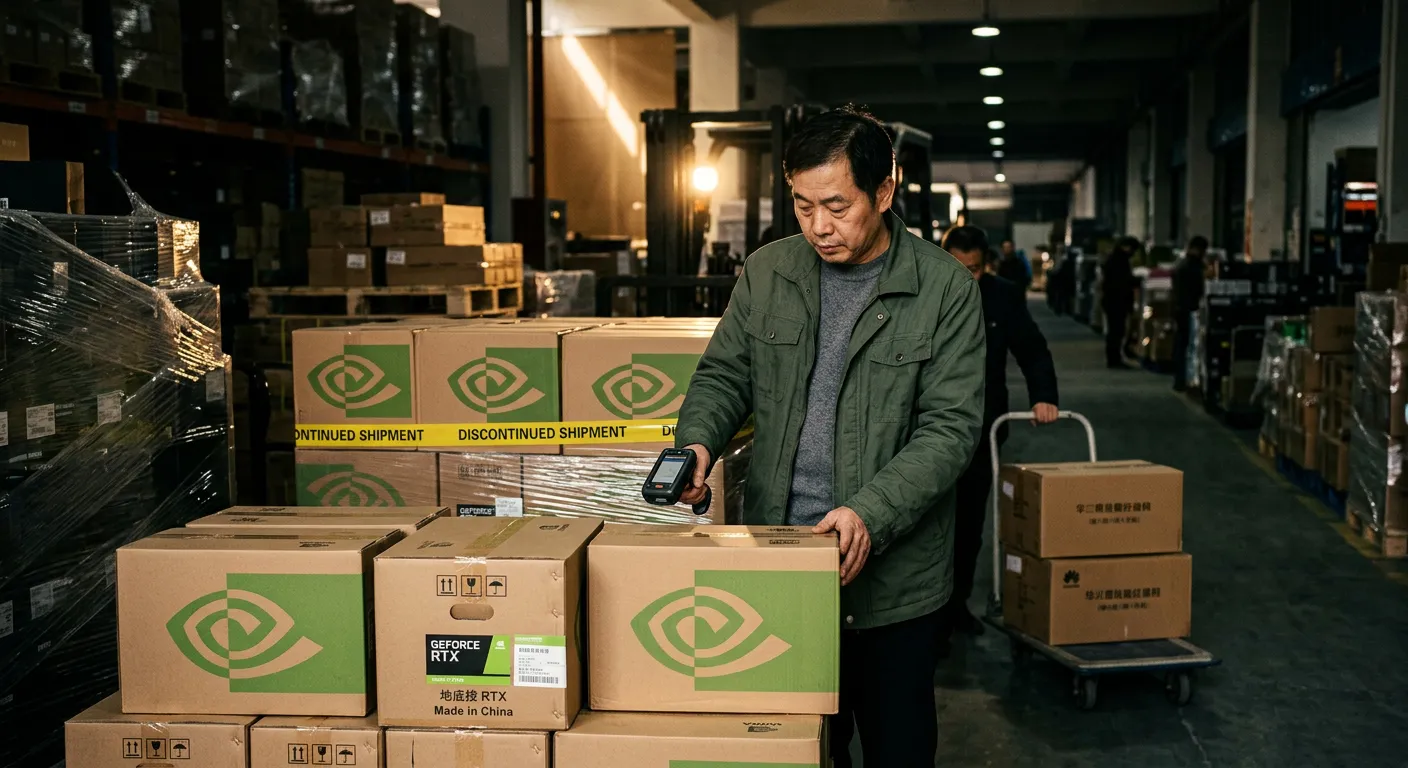
Nvidia's Asia Buyer Purge Exposes the Real Gatekeeper: Beijing
[Nvidia cut more than half its approved Asian buyers in July 2026 to stop chip diversion to China — but both governments are now blocking the same trade for opposite reasons, and Huawei is the beneficiary.]
Nvidia slashed its authorized Asia customer list by more than half in mid-July 2026, deploying inspectors to data centers across Singapore, Malaysia, and Japan to physically verify that its AI chips are not being diverted to China. The real story is that both Washington and Beijing are now blocking the same trade for opposite reasons, and the company that benefits most is Huawei. The whitelist is Nvidia's commercial response to a regulatory shift that made ownership, not geography, the compliance trigger. Yet it was forced into motion not by policy foresight but by a $2.5 billion smuggling scandal that exposed how porous the company's Asian distribution network had become. The deeper paradox: Washington approved roughly 10 Chinese companies to buy Nvidia's H200 chip in January 2026, yet as of mid-May, zero shipments had actually landed, blocked not by US export controls but by Chinese customs and Beijing's push to favor domestic alternatives.
The Whitelist: What Nvidia Actually Did
Nvidia introduced a "white list" of Asian customers that passed new compliance checks designed to stop its AI chips from reaching China through third countries, the Financial Times reported on July 14, 2026. More than half of its previous Asian customers — particularly neo-cloud providers — failed the initial review and were removed, according to people familiar with the matter. Nvidia now sends staff to visit customer data centers, verify contracts, and interview end users before approving sales, with the US Commerce Department's Bureau of Industry and Security providing oversight. Those cut off can reapply after making changes.
The crackdown concentrates on Singapore, Malaysia, and Japan, the three jurisdictions that have featured most often in chip-diversion cases. Singapore alone accounted for 18% of Nvidia's revenue in recent financial statements, yet physical shipments to the island comprised less than 2% of total volume, a gap that reflects how many customers use Singapore entities to purchase chips destined elsewhere. The Lowy Institute described this practice as "Singapore-washing" — Chinese companies setting up subsidiaries or reincorporating in the city-state to mitigate geopolitical scrutiny directed at China-based entities.
The whitelist is the commercial expression of a broader regulatory shift. In May 2026, BIS issued guidance requiring export licenses for advanced chips going to any entity whose ultimate parent is headquartered in China or Macao, regardless of where that entity operates. A Singapore address no longer settles anything. This rule is codified in the Export Administration Regulations at 15 CFR § 744.23, which requires a license for advanced computing items destined to "an entity that is headquartered in, or whose ultimate parent company is headquartered in, either Macau or a destination specified in Country Group D:5" — the group that includes China. The
Al Jazeera reported that BIS issued the clarification in response to questions about whether it was enforcing pre-existing license requirements after overturning the Biden administration's Framework for Artificial Intelligence Diffusion. Nvidia itself said the guidance "reaffirms that NVIDIA's sales and vetting process is correct."
The Smuggling Scandal That Forced Nvidia's Hand
The whitelist was not a proactive compliance measure. It was a reactive scramble after a $2.5 billion smuggling ring exposed the company's distribution network as systematically compromised.
On March 19, 2026, the Department of Justice unsealed an indictment charging Yih-Shyan "Wally" Liaw, co-founder of Super Micro Computer, and two associates with conspiring to smuggle approximately $2.5 billion worth of Nvidia-loaded servers to China through a Southeast Asian proxy company. According to the BBC, the scheme was elaborate: the trio allegedly placed orders for servers through an unnamed Southeast Asia-based firm, fabricated end-use documentation, staged dummy replica servers in a rented warehouse to fool auditors, and used hair dryers to remove serial number labels from real servers before shipping them to China in unmarked boxes. The DOJ said at no point did the defendants have a license to export the servers.
The indictment sent shockwaves through Washington. Senators Jim Banks and Elizabeth Warren wrote to Commerce Secretary Howard Lutnick demanding the immediate suspension of all active Nvidia export licenses. In their letter, the senators wrote: "Every chip that reaches Beijing through a Malaysian shell company or a Thai front entity is a chip that should never have left the country." They specifically questioned whether Nvidia CEO Jensen Huang's public assurances, including his statement that "there's no evidence of any AI chip diversion," were materially false or misleading, and asked BIS to determine whether those representations influenced licensing decisions.
Senator Tom Cotton and Representative Bill Huizenga sent a parallel letter urging BIS to implement anti-diversion provisions from their Chip Security Act, which would require location verification mechanisms on exported chips. Cotton's office cited multiple cases: a smuggling ring buying Nvidia chips through straw purchasers, a black-market network routing chips through Malaysia and Thailand, and Megaspeed, a Singapore-based spin-off of a Chinese government-owned cloud company that imported over $4.6 billion worth of Nvidia hardware and is under investigation.
The enforcement net widened rapidly. On June 29, 2026, Taiwanese prosecutors searched the offices of Super Micro Taiwan, distributor Albatron, and data center operator Chief Telecom, investigating six individuals for smuggling roughly $22 million worth of Nvidia chips into China, according to AEI. Authorities found 50 sets of servers containing Nvidia GB300 chips and NT$9 million in cash. Three days later, Singapore police seized a S$55 million ($42.5 million) mansion near the Botanic Gardens, charging Aperia Group CEO Wei Zhaolun with money laundering for allegedly using S$38 million in criminal proceeds to fund the purchase. The
BBC reported that the servers in that case were bought from Dell, Super Micro, and Asus.
The economics of smuggling are straightforward. Restricted Nvidia B300 servers reportedly sell for around $1 million inside China, close to double the US list price — a margin that funds creative logistics. The AEI noted that the Supermicro case was "not a unique failure, but the logical product of an export control system that runs on bribeable compliance auditors and stickers that can be peeled off with a hair dryer in a rented warehouse." BIS has fewer than 500 employees and only nine Export Control Officers posted at embassies worldwide, covering hundreds of billions of dollars in controlled trade.
The Paradox: Both Governments Blocking the Same Trade
Here is the structural twist that reframes the entire story. Washington spent years building export controls to keep advanced chips out of China. Beijing is now doing the same job from the other direction, arguably more effectively.
In December 2025, Trump announced the US would allow Nvidia to sell its H200 chip to China, with a 25% fee. BIS implemented the policy on January 13, 2026, issuing a rule that permitted exports of the H200 and AMD's MI325X under a case-by-case license review, capped at 50% of cumulative US domestic shipments. The Congressional Research Service noted that some lawmakers raised constitutional concerns, citing Article I, Section 9, Clause 5, which prohibits federal export taxes, and 50 U.S.C. §4815(c), which prohibits BIS from collecting fees for export licenses. The
CNAS estimated that China could purchase up to 850,000 H200 chips under the 50% cap, with the total compute equivalent of nearly 900,000 H200s when combined with AMD's MI325X.
Washington approved roughly 10 Chinese companies — including Alibaba, Tencent, ByteDance, and JD.com — to purchase H200 chips, with potential allocations of up to 75,000 chips each. But as of mid-May 2026, zero H200 chips had actually been delivered. The Brookings Institution put it bluntly: "US companies have exactly zero market share of the AI chip market in China and have no prospect of returning to their once-dominant position there. The ball game is over, and the US has lost."
The blockage is not on the American side. Beijing capped total H200 imports at under 200,000 chips, less than half of what firms requested, and restricted their use to AI training only, not inference. Chinese customs procedures have delayed shipments. More structurally, Beijing has mandated that state-funded data centers use only domestic chips, effectively locking Nvidia out of a massive market segment. In September 2025, China's Cyberspace Administration instructed major tech firms including Alibaba and Tencent to cease purchasing Nvidia chips, citing alleged legal violations, according to the Observer Research Foundation. In November 2025, authorities further barred the use of foreign chips in state-led data center projects that were less than 30% complete.
The MERICS analysis captured the dynamic precisely: China quietly allowing its tech giants to purchase H200s is "a reality check for its AI chip ambitions." Despite claims about advances in homegrown semiconductors, the top AI players still need Nvidia chips to keep pace. But Beijing will continue to balance the goals of developing cutting-edge AI and switching to domestic chips while US policy allows exports.
The Real Winner: Huawei and China's Domestic Chip Push
The two-sided squeeze is accelerating exactly what Washington's controls were designed to prevent: the rise of a competitive Chinese AI chip industry.
Huawei and Cambricon are poised to dominate China's AI server market, potentially capturing around 56% in 2026, up from 46% in 2025, according to TrendForce data reported by the South China Morning Post. Domestic suppliers and AI-focused ASICs from Chinese internet firms are collectively projected to account for roughly 79% of the market. Nvidia and other foreign suppliers are expected to see their China market share decline to about 21%. Alibaba unveiled its Zhenwu M890 chip in May 2026, claiming three times the performance of its predecessor with 144GB of high-bandwidth memory and 800GB/s interconnect bandwidth. Alibaba cited 560,000 Zhenwu chips shipped across 400-plus enterprises.
The GAO reported that BIS works with six other US agencies to develop, implement, and enforce the semiconductor rules, but the enforcement challenge is structural. The Supermicro indictment revealed that conspirators fabricated end-use documentation, staged dummy servers, and arranged for a "friendly" auditor who never visited the site. End-use checks must be coordinated with host governments, meaning the entity under scrutiny typically knows a visit is coming.
The historical parallel is instructive. In the late 1980s, the Coordinating Committee for Multilateral Export Controls (CoCom) tried to keep advanced computing from the Soviet bloc. The system leaked relentlessly — Japanese semiconductor equipment reached Soviet factories through third-country intermediaries — and the controls collapsed not because they failed but because the target regime did. The difference today is that China's domestic chip industry is advancing, not collapsing, and the controls are accelerating that advance rather than constraining it.
Diplomat View
The bottom line: Nvidia's whitelist is a compliance belatedly catching up to a distribution network that was already compromised. The real gatekeeper is no longer Washington — it is Beijing, which is blocking Nvidia's chips from the inside while building the domestic alternatives that will make the restrictions permanent. Huawei is the decisive beneficiary.
Beijing's import caps and domestic procurement mandates, if maintained, mean Nvidia's China revenue will not recover to 2024 levels regardless of what Washington permits. The Chip Security Act, if passed with location-verification requirements, would shift the compliance burden from paperwork to hardware, but would not restore market access that Beijing has already decided to restrict. A single additional major smuggling case would likely push Congress to force a full license suspension that even Trump's deal-making instincts cannot override.
What to watch next:
- September 2026: House Foreign Affairs Committee markup of the Chip Security Act, which would require location-verification mechanisms on exported AI chips.
- Q3 2026: Supermicro independent investigation results, expected from board directors Scott Angel and Tally Liu, which could trigger further license reviews.
- Ongoing: BIS license review cycle for H200 exports. A pause or revocation would confirm the Banks-Warren letter found traction, but by then Huawei will have already won the market Washington spent years trying to protect.
Discover more
India
700 Activists Accuse PM Modi of MCC Breach
Over 700 activists allege PM Modi breached election code with a televised address attacking opposition parties just before state elections.
US Politics
SNAP Food Assistance Faces Legal Challenges
In 2026, SNAP faces stricter eligibility rules and mounting legal challenges, threatening food assistance for the millions of Americans who rely on the program.
US Politics
House Ethics Committee Pushes Sexual Miscond.
The House Ethics Committee has shifted responsibility for sexual harassment settlement records to the Office of Congressional Workplace Rights, complicating disclosure efforts.

Economics
Fed's Amex AML order puts correspondent banking on notice
Federal Reserve's Amex AML order requires board-level controls and a 90-day plan; OCC fined the bank $350 million over enterprise-wide deficiencies.