Northern Shield pipeline: Canada’s energy bet
A sovereignty project against US leverage in energy.
Model Diplomat8 min readNorth America
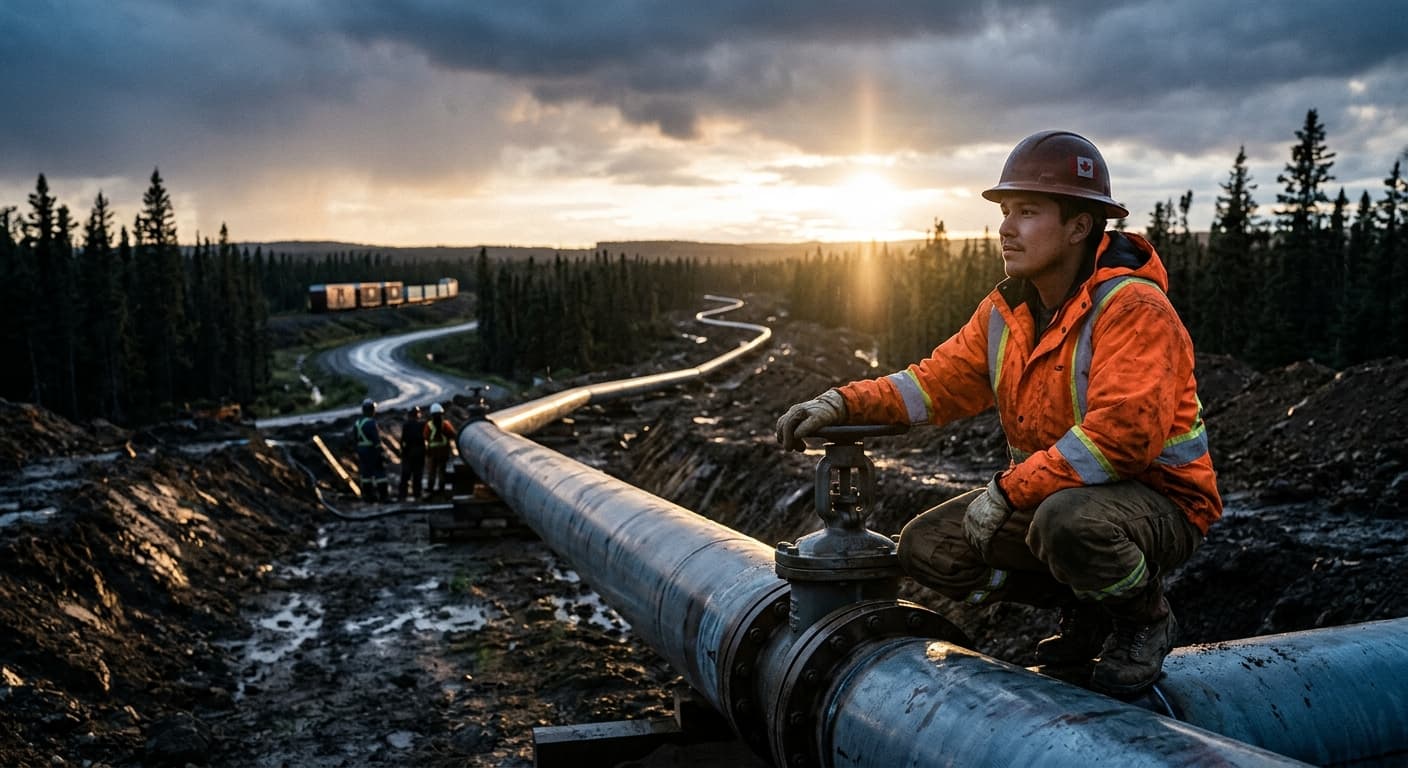
Northern Shield pipeline: Canada's tariff-era energy security bet
Smith and Ford's 3,300-km Hardisty-to-Sarnia oil pipeline is a hedge against US leverage — but a second pipeline Alberta doesn't strictly need.
The 3,300-kilometre "Northern Shield" pipeline that Alberta Premier Danielle Smith and Ontario Premier Doug Ford unveiled in Calgary on July 6, 2026 is not a market project. It is a sovereignty project aimed squarely at Washington. On the numbers, Canada already has close to enough capacity to move its crude; what it lacks is a route that never crosses the United States. Announced two days after Prime Minister Mark Carney finalized a separate memorandum for a Pacific line, the 500,000-barrel-per-day proposal converts a decade-old political grievance — that Ontario and Quebec refineries reach Alberta oil only through Michigan and Wisconsin — into a geopolitical infrastructure play. The winners, if it gets built, are Alberta producers and Ontario refiners insulated from US chokepoints. The losers are the federal climate architecture, existing pipeline operators facing capacity glut, and Manitoba Premier Wab Kinew, who now has to explain why an all-Canadian pipeline is routing through his province without his signature.
What Smith and Ford actually proposed
The Northern Shield Energy Corridor would run from the Hardisty tank farm in central Alberta — the pricing point for Western Canadian Select — through Saskatchewan and Manitoba to the Sarnia refining cluster on the St. Clair River, CBC News reported. Initial throughput would be 500,000 barrels per day of crude, with an option to expand to 800,000 and to carry natural gas and refined products alongside. There is no cost estimate, no in-service date, no private proponent, and no confirmed federal role.
According to the Toronto Sun, Smith and Ford pitched the line as "the country's first pipeline for western oil to reach the east that's contained" entirely within Canada — a direct answer to the fact that every existing barrel of Alberta crude reaching Ontario refineries today does so by crossing US soil. Ontario is funding a feasibility study and has begun Indigenous consultation. Manitoba, whose consent is geographically unavoidable, is out: Premier Kinew has said his province will only entertain large projects that involve First Nations from the outset,
The Deep Dive noted, and this one did not.
The angle: this is a Trump tariff project, not an oil project
Read Northern Shield alongside three data points and its purpose sharpens.
First, Canadian pipeline capacity is not the binding constraint most Canadians think it is. The Canada Energy Regulator's own data, summarised by the C.D. Howe Institute, puts total future export-pipeline capacity at roughly 5.9 million barrels per day once Trans Mountain optimization and Enbridge Mainline Phase 1 and 2 expansions are complete — against forecast Western Canadian production of 5.2 to 5.9 million barrels per day. Andrew Leach's IRPP study of Canadian pipeline economics
notes explicitly that "the pipeline into Sarnia has significant excess capacity at present." Ontario is not oil-starved. It is US-dependent.
Second, that US dependence is now a live vulnerability. A February 2025 Congressional Research Service brief, U.S. Petroleum Trade: Crude Oil Imports from Canada and Mexico, lays out the mechanics: Alberta crude reaches PADD 2 refineries in the US Midwest — and, via the Enbridge Mainline reversing back north at Sarnia, Ontario itself — through infrastructure that a US administration could tariff, tax, or, in Michigan's case, shut. Governor Gretchen Whitmer's ongoing attempt to close Enbridge's Line 5 under the Straits of Mackinac has already forced the Canadian government to invoke the 1977 Canada-US Transit Pipelines Treaty and file an intervenor brief; the
C.D. Howe Institute has documented that even the Trump administration has now conceded, in a September 2025 US District Court filing, that it is bound by that treaty. That is precisely the kind of concession Ottawa cannot count on twice.
Third, the political weather in Washington has structurally shifted. Trump-era tariffs on Canadian energy — 10% under executive order, per the CRS analysis — combined with Trump's post-Maduro ambition to rebuild Venezuelan Gulf Coast supply, mean Alberta's marginal export barrels face new competition and new price pressure. Carney told reporters in Paris in early 2026 that Canadian oil remains competitive on cost and carbon, the BBC reported, but he simultaneously advanced a Pacific pipeline because, in his words, "Canada is focused on diversifying its exports."
Northern Shield is the eastward mirror of that Pacific bet. Its economic case is thin; its strategic case is that if Washington ever pulls the Line 5 or Mainline lever, Ontario refineries in Sarnia — Imperial, Suncor, Shell — can still receive Alberta crude without an American middleman.
The historical parallel Ottawa has not forgotten
If this feels familiar, it is. In 2013 TransCanada proposed Energy East, a 4,500-km, 1.1-million-barrel-per-day line from Hardisty to Saint John, New Brunswick — a longer, deeper version of Northern Shield's logic. The company
abandoned it in October 2017 after Canada's National Energy Board expanded the review to include upstream and downstream greenhouse gas emissions and after opposition from Quebec municipalities and Indigenous nations along the route.
Two things about Northern Shield's design suggest Alberta and Ontario have studied that failure closely. It stops at Sarnia rather than pushing east through Quebec, avoiding the province whose 2017 opposition helped kill Energy East. And its 500,000-barrel-per-day base case is less than half the Energy East volume, aimed at Ontario's roughly 630,000 barrels per day of refining capacity — 23% of Canada's total, according to the Macdonald-Laurier Institute's analysis of the domestic refining fleet — rather than at tidewater export. That is a smaller, less contested ask.
But the biggest change is legislative. Since Energy East died, Parliament has passed the Building Canada Act, part of Bill C-5, which received first reading on June 6, 2025 and became law June 26. The statute is available on Parliament's own site and creates a Major Projects Office empowered to designate projects "in the national interest," cutting approval timelines to a maximum of two years with a "one project, one review" approach with provinces. Northern Shield is exactly the kind of project the BCA was drafted to accelerate — provided Carney's cabinet chooses to list it.
Why Ottawa is not yet on board
It has not. The West Coast pipeline is on Carney's fast-track list; Northern Shield is not. Carney's November 2025 memorandum with Smith, reported by the BBC, committed the federal government to advancing a single Pacific line paired with the Pathways Alliance carbon-capture project, in return for suspending the federal oil and gas emissions cap and adjusting the northern British Columbia tanker moratorium. Environment and Climate Change Minister Steven Guilbeault resigned that evening, citing "major environmental impacts." That is the political ceiling Carney is working under.
Adding Northern Shield to the queue would test that ceiling twice. The Macdonald-Laurier Institute's Heather Exner-Pirot notes that the Alberta-Ottawa MOU is already "comprised exclusively of sticks for oil producers" — a $130-per-tonne industrial carbon price, Pathways Alliance obligations, methane equivalency terms. A second west-east line would demand a second carbon concession Carney has no political room to offer. And on pure economics, C.D. Howe warns that layering another million barrels a day of capacity onto a system already at 5.9 million bpd of forecast capacity risks lowering tolls across the network and undermining the profitability of existing lines — including the federally owned Trans Mountain, whose C$34-billion cost the Canadian taxpayer is still absorbing.
Who actually benefits, who loses
Winners, in order of clarity:
Alberta producers. Every additional route reduces the Western Canadian Select discount to WTI, which C.D. Howe put at roughly US$18 a barrel in October 2025. The Trans Mountain expansion alone narrowed that gap by $5–7. Northern Shield's optional expansion to 800,000 bpd would displace roughly that volume of US-sourced imports into Ontario, keeping Canadian barrels inside Canadian refining margins.
Ontario refiners and voters. Sarnia's four refineries currently rely on a mix of Alberta crude routed through the US and northbound US supply. A dedicated Canadian feeder gives Ford political cover against any future US tariff and hardens Ontario's refined-products supply — the same logic that made the 2015 Line 9 reversal succeed. C.D. Howe's Ben Dachis documented that after Line 9's flow reversed, Canadian crude replaced foreign imports at Quebec refineries "barrel-for-barrel."
Danielle Smith politically. The Aljazeera coverage of Alberta's separatist movement shows Smith walking a careful line with sovereignty activists. Two pipelines announced within a week — one federal, one interprovincial — let her claim wins on both flanks.
Losers:
Wab Kinew's Manitoba. Manitoba is the province Alberta and Ontario cannot go around; its refusal to join at launch is the single largest procedural risk to the project. Constitutional obligations to consult under the Supreme Court's Tsilhqot'in and Chippewas of the Thames jurisprudence, catalogued in SSRN's survey of pipeline consultation law, do not disappear because two premiers announce a route.
Federal climate architecture. Canada's 2050 net-zero commitment survives the Carney-Smith MOU only through a paired carbon-capture obligation. Northern Shield arrives with no such obligation attached. If Ottawa greenlights it under the Building Canada Act without a matching emissions concession, the credibility of the entire climate framework Guilbeault resigned to defend erodes further.
Enbridge and Trans Mountain. C.D. Howe's commercial-viability analysis is blunt: a new one-million-bpd Pacific line is already "too much capacity for the system." Adding Northern Shield on top compounds toll compression on lines built with public and private capital under the assumption that they would be full.
Diplomat View
Northern Shield is best understood not as a competing project to Carney's Pacific line but as its political precondition: Alberta and Ontario extracting a national-security frame for oil infrastructure that federal Liberals spent a decade trying to reframe as a climate question. The clarifying test is whether Ottawa refers the project to the Major Projects Office by the end of 2026. If it does, Northern Shield graduates from provincial press conference to national-interest project and the Building Canada Act becomes, in practice, an energy-security statute rather than a nation-building one. If it does not, the base case, Northern Shield functions as leverage: a permanent reminder to Washington that Ontario has a fallback route, and to Ottawa that Alberta can build coalitions without it.
The forecast that would revise this call: Kinew reversing course under federal pressure and a private proponent, most plausibly Enbridge or South Bow, submitting a binding open season by mid-2027. Absent both, Northern Shield joins Energy East in the archive of announced-but-unbuilt Canadian pipelines — but the announcement itself will have already done its geopolitical work.
What to watch
- October 1, 2026: Federal deadline under the Alberta-Ottawa MOU to designate the Pacific pipeline as a project of national interest. Whether Northern Shield is bundled in, sidelined, or explicitly excluded is the tell.
- Manitoba provincial position, autumn 2026: Kinew's government has committed to reviewing route studies; any softening on Indigenous consultation terms opens the corridor.
- US tariff review, first quarter 2027: The CUSMA renegotiation kicks off. If Trump lifts or expands 10% energy tariffs, the political urgency behind Northern Shield either evaporates or hardens permanently.
- September 1, 2027: The MOU-set target for federal approval of the West Coast pipeline. Slippage here signals Ottawa cannot deliver on one pipeline, let alone two.
The Bottom Line
Northern Shield is Canada's answer to the question Trump's tariffs forced onto the table: can Alberta oil reach an Ontario refinery without a US permit? On the economics alone, the pipeline is redundant; on the geopolitics, it is the only west-east route Ottawa can point to that Washington cannot touch. Whether it gets built matters less than the fact that, as of July 6, 2026, two Conservative premiers have put Canada's energy sovereignty in infrastructure form — and the federal Liberals now have to either claim it or own the refusal.
Discover more
Global Politics
Xi Jinping Calls China-Russia Ties 'Precious'
Xi Jinping's description of China-Russia ties as 'precious' reflects a strategic imbalance, with Beijing dictating terms in the partnership.

US Politics
SNAP Food Assistance Faces Legal Challenges
In 2026, SNAP faces stricter eligibility rules and mounting legal challenges, threatening food assistance for the millions of Americans who rely on the program.

India
Women’s Reservation in India
India's 33% women's reservation law is enacted but won't take effect until after 2029 due to political setbacks and census delays.

Economics
Fed's Amex AML order puts correspondent banking on notice
Federal Reserve's Amex AML order requires board-level controls and a 90-day plan; OCC fined the bank $350 million over enterprise-wide deficiencies.