North Korea's Twin-Track Diplomacy
Kim Jong Un's dual-track strategy with Beijing and Moscow
Model Diplomat8 min readEast Asia and Pacific
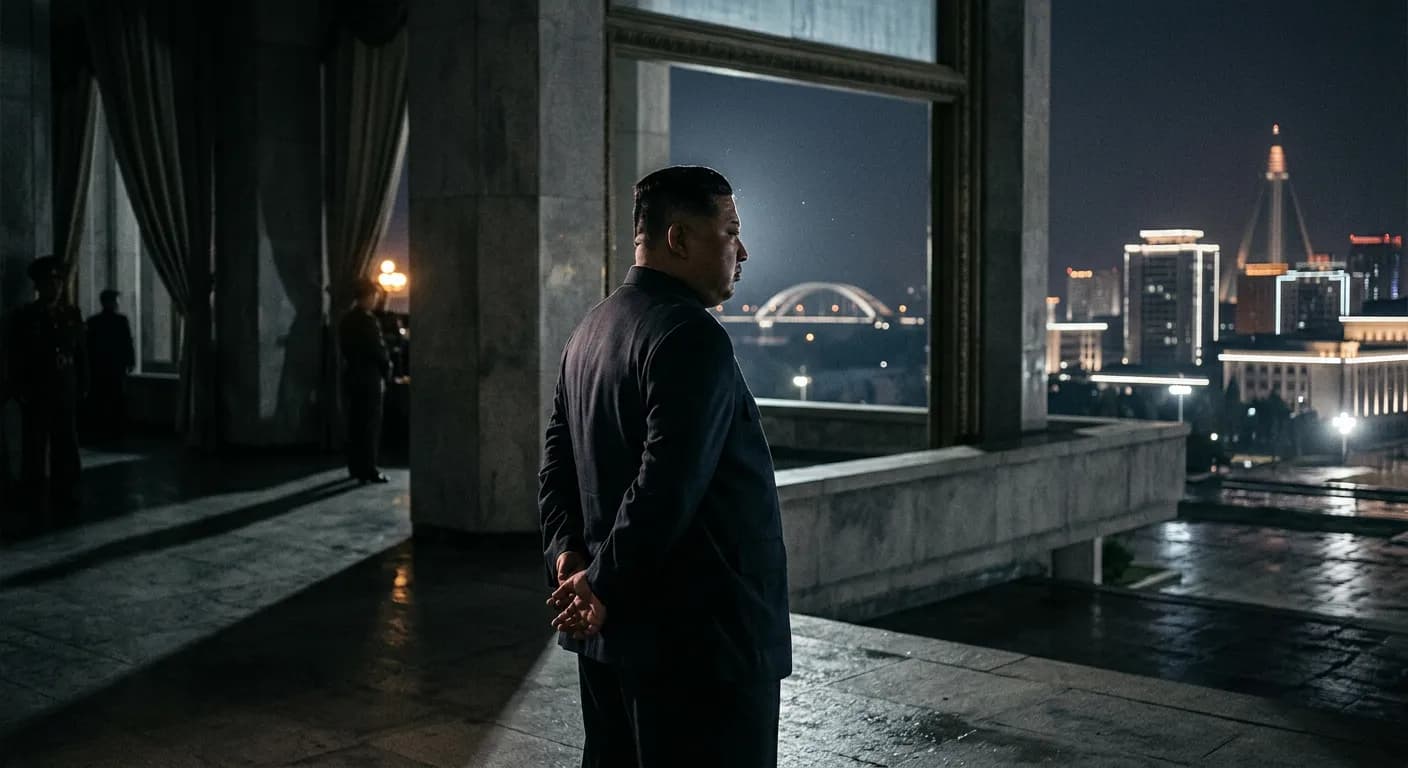
North Korea's Twin-Track Diplomacy: Courting Beijing and Moscow While Sealing the Southern Border
Kim Jong Un's simultaneous restoration of ties with China and deepening of military alliance with Russia gives Pyongyang unprecedented strategic space — and removes any remaining incentive to negotiate with Seoul, Tokyo, or Washington.
On July 16, 2026, 38 North published an analysis identifying a coherent pattern in North Korea's 2026 diplomacy: Pyongyang is pursuing what author Kibum Han calls "balanced diplomacy" toward China and Russia: restoring the China relationship through Xi Jinping's first Pyongyang visit in seven years while institutionalizing the Russia alliance through a proposed five-year military cooperation plan, even as it hardens its posture toward South Korea, Japan, and the United States. The thesis is that Kim Jong Un has calculated he no longer needs to negotiate with anyone he does not want to. Two great-power patrons give him the economic safety net and military technology pipeline to make that stick.
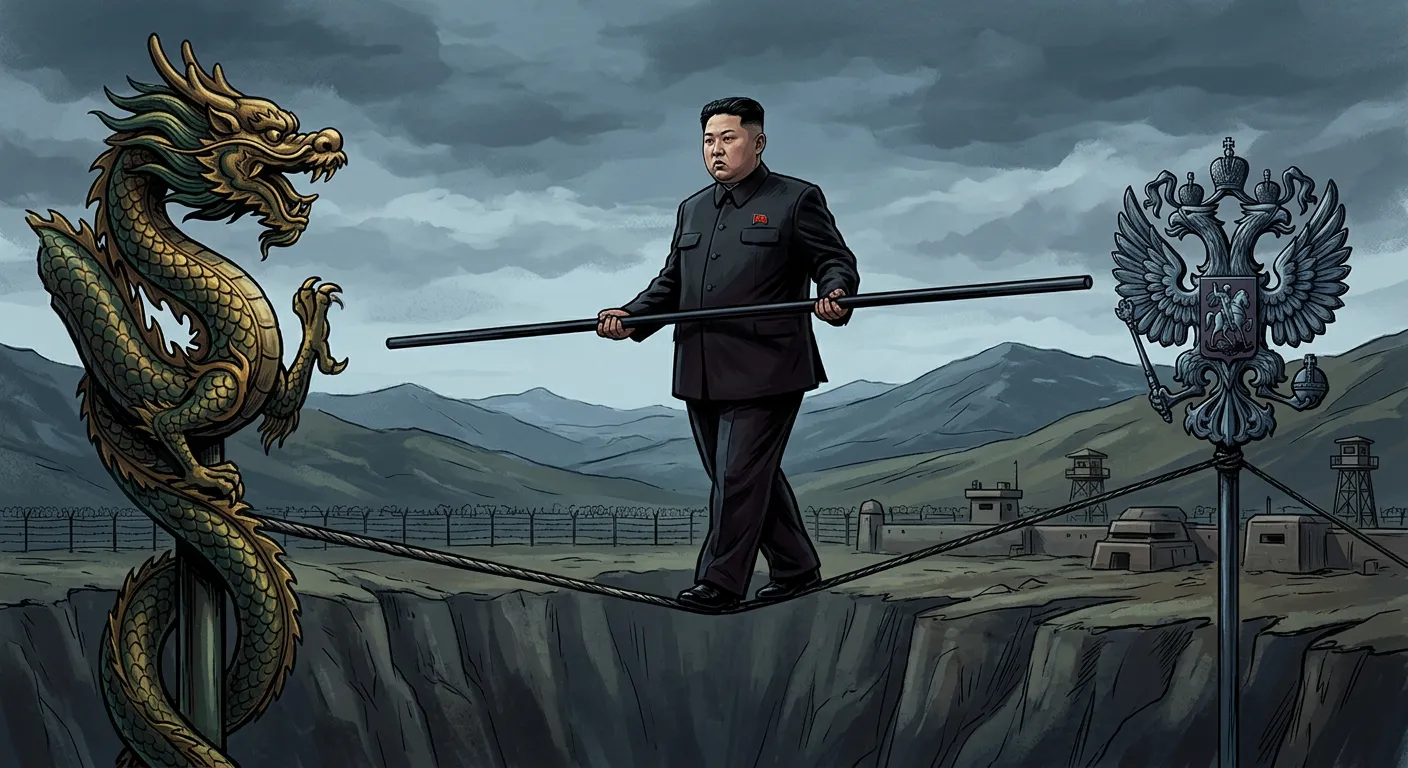
The China Restoration: Denuclearization Drops Off the Agenda
Xi Jinping's June 8-9 visit to Pyongyang was his first overseas trip of 2026 and his first to North Korea since 2019. The optics were deliberate: Xi, who generally receives foreign leaders in Beijing, chose to travel, signaling that China considers the relationship worth the personal investment. According to Al Jazeera, KCNA reported that Kim affirmed the China relationship as "the most important top-priority strategic work," and Xi declared ties had reached "a new historical starting point" on the 65th anniversary of the two countries' friendship treaty.
The substantive shift was what disappeared from the conversation. For the first time in a Xi-Kim summit, denuclearization was entirely absent from the public readout. Xi called for enhanced "military affairs" exchanges and broader "strategic coordination" to "safeguard their respective sovereignty, security and development interests" — language that 38 North interprets as Beijing shifting its priority from denuclearization to security alignment.
The visit was not altruism. As BBC reported, Western diplomatic sources confirm China has grown increasingly concerned about the depth of the Russia-North Korea partnership, particularly after the mutual defense pact Putin and Kim signed in June 2024. Beijing wants to reassert influence over a strategically vital but unpredictable partner, and to ensure that if Donald Trump attempts another bilateral deal with Kim, China remains the gatekeeper. Victor Cha, senior vice president for Asia at CSIS, told the BBC that if China takes a strong stance against Pyongyang's nuclear program, "this would only push North Korea more into the arms of Putin."
The economic lever remains decisive. According to a 2022 estimate cited by Al Jazeera, China accounts for as much as 95 percent of North Korea's trade. Bilateral trade rose 22 percent in the first two months of 2026 compared to the same period in 2025, as
Al Jazeera reported. Kim needs China for survival. But the Xi visit confirms that China now needs Kim to stay anchored — and is willing to drop the nuclear file to keep him there.
The Russia Alliance: Institutionalizing Blood Ties
While China restored the political relationship, Russia institutionalized the military one. The most consequential development of 2026 may be Russian Defense Minister Andrey Belousov's April 27 visit to Pyongyang for the opening of the Memorial Museum of Combat Feats at Overseas Military Operations — a museum dedicated to North Korean soldiers killed fighting in Russia's Kursk campaign. According to BBC, Belousov told Kim that Moscow was "prepared to sign a Russian-Korean military cooperation plan for the 2027-2031 period."
That is a five-year institutional commitment, not a wartime expedient. 38 North notes that the visits by Russia's natural resources and defense ministers suggest an institutionalized exchange: North Korean troops for Russian energy and military technology. The arrangement extends to the subnational level, with provincial delegations from South Phyongan and South Hwanghae visiting Russia — an uncommon occurrence suggesting cooperation is diffusing beyond central governments.
The human cost is documented. A BBC investigation based on satellite imagery of the Pyongyang memorial estimated approximately 2,304 names engraved on memorial walls. South Korea's National Intelligence Service estimated in February 2026 that about 6,000 of the 11,000 deployed North Korean soldiers had been killed or wounded. The
UK Ministry of Defence placed total casualties above 6,000.
What Pyongyang receives in return is the strategic prize. According to NPR, South Korea's intelligence agency assessed that Russia is providing "technical guidance for reconnaissance satellites and launch vehicles, as well as physical assets such as drones, electronic warfare equipment and SA-22 surface-to-air missile systems." The
CSIS Beyond Parallel analysis notes Russia has financed several North Korean military programs and given the country air defense equipment, anti-aircraft missiles, and advanced electronic warfare systems.
The physical infrastructure reinforces the commitment. The first road bridge connecting Russia and North Korea across the Tumen River — the Khasan-Tumangang Bridge — was formally connected on April 21, 2026, as BBC Verify documented. Designed to handle up to 300 vehicles and 2,850 people per day, the bridge offers a permanent route for transferring military goods and munitions in both directions. North Korean troops marched on Red Square for the first time during Russia's May 9 Victory Day parade.
Russia also provides diplomatic cover. At the 2026 NPT Review Conference, which ended without consensus on May 22, Russia pushed for the deletion of language on North Korea's nuclear program, prompting South Korean objections, as Chatham House reported. This extends a pattern: in 2022, Russia and China jointly vetoed a US-led UN Security Council resolution to impose new sanctions over North Korean missile tests.
The Southern Front: Constitutional Hostility and Physical Fortification
While opening doors to the north, Kim Jong Un is sealing the one to the south. North Korea's revised constitution, confirmed by South Korea's government in May 2026, drops all references to peaceful unification, redefines the country's territory as only the northern half of the peninsula, and designates South Korea as a "hostile state," as NPR reported. The constitutional revision codifies what Kim announced in January 2024: the abandonment of unification as a national goal and the designation of South Korea as the "principal enemy."
The military posture follows the legal one. Kim inspected a munitions factory producing 155-mm self-propelled gun-howitzers slated for deployment at the southern border within 2026, alongside "various operational and tactical missile systems and powerful multiple rocket launcher systems," as NPR reported. On June 25, 2026, Kim observed weapons tests and ordered the military to adopt a "deadly and destructive offensive posture," demanding that enemies "feel constant uneasiness and fear," according to
Al Jazeera.
Satellite imagery published by BBC Verify shows North Korea building sections of what appears to be a wall near the DMZ, with land cleared within the North Korean-controlled side of the buffer zone — activity that CSIS's Victor Cha called a potential violation of the 1953 armistice, which prohibits hostile acts within the DMZ without prior consultation. South Korea's Joint Chiefs of Staff confirmed ongoing reinforcement of tactical roads, mine-laying, and land clearance along the border.
The Japan Front: Coordinated Criticism
38 North highlights a notable pattern: Kim's criticism of Japan at the June Party plenum, immediately following the Xi summit, suggests growing North Korea-China policy coordination toward Tokyo. This aligns with Beijing's own posture. China's Commerce Ministry in February 2026 restricted exports to 40 Japanese entities it accused of contributing to Japan's "remilitarization," as
NPR reported, and Beijing has repeatedly criticized Tokyo over Prime Minister Sanae Takaichi's November 2025 statement that Japan could intervene if China used force against Taiwan.
The convergence is not accidental. Pyongyang's portrayal of Japan as a "reemerging militarist threat" and Beijing's export controls against Japanese defense-linked entities serve the same strategic function: undermining the US-Japan-South Korea trilateral that both China and North Korea see as a containment architecture.
The Strategic Logic: Cold War Playbook, Updated
Brookings scholar Kyung-joo Jeon frames the strategy as adapted Cold War maneuvering. In an analysis, Jeon argues that Pyongyang's approach "echoes Pyongyang's Cold War-era maneuvering between Moscow and Beijing, but it is adapted to a more fragmented global order and less cohesive U.S. alliance system." The key difference from the Cold War is that Kim now has a nuclear arsenal and combat-tested troops with modern warfare experience, assets his grandfather and father never possessed.
The institutionalization is what makes 2026 different. The Russia-North Korea relationship entered "alliance" territory in 2024 with the comprehensive strategic partnership treaty and troop deployments. In 2026, it is being built to last beyond the Ukraine war: a five-year military cooperation plan, a permanent road bridge, provincial-level exchanges, and a memorial museum celebrating the "liberation of Kursk." As BBC quoted Cho Han-bum of the Korea Institute for National Unification, the memorial signifies Pyongyang's willingness to continue military cooperation with Russia "regardless of how the war unfolds."
China's restoration adds the economic and diplomatic safety net that Russia — sanctioned and war-consumed — cannot fully provide. The result is what 38 North describes as the possibility of "trilateral North Korea-China-Russia cooperation," though without formal mechanisms. The simultaneous presence of Xi, Putin, and Kim at Beijing's September 2025 military parade was the symbolic high point; the absence of institutionalized trilateral structures is the practical limit.
Diplomat View
The strategic calculation is clear: Kim Jong Un has determined that two patrons are better than one, and that no patron is better than negotiation with adversaries. The China-Russia dual track gives him what no previous North Korean leader has simultaneously enjoyed — a reliable economic lifeline from Beijing, an active military technology pipeline from Moscow, and diplomatic cover at the UN from both. This configuration removes the principal leverage the US and its allies have used for three decades: the threat of isolation.
The forecast: North Korea will continue to reject denuclearization talks, continue fortifying the DMZ, and continue escalating rhetoric against Japan and South Korea through 2027. The 2027-2031 Russia-DPRK military cooperation plan, if signed, will be the next inflection point. It would lock in technology transfers for a full five-year cycle regardless of how the Ukraine war ends.
What would change the forecast: a sharp deterioration in US-China relations that forces Beijing to choose between managing North Korea and confronting Washington, which could push Xi to reimpose leverage over Pyongyang. Alternatively, a Russia-Ukraine ceasefire that eliminates Moscow's need for North Korean troops would test whether the alliance has genuine strategic depth or was purely transactional. Neither scenario is likely before late 2027. Until then, Kim holds the balance — and he knows it.
What to watch:
- Signing of the Russia-DPRK 2027-2031 military cooperation plan — expected before end of 2026, per Belousov's April statement
- US-North Korea diplomatic signaling after the November 2026 US midterm elections, if Trump revives his interest in direct engagement
- South Korea's response: President Lee's government is debating whether to compromise on its nuclear posture to induce Pyongyang back to dialogue, as
Brookings reports — a decision that will define Seoul's strategy through the decade
Discover more

US Politics
Next Generation Republicans
A leaked survey shows 39% of Republicans under 30 do not identify as MAGA, revealing a split in the GOP's future leadership.
US Politics
SNAP Food Assistance Faces Legal Challenges
In 2026, SNAP faces stricter eligibility rules and mounting legal challenges, threatening food assistance for the millions of Americans who rely on the program.
India
700 Activists Accuse PM Modi of MCC Breach
Over 700 activists allege PM Modi breached election code with a televised address attacking opposition parties just before state elections.

Economics
Fed's Amex AML order puts correspondent banking on notice
Federal Reserve's Amex AML order requires board-level controls and a 90-day plan; OCC fined the bank $350 million over enterprise-wide deficiencies.