Trump ICC Sanctions Face Third First Amendm
DAWN and TAAG sue over ICC sanctions, testing executive power
Model Diplomat8 min readNorth America
Trump ICC Sanctions Face Third First Amendment Loss
DAWN and TAAG sued the Trump administration on July 15, 2026, arguing ICC sanctions violate free speech — and every federal court to rule on the order has already agreed, turning the White House campaign to "dismantle" the court into a test of how far executive sanctions power can reach into domestic political advocacy.
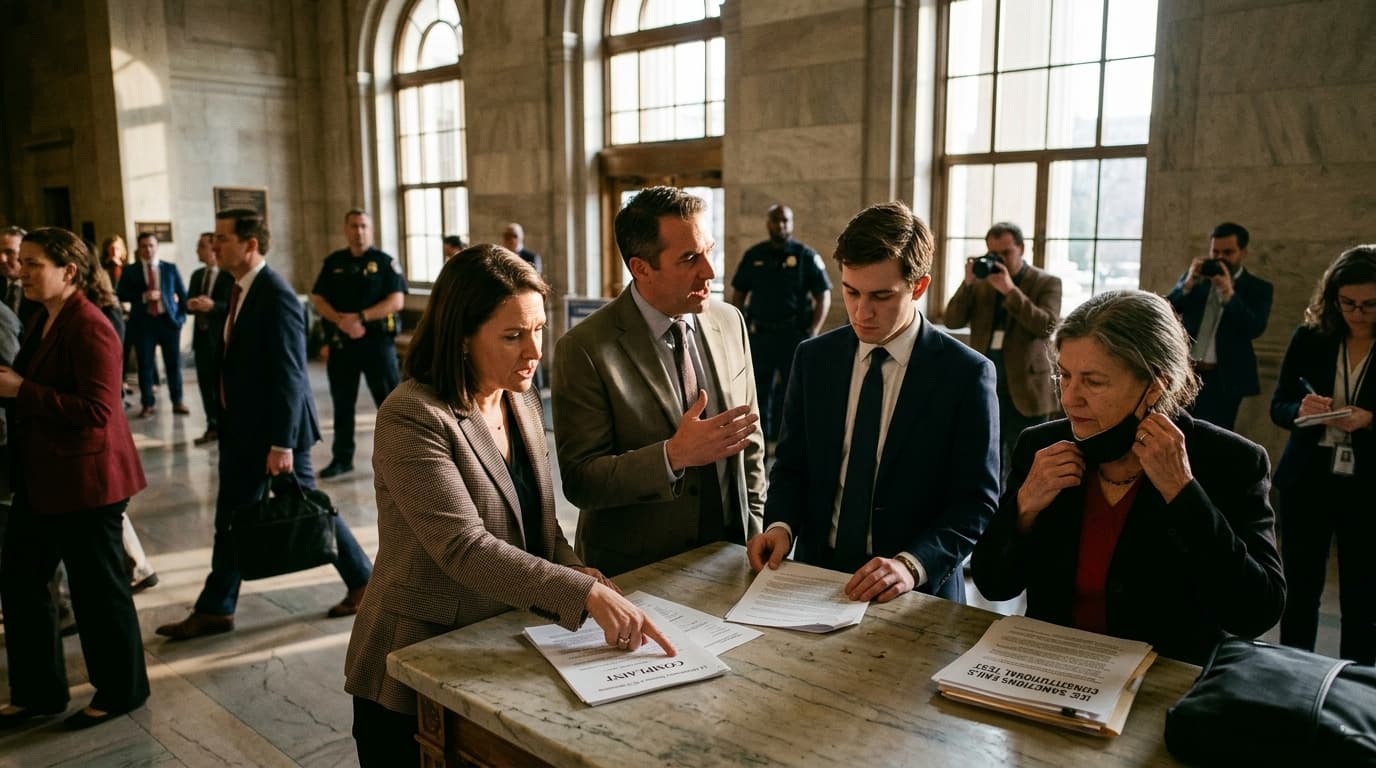
Two US-based advocacy groups filed suit in a New York federal court on July 15, 2026, challenging Executive Order 14203 as an unconstitutional restraint on Americans' speech and association. Democracy in the Arab World Now (DAWN) and the Taxpayer Alliance Against Genocide (TAAG) argue that the order, signed by President Donald Trump on February 6, 2025, blocks them from submitting evidence to the International Criminal Court, coordinating with sanctioned Palestinian rights groups, and engaging in advocacy the government disfavors — all under threat of civil penalties and up to 20 years' imprisonment. According to the BBC, the groups say they withheld submissions to the court and avoided coordination with sanctioned parties for fear of prosecution.
The suit is the fourth legal challenge to EO 14203 or its 2020 predecessor, and the administration has lost every ruling on the merits. What changes the calculus this time is the plaintiff profile. Previous challengers were law professors and ICC employees with direct professional ties to the court. DAWN and TAAG are membership organizations claiming a chilling effect on ordinary political advocacy — a framing that pushes the courts toward a ruling on the order's validity as a whole, rather than narrow relief for individual plaintiffs.
A losing streak in federal court
The legal lineage is straightforward. In June 2020, Trump's first administration issued Executive Order 13928, sanctioning ICC officials over the court's Afghanistan investigation. Four months later, the Open Society Justice Initiative and four law professors sued, arguing the order violated the First Amendment by criminalizing speech that supported ICC prosecutors. On January 4, 2021, Judge Katherine Polk Failla of the Southern District of New York granted a preliminary injunction, finding the order imposed content-based speech restrictions that "prohibit[ed] or chill[ed] significantly more speech than" necessary and likely failed not only strict scrutiny but intermediate scrutiny as well, according to the Open Society Justice Initiative v. Trump ruling. The government declined to appeal. President Joe Biden rescinded the order in 2021.
Trump then reissued materially identical language in February 2025. The same plaintiffs re-sued, and on July 30, 2025, Judge Jesse Furman granted a permanent injunction, concluding that EO 14203 "constitutes a content-based regulation of their speech-based activities and cannot survive strict scrutiny," according to the Rona v. Trump opinion. A separate suit by law professors Matthew Smith and Akila Radhakrishnan raised identical claims, arguing the order's prohibition on providing "services… to, or for the benefit of" sanctioned persons swept in constitutionally protected speech, according to the
Smith v. Trump complaint.
A third track came from ICC personnel themselves. Eric Iverson, a US citizen and career ICC prosecutor leading the Darfur investigation, sued in the District of Columbia, arguing the order forced him to cease investigating a genocide that had claimed 300,000 lives, according to his preliminary injunction motion. On June 25, 2026, three sanctioned ICC judges — Kimberly Prost of Canada, Solomy Balungi Bossa of Uganda, and Reine Adelaide Sophie Alapini-Gansou of Benin — filed their own suit in Manhattan, calling the sanctions "tantamount to the financial death penalty" and arguing they were designed to coerce judicial decisions, according to
Al Jazeera.
The most revealing ruling came in the Albanese case. UN Special Rapporteur Francesca Albanese was sanctioned in July 2025 after recommending that the ICC pursue war crimes prosecutions against Israeli and US nationals. On May 13, 2026, US District Judge Richard Leon granted a preliminary injunction, finding the government sought to regulate her speech "because of the idea or message expressed," according to Al Jazeera. "Albanese has done nothing more than speak," Leon wrote. "Her recommendations have no binding effect on the ICC's actions — they are nothing more than her opinion." The administration appealed, and the DC Circuit issued an administrative stay on May 28, 2026, restoring the sanctions pending appeal — a procedural stay that, as
Al Jazeera noted, "should not be construed in any way as a ruling on the merits."
The IEEPA trap
The constitutional argument is strong. The statutory argument may be stronger — and harder to fix.
EO 14203 invokes the International Emergency Economic Powers Act, a 1977 statute that delegates emergency economic powers to the president. But IEEPA carries an express limitation: the Berman Amendment, added in 1988 and broadened in 1994, bars the president from regulating "the importation from any country, or the exportation to any country… of any information or informational materials," regardless of format or medium. The DAWN/TAAG complaint argues the order violates this exemption by criminalizing the transmission of evidence, legal analysis, and advocacy materials to the ICC — activity the statute expressly shields.
The courts have so far agreed. Judge Failla noted in 2021 that "any attempt by OFAC to impose penalties for conduct covered by the informational materials exemption plainly would be ultra vires," according to the Open Society Justice Initiative ruling. The Office of Foreign Assets Control has historically taken a narrower view, holding that the Berman Amendment protects only materials "fully created and in existence at the date of the transactions," according to the
Rona v. Trump briefing. The plaintiffs reject that reading as inconsistent with the statute's text.
The dual-track matters because the IEEPA claim offers a route to a ruling that reaches beyond individual plaintiffs. A First Amendment injunction can be narrowly tailored to the parties before the court. A ruling that EO 14203 exceeds IEEPA's statutory authority — that the president cannot use sanctions to regulate informational materials at all — would cut at the order's foundation and constrain future administrations from replicating it. A federal judge in the Southern District of New York already ruled on July 30, 2025 that the order violated the First Amendment as a content-based regulation failing strict scrutiny, according to Mondaq legal analysis.
The executive order itself is remarkably broad. Section 3(a) prohibits all US persons from providing "services… to, or for the benefit of" any sanctioned individual, according to the Federal Register publication. The term "services" is undefined. OFAC designated ICC Prosecutor Karim Khan the same day the order was signed, according to the
Treasury Department. By December 2025, the administration had sanctioned approximately nine ICC judges, two prosecutors, three Palestinian rights organizations, and the UN Special Rapporteur, according to
Al Jazeera.
Escalation without legal ground
The administration's response to the losing streak has been to escalate, not retreat. On July 13, 2026, Secretary of State Marco Rubio announced a "whole-of-government response to systematically disable" the ICC, vowing to use "all the tools at our government's disposal" to "dismantle the ICC, brick by brick, if necessary," according to Al Jazeera. The State Department listed actions under consideration: increased sanctions and travel bans for ICC personnel, pressure on allies to reject the court's authority, and "increased scrutiny of nations that refuse to reject the ICC's false authority while relying on US assistance."
The timing is notable. The ICC has not taken any new action related to the US or its allies since Trump took office in January 2025. William Schabas, a professor of international law at Middlesex University London, called the timing "perplexing" and suggested the administration may be "speculating on where the court might investigate" — including actions during the US-Israel war with Iran, strikes on drug smuggling boats in the Caribbean, and the abduction of Venezuelan President Nicolás Maduro, according to Al Jazeera. The campaign is preventive, not reactive.
Rubio, Acting Attorney General Todd Blanche, and Treasury Secretary Scott Bessent are named as defendants alongside Trump in the DAWN/TAAG suit. The administration has previously defended the sanctions as necessary to target "illegitimate and baseless actions targeting America and our close ally Israel," according to the BBC. The White House has not responded to the lawsuit.
Who benefits, who loses
The immediate losers are the sanctioned individuals. The ICC judges suing the administration described being unable to use credit cards, access banking services, use Amazon or Google, book travel, or obtain health insurance, according to Al Jazeera. They also said the sanctions bar the submission of evidence and argument in proceedings before them — meaning the US campaign is degrading the court's capacity to hear cases unrelated to Israel or the United States.
The ICC itself loses operational capacity. Sanctions on the prosecutor, judges, and evidence-providing organizations disrupt investigations across the court's docket, not just the Israel and Afghanistan cases. The Darfur investigation, directly supported by the United States since 2005, has been forced into pause by the designation of ICC personnel.
The administration loses legal ground with each ruling. A pattern of preliminary injunctions, permanent injunctions, and judicial findings that the order is content-based and fails strict scrutiny creates precedent that will constrain not just EO 14203 but any future attempt to use IEEPA against advocacy organizations. The Berman Amendment question, if resolved against OFAC's narrow interpretation, would narrow the executive's sanctions toolkit more broadly.
The winners are the plaintiffs and the legal framework they are building. DAWN and TAAG's suit, by framing the harm as a chilling effect on millions of Americans' political expression rather than on a handful of professors' professional activities, creates a record designed to support the broadest possible ruling. Representative Ilhan Omar introduced a resolution on July 16, 2026 calling on the US to join the ICC by ratifying the Rome Statute, according to Al Jazeera — a legislative long shot, but a signal that the sanctions campaign is generating congressional pushback rather than consensus.
What to watch
-
The DAWN/TAAG preliminary injunction briefing: The plaintiffs will likely seek a preliminary injunction. Given that Judge Furman already granted a permanent injunction in the Rona case on the same order, the Southern District of New York could move quickly. Watch for the government's response and any request for a stay pending appeal.
-
The DC Circuit's ruling on the Albanese appeal: The administrative stay is procedural. A merits ruling on whether the district court's preliminary injunction was properly granted will signal whether the appellate courts share the district courts' First Amendment analysis.
-
Rubio's "actions under consideration": The State Department listed increased sanctions, travel bans, and pressure on allies as steps it is weighing. Each new designation creates a new potential plaintiff and a new vehicle for challenge. The administration's escalation strategy multiplies its legal exposure.
The Bottom Line
The DAWN/TAAG lawsuit is the fourth challenge to Trump's ICC sanctions regime, and every federal court to rule has found the order likely unconstitutional. The administration's response — Marco Rubio's pledge to "dismantle the ICC, brick by brick" — is an escalation strategy that multiplies legal exposure with each new designation. If the courts resolve the IEEPA question against the government's narrow reading of the Berman Amendment, the result will constrain not just this executive order but any future attempt to deploy sanctions against domestic political advocacy.
Discover more
India
Congress Advocates 33% Women’s Quota
Congress calls for a 33% women's reservation in the existing 543 Lok Sabha seats, countering Modi's plan to expand the house to 850 seats.

Global Politics
US Seizes Iranian Ship, Tensions Surge
The US seizure of the Iranian ship Touska highlights a shift in control over the Strait of Hormuz, favoring Iran's strategic position.
US Politics
SNAP Food Assistance Faces Legal Challenges
In 2026, SNAP faces stricter eligibility rules and mounting legal challenges, threatening food assistance for the millions of Americans who rely on the program.

Economics
Fed's Amex AML order puts correspondent banking on notice
Federal Reserve's Amex AML order requires board-level controls and a 90-day plan; OCC fined the bank $350 million over enterprise-wide deficiencies.