Norfolk Island's Foreign Policy Dilemma
Exploring the impact of tariffs on Norfolk Island's governance.
Model Diplomat4 min readoceania
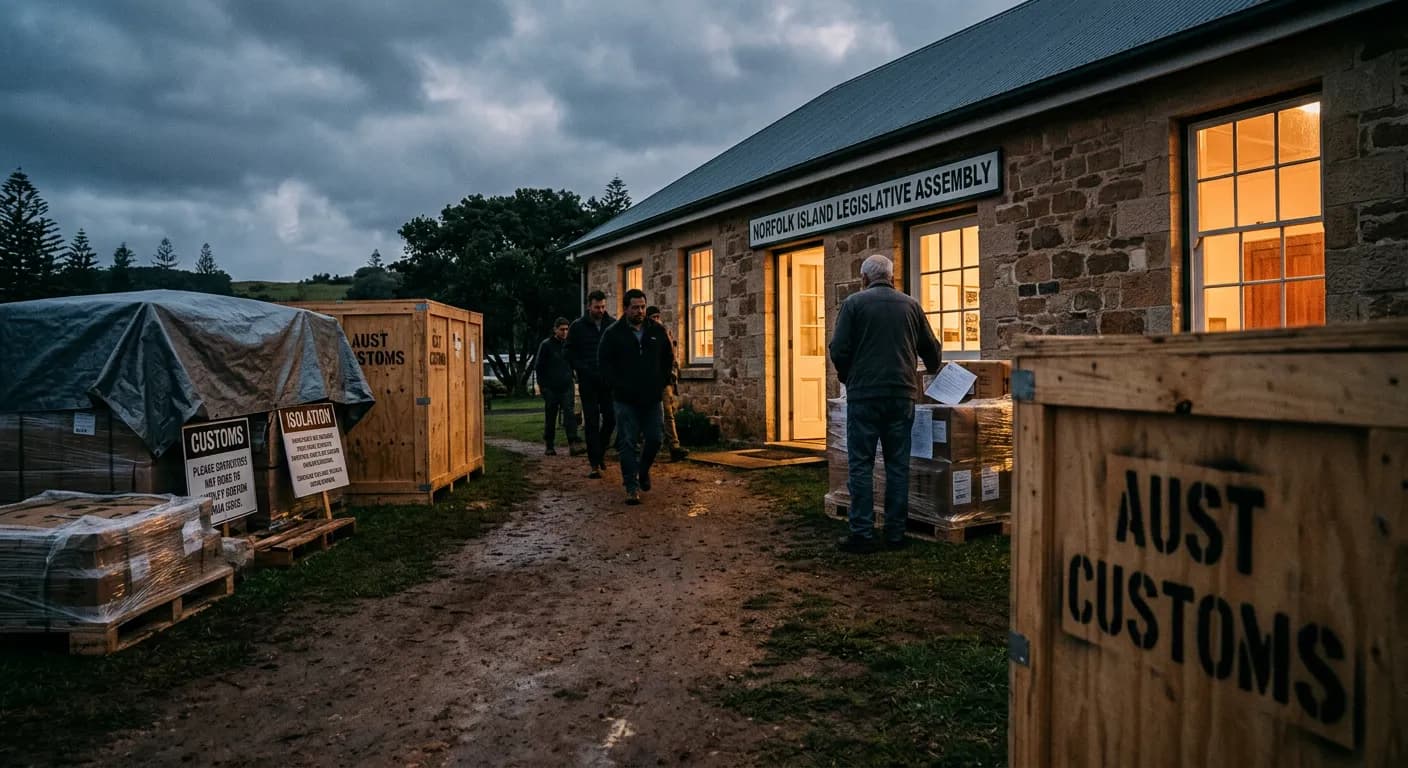
Norfolk Island Has No Foreign Policy — And That's the Whole Problem
When a 29% tariff landed on 2,200 people, Canberra discovered its territorial governance model has a price tag.
The Model Diplomat profile on Norfolk Island, updated June 10, 2026, lays out a blunt reality: the island does not conduct its own foreign policy, holds no UN membership, and cannot negotiate trade agreements. Australia owns every lever — law, funding, border control, and international representation — under the Norfolk Island Act 1979 and subsequent reforms. What the island presents diplomatically is local advocacy filtered through Canberra. That arrangement just became measurably expensive.
The profile's timing matters. In April 2025, the Trump administration imposed a 29% tariff on Norfolk Island — nearly triple the 10% baseline rate applied to mainland Australia and other Australian territories like Christmas Island and the Cocos (Keeling) Islands, as BBC News reported. The US imported roughly $273,000 in goods from Norfolk in 2022, mostly labeled "chemicals."
Al Jazeera noted the US ran a trade deficit with Norfolk Island of just $100,000 in 2024 — a rounding error that somehow triggered a tariff rate reserved for alleged trade adversaries.
Prime Minister Anthony Albanese called the tariffs "totally unwarranted" and "not the act of a friend." But the deeper embarrassment was structural: Norfolk Island had no independent seat at any table to push back. Canberra had to carry the representation, and the tariff differential — 29% versus 10% — suggested Washington's trade machinery treated the territory as a distinct entity despite Australia's legal claim that it is not.
How self-government was dismantled
The roots of this powerlessness trace to 2015, when Canberra revoked Norfolk Island's 35-year experiment in self-governance. The Legislative Assembly was abolished, replaced in 2016 by the Norfolk Island Regional Council operating under New South Wales — and later Queensland — local government law. NPR reported at the time that the island was effectively bankrupt, receiving more than $12.5 million annually in Commonwealth subsidies for a population of roughly 1,800.
The trade-off was explicit: islanders gained access to Medicare, Centrelink, and Australian income taxation, while losing their legislature, their tax-haven status, and any formal mechanism for external advocacy. A 2016 BBC analysis documented that the Norfolk Island People for Democracy group petitioned the UN seeking recognition of self-determination rights — a move that went nowhere, as Australia successfully blocked the island from appearing on the UN's list of non-self-governing territories.
From a power perspective, Canberra consolidated control and assumed the corresponding liability. The tariff episode revealed the liability is real and quantifiable. A territory with no trade policy tools and no diplomatic personhood cannot negotiate exemptions, file disputes at the WTO, or lobby Washington directly. Everything runs through a single channel — and when that channel produced a result worse than the mainland's, no alternative existed.
Who benefits, who pays
The beneficiary of the current arrangement is the Australian federal government, which maintains unified territorial sovereignty, controls the island's exclusive economic zone fishing royalties, and sets the terms of integration. The 2015 reforms also resolved a persistent fiscal drain: the Commonwealth had been subsidizing a self-governing territory that could not fund itself.
The losers are Norfolk Islanders — particularly the roughly 38% descended from Pitcairn settlers — whose local exporters faced a tariff rate that bore no relationship to any trade practice they controlled. The Guardian's subsequent analysis, cited by BBC, found that shipments had likely been mislabeled as originating from Norfolk Island rather than their actual places of origin, meaning the entire tariff basis may have been a data error. Without independent standing, correcting that error required Canberra's bandwidth and willingness.
New Zealand's role is secondary. Geography, tourism links, and aviation connectivity make it relevant, but Wellington is not a negotiating partner for Norfolk's external affairs. The 13% of residents holding New Zealand citizenship at the 2011 census are subject to the same Australian sovereign framework.
What to watch next
The Model Diplomat profile does not announce any policy shift — it catalogs an ongoing arrangement. But the tariff episode has exposed a vulnerability that Canberra's 2025-2026 budget cycle cannot ignore. Watch whether Australia moves to harmonize trade classifications across all external territories to prevent a repeat of the 29% anomaly. Also watch whether Norfolk Island's local council presses for any form of trade-advocacy capacity — even advisory — within the Administrator's office. The next stress test will come if Washington's tariff framework is revised or if any Norfolk exporters seek formal redress through Australian trade dispute mechanisms.
The larger lesson: when a territory has no foreign policy, it has no buffer when someone else's foreign policy lands on it by accident.
Discover more

US Politics
SNAP Food Assistance Faces Legal Challenges
In 2026, SNAP faces stricter eligibility rules and mounting legal challenges, threatening food assistance for the millions of Americans who rely on the program.

India
Delhi CM Rekha Gupta Blasts Opposition's Delm
Delhi CM Rekha Gupta's remarks on women's quota defeat reveal BJP's strategy for the 2029 Lok Sabha elections, focusing on delimitation.
Global Politics
Trump's Conflicting Messages on Iran War
Trump's mixed messages on Iran reflect a strategy of audience management, benefiting Tehran amid a complex geopolitical landscape.

Conflict & Security
Drone Warfare Killing Aid Workers at Unprec
Over 1,000 humanitarian workers killed in three years as cheap armed drones collapse legal protections. Gaza, Sudan, Ukraine, and DRC see deliberate targeting of aid convoys and hospitals with zero prosecutions.