Naidu Defends Delimitation, Ensures Fairness
Chandrababu Naidu claims delimitation is fair for all states.
Model Diplomat8 min readIndia

Naidu Defends Delimitation: Why the South's Swing Vote Just Broke Ranks
Chandrababu Naidu says delimitation is "inevitable" and no state will face injustice. Here is what the numbers say, and why his pivot matters for the 2029 map.
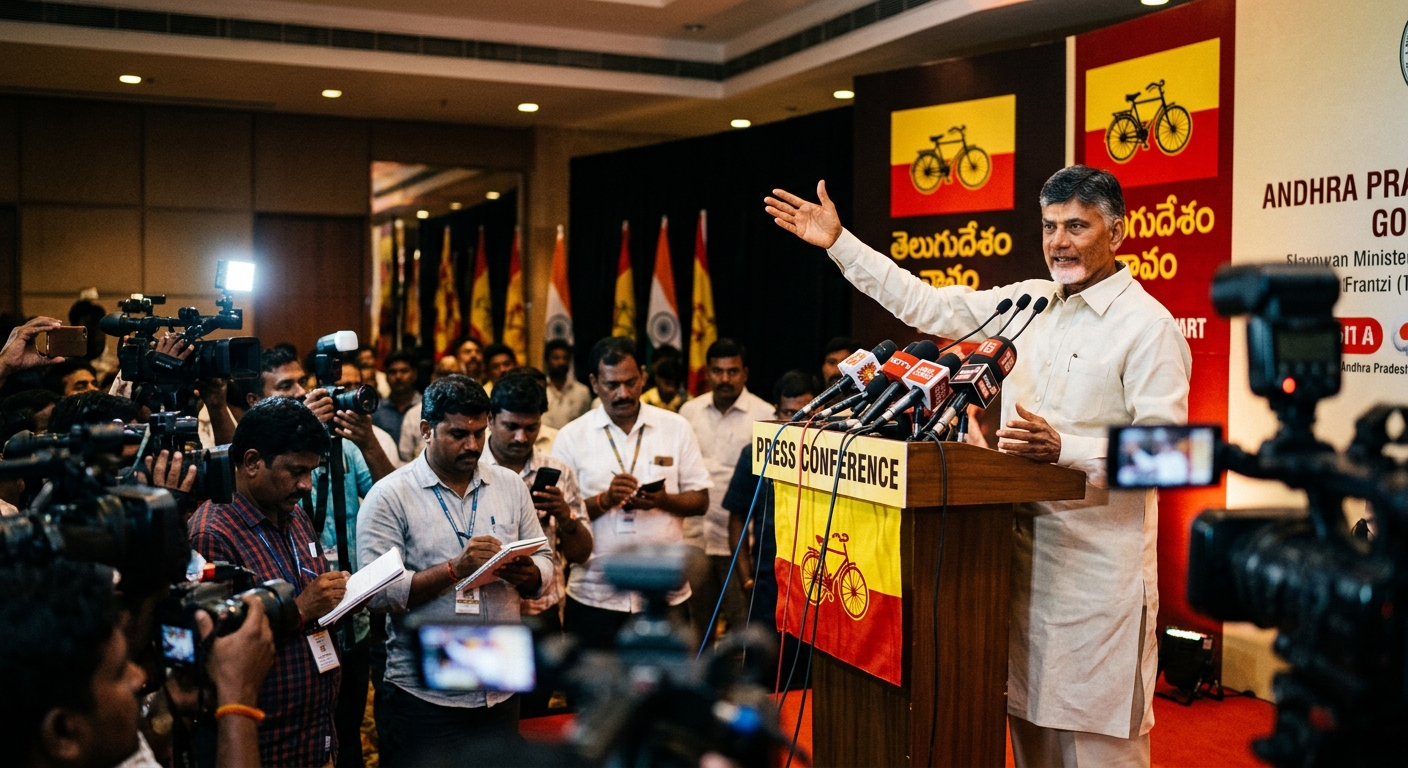
Andhra Pradesh Chief Minister N. Chandrababu Naidu used the last day of the Tamil Nadu campaign on April 21, 2026 to break with every other southern chief minister on the single most consequential constitutional question facing India: how to redraw the Lok Sabha. His pitch — delimitation is "inevitable," no state will lose seats, and the Congress and DMK are lying about the arithmetic — is not a technical view. It is the political cover the Modi government needs to bring back a bill that lost on the floor of Parliament three days earlier. Naidu is now the single most important southern signature on any deal that redraws India's political map by 2029 — and the price of that signature is what this story is about.
What Naidu actually said, and where the bills stand
Speaking to reporters in Chennai, Naidu defended the three delimitation-linked bills introduced during the special session — the Constitution (131st Amendment) Bill, 2026, the Delimitation Bill, 2026, and the Union Territories Laws (Amendment) Bill, 2026 — as "fair to all states." According to The Hindu BusinessLine, he directly attacked Rahul Gandhi and MK Stalin for claiming victory over the "stalled bill," insisting the delay was procedural, not political.
The bills did not stall. They failed. A Press Information Bureau bulletin issued at the close of the Budget Session confirms that the 131st Amendment "could not have the required majority as per Article 368(2) of the Constitution of India on its motion for consideration," and that the two dependent bills "were not proceeded further." Modi's National Democratic Alliance holds 293 Lok Sabha seats against the 360 needed for a two-thirds majority, according to
Al Jazeera's pre-vote count. That gap — 67 votes — is Naidu's leverage.
Naidu has since told reporters the bill will return with an explicit 50% proportional-increase clause written in, calling the earlier omission a "technicality," per the Economic Times. That is the concession he is claiming credit for.
The arithmetic behind "no injustice"
Home Minister Amit Shah's reply in the Lok Sabha is the primary document Naidu is standing on. Shah told the House that a flat 50% expansion would take the Lok Sabha from 543 to 816 seats — the "850" number in the bill is a rounded ceiling — and lift the five southern states from 129 seats (23.76%) to 195 seats (23.87%). Andhra Pradesh alone rises from 25 to 38. Tamil Nadu goes from 39 to 59. Kerala from 20 to 30. On Shah's numbers, every state gains in absolute terms and the southern share is protected to two decimal places.
The problem is what Shah did not commit to in law. The BBC's reporting on the draft quotes Arghya Sengupta of the Vidhi Centre for Legal Policy noting that the bill raises the ceiling to 850 seats "but the basis for this number is unclear and does not appear to be proportionate to population growth recorded in the 1971 and 2011 census." BJP MP K. Laxman told the BBC delimitation would be done on a "pro-rata" basis; Sengupta's response is direct: "the absence of a clear proportional formula means outcomes could vary — and favour more populous states."
The Carnegie Endowment for International Peace modelled both paths in May 2026. Under Shah's flat 50% formula, southern states hold their share. Under a genuine population-based reapportionment using 2026 projections, the five southern states lose 27 seats collectively, while Bihar, UP and Rajasthan pick up 26. Uttar Pradesh alone would grow to roughly 128 seats — nearly the size of the entire southern bloc. That is the scenario Naidu is telling voters cannot happen. It is also the scenario the current draft does not legally rule out.
The pivot: from "have more babies" to "no threat"
Naidu's own position has moved. In October 2024, he told an industry event he was "thinking of providing incentives to families with more children" because of the coming delimitation, per the Takshashila Institution. The same year his cabinet scrapped Andhra Pradesh's two-child bar on contesting local elections — a signal that the state was preparing for a demographic penalty in Delhi.
That was the man warning of a threat. Eighteen months later he is the man dismissing it. Newslaundry's Pooja Prasanna reported his current line — "I see no threat to south India" — and made the point cleanly: "That 50 percent assurance is not part of any law. It is not written into any bill. And Naidu is not a first-time politician."
Two things changed between the warnings and the reassurance. First, Naidu's TDP re-entered the NDA and now sits inside the government as the second-largest partner. Second, the government tabled a version of the bill in which the pro-rata formula was verbal, not legislative — precisely the version that keeps Naidu inside the room while giving the BJP flexibility on the final formula. He is defending the promise, not the text.
Why Stalin is not going quiet
Tamil Nadu's Chief Minister MK Stalin called the plan a "massive historic injustice" and, on the eve of the special session, burned a copy of the bill and hoisted a black flag, according to Al Jazeera and NPR's Delhi correspondent. Kerala's chief minister described delimitation as a "sword of Damocles" over the south. Milan Vaishnav's earlier
Carnegie analysis — using Alistair McMillan's Webster-method calculations — showed that four southern states would forfeit 17 Lok Sabha seats under 2011 census figures, and that preventing any state from losing seats would require an 848-member house, "exceeding the maximum strength of any lower house or unicameral body in a democratic country today."
Stalin's position is not hysterical; it is a floor-plus-proportionality demand. He wants two things Naidu has now stopped asking for: an explicit statutory guarantee that no state loses seats, and a delay tied to the 2027 census results rather than 2011 data. The academic case that the north is genuinely under-represented is real — an MP in Bihar today represents roughly 3.1 million citizens, in Kerala 1.75 million, per Takshashila — but Stalin's counter is that redressing that gap by shifting weight north effectively taxes states that succeeded on the family-planning targets Delhi itself set in the 1970s.
The peer-reviewed literature captures the trade-off with hard numbers. A paper in the International Journal of Research and Scientific Innovation by Paladugula Dhanraj estimates that on current projections "northern states potentially gain 43 parliamentary seats while southern states lose 24," and argues India will need a hybrid formula — a floor for smaller/slower-growth states, weighted voting, or European-Parliament-style degressive proportionality — to keep the federal structure intact.
Who wins, who loses, if Naidu holds the line
Follow the seats and follow the money.
The BJP wins the framing war. Naidu's endorsement lets the party say the bill has southern buy-in the next time it is tabled, breaking the "north-versus-south" story Stalin has built his 2026 campaign around. The NUS Institute of South Asian Studies notes that the BJP-AIADMK alliance in Tamil Nadu is banking on cracking the DMK's Dravidian frame; Naidu attacking the DMK in Chennai on the last day of campaigning is not incidental to that project.
Naidu wins short-term leverage. His 16 Lok Sabha MPs are inside the tally Modi needs to reach 360. Every reintroduction of the bill runs through his caucus, and his price — the explicit 50% clause — is now the public benchmark.
The DMK, Congress and CPI(M) lose their strongest structural argument if the bill returns with the pro-rata formula written in. Their fallback — that even a proportional expansion "creates a mismatch," in Sengupta's phrase, because state assemblies are not similarly expanded — is a real point but a harder one to fit on a black flag.
Southern voters lose optionality. The Carnegie analysis is blunt: using 15-year-old census data to redraw seats "would not fully restore democratic equality," and the 2027 census results will be even more skewed against the south. A 50% flat expansion locks in the 2011 shares — good for the south relative to a strict population redraw, bad relative to the status quo of "no redraw at all."
Diplomat View
Naidu's defence of delimitation reads as reassurance; it functions as a signal that the south's most senior NDA voice will accept a bill without a statutory proportionality guarantee, provided the political promise holds. That is a real concession to the government, and it is why the bill will come back. The defensible forecast: the 131st Amendment is reintroduced during the Winter Session with an explicit 50% pro-rata clause written in, and passes with TDP, JD(U) and a slice of the BJD or YSRCP — not because the opposition is convinced, but because voting against a bill that expands women's reservation and every state's seat count is politically unaffordable in a Tamil Nadu election year. What would falsify this call: (a) the government tables a bill that uses 2027 census figures rather than 2011, at which point Naidu's cover collapses and the south goes back to a united front; (b) the Tamil Nadu result in May 2026 delivers a landslide for the DMK on an explicitly anti-delimitation platform, forcing Naidu to re-hedge before the Winter Session; (c) the Supreme Court entertains a challenge on Article 368 grounds. Watch the census schedule, not the parliamentary calendar — the sequencing of the 2027 enumeration is the real variable.
What to watch next
- May 2026: Tamil Nadu assembly result. A DMK sweep on a delimitation-heavy campaign changes Naidu's math overnight.
- Winter Session 2026 (Nov–Dec): Government's stated window to reintroduce the Constitution (131st Amendment) Bill with the 50% clause.
- Q1 2027: Individual-enumeration phase of the census begins. Whichever census the final delimitation uses — 2011 or 2027 — determines whether Shah's arithmetic or Vaishnav's holds.
The Bottom Line
Naidu's "no injustice" line is not a legal guarantee; it is the political cover the BJP needs to bring back a delimitation bill that failed by 67 votes in April 2026. If he holds it through the Tamil Nadu election and the Winter Session, the Lok Sabha grows to 816 seats on Shah's pro-rata formula and the north-south fight is deferred, not resolved. If the final bill is instead pegged to the 2027 census, the same numbers that make Naidu look statesmanlike today will cost the south up to 27 seats — and the man who called delimitation "inevitable" will own that outcome.
Discover more
India
CPI(M) Calls to Decouple Quota from Delimita
CPI(M) advocates for a 33% women's quota in Lok Sabha by 2029, removing the need for delimitation and census linkage.
India
BJP's Delimitation Strategy
Congress leader K.C. Venugopal claims the BJP uses women's reservation to advance delimitation, raising fears over electoral fairness ahead of the 2029 polls.
India
Congress Advocates 33% Women’s Quota
Congress calls for a 33% women's reservation in the existing 543 Lok Sabha seats, countering Modi's plan to expand the house to 850 seats.

Conflict & Security
Drone Warfare Killing Aid Workers at Unprec
Over 1,000 humanitarian workers killed in three years as cheap armed drones collapse legal protections. Gaza, Sudan, Ukraine, and DRC see deliberate targeting of aid convoys and hospitals with zero prosecutions.