Malaysia's Diplomatic Blueprint: Hedge
Anwar's strategy for navigating global tensions
Model Diplomat3 min readasia
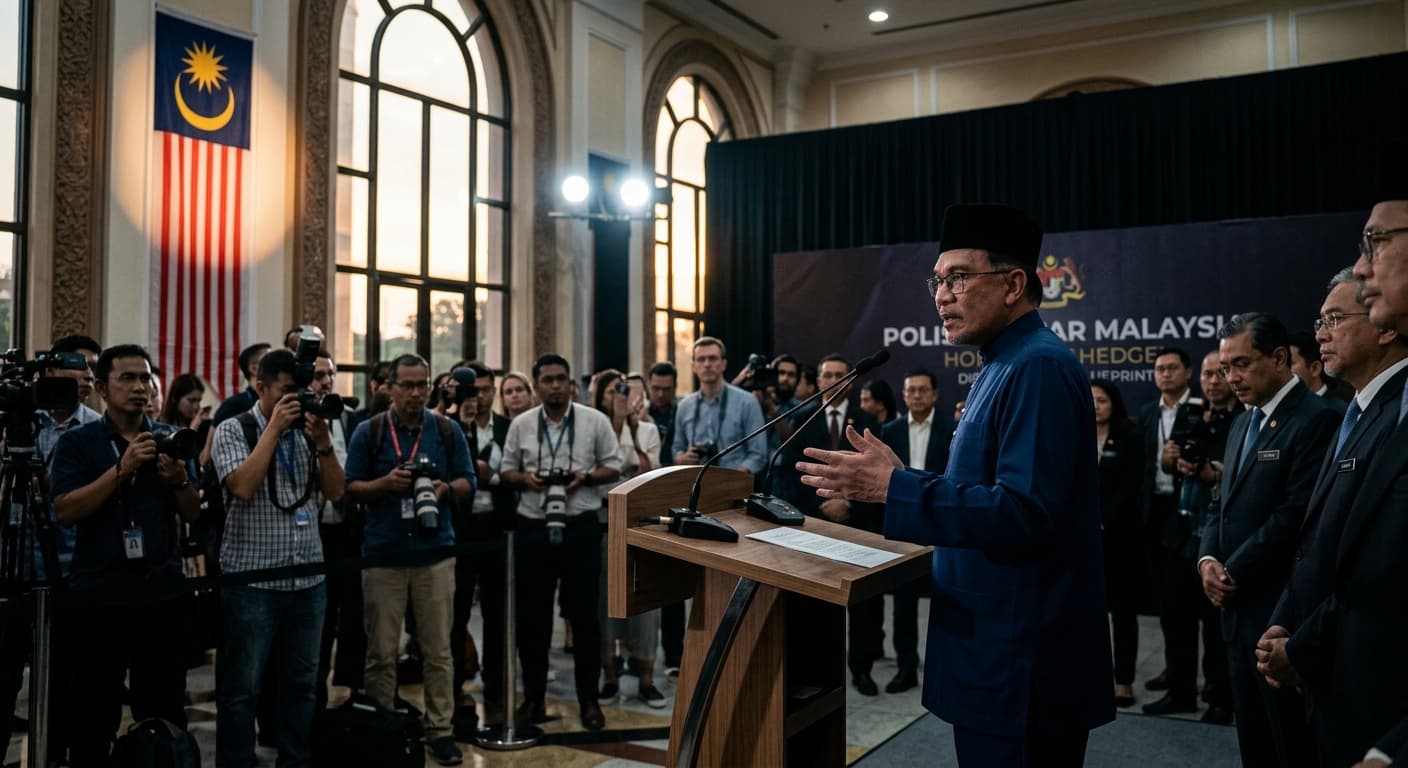
Malaysia's Diplomatic Blueprint: Hedge Against a Fragmenting World
Anwar launches Wisma Putra's 2026–2030 strategy — 8 thrusts, 139 programmes, but the real story is the seven threats it names: armed conflict, economic weaponisation, major-power rivalry, and a trade-dependent economy caught in the crossfire.
Prime Minister Anwar Ibrahim launched Malaysia's Foreign Ministry Strategic Plan 2026–2030 on February 23, 2026 — a 139-programme framework that reads less like a bureaucratic roadmap and more like a survival manual for a mid-sized power navigating great-power fragmentation. BERNAMA
The plan, formally introduced during a MADANI Iftar event in Putrajaya hosted by Foreign Minister Mohamad Hasan, anchors itself in eight strategic thrusts spanning bilateral diplomacy, ASEAN centrality, economic diversification, maritime sovereignty, digital transformation, consular protection, institutional modernisation, and multilateral activism. Diplomacy & Beyond Plus It aligns with the 13th Malaysia Plan (RMK13), the MADANI Economy Framework, and the Public Service Reform Agenda (ARPA) — making foreign policy a direct instrument of domestic economic strategy.
The Threat Matrix
What makes this document more than ceremonial is the companion analysis Wisma Putra released the same day, identifying seven strategic threats that shaped the planning: armed conflicts and maritime disputes, major-power rivalry, economic weaponisation, climate-induced resource scarcity, cross-border terrorism, disruptive technologies including AI, and the erosion of global governance institutions. BERNAMA
The ministry warns that "over-reliance on a few external partners undermines resilience and hampers the pursuit of a well-balanced and independent foreign policy." That sentence is the strategic thesis. It applies equally to Beijing and Washington.
The plan explicitly flags that global trade is "increasingly vulnerable to geopolitical tensions," with supply-chain disruptions, reshoring trends, and tariff escalation threatening Malaysia's export-dependent economy. In response, the strategy prioritises broadening and diversifying trade and investment links and accelerating free trade agreements — a direct hedge against the weaponisation of economic interdependence.
ASEAN as the Load-Bearing Pillar
ASEAN centrality gets top billing — and for good reason. Malaysia held the ASEAN chairmanship in 2025, and the plan "carries forward the legacy and progress" from that year. Diplomacy & Beyond Plus notes the emphasis on ASEAN's technological capacity-building and digital connectivity as the grouping approaches its 60th anniversary in 2027 and advances toward the ASEAN 2045 Vision. This is not nostalgia. It is Kuala Lumpur positioning itself as the indispensable convenor in a region where US-China competition is intensifying.
The IMF's February 2026 Article IV consultation reinforces the economic stakes: Malaysia grew an estimated 4.9% in 2025, but risks are "tilted to the downside" from protectionist trade measures and a potential AI-boom bust. The Fund endorsed "deeper trade and financial integration within ASEAN" to boost growth potential. IMF Wisma Putra's plan operationalises that advice.
Technology as a Diplomatic Currency
One underappreciated feature: the plan embeds technology cooperation as a cornerstone of bilateral partnerships. Priority areas include climate technologies, renewable energy systems, the digital economy, and cross-border data initiatives. Diplomacy & Beyond Plus This moves Malaysia beyond being a semiconductor assembly hub toward something more strategic — positioning itself as a partner in innovation rather than just a production node. It also creates new negotiating chips with both the US (which dominates AI and chip design) and China (which leads in renewables and digital infrastructure).
What to Watch
The plan's eight thrusts and 139 programmes include measurable KPIs and a monitoring framework, but the real test is execution. Three pressure points:
- US tariffs at 19% remain unresolved. The plan's trade-diversification imperative will be measured by how quickly Malaysia concludes new FTAs — not how many it announces.
- South China Sea friction with China continues, particularly around Petronas exploration. The plan's sovereignty and maritime pillar will face immediate stress tests.
- The 2027 ASEAN milestone. Malaysia's ability to convert its 2025 chairmanship legacy into institutional influence will shape whether the grouping remains relevant or becomes a bystander in great-power competition.
The document's most telling phrase may be its simplest: "principled, pragmatic and forward-looking diplomacy." In a world where tariffs are weapons and alliances are transactional, Malaysia is betting that the best defence is a diversified address book.
Discover more
US Politics
SNAP Food Assistance Faces Legal Challenges
In 2026, SNAP faces stricter eligibility rules and mounting legal challenges, threatening food assistance for the millions of Americans who rely on the program.
Global Politics
Trump's Conflicting Messages on Iran War
Trump's mixed messages on Iran reflect a strategy of audience management, benefiting Tehran amid a complex geopolitical landscape.
US Politics
House Ethics Committee Pushes Sexual Miscond.
The House Ethics Committee has shifted responsibility for sexual harassment settlement records to the Office of Congressional Workplace Rights, complicating disclosure efforts.

Conflict & Security
Drone Warfare Killing Aid Workers at Unprec
Over 1,000 humanitarian workers killed in three years as cheap armed drones collapse legal protections. Gaza, Sudan, Ukraine, and DRC see deliberate targeting of aid convoys and hospitals with zero prosecutions.