Modi's Bold Plan
India's Parliament to grow by 55% with women's reservation
Model Diplomat3 min readIndia

Modi's Parliament Expansion and Women's Reservation Drive: Reinventing India's Democracy
India’s Parliament is set to expand by 55%, with a historic push to reserve one-third of all seats for women—reshaping political representation and federal balance.
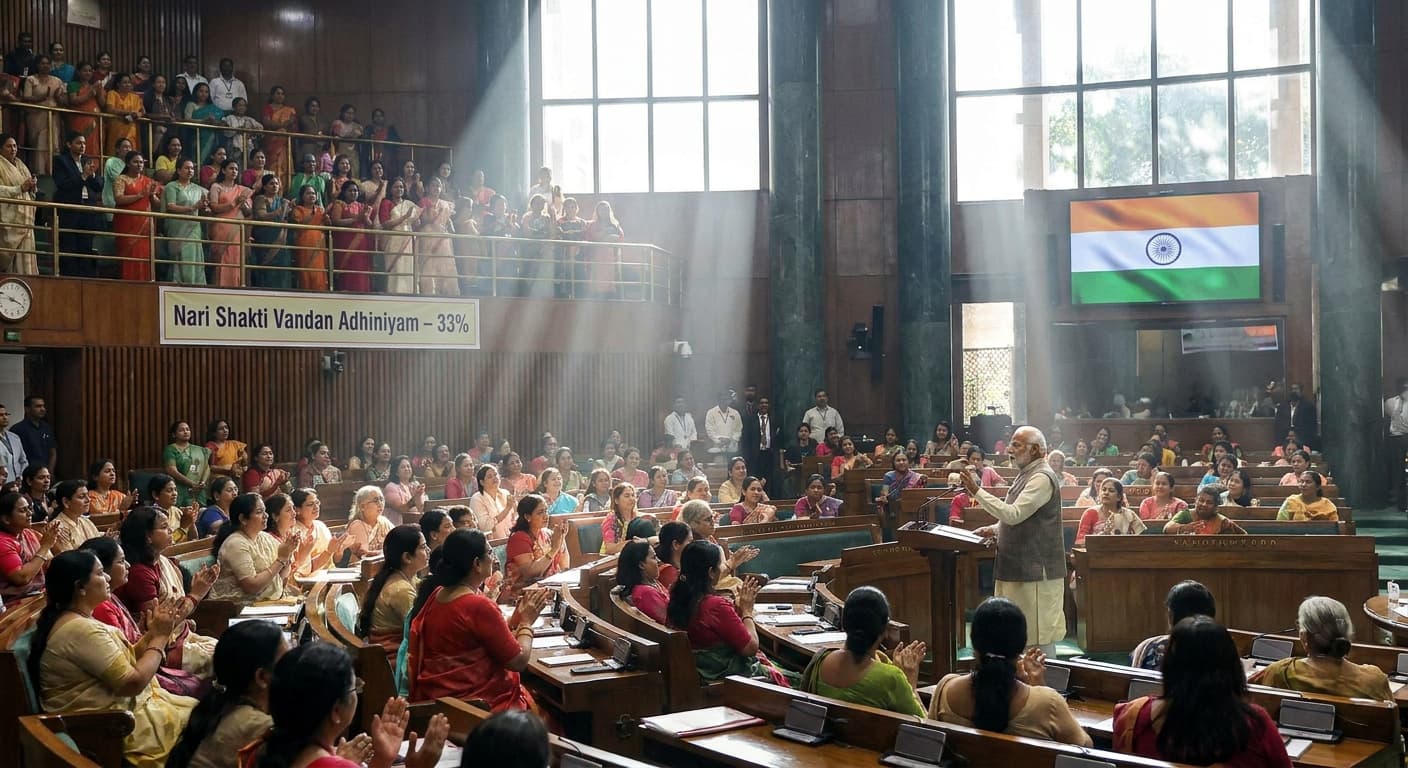
On April 16, 2026, Prime Minister Narendra Modi's government delivered a bold legislative package in Parliament: an overhaul that increases the Lok Sabha (lower house) seats from 543 to approximately 850, coupled with a constitutional mandate for women to occupy one-third of these seats. This ambitious effort also redraws electoral boundaries via a delimitation exercise to reflect updated population data without reducing southern states’ proportional representation—a major point of contention in Indian politics.
Why This Matters: Expanding and Feminizing Representation
India’s current Parliament dramatically underrepresents women—about 14% in the lower house and 17% in the upper house—well below global averages. Modi’s plan, a continuation of a 2023 law linking the women’s reservation to census updates, mandates women hold 33% of seats in the expanded Lok Sabha and state legislatures by the next general and local elections in 2029. This would be a seismic shift in Indian political culture, aiming to enfranchise millions of new female voters and leaders.
The expansion itself—around a 55% increase in seats—addresses population shifts and seeks to recalibrate representation fairly across states. While this might sound like a purely technical move, it has major political implications. Modi insists that no state will lose out: northern, southern, eastern, and western states alike will have their proportional share maintained. Union Home Minister Amit Shah detailed that southern states, including Tamil Nadu, stand to gain about 50% more seats, assuaging concerns about a decline in their influence.
The Political and Federal Stakes
Delimitation is politically charged in India. Redrawing boundaries often benefits the ruling party and can ignite regional resentments. Modi’s government faced opposition accusations of gerrymandering under the guise of reform. Yet by publicly guaranteeing no state will be marginalized, Modi seeks to pre-empt federal disputes that have historically caused friction between the Centre and states.
At the same time, the women’s reservation quota, though popular among civil society and many parties, faces skepticism as some fear an uneven advantage or tokenism. Modi frames the reform as ushering India “in a new direction,” emphasizing women’s greater voice and governance sensitivity as crucial to the nation’s democratic maturity.
What to Watch Next
The bills still require ratification by at least half of the states to pass constitutional muster—which means political negotiations at the state level will be decisive. Watch closely how regional parties, especially in southern and eastern India, respond—will they accept expanded seats without losing leverage? And will women’s groups and voters push for implementation beyond symbolic milestones?
Also critical is the 2029 election cycle, which will test whether expanded and feminized legislatures translate into substantive policy and power shifts rather than merely changing the numbers. This package offers a blueprint for 21st-century Indian democracy, but its success depends on execution and political buy-in across India’s diverse states.
This is India's most substantial parliamentary reform since independence: a recalibration of size, geography, and gender in political power—elements that will shape Indian politics for the coming decades.
Explore more about India’s politics and democratic evolution and broader
Global Politics.
Sources:
Discover more
Global Politics
Modi's 33% Women Reservation Bill Impact
India's Women's Reservation Bill would reserve 33% of parliamentary seats for women, a reform poised to reshape political dynamics and gender representation.

India
India's Lok Sabha Seats Rise 50% with Women
India plans to expand Lok Sabha seats by 50% while reserving 33% for women, a sweeping overhaul set to reshape political representation across the country.

India
Modi's Women’s Reservation Bill
PM Modi's Women's Reservation Bill aims to expand women's seats in India's Parliament, a reform poised to reshape democracy and shift electoral dynamics.

Economics
Fed's Amex AML order puts correspondent banking on notice
Federal Reserve's Amex AML order requires board-level controls and a 90-day plan; OCC fined the bank $350 million over enterprise-wide deficiencies.