Modi Elevates BJP’s Bengal Origins at Kolkata Swearing-In
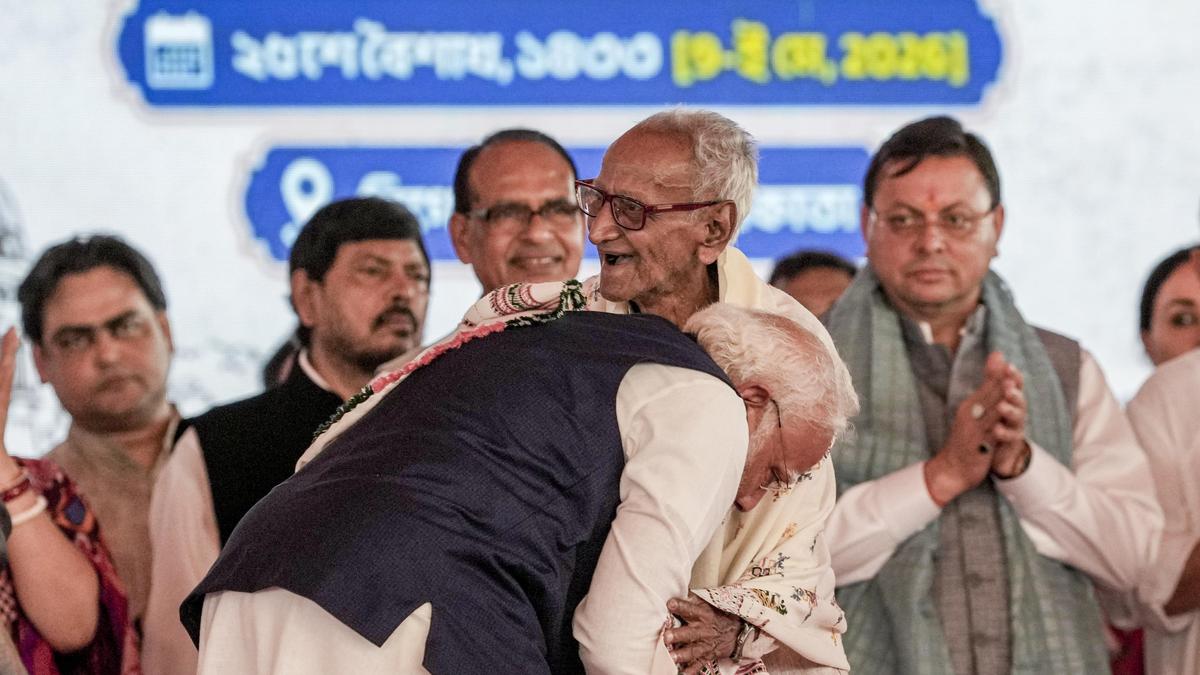
At Suvendu Adhikari’s swearing-in, Modi saluted 98-year-old Makhanlal Sarkar — a symbolic nod to BJP’s grassroots claim in Bengal.
Prime Minister Narendra Modi used the swearing-in of Suvendu Adhikari as West Bengal’s ninth chief minister to stage a deliberate piece of party memory politics: he met 98-year-old Makhanlal Sarkar, presented him a shawl, and took his blessings at Brigade Parade Grounds in Kolkata, according to  The Hindu. The message was explicit in Modi’s own social-media post, which described Sarkar as a “devout nationalist” who worked with Syama Prasad Mookerjee and said the BJP would leave “no stone unturned” to fulfil Mookerjee’s vision, as reported by
  New Kerala.
The power move is narrative, not protocol
This was not just a courtesy call. Modi was anchoring the new Bengal government in the BJP’s pre-electoral mythology — Mookerjee, the early nationalist movement, and the oldest surviving cadres who can embody that lineage. According to The Hindu, Sarkar was arrested in Kashmir in 1952 while accompanying Mookerjee during the movement to hoist the Indian tricolour there, later became organisational coordinator across several north Bengal districts after the BJP’s formation in 1980, and helped enrol nearly 10,000 members within a year.
That matters because the BJP’s claim in West Bengal has always been two things at once: an electoral challenge to the TMC, and a cultural argument that the party is not an outsider. Modi’s gesture was designed to collapse that distinction. The old cadre becomes the proof of rootedness; the new chief minister becomes the product of a longer historical arc. For a party that still needs to widen its base beyond hard-core supporters, that is a useful image to broadcast on  India.
Why this lands in Bengal now
The symbolism also works because Bengal remains one of the BJP’s most identity-sensitive theatres. Dainik Statesman reported that this was the first BJP government to take oath in West Bengal and described the ceremony as emotionally charged, with party veterans and central leaders filling the stage while Modi publicly honoured an old organiser who had spent decades building district structures when the BJP was still marginal in the state ( Dainik Statesman). That framing is useful for the party: it shifts attention from organisational fragility to historical endurance.
It also serves Modi personally. By making the oldest worker the centrepiece, he reinforces his own image as custodian of BJP tradition, not just its national campaigner. New Kerala quoted him saying the party was proud to have “motivating figures” who strengthened it from among the people. That language is aimed at cadres, not rivals: it rewards loyalty, signals continuity, and reminds local leaders that status in the BJP still runs through the central leadership.
What to watch next
The immediate question is whether the new Bengal government can convert symbolism into machinery. Watch the first cabinet decisions, the choice of district-level appointments, and whether the party uses Sarkar-style veteran outreach to build a broader organisational bridge in north Bengal and beyond. The next real test is whether this oath-day theatre helps Adhikari project authority beyond the rally ground and into district administration — and whether the BJP can turn legacy politics into votes before its next statewide battle.