Lee's Mongolia Gambit: Denuclearization & REE
South Korea's Lee Jae Myung enlists Mongolia as broker on North Korea.
Model Diplomat8 min readNortheast Asia
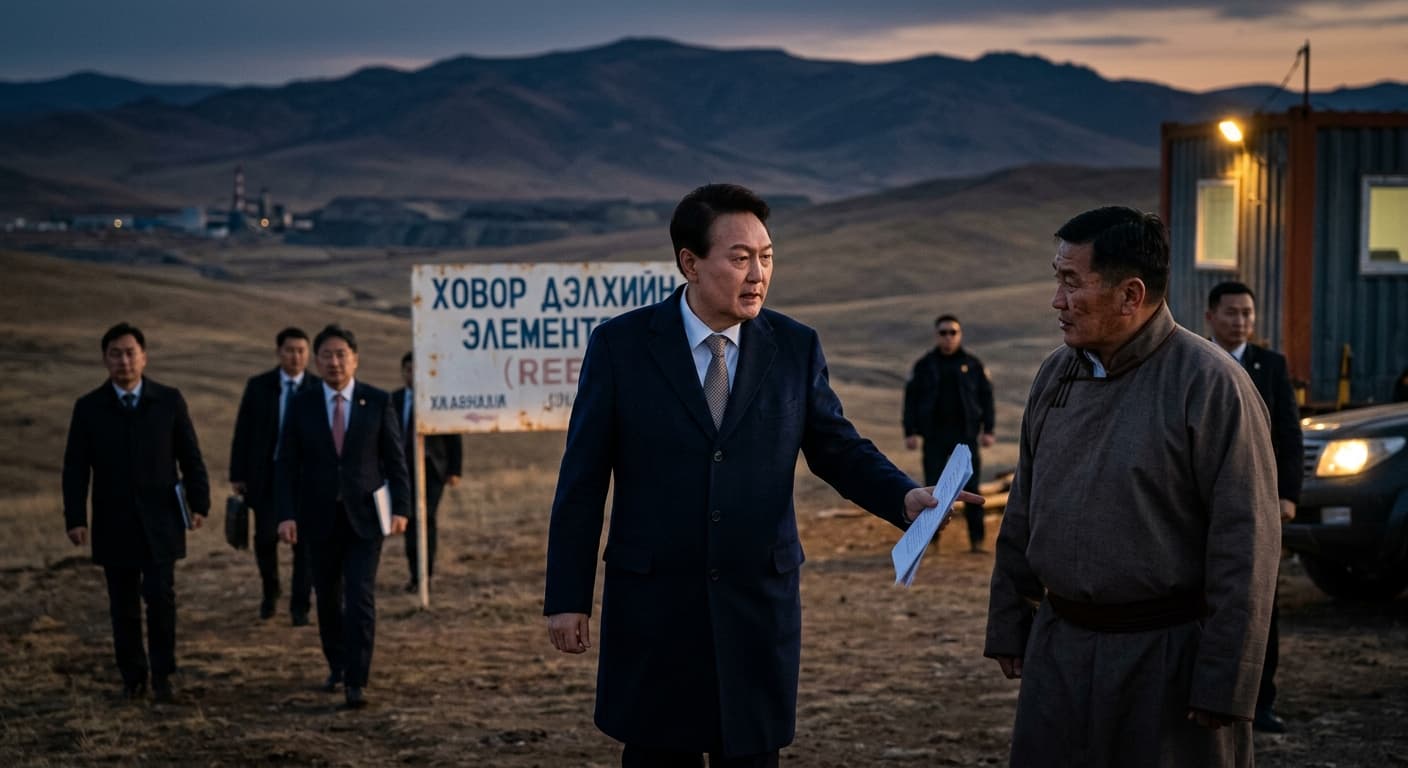
Lee's Mongolia Gambit: Phased Denuclearization Meets Rare-Earth Realpolitik
South Korea's Lee Jae Myung enlists Mongolia as broker on North Korea and rare-earth partner — a two-track bet on Northeast Asian security and supply-chain de-risking.
South Korean President Lee Jae Myung landed in Ulaanbaatar on July 9, 2026 — the first South Korean state visit to Mongolia in 15 years — and used the occasion to fuse two strands of his foreign policy into one thesis: the road to a "phased" denuclearization of the Korean Peninsula runs through the same country Seoul now needs to escape China's stranglehold on critical minerals. In an interview with Mongolia's state agency Montsame carried by Yonhap, Lee called Mongolia a "trusted partner" for bridging the divided Koreas and, in the same breath, cast Mongolian mineral wealth as a "strategic asset" for Korean industry and national security. The angle is not the denuclearization line — Lee has repeated versions of it for a year — but the vehicle: after Xi Jinping was asked to mediate in January and Donald Trump enlisted as "peacemaker" in August 2025, Lee is now betting on Ulaanbaatar as the one capital in Northeast Asia that Pyongyang, Beijing, Moscow and Washington all still tolerate in the room.
The pitch: freeze, reduce, dismantle — with a Mongolian doorway
Lee's "phased" formula is not new language, but it is newly explicit. He first floated a three-step sequence — freeze, reduce, dismantle — to NPR in September 2025 and to the
BBC days later, describing a freeze as a "feasible, realistic alternative" while North Korea churns out an additional 15–20 warheads a year. In Shanghai on January 7, 2026, he asked Xi to play "mediator for peace" and proposed a halt to new warheads, ICBM development and nuclear-material transfers as an interim gain,
Al Jazeera reported. Brookings analyst Andrew Yeo described the resulting posture as Seoul acting as "pacemaker" to Trump's "peacemaker" role, without abandoning denuclearization as an ultimate goal, in a
Brookings analysis.
What Ulaanbaatar adds is a channel. Mongolia was the third state to recognize North Korea after the Soviet Union, sheltered thousands of DPRK war orphans in the 1950s, and — uniquely in Northeast Asia — maintains visa-free travel and warm party-level ties with Pyongyang while running a stable democracy. Brookings scholars Maricarmen Barron Esper and Christopher Sands argue that this makes Mongolia less a proxy than a neutral meeting ground, a "Finland to a future Northeast Asian Helsinki." The annual Ulaanbaatar Dialogue on Northeast Asian Security has been the region's only track-1.5 forum where North Korean deputy foreign ministers actually turn up, according to a
Friedrich-Ebert-Stiftung interview with its organizer.
The wall Lee is speaking into
The problem for Lee's phased approach is that the counterparty has slammed the door twice this year. At the Workers' Party Ninth Congress in late February 2026, Kim Jong Un declared the DPRK's nuclear-state status "completely and absolutely irreversible" and said denuclearization "can never happen," per an Observer Research Foundation reading of the congress report. In May 2026, according to South Korea's Ministry of Unification cited by the American Enterprise Institute, Kim
amended the constitution to give the State Affairs Commission chairman explicit authority over "nuclear forces" and hinted at decentralizing nuclear command and control — hardening against decapitation and burying reunification as a state goal. The Congressional Research Service's most recent primer on Pyongyang's arsenal notes Kim views nuclear weapons as a "guarantor of regime security" with "no intention" to renounce them, per the
2026 Annual Threat Assessment.
The Quincy Institute's James Park argues bluntly that North Korean denuclearization "is no longer possible" and Washington's continued insistence on it is what keeps Pyongyang out of the room. Lee's word choice — "phased," alongside the softer "nuclear-free Korean Peninsula" formula — is calibrated to keep the alliance script intact while quietly conceding what analysts across the ideological spectrum now say aloud: an immediate rollback isn't on the table.
The second track: mineral leverage disguised as diplomacy
The more consequential half of the Ulaanbaatar visit is economic. Lee will sign a joint declaration proclaiming a "Golden Age of Korea-Mongolia Relations" alongside President Ukhnaa Khurelsukh, The Korea Herald reported, and pitched a supply-chain model that runs "from exploration to refining and human-resources training," according to
Aju Press. That vertical framing matters. South Korea's Ministry of Trade, Industry and Energy set a target in 2023 of cutting China dependence for ten strategic minerals from roughly 80% to 50% by 2030, an architecture the state-funded
Korea Institute for International Economic Policy has since described as still largely MOU-based and legally soft.
The urgency is fresh. On April 4, 2025, Beijing imposed export controls on seven rare-earth elements and their magnets, followed by a sharper October 9, 2025 escalation adding five more REEs and processing equipment — a "significant escalation" that briefly cut magnet exports 73% in May 2025, per an Utrikespolitiska institutet study. Korea and Japan were among the few destinations to which dysprosium and yttrium oxide shipments resumed, but at reduced volumes. Seoul currently imports roughly 95% of its rare earths, 98% of its gallium and 93% of its indium from China, per an
ORF analysis — a dependency an ORF-cited KIEP model projects could cost 10.8% of secondary-battery exports and 24.2% of auto-parts exports in a serious disruption.
Mongolia is not a like-for-like substitute — the European Parliament Research Service's 2024 briefing on EU-Mongolia relations concluded that Mongolia's rare-earth deposits remain at an early exploration stage, disadvantaged by remoteness, cost and administrative hurdles, with no economic REE extraction expected in the short-to-medium term. But the geography is unrivalled: Ulaanbaatar sits between the two states Lee most needs to hedge against, and Mongolia holds proven molybdenum, copper, fluorspar, tungsten and uranium deposits that overlap with Seoul's 33-mineral watchlist. In February 2025, Mongolia
renamed its state mining champion "Erdenes Critical Minerals" and added rare earths to its mandate — a signal that Ulaanbaatar wants to move up the value chain rather than sell ore to Beijing at 88% unprocessed.
The mismatch Lee is trying to close is stark. Chinese firms hold 159 mining licences in Mongolia to South Korea's 11, according to Australia's 2023 Mongolian Mining Projects Report cited by the European Parliament. China takes 84% of Mongolian exports; Russia supplies more than 90% of Mongolian energy imports, per a Congressional Research Service primer. In that context, Ulaanbaatar's Prime Minister Luvsannamsrain Oyun-Erdene has openly courted "third neighbours," a doctrine cultivated since 1990 to buy strategic breathing room from Beijing and Moscow. Seoul fits neatly into that frame — and, unlike Washington, comes without the political baggage of Taiwan or Xinjiang-linked sanctions.
Who benefits, who loses
The concrete winners: Korea's battery and semiconductor conglomerates, Mongolia's Erdenes Critical Minerals vehicle, and Khurelsukh's government, which now has a second Northeast Asian counterweight to Beijing after Japan (which upgraded to a "Special Strategic Partnership" in 2022). Trump's Washington gets a quieter win too — Seoul is operationalizing the trilateral US-Japan-Korea supply-chain architecture reaffirmed in Trump-Takaichi's "New Golden Age" documents and the 2026 Critical Minerals Action Plan, without appearing to take orders from it. CSIS's Victor Cha has argued that Lee's approach in
Washington already threaded that needle — reaffirming denuclearization language while preparing for a freeze in practice.
The losers are more interesting. Beijing loses two ways at once: a diplomatic monopoly over the Korean peninsula and a piece of its rare-earth leverage. Chinese analysts quoted by the Royal United Services Institute frame Seoul's minerals moves as accelerating "de-Sinicisation" — the paradox of Beijing's own export-control weapon, per RSIS. Moscow, having spent 2024–2025 upgrading its ties to Pyongyang and dangling the Power of Siberia 2 pipeline through Mongolia, watches Ulaanbaatar entertain a South Korean pitch that Kim will read as a hostile encirclement dressed in trade language. And Kim himself — whose September 2025
Supreme People's Assembly speech branded Lee a "confrontation maniac" via KCNA — gains a talking point: any Mongolian mediation now looks contaminated by a South Korean minerals grab tilted toward Washington's supply-chain bloc.
The historical parallel that reframes the visit
The Elbegdorj precedent is instructive. In 2013, Mongolia's then-president spoke at Kim Il Sung University and declared, in Pyongyang, that "no tyranny lasts forever" — while keeping the border open to North Korean defectors and hosting Japan-DPRK abduction talks. That model — brutal candour paired with irreplaceable convening power — is the one Lee is quietly buying into. He is not asking Ulaanbaatar to deliver Kim; he is asking it to keep the room open. Mongolia's own UN General Assembly statements have consistently offered the Ulaanbaatar Dialogue as a confidence-building mechanism aimed explicitly at denuclearizing the Korean Peninsula — a rare piece of primary text where an Asian government commits its territory to that mediation role.
The parallel that reframes the visit, though, is not 2013 but 1975. Berlin's Freie Universität scholar Lee Eun-Jeung has argued for years that Mongolia could play "Finland" to a future Northeast Asian Helsinki process — a small, neutral state where a multilateral framework for peninsular peace could actually be drafted. Lee Jae Myung's visit is the first time a sitting South Korean president has explicitly bought into that framing on Mongolian soil, and paired it with concrete economic ballast.
What to watch next
Three catalysts will decide whether Ulaanbaatar becomes more than a photo opportunity:
- September 2026 UN General Assembly week: Watch whether Mongolia hosts a sidelines meeting including DPRK officials, and whether Lee uses his General Assembly address to formalize the "phased" language into a US-Korea-Japan trilateral position.
- Erdenes Critical Minerals tenders (Q4 2026): Concrete Korean equity stakes in Mongolian rare-earth or tungsten projects would signal the "golden age" declaration has teeth. Absent tenders, this is another MOU.
- The next Ulaanbaatar Dialogue: A DPRK delegation's presence — or absence — will tell you whether Kim is willing to keep even a track-1.5 line open now that his constitution forbids the substance.
Diplomat View
Lee's Ulaanbaatar visit is not really about denuclearization; it is about buying an insurance policy for the day Beijing weaponizes rare earths against Korean industry, priced in the currency of Mongolian mediation with Pyongyang. The "phased" formula is a hedge — an alliance-safe rewrite of what US and South Korean analysts increasingly concede in private: that Kim's constitutional lock-in and the 2026 Ninth Party Congress have ended CVID as a serious near-term goal. By anchoring that concession inside a Mongolian golden-age partnership loaded with minerals cooperation, Lee gets three things for the price of one visit: cover with Washington (denuclearization remains "the goal"), a channel to Pyongyang that neither Xi nor Trump controls, and a modest but symbolically potent inroad against Beijing's 84% share of Mongolian exports. The forecast that would flip: if by mid-2027 no Korean firm has closed a hard-currency minerals deal in Mongolia, and no DPRK official has sat down under Mongolian auspices with a South Korean counterpart, then the "golden age" is rhetoric and the phased strategy collapses back into Trump-dependency. If either happens, Lee will have quietly re-drawn Northeast Asia's diplomatic geometry more than any president since Kim Dae-jung.
Discover more
US Politics
House Ethics Committee Pushes Sexual Miscond.
The House Ethics Committee has shifted responsibility for sexual harassment settlement records to the Office of Congressional Workplace Rights, complicating disclosure efforts.

US Politics
SNAP Food Assistance Faces Legal Challenges
In 2026, SNAP faces stricter eligibility rules and mounting legal challenges, threatening food assistance for the millions of Americans who rely on the program.

International Relations
Pakistan's Key Role in US-Israel-Iran Meddle
Pakistan is seeking to mediate the US-Israel-Iran conflict, balancing high-stakes diplomacy against severe economic pressures and steep regional challenges.

Economics
Fed's Amex AML order puts correspondent banking on notice
Federal Reserve's Amex AML order requires board-level controls and a 90-day plan; OCC fined the bank $350 million over enterprise-wide deficiencies.