Lee's Denuclearization Pivot Centers Mongolia
South Korea's new strategy elevates Mongolia in diplomacy.
Model Diplomat9 min readNortheast Asia
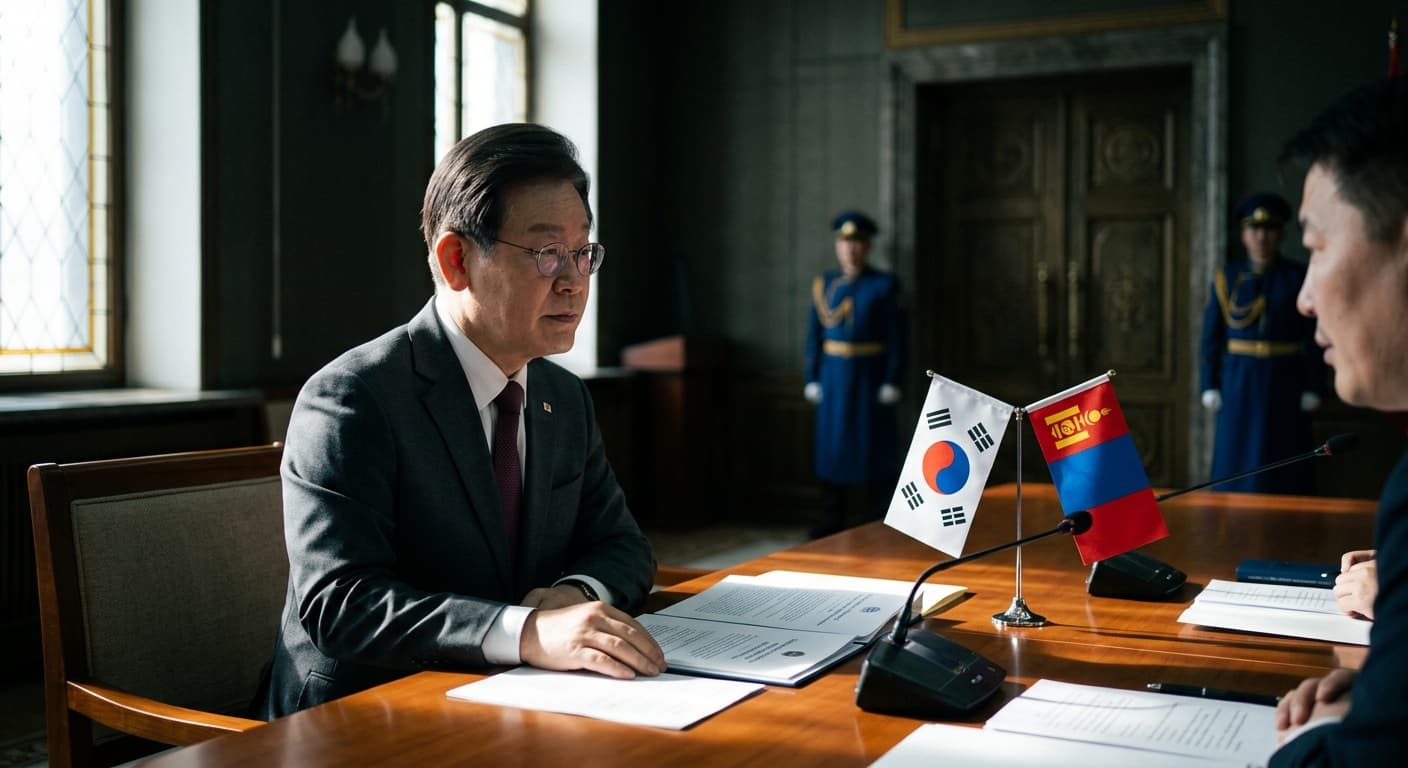
Lee's phased denuclearization pivot puts Mongolia at the center of Korea diplomacy
South Korea's Lee Jae Myung uses his Ulaanbaatar visit to formalize a freeze-first nuclear track and lock in a rare-earth hedge against Beijing.
President Lee Jae Myung arrived in Ulaanbaatar on July 9, 2026, and did two things at once that Seoul had been telegraphing for a year: he formally abandoned the "complete, verifiable, irreversible denuclearization" framework in favor of a phased freeze-then-reduce process, and he elevated Mongolia — a landlocked democracy with unbroken diplomatic ties to Pyongyang since 1948 and an estimated 3.1 million tonnes of rare-earth reserves — from a peripheral partner to Seoul's designated bridge state. The move matters because it aligns Lee's peninsula strategy with the Trump administration's transactional instincts, with China's public silence on denuclearization since the September 2025 Beijing parade, and with a critical-minerals problem — roughly 95% of South Korea's rare-earth imports come from China — that no longer has a purely economic solution.
In an interview released July 9 by Mongolia's state agency Montsame and reported by Yonhap, Lee said Seoul would pursue "phased denuclearization of the Korean Peninsula" while normalizing inter-Korean ties, and called Mongolia a "trusted partner" in that effort. The
Korea Herald reported that Lee and President Ukhnaagiin Khurelsukh would adopt a "Golden Age of Korea-Mongolia Relations" joint declaration the same day, elevating the bilateral relationship to a strategic partnership and setting up a joint business forum on critical minerals.
The end of CVID, in slow motion
The language Lee used in Ulaanbaatar is not new — it is the ratification of a shift he has been running for six months. In an August 2025 interview with the BBC, Lee said he would accept a Trump–Kim deal that froze North Korean production as "an interim emergency measure," noting Pyongyang was adding 15–20 warheads a year. On January 5, 2026, standing beside Xi Jinping in Beijing, Lee proposed a freeze in exchange for "compensation or some form of return" and asked China to mediate, according to
Al Jazeera. The Ulaanbaatar formulation completes the transition from talking point to declared policy.
The numbers explain the pivot. SIPRI's 2026 Yearbook estimates that, as of January 2026, North Korea had assembled around 60 warheads and possessed fissile material for at least 90, up from roughly 50 the year before, according to SIPRI. The stockpile is compounding at roughly 10 warheads a year. So is the delivery system: SIPRI recorded the debut of the solid-fuelled "next-generation" Hwasong-20 ICBM and new manoeuvrable medium-range systems designed to evade missile defences during 2025.
Brookings scholar Andrew Yeo argues Seoul has settled on a sequence — "freeze, followed by reduction and eventual dismantlement" — and now uses the phrase "nuclear-free Korean Peninsula" interchangeably with denuclearization to reflect the softer sequencing, per Brookings. Washington has not moved formally. The
White House joint fact sheet from the October 29, 2025 Trump–Lee state visit in Gyeongju still refers to "the complete denuclearization of the DPRK." But the same document commits both leaders to implementing the 2018 U.S.–DPRK Singapore joint statement — a text that never used the word "complete." That is the drafting compromise Lee needed. CSIS analysts noted at the time that Lee's "pacemaker to Trump's peacemaker" framing was designed precisely to give Washington a Korean partner on any freeze deal, per
CSIS.
The environment shifted decisively in mid-2026. On June 9, Xi Jinping visited Pyongyang for the first time in seven years and neither the Chinese nor the North Korean readouts mentioned denuclearization — an omission Al Jazeera reported as "tacit acceptance from China" of Kim's nuclear status. Ten days later, on the sidelines of the G7 in Evian, Trump told Lee that "the time had come to pay attention to the North Korea issue" now that the Iran file was closed, per
Al Jazeera. Ulaanbaatar is where Lee positions himself for that window.
Why Mongolia, and why now
The choice of Ulaanbaatar is not sentimental. Mongolia is the only democracy in Northeast Asia with uninterrupted diplomatic and cultural ties to Pyongyang since 1948, hosted more than 200 North Korean war orphans in the 1950s, and — critically — is the only country to have obtained parallel security assurances from all five nuclear-weapon states as a self-declared single-state nuclear-weapon-free zone. That status was reaffirmed most recently in UN General Assembly resolution 79/30, adopted without a vote on December 2, 2024, which invited member states to continue cooperating with Mongolia on its "independent foreign policy" and nuclear-weapon-free status. Mongolia is also a state party to the Treaty on the Prohibition of Nuclear Weapons, legally bound since March 10, 2022, per the
UN's nuclear-weapon-free zones platform.
That combination — a nuclear-abstinent democracy with working channels to Kim Jong Un — is exactly what a freeze-first strategy needs. Since 2014, Mongolia has hosted the Ulaanbaatar Dialogue on Northeast Asian Security, a track-1.5 forum that has brought together North Korean deputy foreign ministers, US officials, and Chinese and Russian participants — the closest functional heir to the defunct Six-Party Talks. A March 2026 SIPRI backgrounder argued that a revived Northeast Asian security framework should focus on stability rather than the "seemingly irreconcilable issue of denuclearization" and that Mongolia is the natural launcher, per SIPRI. Damba Ganbat, the Dialogue's longtime organizer, put the pitch bluntly in an
FES interview: Mongolia is "one of the few countries in the world that can rightfully claim to maintain good relationships with both Koreas and their respective allies."
That is the diplomatic architecture Lee is buying into. The "trusted partner" framing in Ulaanbaatar effectively volunteers Mongolia to host freeze-verification conversations that neither Beijing nor Seoul can convene directly. Kim's regime distrusts Beijing's leverage and refuses Seoul's — a Brookings analysis notes that North Korea's approach to Ulaanbaatar reflects "its refusal to subordinate its agenda to those of larger neighbors," per Brookings. Mongolia is one of the few capitals where North Korean diplomats travel without minders and speak without prepared scripts.
The minerals hedge behind the peninsula pitch
The second half of Lee's visit answers the question the first half raises: what does Mongolia get for lending its neutrality? Roughly 30% of Mongolia's GDP, 94% of its exports, and 79% of its foreign direct investment come from mining, according to ISPI, and Ulaanbaatar is aggressively pursuing "third-neighbor" partners to break its dependence on China as the sole downstream buyer. In February 2025, the government renamed its state mining enterprise "Erdenes Critical Minerals" and expanded its mandate to include rare earth elements — a signal that Mongolia intends to move up the value chain.
Seoul is in the mirror-image bind. South Korea imports about 95% of its mineral needs, and roughly 95% of its rare-earth imports, 98% of its gallium, and 93% of its indium come from China, per an ORF analysis. A modelling exercise by the
Korea Institute for International Economic Policy estimates that a four-month Chinese disruption of rare-earth and permanent-magnet exports would cut Korean auto-parts exports by 24.2% and battery exports by 10.8%. That is the exposure Lee is trying to hedge. The
Aju Press reported Lee's pitch verbatim in Ulaanbaatar: a business model "throughout the entire supply chain of critical minerals, from exploration to refining and the training of personnel for value-added industries."
| Mineral | Mongolia reserve estimate | South Korea's China-import share |
|---|---|---|
| Rare earth elements | ~3.1 million tonnes | ~95% |
| Copper | 56.5 million tonnes | High (secondary battery input) |
| Fluorspar | 35.9 million tonnes | Key steel/nuclear input |
| Lithium | 1.16 million tonnes | ~84% (lithium hydroxide) |
| Coking coal | 36.6 billion tonnes | Steel industry input |
Sources: ISPI (Mongolia reserves, 2025); ORF and KIEP (South Korea China-import shares, 2023–2025).
The pairing is not new — Seoul and Ulaanbaatar established a cooperation committee on rare earth minerals in 2023, and the first trilateral Critical Minerals Dialogue among the United States, Mongolia and South Korea took place in Ulaanbaatar the same year, per ISPI. What is new is scale and framing. A
RAND report commissioned to inform Lee's incoming administration explicitly recommended Mongolia as one of two priority partners — alongside India — for Korea–Japan–US trilateral supply-chain cooperation. The "Golden Age" declaration is the diplomatic vehicle for that.
There is a subtler winner. Japan, Mongolia's largest bilateral donor and its first Economic Partnership Agreement counterpart, upgraded ties to a "Special Strategic Partnership" in 2022 and committed under a 2022–2031 Action Plan to cooperate on "long-term, stable supply of Mongolian copper, REEs, and other mineral resources," per CSIS. Mongolia holds an estimated $1–3 trillion in untapped mineral reserves but processes only about 12% domestically. A Korea–Mongolia refining hub — the model Lee explicitly proposed — plugs into a Japanese-financed processing architecture that already exists. Tokyo, quietly, is the third beneficiary of Lee's Ulaanbaatar trip.
Historical parallel: Helsinki, not Hanoi
The right frame for the Ulaanbaatar move is not the 2019 Hanoi summit, which collapsed over the scope of denuclearization, but the 1975 Helsinki Final Act, which set aside the German question and legalized the status quo in exchange for cooperation on the "Basket III" issues of human contacts, trade, and confidence-building. Mongolian and German scholars have argued for years that Ulaanbaatar could be a "Helsinki of the East," playing the Finnish role of neutral convener — an argument set out in a Friedrich-Ebert-Stiftung interview with participants at the 2018 Ulaanbaatar Dialogue.
Lee's framing tracks that logic. He is not asking Mongolia to broker denuclearization; he is asking it to host the process by which denuclearization becomes a long-run aspiration rather than a precondition. That is the same conceptual move the 1975 Helsinki process made with German reunification: acknowledge that resolution is decades away, and use the interim to build the trust that eventually makes it possible.
The risks are real. Foreign Affairs argues that any revived deal will require Seoul to sacrifice "the unrealistic rhetoric about fully denuclearizing North Korea and reunifying the two countries," a shift that will cost Lee politically among South Korean conservatives, per Foreign Affairs. Kim Jong Un has publicly declared North Korea an "irreversible" nuclear state and, before Xi's June 2026 Pyongyang visit, announced plans to "exponentially" expand nuclear-warhead production capacity. A freeze at 60 warheads is not disarmament; it is arms control in the mode of SALT I, and it institutionalizes North Korea's status as the world's ninth nuclear-armed state.
Who benefits, who loses
The clear winners are Ulaanbaatar — which converts a small-country geographic burden into diplomatic leverage and a rare-earth premium — and Beijing, which watches Seoul quietly ratify a freeze-based framework Xi has been urging since the January 2026 summit. The Trump administration benefits too: a Seoul-endorsed freeze makes a Trump–Kim meeting easier to sell as a win rather than a climbdown from Hanoi. The losers are South Korean conservatives who campaigned on CVID, Japan's hawks who want a harder line on Pyongyang (though Tokyo gains commercially), and the arms-control purists at the UN and IAEA who see freeze-first as legitimizing a nuclear-armed North Korea.
What to watch
- APEC 2026 sidelines — whether a Trump–Kim meeting materializes and whether Lee is invited into any trilateral formulation.
- The next Ulaanbaatar Dialogue (typically held in June) — whether it is upgraded from track-1.5 to full track-1 status, and whether North Korea sends a vice-minister-level delegation.
- The Korea–Mongolia strategic partnership implementation plan — whether the "entire supply chain" model Lee proposed produces a binding refining-and-training agreement by year-end, or remains, like most of Seoul's mineral MOUs, "primarily declaratory," in
KIEP's phrase.
Diplomat View
Lee's Ulaanbaatar visit is the moment South Korea stopped pretending its policy was still CVID and started operating as if the goal were arms control. That is a defensible bet — the alternative is watching Pyongyang's stockpile grow at 10 warheads a year while denouncing it — but it is not a cost-free one. The forecast: within 12 months, a Trump–Kim meeting with a freeze framework will be tabled, and Seoul will publicly support it; within 24 months, a Northeast Asian regional security dialogue anchored in Ulaanbaatar will begin, initially without a denuclearization agenda item. That forecast would change if (a) Kim tests a seventh nuclear device and forces Washington back to a maximalist posture, (b) a Chinese rare-earth embargo forces Seoul to prioritize alliance solidarity over engagement, or (c) South Korean conservatives retake the National Assembly in 2028 and unwind the phased framework legislatively. The Mongolia gambit is Lee's insurance against all three: a bridge partner that costs Beijing nothing to accept, Washington nothing to endorse, and Seoul nothing to lose if the freeze track fails.
The Bottom Line
Lee Jae Myung's July 9 pivot in Ulaanbaatar formalizes South Korea's shift from complete denuclearization to a phased freeze-first framework, and it names Mongolia — not China, not Japan — as the neutral convener best positioned to make that framework work. The deal Seoul is offering Ulaanbaatar is explicit: broker the peninsula, get the rare-earth refining hub. If it holds, Mongolia becomes the Helsinki of Northeast Asia and the exit ramp from a nuclear standoff that Washington, Seoul and Beijing have quietly agreed is unwinnable on Hanoi terms.
Discover more
US Politics
SNAP Food Assistance Faces Legal Challenges
In 2026, SNAP faces stricter eligibility rules and mounting legal challenges, threatening food assistance for the millions of Americans who rely on the program.
US Politics
House Ethics Committee Pushes Sexual Miscond.
The House Ethics Committee has shifted responsibility for sexual harassment settlement records to the Office of Congressional Workplace Rights, complicating disclosure efforts.
India
BJP's Misunderstanding of Women's Quota Needs
The BJP's linking of the Women Reservation Bill to delimitation risks delaying women's empowerment in India, misreading the aspirations of female voters.

Economics
Fed's Amex AML order puts correspondent banking on notice
Federal Reserve's Amex AML order requires board-level controls and a 90-day plan; OCC fined the bank $350 million over enterprise-wide deficiencies.