Lebanon's Ultimatum: Stakes in Rome Talks
Lebanon demands Israeli withdrawal to attend Rome talks.
Model Diplomat8 min readMiddle East
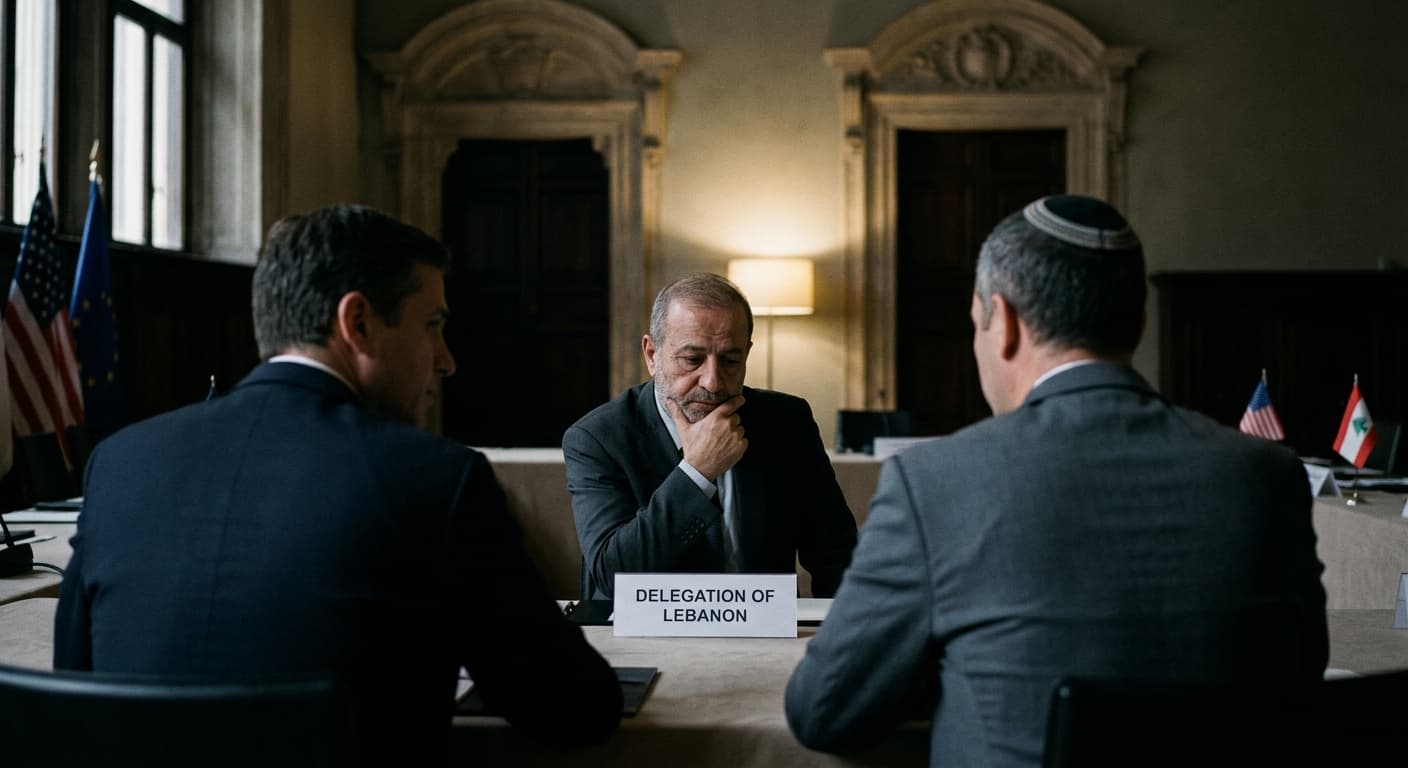
Beirut's Rome Ultimatum: Small Test, Regional Stakes
Lebanon says it will boycott the July 15-16 Rome talks unless Israel pulls back from two "pilot zones" — a technical test that decides whether the US-brokered framework survives and whether Gulf capital flows.
Lebanon told AFP on July 8, 2026 that it will skip the sixth round of US-mediated talks with Israel — scheduled for Rome on July 15–16 — unless Israeli forces first withdraw from two small "pilot zones" in the south, as pledged in the trilateral framework signed in Washington on June 26. The demand looks technical. It is not. It is the smallest possible test of whether Washington can move Benjamin Netanyahu even a kilometre; whether Saudi Arabia will finance reconstruction; and whether Tehran's rival Iran-US Memorandum of Understanding — which orders an unconditional halt to all fighting — quietly becomes the operative document in Lebanon.
According to a Lebanese diplomatic source cited by The Times of Israel, Beirut is "stipulating Israel's withdrawal from two pilot zones in order to participate in the round of talks in Rome." Five previous rounds of shuttle diplomacy since April have produced a ceasefire framework but no Israeli boots off Lebanese soil. The IDF still occupies roughly 5–6 percent of the country, according to
the BBC, down from a peak near 20 percent during the March 2026 offensive, in which more than 4,000 Lebanese were killed and over 1.2 million displaced, per
Al Jazeera's compilation of the war's toll.
What Lebanon is actually demanding
The pilot zones are geographically trivial. One sits south of the Litani River, outside Israel's declared 10-kilometre "security zone"; the other lies inside that zone, in an area Netanyahu himself conceded the IDF "does not need," in his own words from his June 27 video statement. In these two patches, the Lebanese Armed Forces were supposed to take exclusive security responsibility, with Hezbollah excluded — the first physical proof-of-concept for the entire disarmament-for-withdrawal trade.
The 14-clause framework text — released by the State Department and dissected by the Doha Institute — does not require Israel to withdraw at all. It requires the Lebanese state to disarm Hezbollah first, "not only in the South, but across the whole of Lebanon's territory." Withdrawal appears in the text only as "progressive redeployment," conditional on verification by Israel and oversight by a US-chaired Military Coordination Group. Prime Minister Nawaf Salam's public position —
as recorded by Al Jazeera in June after the fourth round — is that pilot-zone deployment "does not prejudice our right to a full [Israeli] withdrawal, but brings us closer to it." Beirut's actual leverage is exactly what Rome now measures: whether the two pilot patches change hands at all.
That is why the ultimatum is being framed narrowly rather than maximally. Lebanon is not demanding a full pullout; it is demanding the minimum step Netanyahu already publicly conceded. Failure on so small a promise would expose the framework as a paper achievement — a hazard the State Department seems to grasp, given that Rubio himself called the June 26 agreement "the beginning of the beginning" in remarks reported by Al Jazeera.
Why the pilot zones are a proxy for something much bigger
The Rome dispute is not really about two hilltops. It is about which of two contradictory documents governs the ceasefire architecture in the Levant.
Document one is the US-Iran Memorandum of Understanding signed in Islamabad on June 15, 2026. Its first clause mandates the "immediate and permanent termination of military operations on all fronts, including in Lebanon," unconditionally. Document two is the trilateral framework signed 11 days later, which conditions any Israeli move on Hezbollah's nationwide disarmament. As Al Jazeera reported on July 1, Netanyahu on June 30 told troops in southern Lebanon that the IDF "will not leave," and Defence Minister Israel Katz said the army would not withdraw "a millimetre" until Hezbollah is disarmed. Those statements are legally consistent with the framework — and flatly incompatible with the Iran MoU.
If the two pilot zones do not transfer, the framework is dead on arrival, and Iran will argue — with the Gulf quietly nodding — that its MoU is the operative text. That is the second-order dynamic Beirut is exploiting. The Doha Institute's companion analysis argues the framework "goes beyond all previous accords Lebanon has signed with [Israel] — including the 1949 Armistice Agreement, the 'May 17' of 1983… and even the November 2024 agreement." The 1983 comparison is not casual. That US-brokered accord collapsed within a year, followed by the bombing of the US embassy and marine barracks in Beirut, and it was the crisis that consolidated Hezbollah's emergence — a parallel
made explicit by Beirut analyst Ronnie Chatah on Al Jazeera. President Aoun's team knows the reference. So does Riyadh.
Who holds leverage — and who is quietly paying
Three actors matter beyond the Beirut-Jerusalem-Washington triangle: Riyadh, Tehran, and the LAF itself.
Saudi Arabia has been the invisible chair. According to a July 1 White House transcript of President Trump's Oval Office remarks alongside the Israeli and Lebanese ambassadors, a reporter cited Speaker Nabih Berri as telling Prince Yazid bin Farhan that "Lebanon will not move forward with peace unless Saudi Arabia is involved." Trump answered that Riyadh "would be very happy with this." That is diplomat-speak for: the Saudis are not, yet. Al Jazeera's
Beirut reporting in May confirmed Riyadh was actively pressing Aoun, Salam and Berri toward a unified position and against a premature Aoun-Netanyahu summit, insisting Lebanon stay inside the 2002 Arab Peace Initiative framework, which conditions normalisation on Palestinian statehood.
The reason is money. The trilateral text links reconstruction financing to disarmament milestones, per the Doha Institute clause analysis. Washington's own contribution is small: $100 million in UN-coordinated humanitarian aid and $30 million to the LAF, according to
Al Jazeera's tally of Rubio's statement. The rest — power grid restoration, currency stabilisation, the rebuilding of destroyed villages along the border — will come from Gulf capitals or not at all. Riyadh has signalled it will not write cheques while Israeli armour remains visible in Lebanese towns. That is Beirut's real card in Rome: without a pilot-zone pullback, there is no political cover for Gulf donors, and without Gulf donors, there is no framework to implement.
The Gulf calculation extends beyond Lebanon. As Al Jazeera reported on July 2, the June 2026 war left GCC states — all six of which were struck by Iranian retaliation — actively "diversifying" security partnerships toward Pakistan, Turkey, China and Europe, and increasingly viewing Israel's regional posture as a threat rather than an asset. In that context, financing a reconstruction that leaves Israeli boots in Lebanon is politically toxic for Mohammed bin Salman. A pilot-zone withdrawal gives him something to point to; the framework's ambiguity does not.
Tehran holds the second-most powerful veto in Rome, and it is exercising it through inaction. Iranian officials, cited by Beirut News on June 30, reiterated that US commitments to end conflict "on all fronts" remain "important." Translation: if the pilot-zone pullback happens, Iran can quietly accept the framework as compatible with its Islamabad MoU. If it does not, Iran gets a permanent grievance to reopen the nuclear file. That is why Hezbollah leader Naim Qassem has been unusually restrained on the ground even while denouncing the framework, in a Saturday statement
reported by Al Jazeera, as "humiliating, shameful, and a surrender of sovereignty." Tehran is running the clock, not the guns.
The third actor is the LAF, and it is quietly the biggest loser of any Rome collapse. A CNAS assessment records that by mid-October 2025 the army had already removed nearly 10,000 rockets and 400 missiles under phase one of the September 5, 2025 disarmament plan, deployed more than 9,000 soldiers south of the Litani, and secured Beirut airport — a former Hezbollah-linked smuggling hub. Six LAF soldiers were killed on August 9, 2025 dismantling a Hezbollah arms depot at Wadi Zibqin, a bloody proof of intent
documented by the Jerusalem Institute for Strategy and Security. US envoy Tom Barrack put the point bluntly in Beirut, telling reporters, per
Al Jazeera, that "the Lebanese government has done their part. They've taken the first step. Now what we need is Israel to comply with that equal handshake." Beirut is essentially asking Washington to enforce Barrack's own words.
The historical parallel Aoun cannot ignore
The 1983 "May 17 Agreement" between Israel and Lebanon — brokered by the United States, similarly conditional on security arrangements against non-state armed groups — collapsed within ten months. What followed is what the Doha Institute describes as the framework's most dangerous echo: a Lebanese government legally bound to disarm a militia it cannot militarily defeat, without international backing sufficient to survive the attempt. A
June poll of 1,000 Lebanese conducted by LAU professor Jad Melki found 87 percent still view Israel as an enemy, and only 34 percent support a peace agreement — the domestic ceiling Aoun is negotiating under. A framework that ships nothing but Lebanese concessions will break that ceiling.
That is why the pilot-zone demand is calibrated the way it is. It is the smallest deliverable that lets Aoun keep the March 8 political bloc — Berri and, by extension, Hezbollah's parliamentary wing — inside the tent. Hezbollah MP Hassan Fadlallah has already warned, per Al Jazeera, that any LAF enforcement of a Washington-brokered agreement would risk "civil war." Aoun needs Israel to move first to prove the trade is real. Netanyahu, facing Israeli elections around October per the same Al Jazeera analysis, needs to prove the opposite — that he did not blink.
What to watch next
- July 15–16, Rome: Whether Lebanon shows up at all is the first tell. A postponement — likelier than a full boycott — signals US pressure on Israel is working behind the scenes.
- The Military Coordination Group meeting schedule: The framework's trilateral verification body is where an Israeli pilot-zone timetable would first appear. Its absence is itself a data point.
- Saudi financial signalling: Watch for any Riyadh statement tying reconstruction pledges to Israeli movement. That would confirm the Gulf has adopted Beirut's leverage as its own.
- Hezbollah tempo on the ground: Qassem's rhetorical restraint is the leading indicator of whether Tehran still expects the MoU to prevail. A shift to kinetic signalling would mean Iran has given up.
The Bottom Line
Lebanon's Rome ultimatum is a deliberately small demand designed to answer a very large question: whether the US-brokered framework can produce a single reciprocal Israeli step, or whether the Iran-US MoU quietly becomes the document that ends the war. If Netanyahu concedes the two pilot zones, Gulf reconstruction money flows, the LAF's year-long disarmament campaign gains political cover, and the 1983 parallel recedes. If he does not, the framework joins UN Resolution 1701 and the May 17 Agreement on the pile of Lebanese-Israeli deals that shipped nothing — and Tehran, not Washington, will be writing the next chapter of the northern front.
Discover more
US Politics
House Ethics Committee Pushes Sexual Miscond.
The House Ethics Committee has shifted responsibility for sexual harassment settlement records to the Office of Congressional Workplace Rights, complicating disclosure efforts.
US Politics
SNAP Food Assistance Faces Legal Challenges
In 2026, SNAP faces stricter eligibility rules and mounting legal challenges, threatening food assistance for the millions of Americans who rely on the program.
India
700 Activists Accuse PM Modi of MCC Breach
Over 700 activists allege PM Modi breached election code with a televised address attacking opposition parties just before state elections.

Economics
Fed's Amex AML order puts correspondent banking on notice
Federal Reserve's Amex AML order requires board-level controls and a 90-day plan; OCC fined the bank $350 million over enterprise-wide deficiencies.