Lebanon Ceasefire Update: Occupation Continus
UN reports on casualties and displacement amid ceasefire talks.
Model Diplomat7 min readMiddle East
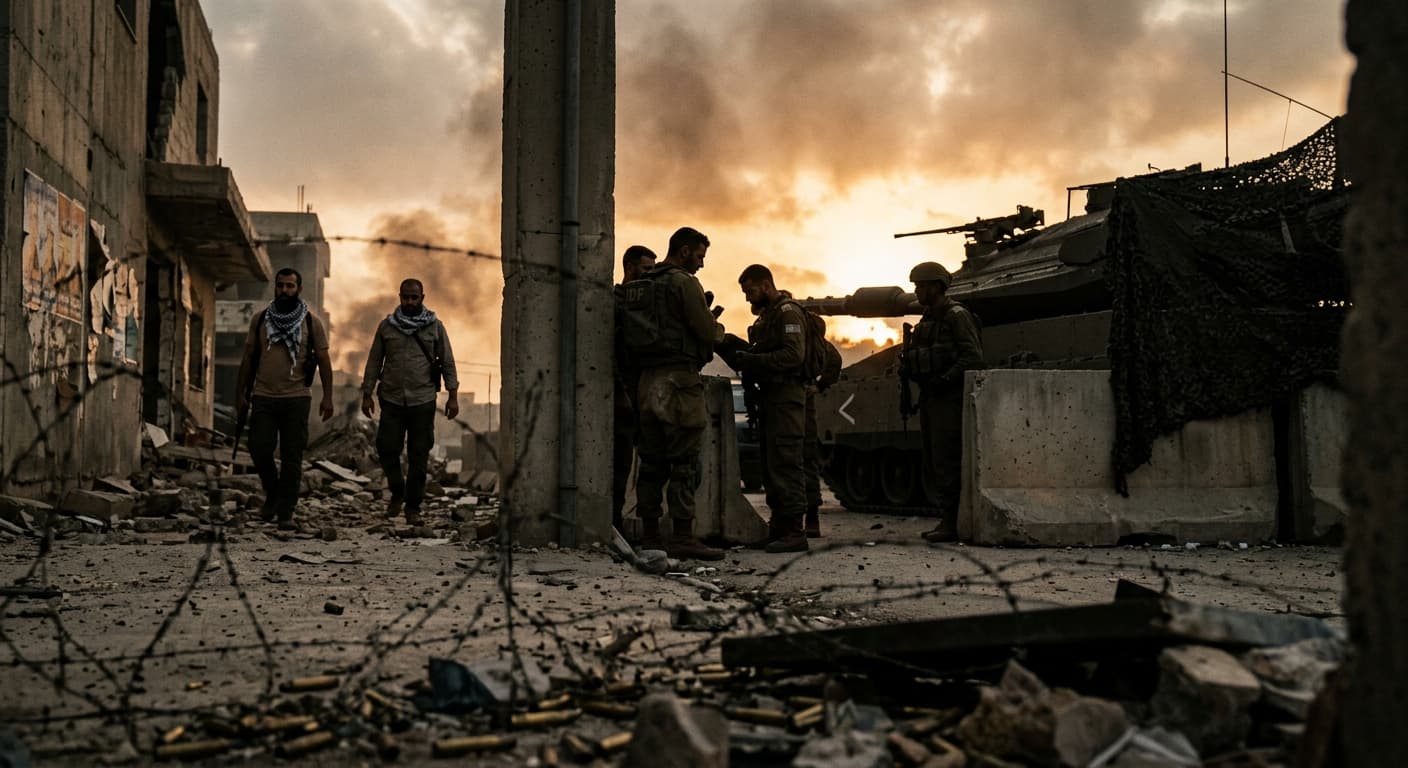
Lebanon Flash Update #41: A Ceasefire That Locks In Occupation
OCHA counts 4,319 dead and 499,784 still displaced as Israel's "progressive redeployment" hardens into open-ended occupation of one-fifth of Lebanon.
The UN's 41st flash update on Lebanon, published July 6, reads like a de-escalation: casualties slowing, 646,107 returnees, shelter populations down 21.5% in four days. But the diplomatic architecture built around this lull — a June 26 Israel-Lebanon framework signed in Washington and a June 15 US-Iran memorandum — has quietly inverted the sequencing of the 2024 ceasefire. Israeli withdrawal is now conditioned on Hezbollah's verified disarmament, not the other way around, and Hezbollah has rejected the deal as "null and void." The result is a legal scaffolding that codifies Israel's control of roughly 570 sq km of Lebanese territory, defers reconstruction indefinitely, and hands Tehran a lever it can pull whenever the US-Iran track wobbles. This is not the end of the war. It is the war frozen at the point most favourable to the party still shooting.
What the numbers actually say
The Lebanon Flash Update #41 records "an overall decline in the intensity and reach of hostilities," but adds that "continued military activity in the south perpetuates further protection risks, prolongs displacement for those seeking to return, and further drives humanitarian needs throughout the country." Lebanon's Ministry of Public Health has now logged 4,319 deaths — including 392 women and 253 children — and 12,203 injuries since the escalation began on March 2, 2026.
Nearly half a million people remain displaced. OCHA notes 37,000 are in 354 collective shelters, while the rest are absorbed by host communities that are themselves exhausted. Three hospitals inside the Israeli-declared military area — Bint Jbeil Public Hospital, Salah Ghandour Hospital in Bint Jbeil, and Salah Ghandour Hospital in Marjaayoun — remain non-operational, and 35 primary health centres are shuttered nationwide, according to the same OCHA update. Funding tells its own story: the $639.9 million 2026 Flash Appeal is 42.2% subscribed, well below what agencies need to sustain returns through winter.
The wire numbers underline the point. The BBC reported on July 6 that an Israeli drone strike on a car in Nabatieh al-Fawqa killed four people — a headteacher, her mother, a foreign domestic worker and a Syrian worker — in the deadliest single incident since the latest ceasefire. Israel's military has said its forces will remain in Lebanon "as long as is necessary."
The framework: withdrawal on Israel's terms
The pivotal document is the 14-point framework agreement signed at the State Department on June 26 by Israeli and Lebanese ambassadors. According to Al Jazeera's reading of the State Department text, the Lebanese Armed Forces are to restore "effective sovereign authority over all Lebanese territory, pending the verified disarmament of non-state armed groups and dismantlement of associated infrastructure." Israel commits only to "progressively redeploy" — beginning with two small "pilot zones" in the Nabatieh region.
The Israeli read of the deal is unambiguous. Israel's Institute for National Security Studies — hardly a hostile source — writes that the agreement gives Israel "implicit agreement that the IDF may, for the time being, continue to maintain a presence in the buffer zone (up to the Yellow Line) for the protection of northern communities" and that withdrawal is "conditioned on progress in achieving its targets vis-à-vis Hezbollah." Prime Minister Benjamin Netanyahu spelled it out on June 27: Israel will "maintain [the buffer zone] until Hezbollah disarms and as long as there is a threat to the State of Israel."
That is a structural reversal of Resolution 1701 and of the November 2024 ceasefire, both of which paired Hezbollah's withdrawal south of the Litani with Israel's withdrawal from Lebanese territory. As Al Jazeera reports, Israel occupies roughly one-fifth of Lebanon; a May investigation by the outlet, based on Israeli military maps, put the footprint of the "Yellow Line" security zone at approximately
570 sq km, with demolitions documented outside its declared boundaries.
What the pilot zones are actually testing
The pilot-zone mechanism is being marketed as a good-faith first step. It is closer to a controlled experiment in whether the Lebanese Army can substitute for Hezbollah in Shia-majority districts without triggering internal conflict — while Israel keeps the rest of its occupation intact.
Netanyahu himself described the arithmetic: "One [pilot zone] is south of the Litani River and outside the security zone altogether, and the other is north of the Litani — a small area in the expanded security zone that we conquered in the last two weeks, and which the [Israeli military] says it does not need." In other words, Israel is handing back land it doesn't want.
Hezbollah's leader Naim Qassem, quoted by Al Jazeera, called the deal a "very dangerous proposition that crosses all red lines," rejecting any linkage between Israeli withdrawal and disarmament. Al Jazeera analyst Ali Hashem's assessment is the operative one:
"Without Hezbollah's consent, this is not going to happen. This is going to be a recipe for another confrontation. The Lebanese government isn't capable of imposing this deal. It's not the de facto force on the ground."
President Joseph Aoun, a former army chief, has told the BBC that forcibly disarming Hezbollah risks civil war: "You can't come to the Shia community and impose this by force. You'll fail, and this will be a disaster." That is the closed loop the framework has created — Israel won't leave until Hezbollah disarms; the Lebanese state cannot disarm Hezbollah without violence; Hezbollah won't disarm while Israel occupies southern Lebanon.
The Iran hedge — and why Tehran is quiet
The framework does not stand alone. It sits inside a June 15 US-Iran Memorandum of Understanding — the so-called Islamabad MoU — which, according to the reporting available, pledges an immediate halt to hostilities "on all fronts," including Lebanon, with no preconditions. The two documents are in open contradiction. The MoU says stop fighting now; the framework says stop fighting when Hezbollah disarms.
For now, Tehran is letting it slide. Analyst Ronnie Chatah told Al Jazeera that despite Iran's leverage, "there's been no serious push by Iran to make Lebanon a priority." Iran, weakened after the February-March war in which Ayatollah Ali Khamenei was killed, needs the MoU to hold more than it needs to defend Hezbollah's autonomy in the south. But that also means Lebanon is now a variable in a larger equation. If US-Iran talks collapse — over sanctions relief, uranium stocks, or a successor to Khamenei — Tehran can reactivate the Lebanese file overnight by permitting Hezbollah to resume fire.
The historical parallel worth naming is the 1983 tripartite agreement between Lebanon, Israel and the United States, which collapsed under the weight of an Israeli occupation Lebanese factions refused to legitimise — and from whose ruins Hezbollah first emerged as the dominant security actor in the country.
Who benefits, who pays
A candid ledger:
Netanyahu buys time before an expected October election without visible retreat. Domestic politics, as Al Jazeera notes, make a hasty withdrawal look like capitulation to Trump; the framework lets him stay while claiming progress.
Trump and Rubio get a signing ceremony, a $100 million humanitarian pledge, and a "beginning of the beginning" — Rubio's own phrase at the State Department — that they can wave at critics of the Iran deal.
President Aoun gets US recognition and a rhetorical claim that the deal "does not legitimise the continued Israeli occupation of Lebanon," as he told a delegation on July 3 per Al Jazeera. What he does not get is a withdrawal timeline.
Hezbollah is boxed in — militarily degraded, politically isolated after Assad's fall cut its Syrian supply line, and rhetorically committed to a maximalist position it cannot enforce.
The 499,784 still displaced, per OCHA, pay in destroyed villages and receding return prospects. Six human-rights groups — Amnesty International, Human Rights Watch, the Lebanese Center for Human Rights, Legal Agenda, Reporters Without Borders and the Union of Journalists in Lebanon — warned on July 3 that clauses 3 and 13 of the framework "appear to be aimed at preventing victims of serious international crimes from seeking justice before international forums," including the ICC and ICJ, according to a joint statement carried by
Al Jazeera.
The UNIFIL clock
Sitting in the background is the December 31, 2026 sunset of the UN Interim Force in Lebanon, whose mandate the Security Council voted to wind down in August 2025 under US pressure. UNIFIL's roughly 7,000 remaining personnel are supposed to hand off to the Lebanese Armed Forces during the same window in which the pilot zones are meant to prove the LAF can hold ground alone. There is no serious plan for what replaces UNIFIL if the pilots fail — and no appetite in either Washington or Jerusalem to fund one.
For Lebanon, that convergence is the real strategic risk: an occupier who won't leave, a militia that won't disarm, an army that cannot deploy, and a peacekeeping mission with an expiration date.
What to watch
- Pilot-zone handover mechanics. The State Department has promised a US-led military coordination group. The first LAF deployments into the two Nabatieh-area pilot zones will indicate whether Israel is actually redeploying or simply relabelling positions it had already abandoned.
- The next Israel-Lebanon negotiating round. A sixth round of direct talks is expected in Washington in July. Watch whether a withdrawal timeline — any timeline — enters the text.
- Israeli elections. Expected around October 2026. A Netanyahu win locked in by a Lebanon posture makes withdrawal harder, not easier.
- UNIFIL drawdown, from January 2027. No successor mechanism has been agreed. If the pilots fail before then, the south enters 2027 without international monitors, without an Israeli withdrawal, and without a Lebanese state monopoly on force.
- The US-Iran track. Any breakdown in the Islamabad MoU immediately reactivates Lebanon as Iran's cheapest lever.
The Bottom Line
Flash Update #41 documents a war that is quieter but not over — and a diplomatic architecture that has quietly traded Israeli withdrawal for Hezbollah disarmament, a swap neither Beirut nor Tehran can deliver. Israel now holds roughly 570 sq km of Lebanese territory with US legal cover, an October election as its deadline, and a framework that lets it stay indefinitely on the argument that Hezbollah is still armed. Until the pilot zones prove otherwise, the "de-escalation" is best read as an occupation with a signing ceremony attached.
Discover more

US Politics
SNAP Food Assistance Faces Legal Challenges
In 2026, SNAP faces stricter eligibility rules and mounting legal challenges, threatening food assistance for the millions of Americans who rely on the program.
US Politics
House Ethics Committee Pushes Sexual Miscond.
The House Ethics Committee has shifted responsibility for sexual harassment settlement records to the Office of Congressional Workplace Rights, complicating disclosure efforts.

India
Delhi CM Rekha Gupta Blasts Opposition's Delm
Delhi CM Rekha Gupta's remarks on women's quota defeat reveal BJP's strategy for the 2029 Lok Sabha elections, focusing on delimitation.

Economics
Fed's Amex AML order puts correspondent banking on notice
Federal Reserve's Amex AML order requires board-level controls and a 90-day plan; OCC fined the bank $350 million over enterprise-wide deficiencies.