Korea's $880bn Chip Sprint Redraws Indo-Pac
Lee Jae-myung's semiconductor push reshapes regional security.
Model Diplomat7 min readAsia
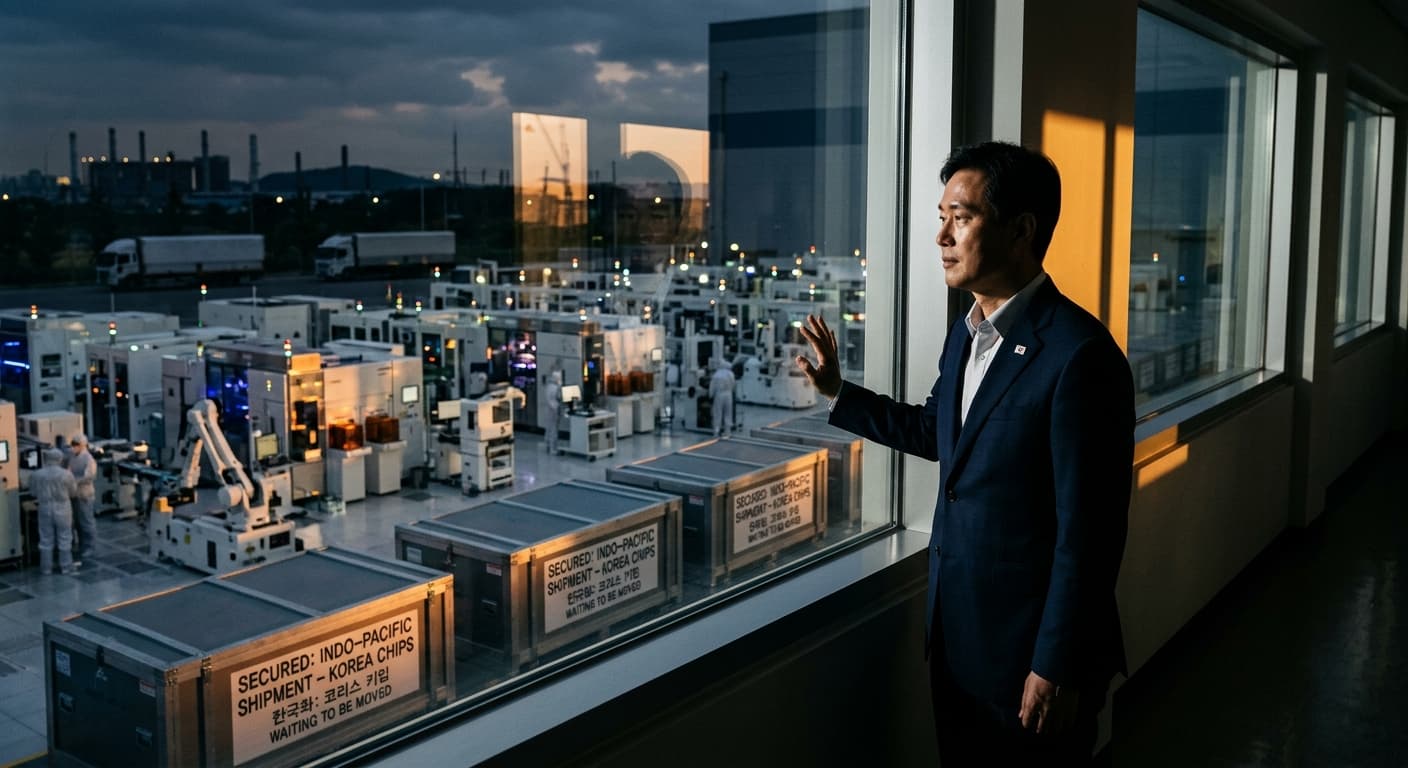
Korea's $880bn Chip Sprint Redraws the Indo-Pacific Silicon Map
Lee Jae-myung's July 6 order to fast-track Korea's $880bn semiconductor and AI build-out is a bet that speed, not scale, decides the Taiwan-era chip race — and it reshuffles Indo-Pacific security in the process.
South Korean President Lee Jae-myung on July 6, 2026 ordered his cabinet to compress environmental reviews, parallel-process permits and pre-build power and water for an $880bn semiconductor and AI push — a directive whose real purpose is not industrial policy but strategic geography. According to Yonhap via Cash Insight, Lee delivered the instruction at a meeting with senior officials and the chiefs of Samsung Electronics and SK Hynix. The thesis of this story: by shortening its own build timelines while Taiwan's silicon shield thickens and China's memory ramp accelerates, Seoul is trying to convert an industrial advantage into an Indo-Pacific insurance policy — and it will succeed or fail on kilowatts, not wafers.
What Lee actually ordered
Lee's speed directive is the operational follow-through to the "Three Mega Projects" plan unveiled on June 29, 2026 — a public-private commitment of at least $880bn across semiconductors, physical AI and AI data centers, as reported by the BBC. Samsung and SK Hynix alone account for roughly 4,755 trillion won (about $3.1 trillion) of long-dated private commitments through 2042, per the companies' combined disclosure as aggregated by
BigGo Finance. The plan sits on top of a 150 trillion won (~$100bn) Public Growth Fund, whose seven priority sectors are anchored by AI chips and semiconductor infrastructure, according to the
Stimson Center.
Lee's own words, published on the Cheong Wa Dae website, frame the industry as national infrastructure:
"The pace of change is breathtakingly fast. At the center of that change stands the semiconductor. Semiconductors are an industry in which our country has secured firm competitiveness in the global market, and the future industry with the greatest potential."
The specific mechanics matter. Lee cited the Yongin cluster — Korea's flagship 562 trillion won mega-fab site — as a warning, ordering officials to compress environmental impact assessments that normally run in sequence with land acquisition and utility hookups. According to the National Assembly Research Service, the Yongin project's most acute bottleneck has been power and water: baseload electricity guarantees and industrial water rights, not clean rooms. The July 6 order pushes those inputs to the front of the queue.
The Indo-Pacific angle: why speed is a security policy
The reason a domestic permitting story matters for regional security is that Korea is the only allied jurisdiction that can materially thicken the semiconductor supply chain outside Taiwan on a five-year horizon. TSMC controls roughly 90% of leading-edge logic manufacturing, and Taiwan's central geographic role in the first island chain is what analysts term the "silicon shield," per the Observer Research Foundation. Roughly $2.45 trillion in goods transited the Taiwan Strait in 2022. In a contingency, that shield is also the world's single largest concentration risk.
Korea sits one strait over. Samsung and SK Hynix together supply about 73% of global DRAM and over half of NAND, according to the German Marshall Fund, and they dominate high-bandwidth memory — the specific memory stack Nvidia's Blackwell and Rubin accelerators require. HBM exports from Korea to Taiwan surged from $1.8bn to $13.3bn in a single year,
KIEP data shows, because the finished AI accelerator is co-produced across the Korea–Taiwan corridor. Any interruption in the Strait would idle Korean HBM fabs within weeks; conversely, expanded Korean capacity is the only near-term way to reduce Taiwan-concentration risk without waiting on Arizona.
That is the security angle Washington reads into Lee's directive. The Carnegie Endowment notes that Nvidia CEO Jensen Huang, meeting Lee at the October 2025 APEC summit in Gyeongju, pledged 260,000 Blackwell GPUs to Korea by 2030 — allocations split among Samsung, SK, Hyundai Motor Group and Naver. Samsung has since passed HBM4 qualification for Google's next-generation TPUs, tripling committed supply for 2026; Samsung and SK Hynix have also joined OpenAI and Oracle's Stargate consortium. The Lee directive tells Washington that Seoul intends to deliver on those quiet commitments on a compressed timeline.
Who benefits, who loses
The immediate beneficiary is not Samsung or SK Hynix, both of which were investing regardless. It is Nvidia and the US AI hyperscalers, who gain a second geographic source of leading-edge memory and packaging outside Taiwan before TSMC Arizona's advanced-node lines are ready. The Istituto Affari Internazionali estimates the US installed base of leading-edge GPUs may rise from 5.5 million in 2024 to 160 million by 2030 — a curve that alone would consume most of TSMC's global wafer capacity. Without Korean HBM and Korean advanced packaging clusters (the Chungcheong region site is explicitly designated for OSAT and packaging), that curve does not close.
The loser is China's memory catch-up strategy. According to KIEP, China's CXMT is now mass-producing 16nm DDR5 DRAM and YMTC shipped 294-layer NAND in early 2025 — closing the gap with Samsung (286 layers) and SK Hynix (321 layers). Every year Korea shaves off its own build cycle is a year Chinese producers cannot use to gain scale under US export controls. That is why the RAND policy game on Korea's tech choices concluded that Seoul's semiconductor industry "would suffer in the short term" from US-China friction but "might benefit in the long term because of the disruption to China's emergence as a serious competitor," per
RAND.
The more subtle loser is Taiwan's silicon-shield doctrine. Taipei has long relied on the argument that no rational actor can afford to disrupt TSMC. As Korea expands leading-edge packaging and HBM capacity — and as TSMC itself moves $165bn of investment to Arizona, per ORF — the marginal cost to the West of a Taiwan Strait disruption falls. That does not embolden Beijing on its own, but it does erode a deterrent that Taipei has spent two decades building.
The energy problem is the security problem
Lee's directive is unusual in one respect: it treats electricity, not silicon, as the binding constraint. He explicitly ordered preemptive build-out of "stable baseload electricity" even as renewables expand, per Cash Insight. This tracks the National Assembly Research Service's
Yongin fact-check, which identified transmission and industrial water — not fab equipment — as the reasons the 2023 construction-start timeline slipped.
The politics are hard. A single leading-edge fab draws roughly 400–500 MW at peak, comparable to a small city. Scaling the Yongin, Pyeongtaek and Chungcheong sites to their designated capacity implies several gigawatts of new baseload — which in Korea's grid means restarting nuclear build-out and expanding LNG import terminals. Lee's Democratic Party base has historically opposed both. The July 6 order effectively resolves that internal argument in favor of the fabs. The Prime Minister's Office briefing archive confirms the government's committed public support for "four pillars" of infrastructure — power, water, roads, and wastewater — at each designated cluster.
Water is the second squeeze. Yongin's daily water demand at full build is estimated at over one million tons, drawn from the Paldang and Hwaseong systems already stressed by Seoul's suburban expansion — a dispute that, per a Sejong University analysis cited by Al Jazeera, consumed roughly 18 months of the Yongin timeline before the Lee administration overrode it.
What could still derail this
Three risks warrant tracking. First, Trump-era tariff friction. Lee closed a July 2025 US trade deal committing Korea to $350bn in US investment; in January 2026 Trump warned he would raise tariffs unless the deal was executed faster, per Carnegie. Korean capital may end up in Texas and Arizona at the expense of the Chungcheong packaging cluster.
Second, domestic politics. Lee's approval slipped below 50% for the first time in mid-June 2026 after the local elections, per the same Carnegie analysis. Compressed environmental reviews are the kind of executive shortcut that produces litigation and rural backlash — the exact coalition Lee needs to keep the Yellow Envelope Act–weary business community aligned.
Third, China retaliation. Beijing's THAAD-era economic coercion cost Korea an estimated $7.5bn in tourism and consumer goods. Samsung's Xi'an fab (40% of NAND output) and SK Hynix's Wuxi DRAM plant remain hostages, per the Peterson Institute. A too-visible Korean pivot into the US-Nvidia-OpenAI ecosystem invites reciprocal pressure.
Diplomat View
The bottom line: Lee's July 6 speed order converts what looked like an industrial spending plan into a strategic act — Korea is buying an insurance premium against a Taiwan disruption, and Washington is the beneficiary of the policy. If Yongin's first advanced-node line hits volume production before TSMC's Arizona 2nm ramp in 2028, the Indo-Pacific chip map will have quietly acquired a second anchor node, and the silicon shield's exclusivity will be over. If it doesn't — if power, water, or Chinese retaliation drag the timeline back to sequence — the Indo-Pacific remains a single-point-of-failure system, and every crisis calculation over the Strait stays exactly as brittle as it is today.
The forecast would revise on any of three signals: an explicit Korean commitment to hosting US-forces logistics for a Taiwan contingency (currently taboo in Seoul); a formal Chinese sanction of Samsung or SK Hynix's China operations; or a Lee cabinet retreat on baseload power expansion under progressive coalition pressure. Absent those, the July 6 order stands as the most consequential piece of Indo-Pacific industrial statecraft since the CHIPS Act — and the silicon shield's clock is already running.
What to watch next
- Late July 2026: Cabinet-level regulatory package translating Lee's directive into revised Environmental Impact Assessment fast-track rules; the statutory test is whether the National High-Tech Strategic Industries Act is amended to codify parallel permitting or left as executive guidance only.
- Q3 2026: First groundbreaking at the Chungcheong advanced packaging cluster and updated Yongin utility-completion schedule from KEPCO.
- October 2026: Anticipated Lee–Trump summit ahead of the APEC leaders' meeting; the $350bn US investment commitment and Korean nuclear-submarine cooperation will test whether Seoul can sustain the pace on both tracks.
- Early 2027: Samsung HBM4 volume qualification for Nvidia Rubin and Google TPU v7 — the operational test of whether Korea's compressed timeline actually delivers.
Discover more

US Politics
SNAP Food Assistance Faces Legal Challenges
In 2026, SNAP faces stricter eligibility rules and mounting legal challenges, threatening food assistance for the millions of Americans who rely on the program.
India
700 Activists Accuse PM Modi of MCC Breach
Over 700 activists allege PM Modi breached election code with a televised address attacking opposition parties just before state elections.
India
Congress Accuses Modi of Stalling Women's Law
Congress accuses Modi of stalling women's reservation law by linking it to delimitation, revealing a deeper electoral strategy.

Economics
Fed's Amex AML order puts correspondent banking on notice
Federal Reserve's Amex AML order requires board-level controls and a 90-day plan; OCC fined the bank $350 million over enterprise-wide deficiencies.